
- Hits: 1231
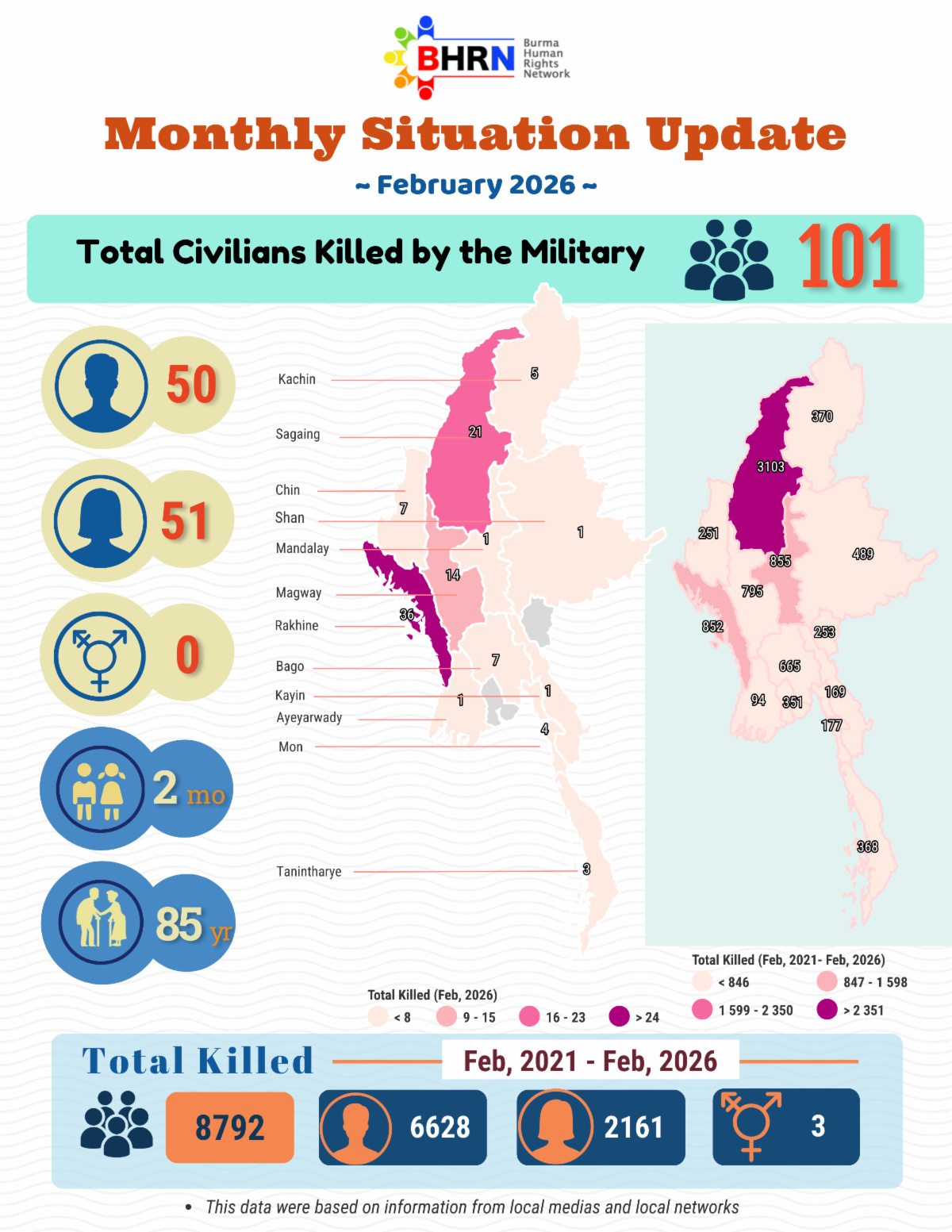
Having concluded its sham elections in January 2026, the Myanmar military junta moved in February to consolidate the power structures that will keep Min Aung Hlaing in command. He signed a law that placed himself above all branches of government, while the military and its proxy party held 505 of 586 parliamentary seats. Regime authorities simultaneously burned the records of the 2020 elections and the NLD government's parliamentary archive, destroying material relevant to ongoing proceedings at the ICC and ICJ. More than 110,000 civil servants rejected the junta's offer to return to work and remained active in the Civil Disobedience Movement. Internationally, Timor-Leste became the first ASEAN member to open criminal proceedings against a fellow member, filing a case against the junta for war crimes and crimes against humanity in Chin State, while Thailand declared its intention to reintegrate the junta into ASEAN despite five years of non-compliance with the Five-Point Consensus.
Throughout the month, junta forces bombed, shelled, and burned civilian areas across Sagaing, Arakan, Magway, Kachin, Kayah, Karen, Chin, and Tanintharyi, killing and injuring civilians, including children. The Burma Air Force struck an Arakan Army detention facility holding regime soldiers as prisoners of war for the fifth recorded time. Arakan Army fighters abducted three Rohingya girls in Buthidaung Township as they tried to flee to Bangladesh. Resistance forces reported significant gains, including a joint operation in Kanbalu Township that reportedly killed 96 soldiers and captured 101, and the recapture of a hilltop outpost in Falam Township within 24 hours of its seizure by regime troops.
Read more: February 2026 - Summary of Monthly Situation Update
- Hits: 1583
The Myanmar military junta completed its three-phase electoral charade in January 2026, with the military-proxy Union Solidarity and Development Party claiming predetermined victory through systematic coercion, fraud, and violence. At least 404 people were arrested for minor acts of dissent such as refusing to display campaign materials or posting critical comments online. Junta forces killed dozens of civilians during the final voting days, including 22 mourners in an airstrike on a funeral ceremony in Bhamo Township. Despite widespread public rejection, demonstrated through protests, boycotts, and the near-total absence of voters at polling stations, the regime will convene a military-controlled parliament in March. This represents the consolidation of military dictatorship behind a facade of civilian institutions. The 2008 Constitution guarantees the military 25 percent of parliamentary seats, ensuring Min Aung Hlaing maintains absolute control regardless of which titles he and his loyalists adopt.
International responses fractured in ways the junta actively exploited. While the European Union, Japan, and ASEAN officially rejected the sham elections, China's Foreign Ministry publicly congratulated Burma, providing high-profile endorsement from the junta's primary arms supplier and UN Security Council protector. Thailand endorsed the process as "political transition" despite being part of ASEAN, while Cambodia and Vietnam sent observers in direct contradiction of the bloc's collective stance. This fragmentation allows the regime to claim divided international opinion and point to evidence of acceptance.
Read more: January 2026 - Summary of Monthly Situation Update
- Hits: 1130
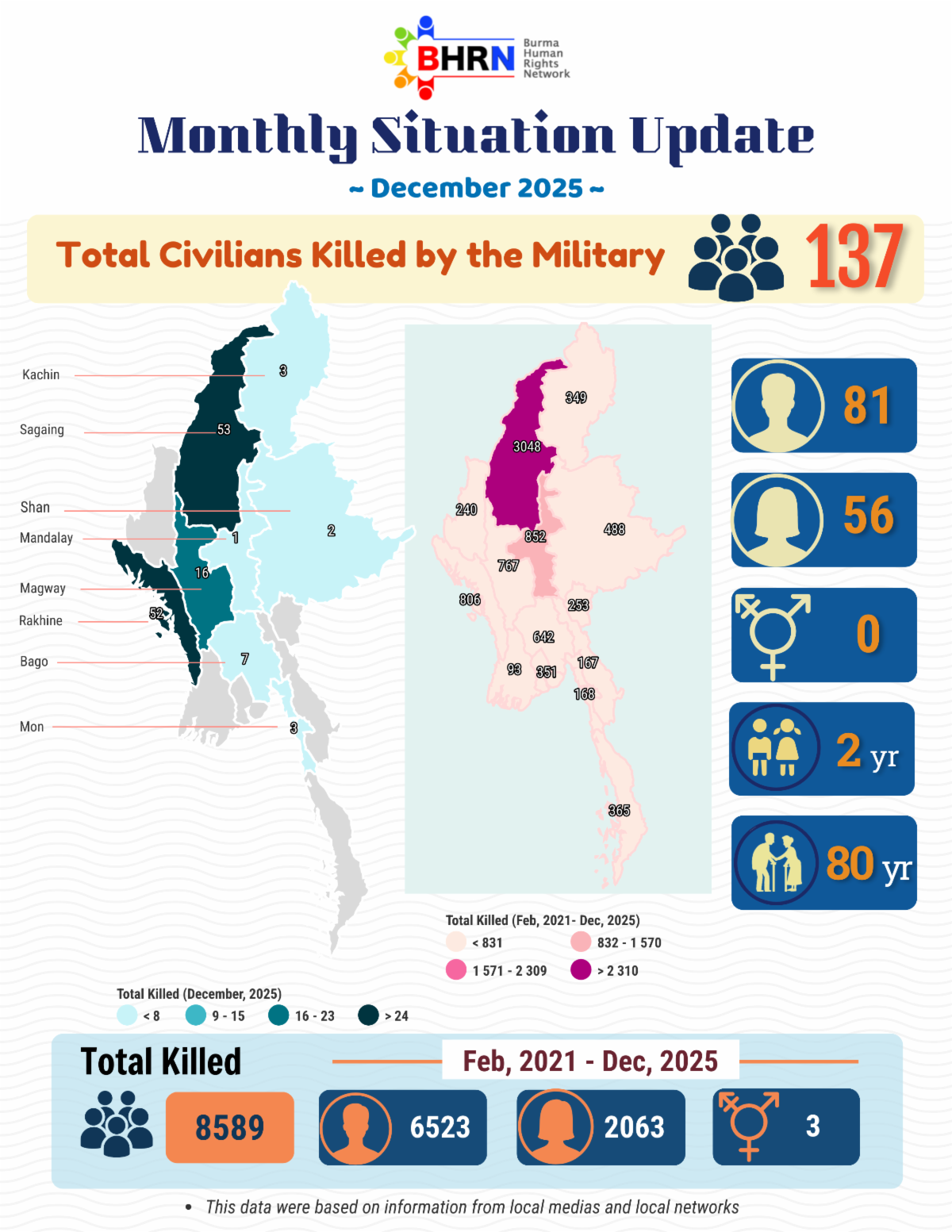
In December 2025, the Myanmar military junta held the first phase of elections on 28 December in 102 of the country's 330 townships, with a second phase scheduled for 11 January 2026. The elections were rejected by the United Kingdom, Canada, Norway, Australia, Switzerland, and the European Union as failing to meet international standards. UN High Commissioner for Human Rights Volker Türk stated there were "no conditions" for free and fair participation. Political parties that won 90 percent of seats in 2020 have been deregistered or barred, the junta cancelled voting in thousands of communities, and the Election Protection Law has been used to charge at least 293 people, including for posting emoji reactions to online posts. Thailand, however, endorsed the process, contradicting ASEAN's October 2025 position that cessation of violence and inclusive dialogue must precede elections. Myanmar nationals overseas have rejected the vote with fewer than 25 people cast ballots at the junta's embassy in Seoul, compared to approximately 10,000 in the 2020 election.
The junta continued military operations throughout the month, targeting civilian infrastructure including hospitals, clinics, schools, and monasteries. On 10 December, International Human Rights Day, the Burma Air Force struck a hospital in Mrauk-U Township, Rakhine State, killing at least 33 civilians and injuring 76. The UN's Independent Investigative Mechanism for Myanmar said this may be one of the deadliest attacks on hospitals since the 2021 coup. Airstrikes continued even as polling stations opened on 28 December, with attacks reported in Budalin Township, Sagaing Region. The Landmine Monitor 2025 report found that Myanmar recorded the highest number of landmine casualties worldwide, with over 2,000 incidents in 2024.
Despite the violence, resistance forces sustained operations across multiple fronts, seizing outposts in Mogok, Budalin, and Letpadan, and inflicting significant casualties on regime troops. Nineteen armed groups formed the Spring Revolution Alliance on 16 December, establishing a central command structure and announcing cooperation with the NUG and ethnic armed organizations. Public defiance continued through the nationwide Silent Strike on 10 December, open protests in regime-controlled Mandalay, and mass rejection of overseas voting. A Fortify Rights investigation documented Thailand forcibly returning approximately 3,500 Myanmar nationals into junta conscription and torture between February 2024 and November 2025. The ICC Registry reported that prolonged silence on the arrest warrant requested against Min Aung Hlaing over a year ago is eroding Rohingya survivors' confidence in international justice.
- Hits: 723
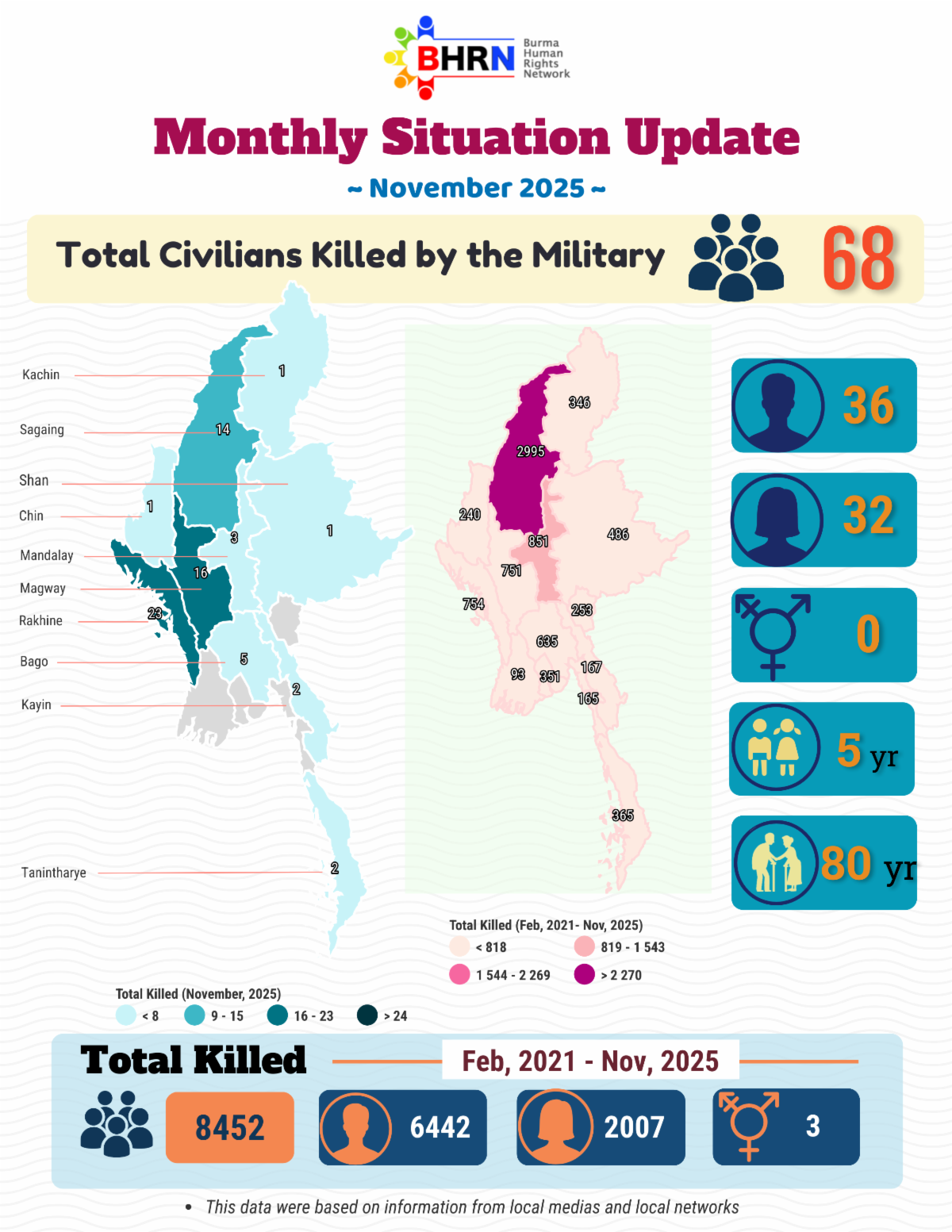
As the junta accelerates preparations for its staged elections, the human rights situation across Myanmar continued to deteriorate this month. November was marked by intensified military violence targeting civilians, escalating persecution of Muslim minorities, and aggressive use of surveillance, arrest, and legal repression to eliminate dissent. The junta carried out repeated airstrikes and artillery attacks on displacement sites, schools, hospitals, and religious infrastructure. In Rakhine State, airstrikes and forced recruitment campaigns targeted Rohingya and other civilians, while new restrictions imposed by the Arakan Army mirrored the discriminatory practices of past military regimes. Arbitrary detentions, torture, and extrajudicial executions persisted across the country, alongside a documented case of gang rape and murder by regime soldiers and a notable rise in attacks on religious institutions.
Resistance forces pushed forward on multiple fronts, seizing strategic ground and disrupting key junta supply chains. The capture of Maw Taung, a major border trade post with Thailand, dealt a blow to the regime’s cross-border revenue and control over Tanintharyi. Chin resistance groups retook Mount Kennedy outpost, while joint offensives across Sagaing, Mandalay, and Magway left hundreds of junta soldiers dead or captured. But even as the resistance made gains, the junta retaliated with increasing brutality, bombing hospitals and shelters, torching villages, and stepping up forced recruitment and arbitrary detention.
Read more: November 2025 - Summary of Monthly Situation Update
- Hits: 675
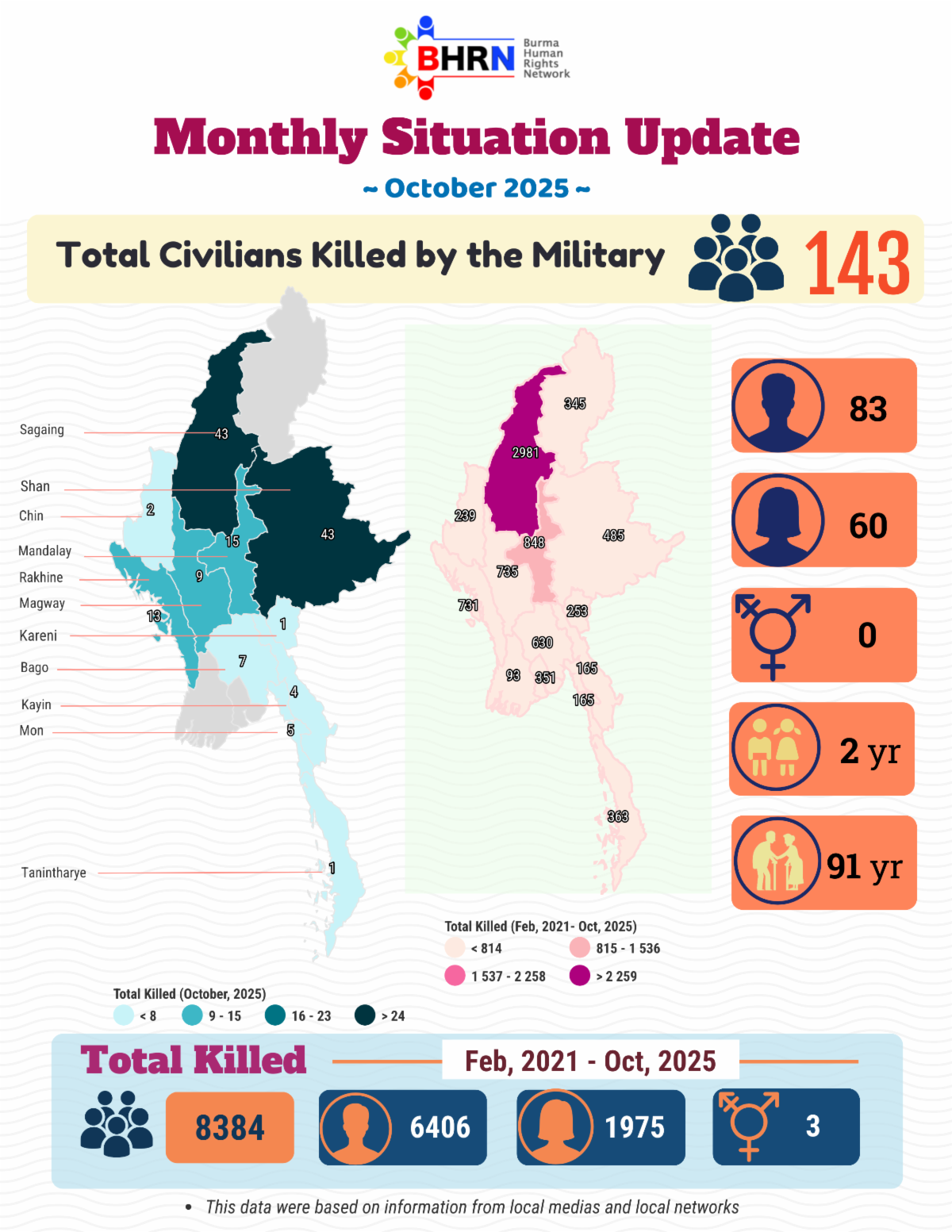
In October, the Myanmar junta ramped up preparations for sham elections in December while systematically coercing participation and attacking civilians across the country. On 16 October, Min Aung Hlaing announced a three-phase timeline covering 274 townships while excluding 56 areas under resistance control. The regime forced internally displaced persons to register as voters in exchange for cash payments, threatened prisoners with solitary confinement unless they cast advance votes, and re-arrested political prisoners at prison gates to silence potential opposition. The junta arrested three prominent artists on 27 October for criticizing an election propaganda film, prosecuted 64 people under a new Election Protection Law authorizing death penalties for vaguely defined "election interference," and banned all campaign rallies. Approximately 55,000 electronic voting machines will replace paper ballots despite serious transparency concerns, while only six parties field national candidates and voter lists contain hundreds of errors including names of deceased people.
Read more: October 2025 - Summary of Monthly Situation Update