
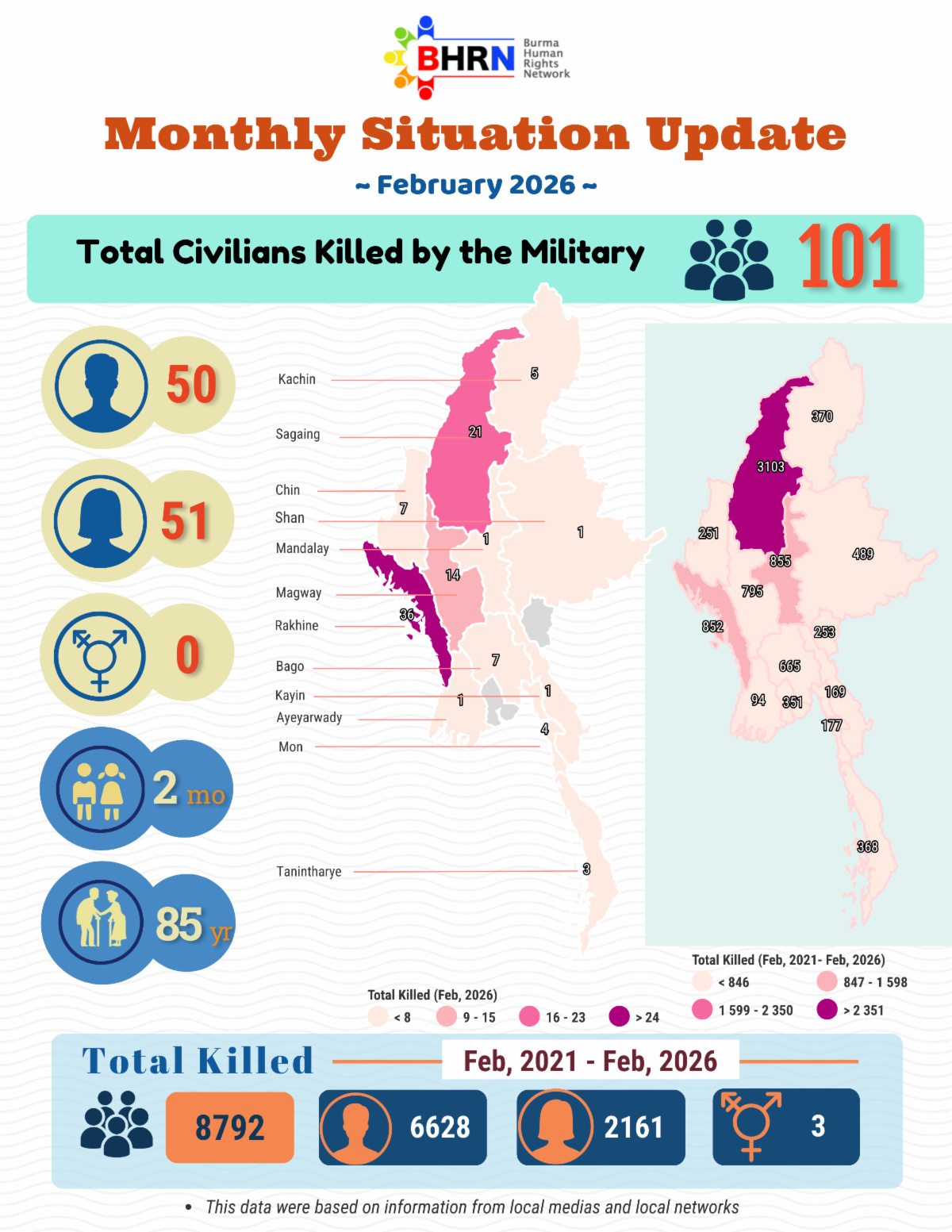
Having concluded its sham elections in January 2026, the Myanmar military junta moved in February to consolidate the power structures that will keep Min Aung Hlaing in command. He signed a law that placed himself above all branches of government, while the military and its proxy party held 505 of 586 parliamentary seats. Regime authorities simultaneously burned the records of the 2020 elections and the NLD government's parliamentary archive, destroying material relevant to ongoing proceedings at the ICC and ICJ. More than 110,000 civil servants rejected the junta's offer to return to work and remained active in the Civil Disobedience Movement. Internationally, Timor-Leste became the first ASEAN member to open criminal proceedings against a fellow member, filing a case against the junta for war crimes and crimes against humanity in Chin State, while Thailand declared its intention to reintegrate the junta into ASEAN despite five years of non-compliance with the Five-Point Consensus.
Throughout the month, junta forces bombed, shelled, and burned civilian areas across Sagaing, Arakan, Magway, Kachin, Kayah, Karen, Chin, and Tanintharyi, killing and injuring civilians, including children. The Burma Air Force struck an Arakan Army detention facility holding regime soldiers as prisoners of war for the fifth recorded time. Arakan Army fighters abducted three Rohingya girls in Buthidaung Township as they tried to flee to Bangladesh. Resistance forces reported significant gains, including a joint operation in Kanbalu Township that reportedly killed 96 soldiers and captured 101, and the recapture of a hilltop outpost in Falam Township within 24 hours of its seizure by regime troops.
Political, Legal, and International Developments Affecting Myanmar
- Timor-Leste Opens Legal Proceedings Against the Junta
On 2 February, Timor-Leste's judiciary opened legal proceedings against the Myanmar military, including Senior General Min Aung Hlaing, for war crimes and crimes against humanity. The case was brought on evidence submitted by the Myanmar Accountability Project (MAP) and the Chin Human Rights Organization (CHRO) documenting rape, murder, and the massacre of civilians in Chin State, as well as indiscriminate strikes on a hospital and systematic attacks on Christian churches and civilian infrastructure. A senior Timorese prosecutor was appointed to examine the submissions. The junta responded by expelling Timor-Leste's charge d'affaires and accusing Dili of violating ASEAN's non-interference principle.
The proceedings are significant on two counts. They are the first time an ASEAN member has initiated legal action against a fellow member, and they come within the opening months of Timor-Leste's ASEAN membership. The Special Advisory Council for Myanmar noted that Timor-Leste acted on its stated commitments to peace almost immediately upon joining the bloc. The junta's response, expelling a diplomat rather than engaging the substance of the allegations, indicates how seriously it regards the development. The Timor-Leste case is one part of an accountability architecture that has expanded considerably over the past year. An Argentine court issued arrest warrants for 25 senior junta officials in February 2025. The ICC prosecutor requested an arrest warrant for Min Aung Hlaing for crimes against humanity against the Rohingya in November 2024. The ICJ concluded oral hearings in The Gambia's genocide case in January 2026, at which Rohingya survivors testified directly before the court for the first time.