
- Hits: 153
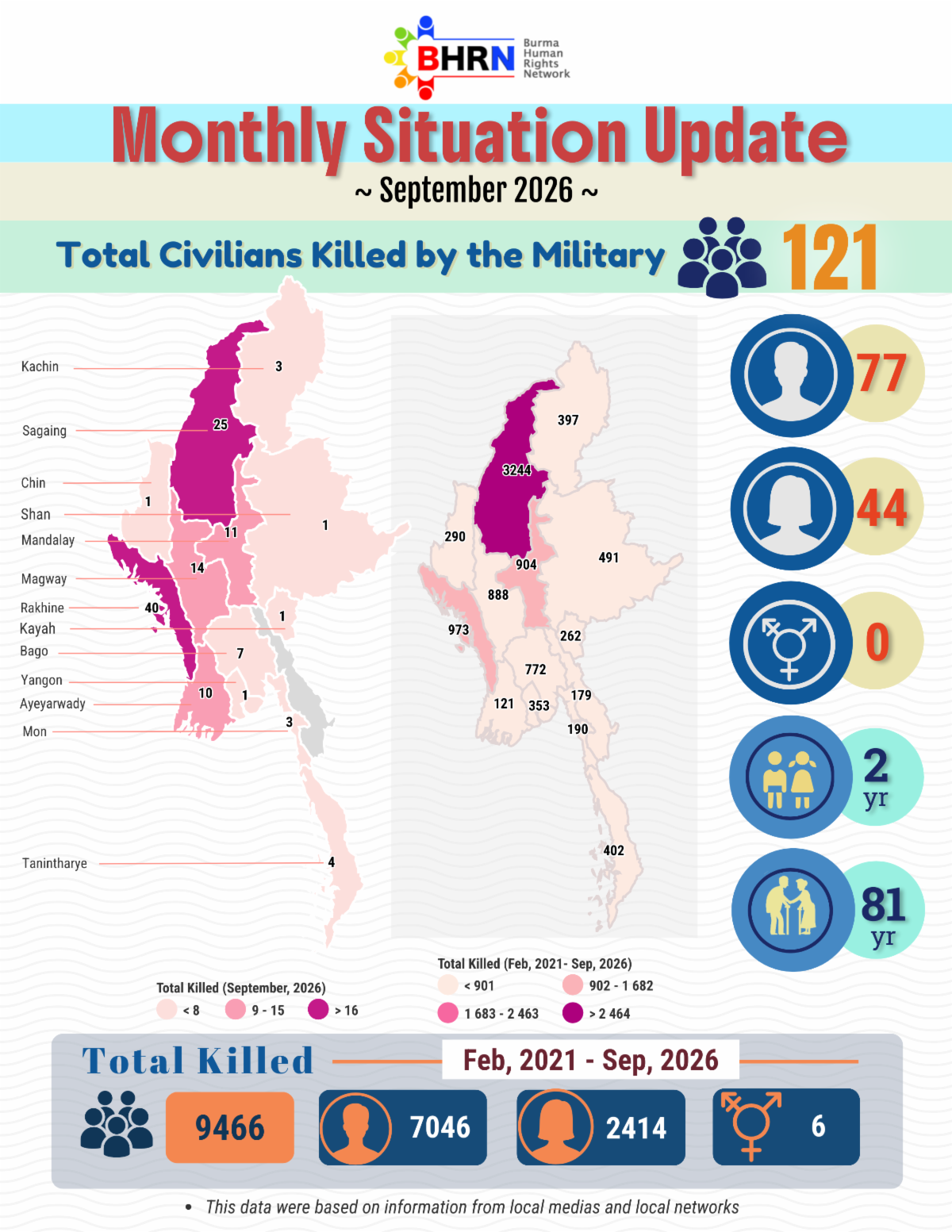
Myanmar’s military junta continued to carry out deadly attacks on civilians throughout September 2026, bombing villages, markets, schools and areas sheltering displaced people. On September 28, military aircraft struck a crowded market in Kyauktaw Township, Rakhine State, killing at least 50 people and injuring 58 others. Across the country, civilians faced arbitrary arrests, forced military recruitment, extortion, ill-treatment in detention and restrictions on access to essential services.
Read more: September 2026 - Summary of Monthly Situation Update
- Hits: 419

In August, Myanmar military forces carried out airstrikes, drone and gyrocopter attacks, artillery fire, village burnings, forced recruitment, and restrictions on humanitarian assistance across multiple states and regions. Civilians were killed in homes, displacement sites, monasteries, hospitals, and villages under resistance or ethnic armed organisation control. On 21 August, a Myanmar Air Force jet bombed a Buddhist monastery during a meditation retreat in Myaung Township, killing 14 people and injuring around 20. On 24 August, two military fighter jets bombed a Buddhist monastery housing a primary school in Paletwa Township while children were in class, killing five civilians, including two children, and injuring 17 others, including nine children.
Read more: August 2026 - Summary of Monthly Situation Update
- Hits: 670
- Hits: 579
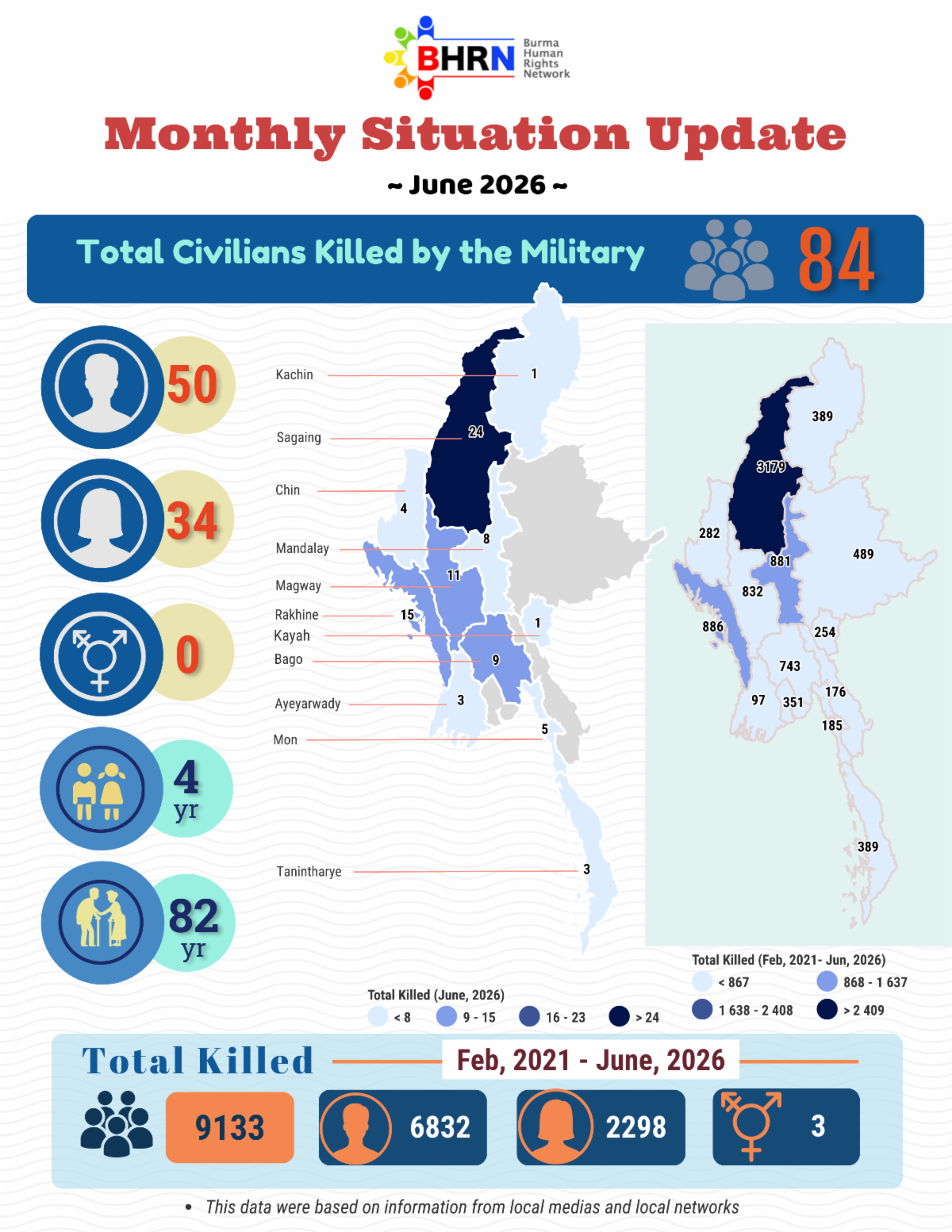
In June 2026, the junta continued to seek recognition from foreign governments as it simultaneously carried out airstrikes on villages, displacement camps, and other civilian areas across the country. Min Aung Hlaing followed his late-May visit to India with a state visit to China, where China issued a joint statement endorsing Min Aung Hlaing and welcoming the military’s fraudulent elections, and the month closed with BIMSTEC moving to hand the junta a regional leadership role while Laos and Belarus deepened ties with the junta. Human rights organisations and parliamentarians pressed governments to reject the junta and pursue accountability for its crimes, as Fortify Rights urged the United Kingdom to lead an International Criminal Court referral under Article 14 of the Rome Statute and civil society lodged a complaint with Thailand’s national human rights commission over gas revenue reaching the military.
- Hits: 1679
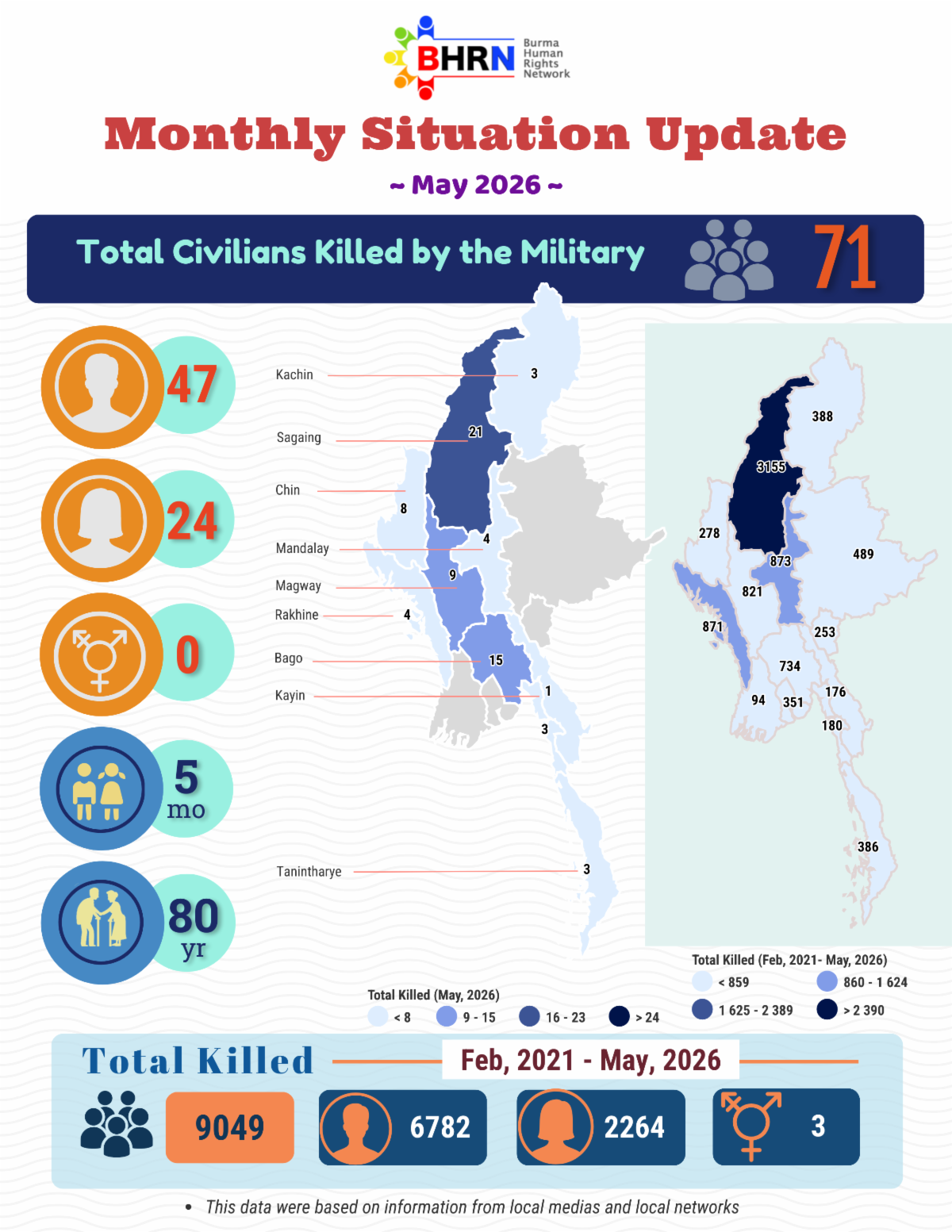
The Myanmar military junta carried out near-daily airstrikes, artillery bombardments, naval shelling, and village burnings against civilians across Myanmar in May 2026, while simultaneously pursuing international recognition from governments that have an obligation to hold it accountable. India became the first government to receive Min Aung Hlaing as a head of state since the Myanmar military junta’s illegal seizure of power in February 2021, extending full head-of-state honours to a man the ICC Prosecutor has sought to arrest for crimes against humanity. The Quad Foreign Ministers had called for the release of those detained in Myanmar just days before the visit. The 48th ASEAN Summit in Cebu produced no enforceable action on Myanmar for the fifth consecutive year. Thailand advocated for junta reintegration into ASEAN, and Malaysia’s foreign minister travelled to Naypyidaw without engaging the National Unity Government or any democratic actors. Foreign ministers agreed to hold a virtual meeting with junta Foreign Minister Tin Maung Swe outside the ASEAN Special Envoy’s mandate and without the National Unity Government present. On 5 May, the Rohingya Maiyafuinor Collaborative Network, the Chin Human Rights Organization, and the Myanmar Accountability Project jointly condemned the junta’s campaign to obstruct war crimes proceedings in Timor-Leste and Indonesia. The junta had expelled Timor-Leste’s chargé d’affaires in January 2026 after Dili opened a criminal file against Min Aung Hlaing. The Steering Council for the Emergence of a Federal Democratic Union carried out its first overseas diplomatic mission, with NUG Foreign Minister Zin Mar Aung leading a delegation to Canada from 30 May alongside representatives of the Karen National Union and the Karenni State Interim Executive Council.