
- Hits: 808
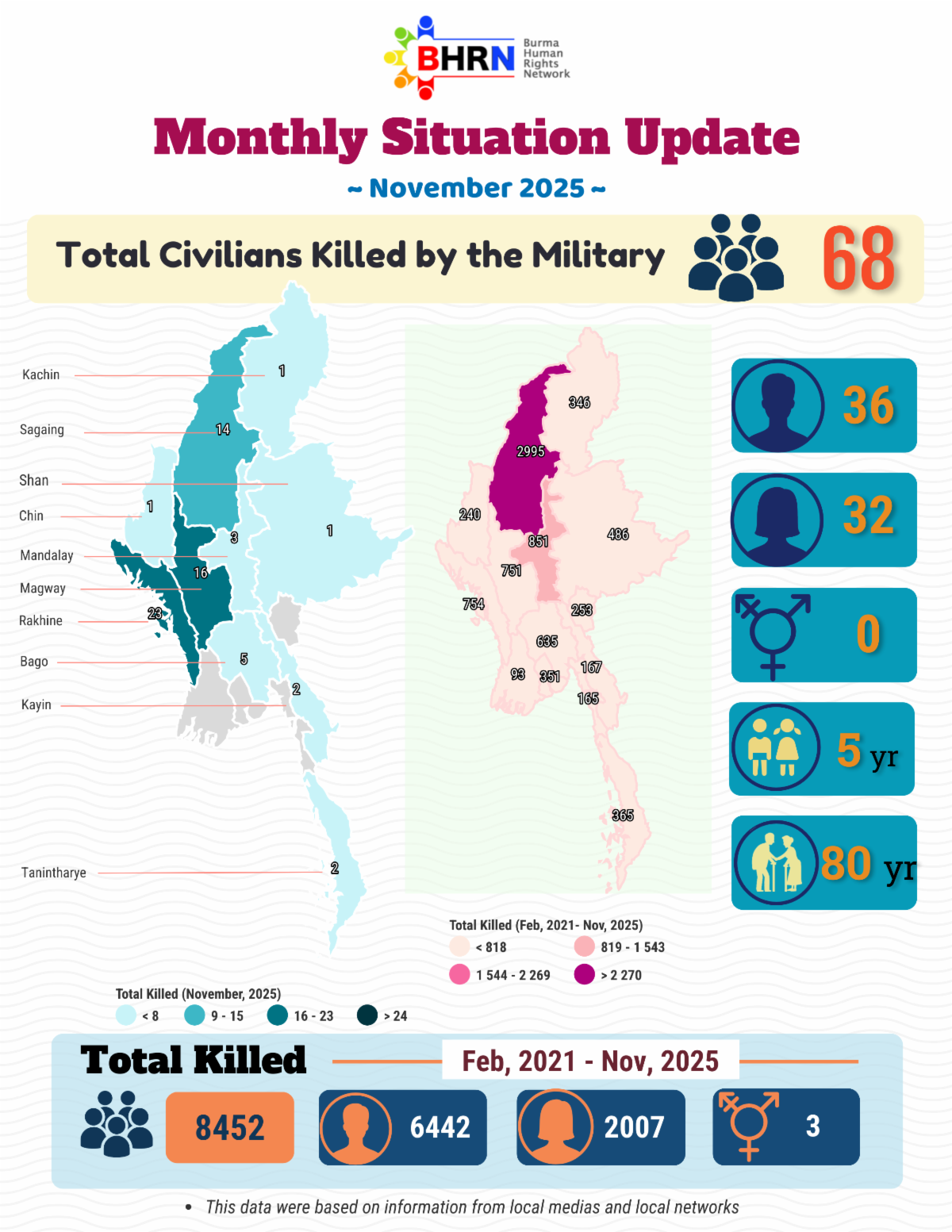
As the junta accelerates preparations for its staged elections, the human rights situation across Myanmar continued to deteriorate this month. November was marked by intensified military violence targeting civilians, escalating persecution of Muslim minorities, and aggressive use of surveillance, arrest, and legal repression to eliminate dissent. The junta carried out repeated airstrikes and artillery attacks on displacement sites, schools, hospitals, and religious infrastructure. In Rakhine State, airstrikes and forced recruitment campaigns targeted Rohingya and other civilians, while new restrictions imposed by the Arakan Army mirrored the discriminatory practices of past military regimes. Arbitrary detentions, torture, and extrajudicial executions persisted across the country, alongside a documented case of gang rape and murder by regime soldiers and a notable rise in attacks on religious institutions.
Resistance forces pushed forward on multiple fronts, seizing strategic ground and disrupting key junta supply chains. The capture of Maw Taung, a major border trade post with Thailand, dealt a blow to the regime’s cross-border revenue and control over Tanintharyi. Chin resistance groups retook Mount Kennedy outpost, while joint offensives across Sagaing, Mandalay, and Magway left hundreds of junta soldiers dead or captured. But even as the resistance made gains, the junta retaliated with increasing brutality, bombing hospitals and shelters, torching villages, and stepping up forced recruitment and arbitrary detention.
Read more: November 2025 - Summary of Monthly Situation Update
- Hits: 772
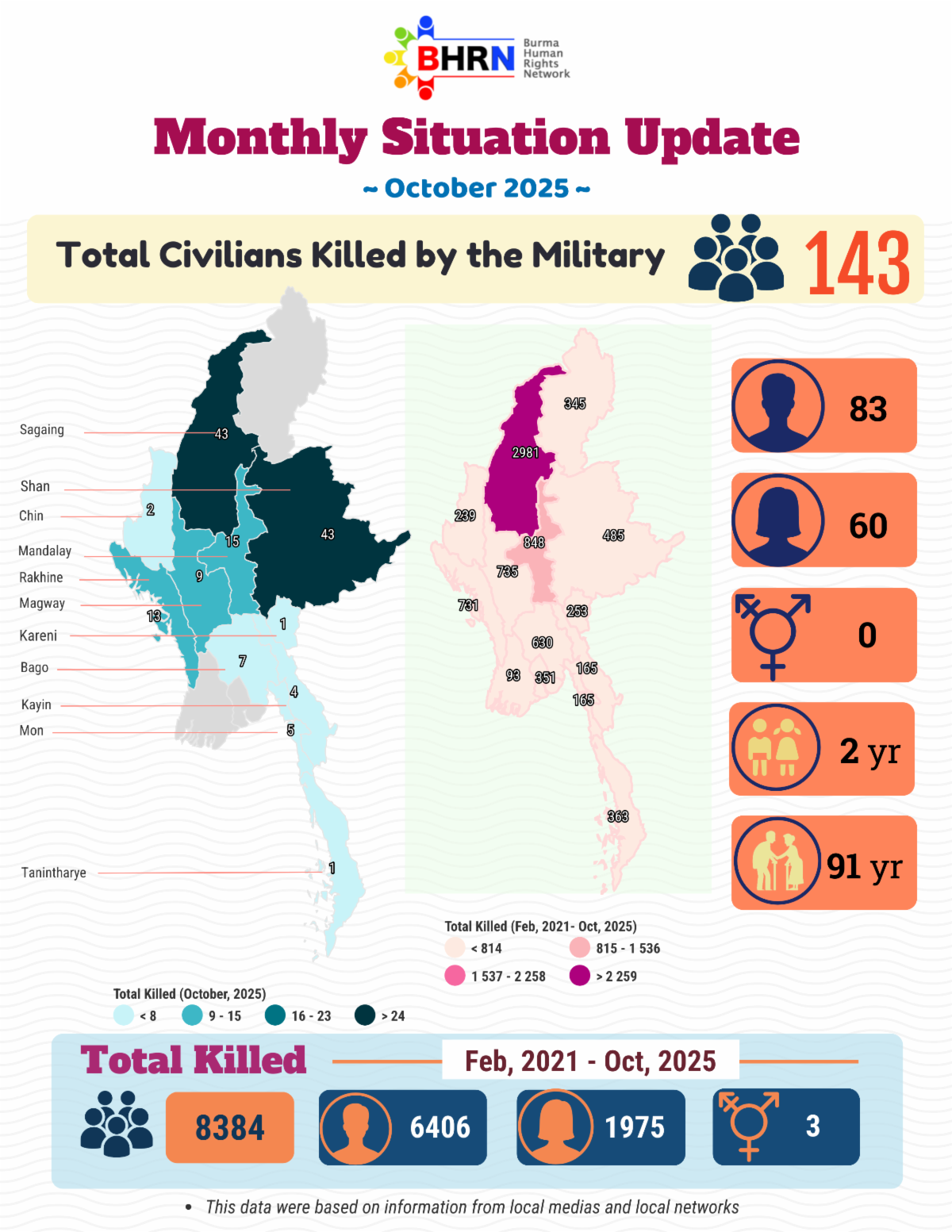
In October, the Myanmar junta ramped up preparations for sham elections in December while systematically coercing participation and attacking civilians across the country. On 16 October, Min Aung Hlaing announced a three-phase timeline covering 274 townships while excluding 56 areas under resistance control. The regime forced internally displaced persons to register as voters in exchange for cash payments, threatened prisoners with solitary confinement unless they cast advance votes, and re-arrested political prisoners at prison gates to silence potential opposition. The junta arrested three prominent artists on 27 October for criticizing an election propaganda film, prosecuted 64 people under a new Election Protection Law authorizing death penalties for vaguely defined "election interference," and banned all campaign rallies. Approximately 55,000 electronic voting machines will replace paper ballots despite serious transparency concerns, while only six parties field national candidates and voter lists contain hundreds of errors including names of deceased people.
Read more: October 2025 - Summary of Monthly Situation Update
- Hits: 1217
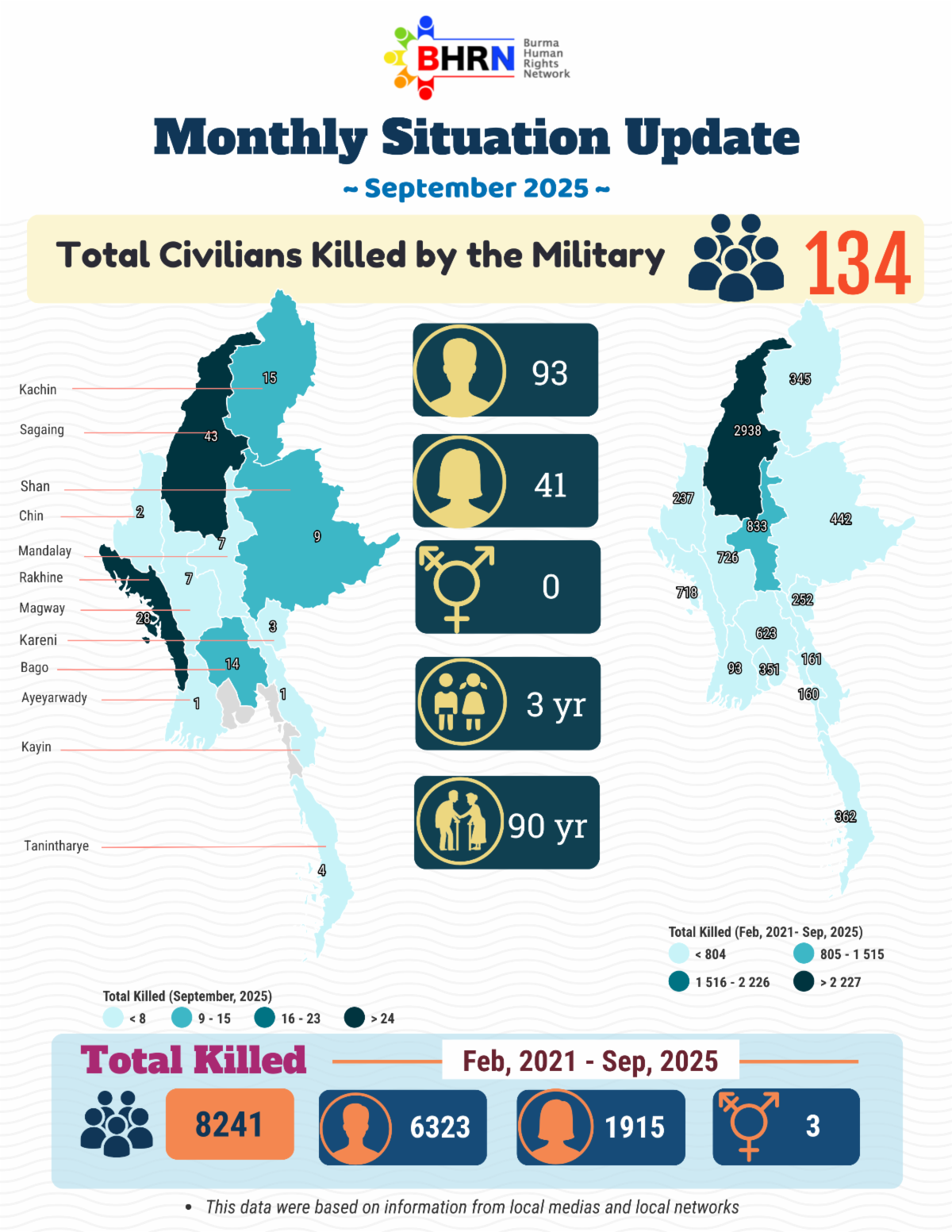
In September 2025, the Myanmar military junta continued laying the groundwork for a tightly controlled first phase of polling scheduled for December, while deepening repression to eliminate scrutiny. The Union Election Commission approved nearly 5,000 candidates under restrictive conditions, barred 56 townships outright, and imposed severe penalties, including against minors, for criticism or perceived disruption of the vote. These developments coincided with the expansion of state surveillance built into national telecom networks, allowing authorities to trace online activity and target individuals for arrest. Taken together, these measures are not designed to reflect the will of the people, but to create the appearance of legitimacy while shielding those in power from scrutiny or accountability.
Read more: September 2025 - Summary of Monthly Situation Update
- Hits: 1430
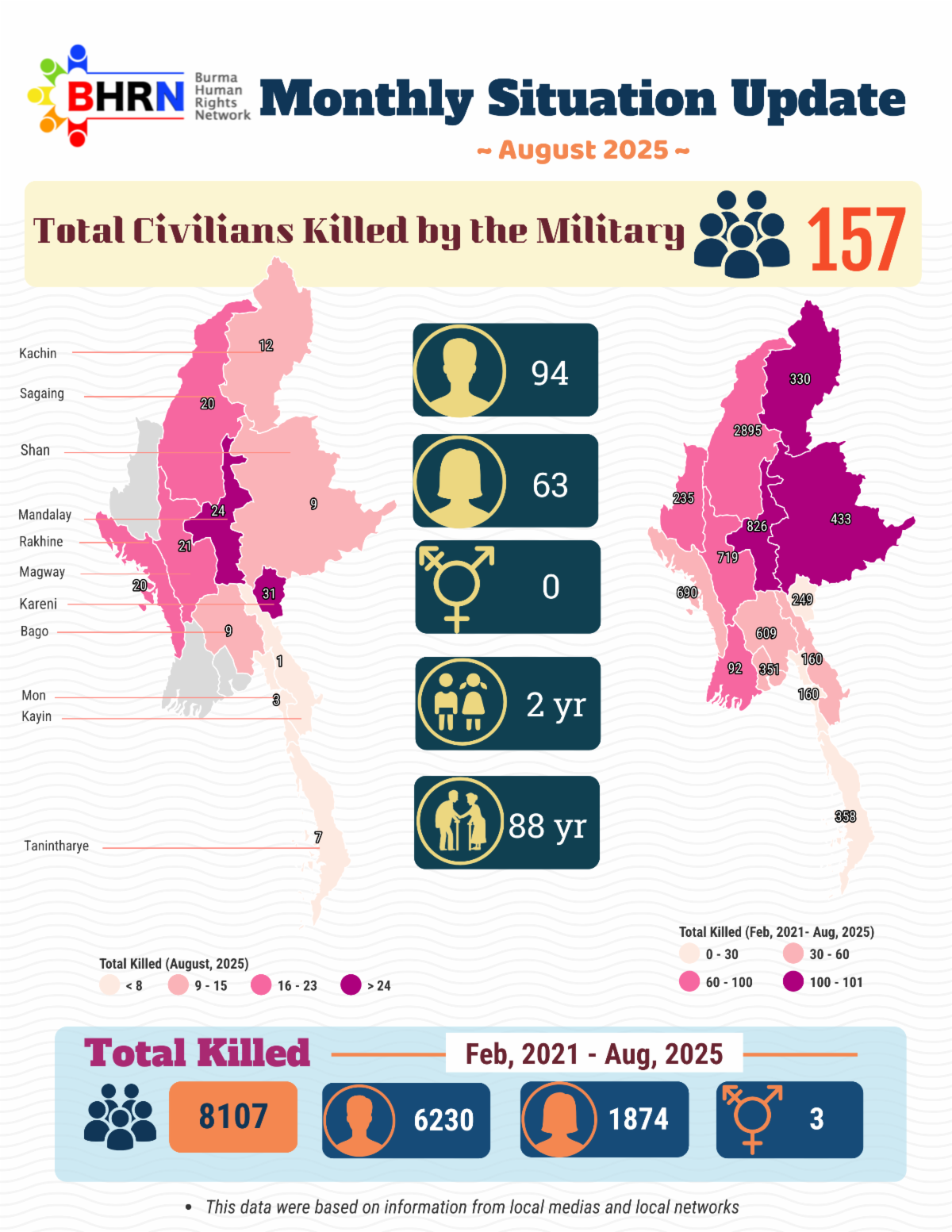
In August, the junta reorganized its rule under the SSPC while widening coercive legislation and surveillance, tightening control over civic space and election preparations. The National Defence and Security Council dissolved the SAC and installed the SSPC under Min Aung Hlaing, then declared a new emergency and martial law in 63 townships. The junta-run Union Election Commission announced a first phase of polling on 28 December 2025. In parallel, the junta activated the Election Protection Law, adopted a Military Secrets law carrying life imprisonment or the death penalty, brought the Cybersecurity Law into force, and suspended key privacy protections. Enforcement in Mandalay through phone searches and PSMS identity screening showed how these measures operate in practice. Together they expand detention, surveillance, and censorship powers and create conditions that cannot support a credible vote.
Read more: August 2025 - Summary of Monthly Situation Update
- Hits: 724
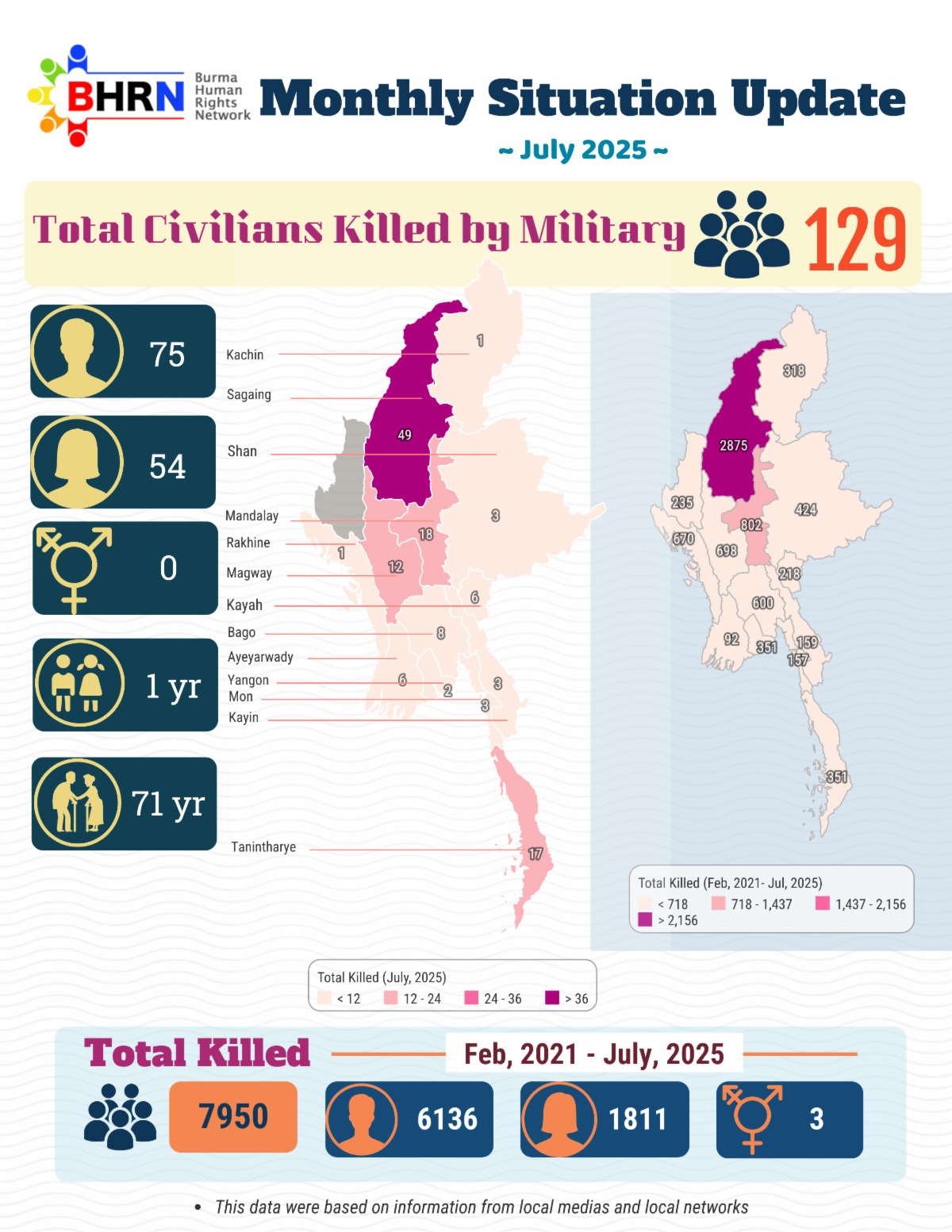
In July 2025, Myanmar’s military junta escalated repression through new laws aimed at silencing dissent and tightening control over civic space. The Cybersecurity Law, now in force, grants the authorities broad powers to monitor, censor, and criminalize online activity, including extraterritorially. The newly enacted election “protection” law imposes severe criminal penalties, including the death penalty, for criticism or peaceful opposition to the junta’s planned elections, further undermining political rights and press freedom.
Serious violations of international human rights and humanitarian law continued across multiple regions, including deliberate attacks on civilians, religious and educational sites, and health facilities, as well as arbitrary detention, torture, and forced labor. In northern Rakhine State, new investigations by Human Rights Watch and Fortify Rights document grave abuses by the Arakan Army (AA) against Rohingya civilians, including killings, beheadings, torture, forced recruitment of children, and severe restrictions on movement and livelihoods. These abuses, combined with the junta’s blockade on aid, have driven the largest movement of Rohingya to Bangladesh since 2017.
The humanitarian situation in Bangladesh’s refugee camps is deteriorating sharply. More than 150,000 new arrivals over the past 18 months are straining already limited resources, with the UN Refugee Agency warning of imminent cuts to health and food assistance unless the current 65 percent funding gap is urgently closed.