
Methodology
This report is based on primary and secondary sources, including on-the-ground documentation by BHRN and other human rights groups and media reports from trusted national and international outlets. It provides a detailed analysis of key events during the month, situating them within international legal frameworks and offers policy recommendations to guide international responses, humanitarian action, and justice efforts.
For more information about any of the incidents documented in this report, or to request interviews or supporting materials, please contact Kyaw Win, Executive Director of BHRN at
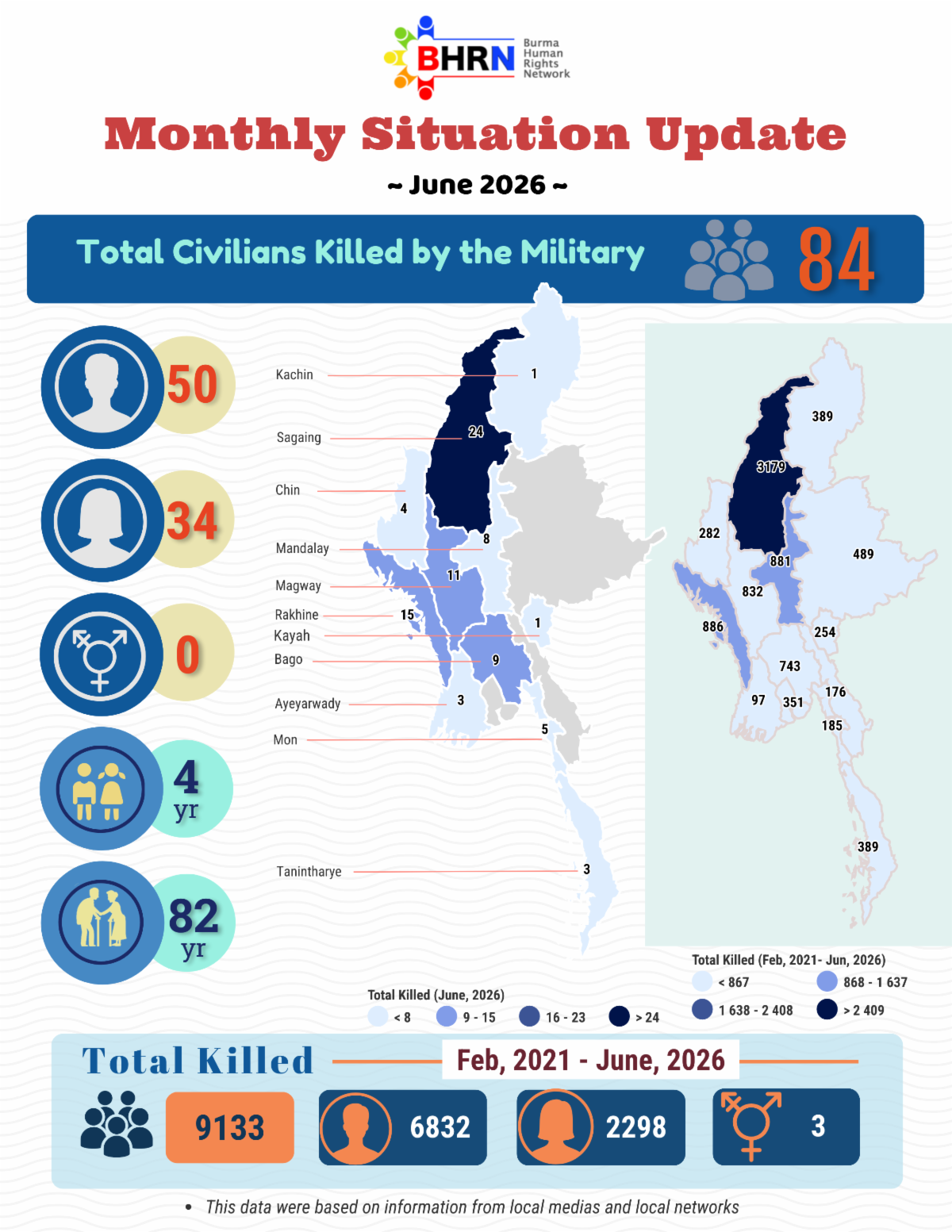
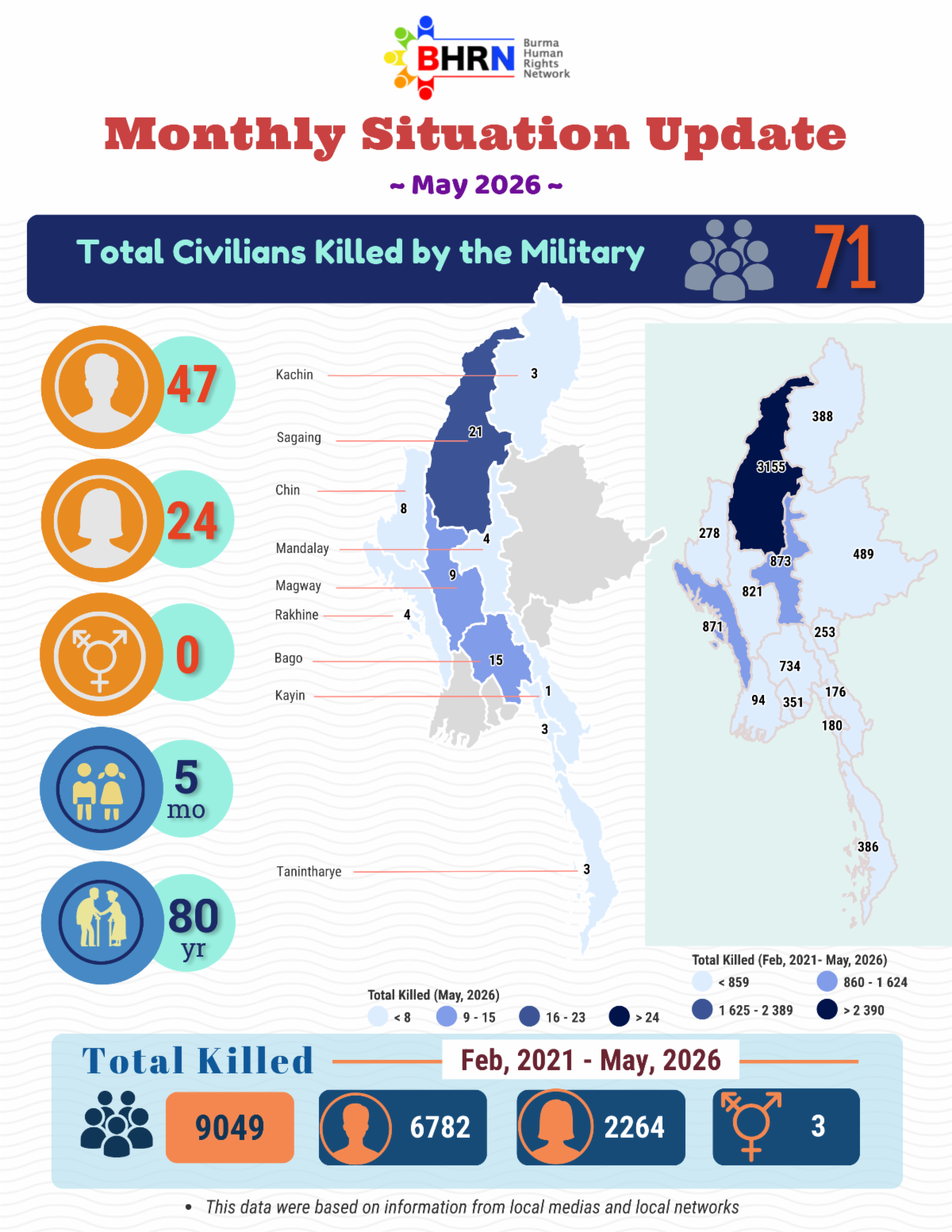
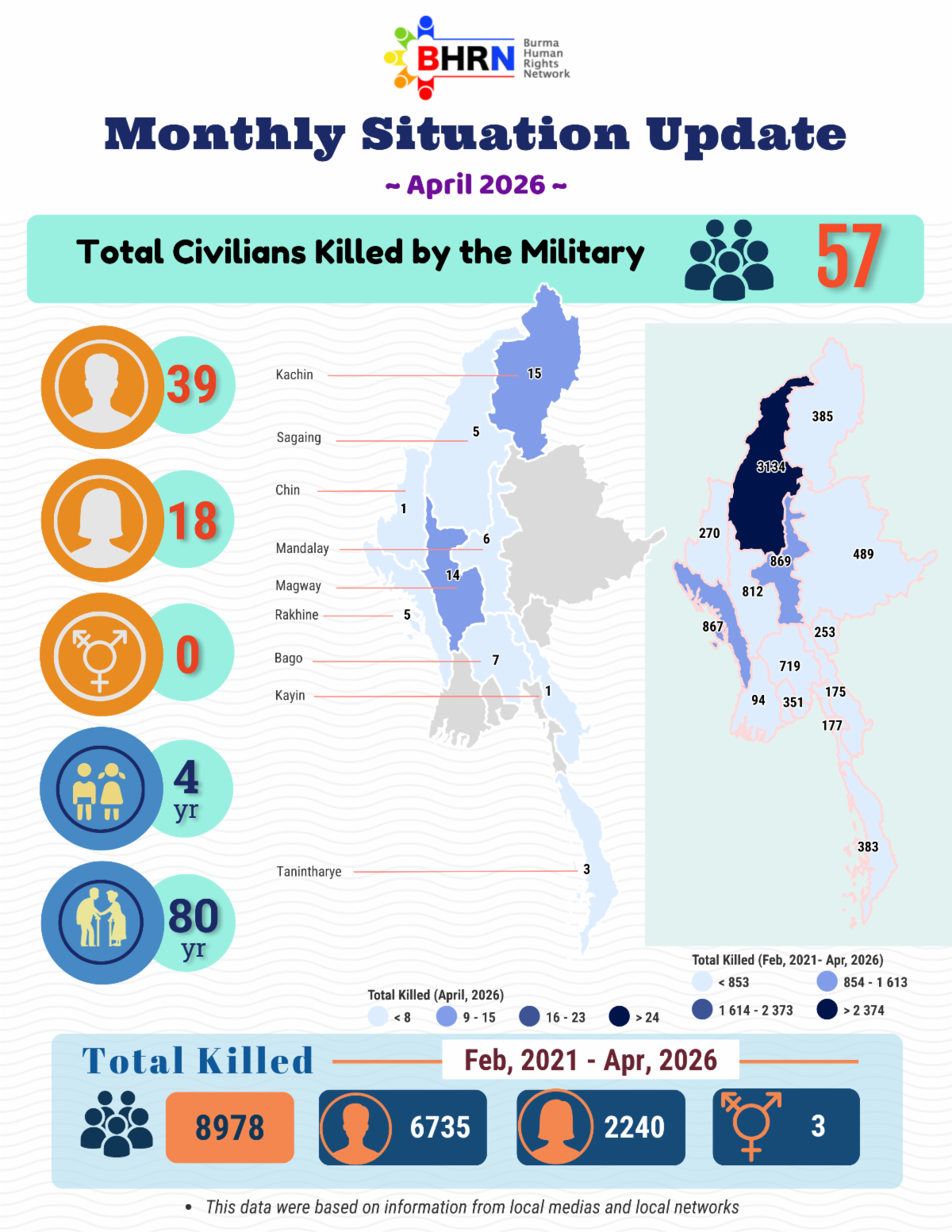
1Info-graphs of BHRN’s Report
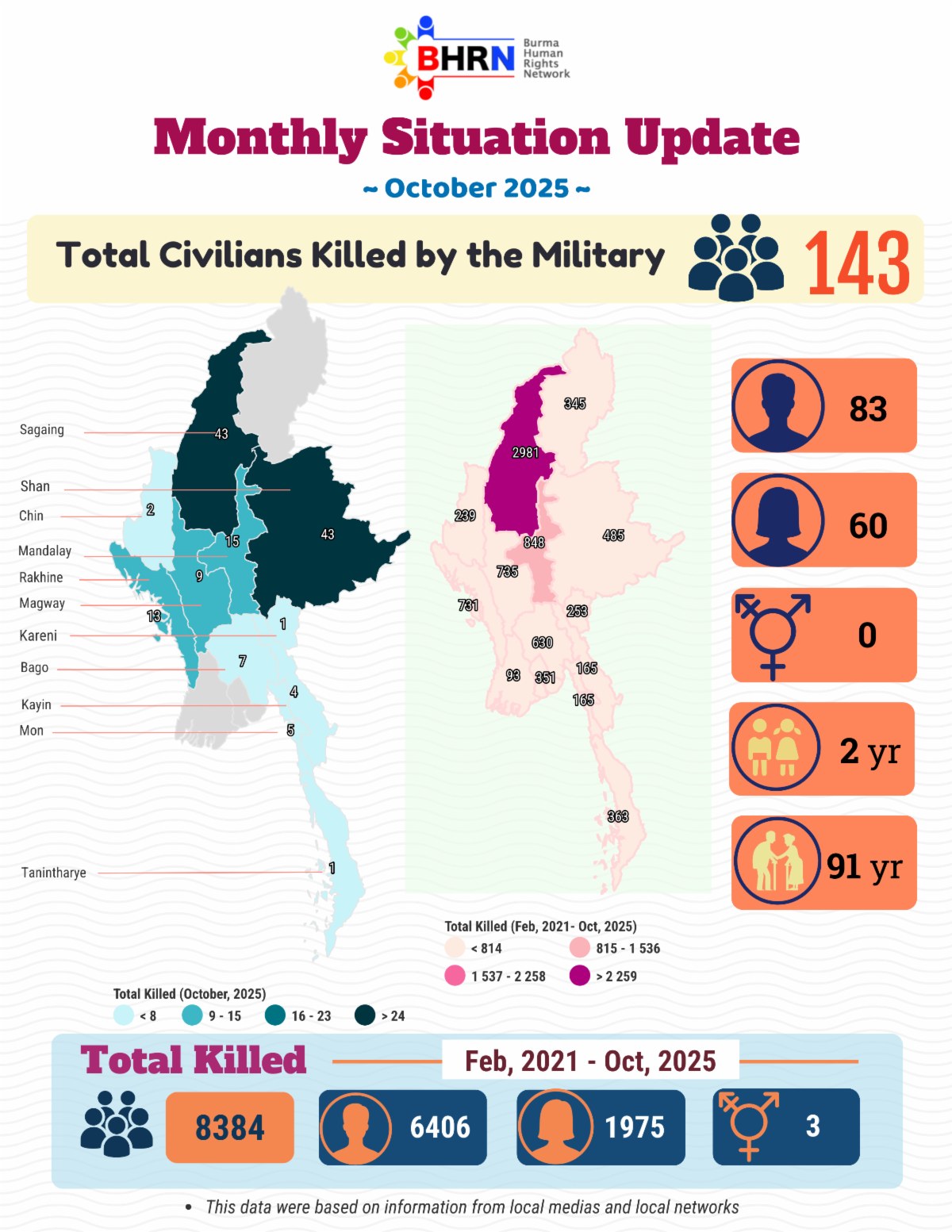
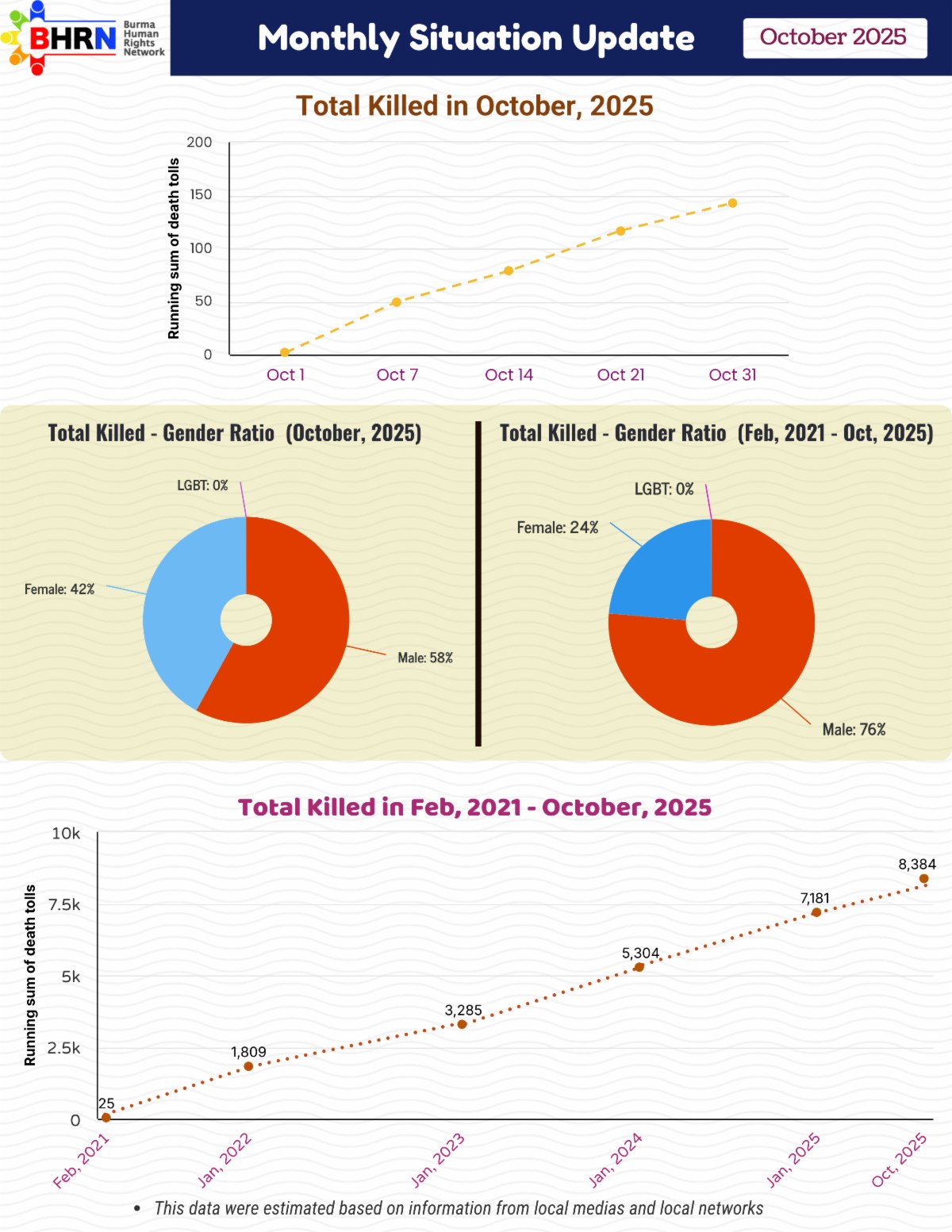
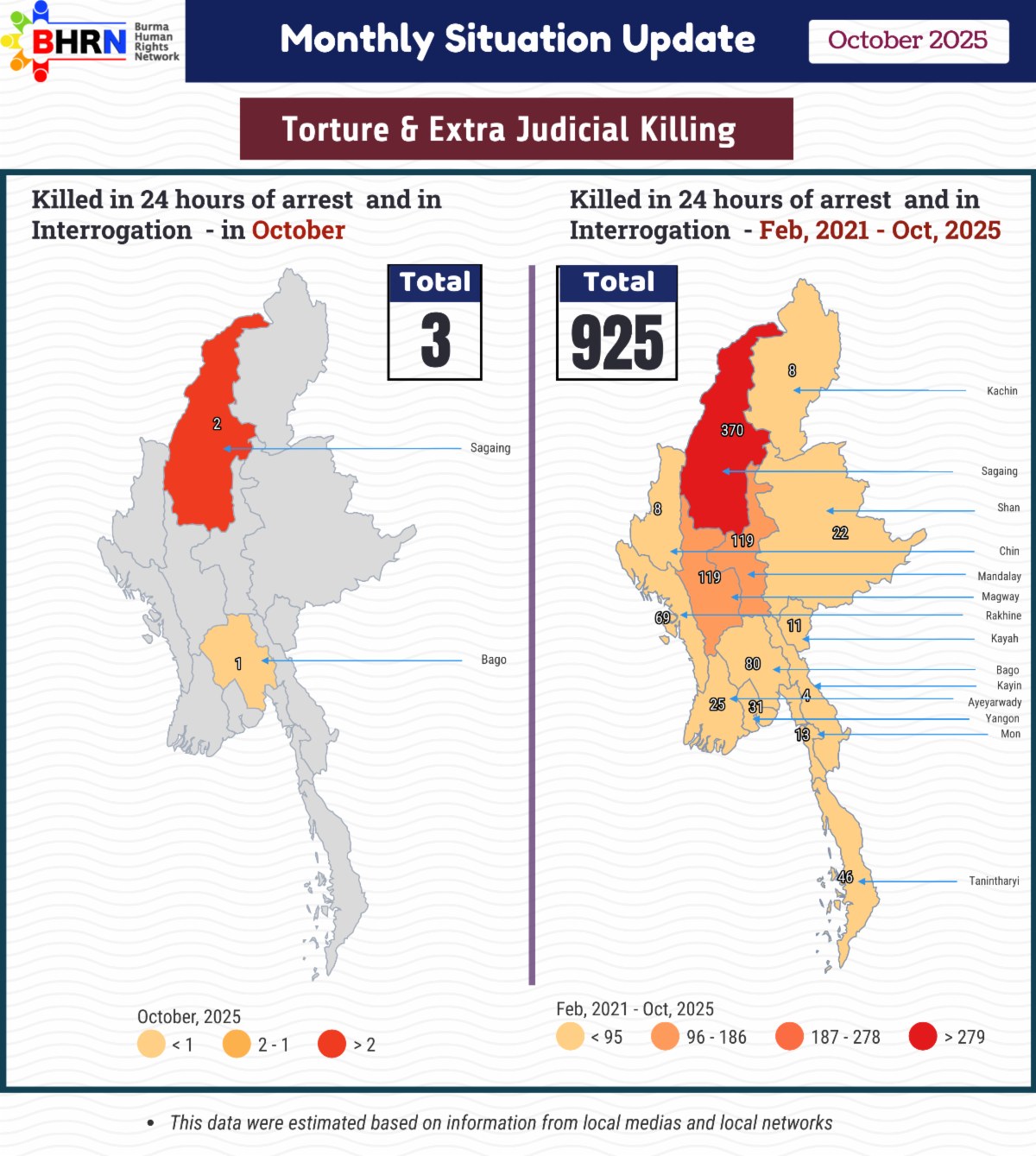
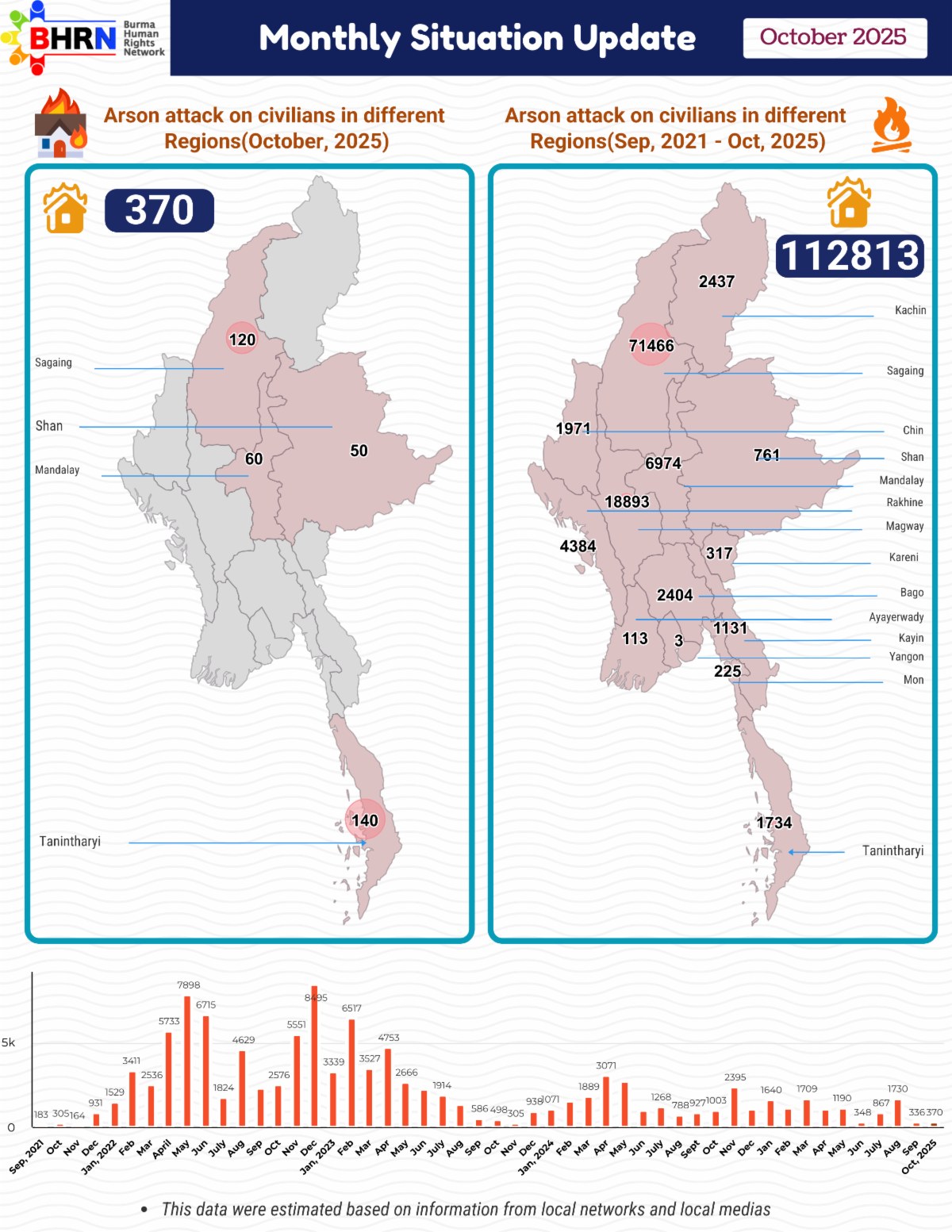


Tap any image to see it full size.
2News Summary and Analysis
This Month in Myanmar – October 2025
In October, the Myanmar junta ramped up preparations for sham elections in December while systematically coercing participation and attacking civilians across the country. On 16 October, Min Aung Hlaing announced a three-phase timeline covering 274 townships while excluding 56 areas under resistance control. The regime forced internally displaced persons to register as voters in exchange for cash payments, threatened prisoners with solitary confinement unless they cast advance votes, and re-arrested political prisoners at prison gates to silence potential opposition. The junta arrested three prominent artists on 27 October for criticizing an election propaganda film, prosecuted 64 people under a new Election Protection Law authorizing death penalties for vaguely defined "election interference," and banned all campaign rallies. Approximately 55,000 electronic voting machines will replace paper ballots despite serious transparency concerns, while only six parties field national candidates and voter lists contain hundreds of errors including names of deceased people.
While ASEAN issued statements opposing the elections, China and Russia provided material support that gave the regime the international cover it needed. On 15 October, Beijing's Special Envoy Deng Xijun pledged "physical and technical support" for the elections, offering infrastructure, training, and observer participation that insulates the regime from Western sanctions. Russia and Belarus accepted observer invitations while India hedged. Malaysia's Foreign Minister visited Naypyidaw on 9 October, which the junta immediately exploited by falsely claiming Malaysia had agreed to send observers, a lie quickly corrected but only after regime media broadcast the claim. The 26 October ASEAN Summit reiterated that elections must follow ceasefire and dialogue but imposed no concrete measures. Meanwhile, the United Kingdom has imposed no new sanctions for a full year, creating gaps in coordinated pressure. Burma Campaign UK noted that Britain "frequently imposes more sanctions on Russia in a single day than it has on the Burmese military in almost five years," allowing UK-linked institutions to facilitate transactions other jurisdictions have prohibited.
Violence against civilians escalated dramatically as the regime prioritized territorial control. On 7 October, the junta's Joint Operations Command announced plans to double airstrikes over the following two months. The regime deployed paramotors, drones, and gyro-copters, indiscriminate weapons difficult to detect that prevent civilians from protecting themselves. On 6 October, paramotors bombed a crowd celebrating a religious festival in Sagaing's Bone To village, killing at least 40 civilians with 10 more dying later from lack of medical care. Between 1-20 October, at least 30 airstrikes on northern Shan State killed 41 civilians including 8 children and destroyed 138 houses, three schools, and three monasteries. Junta troops bombed internally displaced persons with cluster munitions despite no active conflict, committed sexual violence, used civilians as human shields, and conducted raids killing villagers. In Rakhine State, the Arakan Army subjected Rohingya, Hindu, and Chakma civilians to systematic forced labor, with survivors describing months of forced portering, fortification construction, and unpaid work under threat of execution. The AA also arbitrarily arrested Rohingya fishermen and imposed movement restrictions requiring payments to access medical treatment.
Resistance forces maintained pressure despite junta advances in select areas. The Arakan Army and People's Defence Forces continued operations throughout October to encircle a strategic hilltop base threatening a major munitions factory in Magway that supplies nationwide junta operations, displacing 8,500 people from 20 villages. The Kachin Independence Army regained outposts in Bhamo despite heavy junta reinforcements. Six armed organizations rejected the junta's Nationwide Ceasefire Agreement anniversary ceremony from 15-17 October, declaring the agreement void since the 2021 coup. The regime's announcement to double airstrikes, deployment of indiscriminate weapons against religious gatherings and schools, systematic electoral coercion, Chinese material support, and stagnation of Western sanctions confirm that December elections serve not as democratic transition but as a mechanism to consolidate authoritarian control through manufactured legitimacy while terror remains the primary tool of governance.
3Political, Legal, and International Developments Affecting Myanmar
Junta's Sham Elections: Coercion, Repression, and Electoral Engineering
In October, the junta intensified preparations for a multi-phase electoral exercise engineered to fabricate legitimacy while silencing dissent and eliminating any meaningful political competition. On 16 October, Min Aung Hlaing announced the elections would proceed in three phases: the first covering 102 townships on 28 December 2025, with the second and third phases encompassing 172 additional townships throughout 2026. Later that month, the junta confirmed the second phase for 11 January 2026, while 56 townships, most under resistance control, remain excluded entirely. Many of these overlap with the 63 townships placed under martial law in July to facilitate the regime's efforts to reassert territorial control ahead of polling.
The regime continued weaponizing law to eliminate opposition. By 4 October, authorities reported prosecuting 64 people under the General Election Protection Law, enacted in July with penalties including death and life imprisonment for vaguely defined "election interference." On 27 October, the junta arrested three prominent Myanmar artists, director Mike Tee, supporting actor Kyaw Win Htut, and comedian Ohn Daing, for criticizing actors in the junta’s election propaganda film, demonstrating how the statute targets any dissent against the electoral process.
On 18 October, the Union Election Commission banned all campaign rallies and street processions, confining candidates to junta-approved venues. This followed Min Aung Hlaing's reported instruction last month for at least 20 serving or former generals to stand on the Union Solidarity and Development Party ticket, collapsing any distinction between military command and political authority. Only six parties are fielding national candidates, and voter lists that USDP member Hla Swe acknowledged on 5 October contain hundreds of errors in every township, including names of deceased people. The junta is also deploying approximately 55,000 domestically produced electronic voting machines to replace paper ballots, raising transparency and manipulation concerns. In September, ward administrators in Yangon forced households to attend trial votes, threatening to withhold registration documents for non-compliance, while teachers required to staff polling stations were warned not to share training information with the public.
Coercion of vulnerable populations intensified throughout October as the December vote approached. On 2 October, local media reported junta personnel forcing internally displaced persons in Sagaing town to complete voter forms in exchange for 60,000 kyat per household. This extends to detention facilities, where the junta continues pressuring prisoners, including labor activist Daw Myo Myo Aye, to cast advance votes, threatening solitary confinement for refusal. The regime also moved to prevent released prisoners from organizing electoral opposition. On 1 October, authorities re-arrested five political prisoners at Thayarwaddy Prison gates moments after sentence completion, taking them directly to the police station for new terrorism charges, part of a systematic pattern with at least 10 re-detained in 2025 that effectively silences experienced organizers who could mobilize boycotts or document irregularities.
The regime secured cooperation from pro-junta armed groups to facilitate voting in contested areas. On 2 October, media reported that the Karen Border Guard Force, Democratic Karen Benevolent Army, and KNU/KNLA Peace Council announced they would allow elections in territory they control, following a 28 September meeting in Myawaddy Township. A Karen State analyst characterized the decision as reflecting "the interests of the armed group leaders, not the Karen people.”
Why it matters
October revealed how the junta uses arrests, forced registration, and proxy militias to create an electoral facade while eliminating actual competition. The extensive coercion required, threatening artists for criticism, banning public campaigning, forcing displaced populations and prisoners to participate, exposes fundamental weakness: the regime cannot win consent, so it manufactures control through mechanisms violating core ICCPR rights (Articles 19, 21, 22, 25). For governments, donors, and corporations, recognition or engagement normalizes mass disenfranchisement and creates complicity exposure under the UN Guiding Principles and national sanctions regimes.
How the Junta Exploited Malaysia's Visit to Fabricate Observer Support
October exposed how the junta exploits even critical diplomatic engagement to manufacture legitimacy claims. On 9 October, Malaysia's Foreign Minister Mohamad Hasan made a one-day visit to Naypyidaw in Malaysia's capacity as ASEAN chair, meeting Min Aung Hlaing and regime officials to discuss elections and the Five-Point Consensus. The visit was controversial, occurring while the junta has been barred from high-level ASEAN meetings since 2022 for failing to honor April 2021 commitments.
The regime immediately weaponized the visit. On 10 October, regime media falsely claimed Hasan had "vowed to send election observation teams to Myanmar." Hasan quickly corrected the record on 13 October, clarifying that observer participation "will be discussed and decided at the ASEAN Foreign Ministers' meeting, but I don't expect ASEAN to agree." Charles Santiago, former Malaysian lawmaker and ASEAN Parliamentarians for Human Rights chair, stated that sending observers would amount to regime endorsement.
The junta's false claim about Malaysian observer support drew immediate rebuke from regional experts and former officials. On 14 October, former Malaysian Foreign Minister Saifuddin Abdullah, former Thai Foreign Minister Kasit Piromya, and other Special Advisory Council for Myanmar members issued a statement condemning "the military junta's blatant lie" as part of its "continuing propaganda campaign to fabricate legitimacy, again at ASEAN's considerable expense." The statement urged the upcoming ASEAN summit to "unequivocally reject the junta's planned sham election" and "launch a complete strategic reset on Myanmar."
The 26 October ASEAN Summit delivered measured pushback, reiterating that "the cessation of violence and inclusive political dialogue must precede elections," reinforcing the 11 July position that the junta's elections are "not a priority" and "will not solve any problems, but instead will worsen conditions." While consistent, this stops short of concrete measures to constrain the junta.
Why it matters
Malaysia's visit allowed the junta to falsely claim international observer support and broadcast that claim before officials corrected the record. This pattern holds across the region. ASEAN has spent four years in dialogue with the junta without imposing consequences for violations of humanitarian access and political prisoner release commitments under the Five-Point Consensus. The regime has learned that engagement continues regardless of compliance. Governments publicly opposing the elections while maintaining diplomatic and economic ties create a strategic contradiction the regime actively exploits. Continued engagement under these conditions provides the junta operational legitimacy to advance an electoral process fundamentally incompatible with ICCPR Article 25 standards. States maintaining relationships with the regime must recognize they are facilitating a coercive process designed to convert military control into manufactured democratic credentials.
China's Support and the International Divide on Myanmar's Elections
While ASEAN equivocated and regional actors sought distance, China moved decisively in October to provide direct backing for the junta's electoral project, offering both political cover and material support. On 15 October, Beijing's Special Envoy for Asian Affairs Deng Xijun addressed the Nationwide Ceasefire Agreement ceremony in Naypyidaw, declaring China's "non-intervention" policy while stating Beijing "appreciates" efforts to "achieve a peaceful situation in Burma" through the regime's elections. Deng made explicit China's support: "We're ready to give physical and technical support" for the electoral process. This formulation, pledging "non-intervention" while offering material assistance, reveals how Beijing uses rhetorical neutrality to mask decisive intervention.
Deng's commitment reflects established patterns of Chinese involvement in Myanmar's conflict dynamics. He personally oversaw the April 2025 handover of Lashio Township back to junta control as part of a China-brokered 18 January ceasefire between the MNDAA and Naypyidaw. The MNDAA had seized Lashio in August 2024. Its return to junta control demonstrates how Beijing uses ceasefire mediation to reshape territorial outcomes favoring the regime while maintaining its stated non-intervention posture.
Delegations from China, India, Thailand, Malaysia, and Indonesia attended the Naypyidaw ceremony despite calls from six anti-regime armed organizations for the UN and ASEAN to reject the event. Beijing's prominent participation, with a special envoy delivering keynote remarks, communicated to regional actors that China considers the junta a viable governing partner worth public diplomatic investment.
Beijing has provided technical support for the junta's census and electoral preparations throughout 2024-25, invited regime-registered parties to visit China, and accepted the invitation to send election observers. Russia has consistently framed junta actions through a legitimizing lens, with Foreign Minister Lavrov praising regime efforts to "stabilize" Myanmar while Moscow agreed to send observers and pledged cooperation to ensure elections are portrayed as "free and fair." Belarus accepted the observer invitation and promoted inter-parliamentary exchanges tied to the electoral process. Though lacking material capacity to influence outcomes significantly, its participation provides symbolic international diversity the junta will cite against isolation claims. India's position proved ambiguous but ultimately supportive. According to junta media, India agreed to send observers, while India's Ministry of External Affairs expressed PM Modi's hope that elections "will be held in a fair and inclusive manner involving all stakeholders".
Japan articulated the clearest opposition among major Asian economies. On 1 October, the Japanese Parliamentary Association for Supporting Myanmar's Democratization submitted a 15-point appeal to Vice Minister Takumi Miyaji detailing war crimes and urging rejection of the elections and release of Aung San Suu Kyi. This built on Japan's 1 August statement that elections "should be positioned as a process toward the restoration of the democratic political system." The European Union's 31 January position articulated similar principles: "Any elections held without prior inclusive dialogue between all parties and lacking popular support and broad participation are likely to exacerbate violence and instability in Myanmar."
Why it matters
China's pledge of "physical and technical support" for the junta's elections alters the strategic landscape for international pressure. Beijing is providing election infrastructure, poll worker training, surveillance systems, and observer participation that insulates the regime from Western sanctions and diplomatic isolation. The Lashio handover demonstrates Chinese willingness to broker territorial outcomes favoring the junta through ceasefire mediation, signaling involvement extends beyond economic ties to active shaping of military control. Combined with Russian rhetorical support framing the process as stabilization and Indian hedging that avoids explicit rejection, the junta can claim meaningful international backing despite Western and ASEAN opposition. Electronic voting machines require technical expertise the junta lacks domestically, surveillance infrastructure depends on external capacity, and observer missions from China, Russia, and Belarus will generate reports the regime can cite against irregularity documentation. For policymakers, this creates a fundamental challenge: coordinated Western sanctions have limited deterrent effect when Beijing offers alternative legitimacy cover and operational capacity. Effective pressure requires engaging ASEAN states to raise costs for Chinese support, documenting how specific technical assistance enables human rights violations, and developing economic alternatives for resistance organizations that reduce their dependence on Beijing's consent. Without directly addressing China's enabling role, Western accountability measures risk becoming symbolic gestures the regime can dismiss while pointing to Chinese backing as evidence of international acceptance.
UK Sanctions Stagnation and Gaps in Coordinated Pressure
The United Kingdom has not imposed new sanctions on the Myanmar junta since 29 October 2024, marking nearly one year of inaction that exposes a significant gap in what was once the most comprehensive coordinated sanctions regime. This represents a dramatic reversal from Britain's post-coup leadership role.
Burma Campaign UK highlighted this deterioration in an October statement, noting the British government hasn't kept pace with sanctions imposed by the U.S., EU, Canada, and Australia. The organization observed that "the British government frequently imposes more sanctions on Russia in a single day than it has on the Burmese military in almost five years." Director Mark Farmaner stated: "After the coup in 2021, the British government led the world in targeted sanctions against the Burmese military, now it doesn't even follow."
October was when the junta finalized December preparations, announcing the three-phase timeline, intensifying Election Protection Law prosecutions, coercing displaced populations and prisoners, and securing backing from China and pro-regime armed groups. Sustained sanctions pressure could have raised costs for facilitating entities, constrained enforcement resources, and signaled international commitment to denying regime legitimacy. Burma Campaign UK noted that "the failure of the British government to continue imposing sanctions will have been noticed and have provided encouragement for the Burmese military at a time when they are escalating attacks ahead of sham elections."
Britain's static list creates coordination gaps. When allies continue updating their designations to capture new entities and evasion networks, UK-linked financial institutions face reduced compliance obligations and may facilitate transactions other jurisdictions have prohibited. This creates arbitrage opportunities for facilitators who can route transactions through London or operate with reduced asset freeze and travel ban risk. Myanmar military revenue streams, arms procurement networks, and aviation fuel supply chains continuously evolve to evade restrictions. Without regular updates capturing new nodes, sanctions lose effectiveness and the regime learns international attention is temporary. Burma Campaign UK emphasized this principle: "For sanctions to be effective they need to be imposed on a wide range of targets, to have a cumulative impact, and to be imposed on an ongoing basis."
Why it matters
Britain's role in global finance means UK sanctions carry weight beyond bilateral relations. UK-based banks, insurers, and corporate service providers play roles in international transactions that allied jurisdictions may have already prohibited. When UK lists lag, these institutions create sanctions evasion pathways that undermine cumulative pressure. Britain's retreat also signals to the junta that international attention is waning and governments are returning to business as usual despite ongoing atrocities. This reduces deterrent effects. The contrast with Russia sanctions is stark: the government imposes comprehensive, frequently updated measures against Russian entities when leadership prioritizes a program. October offered clear targets for UK action: Union Election Commission officials implementing coercive registration, military commanders overseeing forced voting in prisons, electronic voting machine suppliers, financial institutions processing electoral infrastructure payments. Britain's failure to act during this critical window advantages the regime precisely when coordinated pressure could prove most effective.
4Resistance Gains
In October, resistance forces continued to contest regime control in key strategic areas, mounting attacks on junta outposts and strengthening coordinated offensives near major military production sites. The Arakan Army and allied People's Defence Forces sustained operations in Magway Region's Ngape Township, threatening Myanmar Armed Forces' munitions production capabilities, while the Kachin Independence Army demonstrated continued operational capacity in Bhamo despite recent junta reinforcements.
Key operations and developments
- Early October
Ngape Township, Magway Region
The AA and PDF forces, which had captured a junta outpost in Goke Gyi village in late September, continued operations to encircle the strategically important Nat Yae Kan hilltop base throughout October. Located just two miles from Goke Gyi and overlooking Ka Pa Sa 14 munitions factory, this position is critical for military oversight and supply chain protection. The junta maintained over 1,000 troops at the position with ongoing reinforcements. At least 8,500 people from 20 villages remained displaced across Ngape Township as fighting continued. Control of Nat Yae Kan hill would expose the munitions factory, one of several in Magway supplying ammunition, artillery shells, and small arms for nationwide junta operations, to direct attack.
Magway Region
A group calling itself the "People's Revolution Alliance" reported detaining 27 junta troops who had abandoned their outposts.
Bhamo, Kachin State
The Kachin Independence Army regained control of several outposts in Bhamo town as intense fighting continued. This came despite the junta retaking some positions in September using a flotilla of at least 15 naval vessels. The area remained highly contested throughout October.
Six armed organizations, including former Nationwide Ceasefire Agreement signatories, rejected the junta's NCA 10th anniversary ceremony in Naypyidaw held from 15-17 October. They called for genuine peace efforts rather than military-led forums. The groups - Karen National Union, Chin National Front, All Burma Students' Democratic Front, Pa-O National Liberation Organization, Lahu Democratic Union, and New Mon State Party Anti-Dictatorship faction - declared the NCA null and void since the 2021 coup, stating that ending military dictatorship is the "only answer" to the country's political crisis. The National Unity Government spokesperson stated that anti-regime groups were holding their own talks to achieve genuine peace at an undisclosed location.
5On the Ground: Escalating Violence and Human Rights Violations
In October, junta violence against civilians continued as the regime intensified military operations ahead of its planned December elections. On 7 October, the junta's Joint Operations Command announced its intention to double the number of airstrikes and further increase ground attacks over the following two months to secure territory before the 28 December vote. The junta increasingly deployed new forms of lethal technology, including paramotors, drones, and gyro-copters, which require less training and are far lower-cost than traditional fighter jets and helicopters. Paramotors are inherently indiscriminate weapons incapable of precise targeting, making their use illegal under international humanitarian law. Stealth weaponry, including suicide drones and paramotors, are difficult to detect from the ground, meaning civilians often cannot protect themselves or flee.
ITargeted attacks on civilians
Under international humanitarian law, civilians must never be the object of attack. Article 8(2)(e)(i) of the Rome Statute prohibits attacks intentionally directed against civilians in non-international armed conflicts. When such attacks form part of a widespread or systematic campaign against the civilian population, they may amount to crimes against humanity under Article 7(1), including murder (Art. 7(1)(a)), persecution (Art. 7(1)(h)), and other inhumane acts (Art. 7(1)(k)).
Sagaing Region
Chaung-U Township
Myanmar Armed Forces paramotors bombed a crowd gathered to celebrate Thadingyut, a holiday marking the end of Buddhist lent, in Bone To village. At least 40 civilians were killed and 50 injured during attacks on a sit-in protest against the regime. At least 10 additional people subsequently died from their injuries due to lack of medicine and medical treatment. The attack on a large public gathering during a religious festival demonstrates the junta's disregard for avoiding non-combatant deaths. Ongoing aerial surveillance and bombardment hindered rescue efforts as responders faced security risks and severe shortages of blood, medicine, and equipment.
Myaung Township
Around 20 civilians were injured by airstrikes on Zayatkone village. Residents reported at least 10 bombs were dropped. At least 10 homes, including a monastery, were destroyed, and at least 4,000 residents fled due to fears of further attacks.
Salingyi Township
At least 9 villagers were killed in a series of raids by junta troops near the China-Wanbao copper project. A local source reported that since 18 October, a large military force crossed the Chindwin River from Monywa town and has been targeting villages where civilians live, raiding villages and arresting and killing locals.
Mandalay Region
Ngathogyi Township
Junta troops shot dead 8 civilians and bombed internally displaced people. Two fighter jets and a Y-12 aircraft dropped bombs, along with cluster-like large bombs from five drones that released many smaller bombs. "They bombed the places directly, knowing there were displaced people taking shelter," a local source said. Among the deaths were 6 from Ywar Gyi village and 2 from Kan Hnaung village. The attack occurred despite no active conflict in the area.
- 19 October
Ngathogyi Township
At least 4 civilians were killed by a motorized paraglider bombing. A 55-year-old man and his wife were killed along with a 57-year-old man and a 91-year-old man. A 10-year-old child and a 45-year-old woman were seriously injured. (BHRN interview_06_Mandalay/19Oct25)
- 21 October
Mogok Township
Three girls were killed in an airstrike. Eleven civilian houses were destroyed and a futsal sports ground was damaged. Initial reports suggest two 250-pound bombs were dropped from a jet fighter. (BHRN interview_ 07_Mandalay/21Oct25)
Northern Shan State
Maikhuong village, Kyaukme Township
Ten civilians, including one child, were killed and three others injured in airstrikes by the Burma Air Force.
Kyaukme and Namhsan Townships
Eight civilians were killed, including 5 women and 2 monks, and 20 others injured by airstrikes. Between 1-20 October, the junta carried out at least 30 airstrikes on Ta'ang National Liberation Army-controlled towns of Namhsan, Mantong, Mongngawt, Namtu, Monglon, Mogok, and Momeik, killing 41 civilians including 8 children, and injuring around 50 including 11 children. The strikes also destroyed 138 houses, three schools, and three monasteries.
Kaw Paung village, Kyaukme Township
A monk died and two civilians were injured in an airstrike despite no ongoing active conflict in the area.
Chin State
Mindat Township
Airstrikes injured three civilians and destroyed or damaged several buildings, including houses and administrative offices.
Mindat Township
Four people, including three children, were killed in airstrikes on two villages.
Vanha village, Hakha Township
Two children were killed during an airstrike on a school.
Mon State
- 9 October
Bilin Township
Five children between the ages of six and twelve were killed and eight others injured when the Burma Air Force bombed a village. The strike also damaged three houses and killed two cows. At the time of the attack, there were no reported clashes between KNLA and junta forces in Bilin Township. (BHRN interview_04_Mon/09Oct25)
Karen State
Myawaddy Township
Drone strikes destroyed a health clinic and injured two civilians.
Bago Region
- 22 October
Okpo Township
Junta troops shot and killed 4 civilians and took over 40 local villagers as human shields during a raid on Yae Ngan village. Troops shot two youths at the village entrance, accusing them of being PDF members, then entered the village and killed another civilian. They searched the village and burned down six houses. (BHRN interview_11_Bago/22Oct25)
Ayeyarwady Region
Sapyin village, Yekyi Township
Twenty-four civilians, including children, were killed in an airstrike. Bombs as large as 500 pounds were dropped by two jet fighters twice.
Magway Region
Tae Pin village, Pauk Township
Junta troops killed three civilians during a raid. About 300 troops from Ka Pa Sa 24 Military Ordnance Factory entered the village and arrested over 100 villagers. The junta released 100 civilians after their withdrawal on 13 October. When villagers re-entered after troops left, they found three bodies of people the military had killed.
Tanintharyi Region
1 October (Yebyu Township)
The Myanmar Armed Forces fought the Karen National Liberation Army and People's Defence Forces in the Dawei Special Economic Zone area and set 12 houses ablaze, displacing many residents from four villages.
Thayetchaung Township
Junta troops raided and torched 73 houses in a village following fighting with KNLA and PDF fighters two days prior, causing residents from at least eight nearby villages to flee.
Thayetchaung Township
Airstrikes killed four civilians, injured several others, and destroyed two houses.
IIArbitrary Detention, Torture, and Forced Labor
Arbitrary arrests and detention violate Articles 7(1)(e), 7(1)(f), and 8(2)(c)(ii) of the Rome Statute. These practices were widespread in October.
- 13 October
Nattalin Township, Bago Region
Three civilian youths were arrested to serve as porters for the Myanmar military. One was released after his family paid 2 million kyat to the junta troops. "They even fired guns, and when people heard the gunshots, everyone in the village was in a panic," a source said. The other two were taken away. (BHRN interview_10_Bago/16Oct25)
IIIViolence Against Rohingya and Ethnic Minorities in Rakhine State
Forced displacement, arbitrary detention, extortion, forced labor, and movement restrictions targeting civilian populations on the basis of ethnicity or religion constitute serious violations of international law under Article 7(1)(d) and 7(1)(h) of the Rome Statute. Under Article 8(2)(c)(ii), forced labor may constitute a war crime when systematic.
Arakan Army Forced Labor and Arbitrary Detention
On 22 October, Fortify Rights released an investigation documenting systematic forced labor by the Arakan Army against ethnic minorities in Rakhine State, including Rohingya, Hindu, Chakma, and other civilians. Between November 2024 and October 2025, the organization interviewed 21 survivors and witnesses who described being compelled at gunpoint to carry ammunition, construct fortifications, and perform unpaid labor for months under threat of beatings, detention, and execution. Some arbitrarily detained Rohingya civilians were subjected to forced labor for up to one year.
Survivors reported being forced to carry loads such as ammunition and food rations, build fortifications, repair damaged trenches, bunkers, battalion compounds, and other military infrastructure, as well as perform non-military labor such as tending crops and cattle, clearing vegetation, and maintaining roads and civilian infrastructure under equally harsh conditions.
October Incidents of Arbitrary Detention and Movement Restrictions
Kyauk Hlae Kar village, Maungdaw Township
The Arakan Army arrested 6 Rohingya Muslims while they were working in a shrimp farm without any apparent reason. The detainees were fishermen with no connection to any rebellion against the AA or participation in military operations.
Maungdaw Township
Residents from Kyauk Hlae Kar, Mingalar Gyi, Hla Baw Zar, Paung Zar, and Pyin Phyu villages were strictly banned from entering Maungdaw town without a recommendation letter from the Arakan Army and United League of Arakan. Those wishing to go to town for social events, shopping, or medical treatment require two recommendation letters and must pay 5,000 kyat to the village administrator and area commander to obtain them.
Thayet Oak village, Maungdaw Township
The Arakan Army arrested two Rohingya Muslim youths, Mohamed Rashid (30) and Hala Phutu (aka Shafi Alam, 22), while they were on the way to their work site. Mohamed Rashid has mental health issues, and the arrest could exacerbate his health conditions. Their arrest is seen as a serious human rights violation in the region under AA control.
IVDeaths in Detention
Under international human rights law, all persons deprived of liberty must be treated with humanity and dignity. Denial of medical care may constitute cruel, inhuman or degrading treatment under the Convention Against Torture.
- 28 October
Myingyan Prison, Mandalay Region
A political prisoner, Ko Chan Min Hlaing, died due to inadequate medical care. He was only 29 years old. Ko Chan Min Hlaing was arrested under charges including criminal defamation, explosive, and weapons charges, and was serving a sentence of 15 and a half years. The Political Prisoners Network-Myanmar announced his death on 27 October. (BHRN interview _08_Mandalay/28Oct25)
VSexual and gender‑based violence (SGBV)
Sexual violence by state forces constitutes torture and may amount to war crimes/crimes against humanity (Articles 7(1)(f) and 8(2)(c)(i)).
- 16 October
Kantbalu Township
Junta troops committed rape and killed a woman arrested along with her husband on their way to a religious ceremony at the military checkpoint on the Shwebo-Myitkyina road near Sabal Nanttha village. The husband was also tortured by the military, and then he ran away from them to the local PDFs. (BHRN interview _05_Sagaing/16Oct25)
6Policy Recommendations
For the United Nations and International Community
1. Reject the junta's electoral process as illegitimate: UN member states, ASEAN, and other regional bodies should publicly declare that elections conducted under conditions of mass coercion, arbitrary detention, forced voter registration, and systematic violence cannot produce legitimate governance. The international community must refuse to send observers, recognize results, or engage with any government formed through this process.
2. Impose targeted sanctions on election infrastructure and facilitators: Governments should immediately designate Union Election Commission officials implementing coercive registration, military commanders overseeing forced voting in detention facilities, electronic voting machine suppliers, and financial institutions processing electoral infrastructure payments. Particular focus should be placed on entities providing technical support for the 55,000 electronic voting machines that eliminate transparency and enable manipulation.
3. Address China's enabling role directly: Western governments should engage ASEAN states to raise costs for Chinese support of the junta's elections, document how specific Chinese technical assistance, including election infrastructure, poll worker training, and surveillance systems, enables human rights violations, and develop economic alternatives for resistance organizations that reduce their dependence on Beijing's consent.
4. Close UK sanctions gaps immediately: The United Kingdom must resume regular sanctions designations against Myanmar military entities, revenue sources, and arms procurement networks. UK-based banks, insurers, and corporate service providers are creating sanctions evasion pathways that undermine coordinated international pressure. Britain should match the pace and scope of sanctions imposed by the U.S., EU, Canada, and Australia.
5. Investigate the use of indiscriminate weapons as war crimes: The UN Human Rights Council and the Independent Investigative Mechanism for Myanmar should prioritize documentation of the junta's systematic deployment of paramotors, cluster munitions, and suicide drones against civilian gatherings, religious festivals, schools, and displacement camps. Paramotors cannot target precisely and their use against civilians violates international humanitarian law.
6. Hold the Arakan Army accountable for forced labor: States should impose targeted sanctions on Arakan Army commanders responsible for systematic forced labor of Rohingya, Hindu, Chakma, and other ethnic minorities documented by Fortify Rights and others. Movement restrictions requiring payments for medical access and arbitrary detention of civilians constitute serious violations warranting accountability measures.
For ASEAN
7. Impose material costs for Five-Point Consensus violations: ASEAN's four years of dialogue without enforcement have taught the junta that engagement continues regardless of compliance. The 26 October Summit's reiteration that elections must follow the ceasefire and dialogue is meaningless without consequences. ASEAN must suspend Myanmar from regional economic frameworks including RCEP benefits, freeze transactions with regime-controlled banks through regional financial systems, and condition any future engagement on verifiable progress on humanitarian access and political prisoner release. Without linking diplomatic engagement to concrete penalties for non-compliance, ASEAN statements function as a legitimacy cover for a regime systematically violating the commitments it made in April 2021.
8. Counter junta propaganda exploitation of diplomatic engagement: ASEAN member states should establish protocols preventing the junta from falsely claiming observer commitments or international endorsement following ministerial visits. Malaysia's October experience, where the regime broadcast false claims about election observers before officials could correct the record, demonstrates the need for coordinated messaging and immediate public rebuttals of junta misinformation.
About BHRN
Burma Human Rights Network (BHRN) is based in London, operates across Burma/Myanmar and works for human rights, minority rights and religious freedom in Burma. BHRN has played a crucial role in advocating for human rights and religious freedom with politicians and world leaders.