Methodology
This report is based on primary and secondary sources, including on-the-ground documentation by BHRN and other human rights groups and media reports from trusted national and international outlets. It provides a detailed analysis of key events during the month, situating them within international legal frameworks and offers policy recommendations to guide international responses, humanitarian action, and justice efforts.
For more information about any of the incidents documented in this report, or to request interviews or supporting materials, please contact Kyaw Win, Executive Director of BHRN at
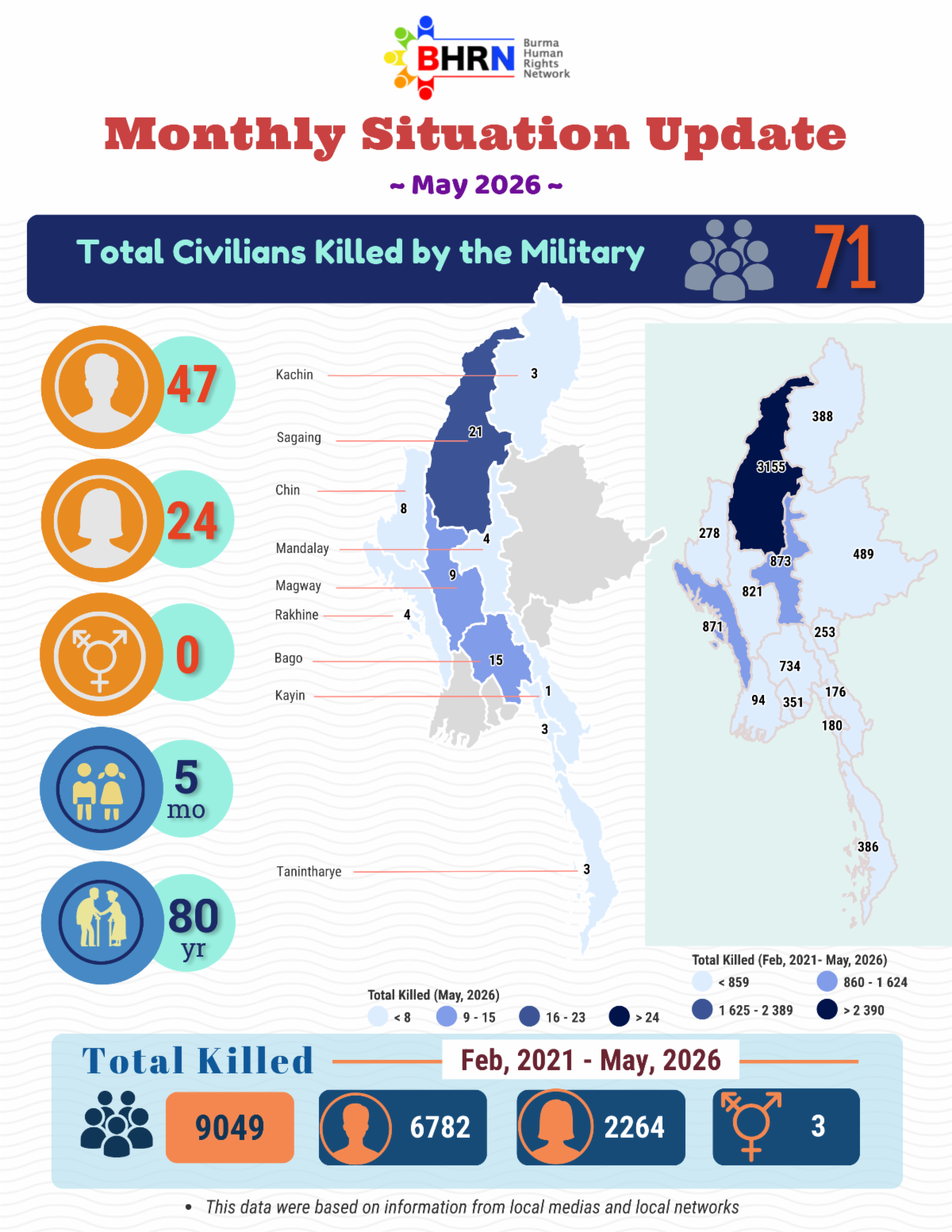
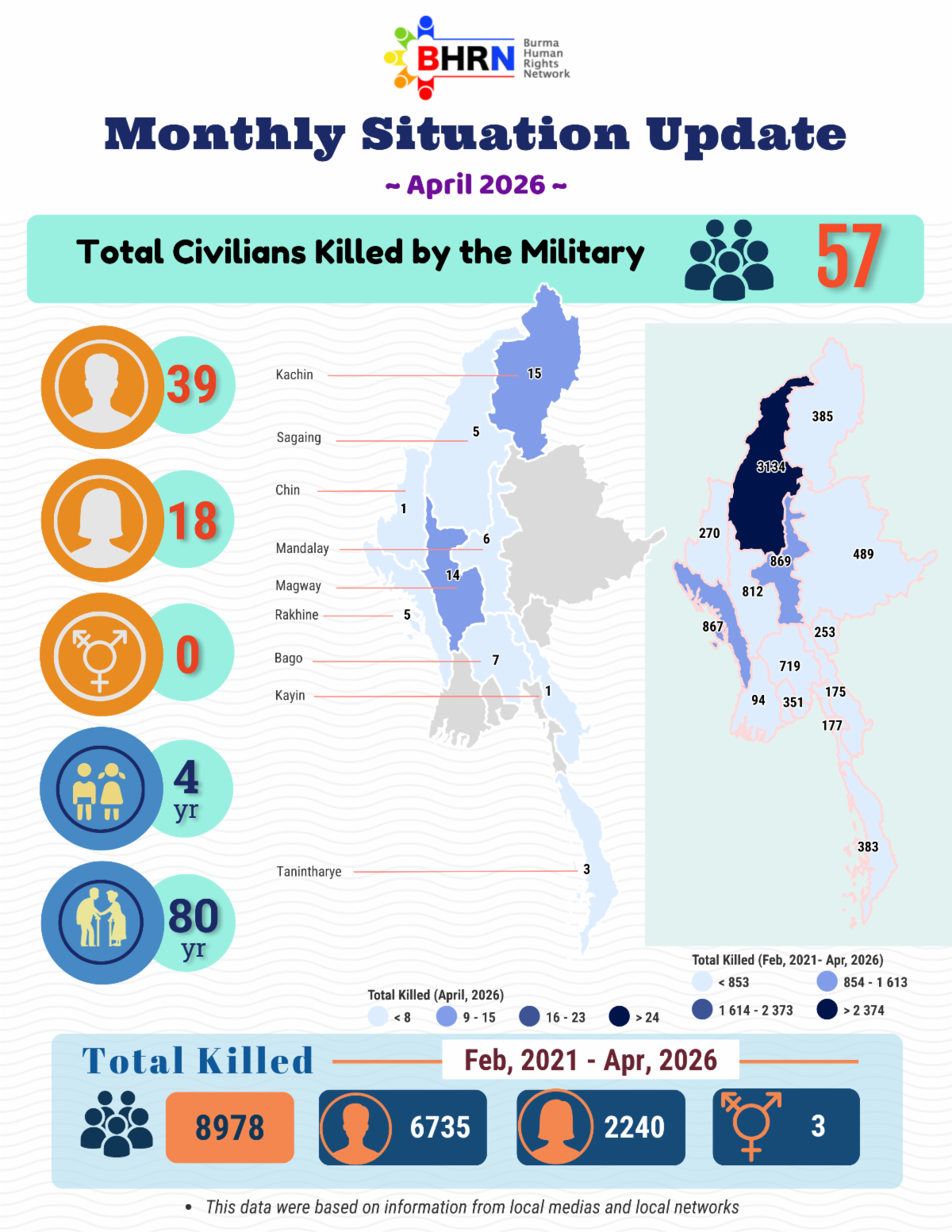
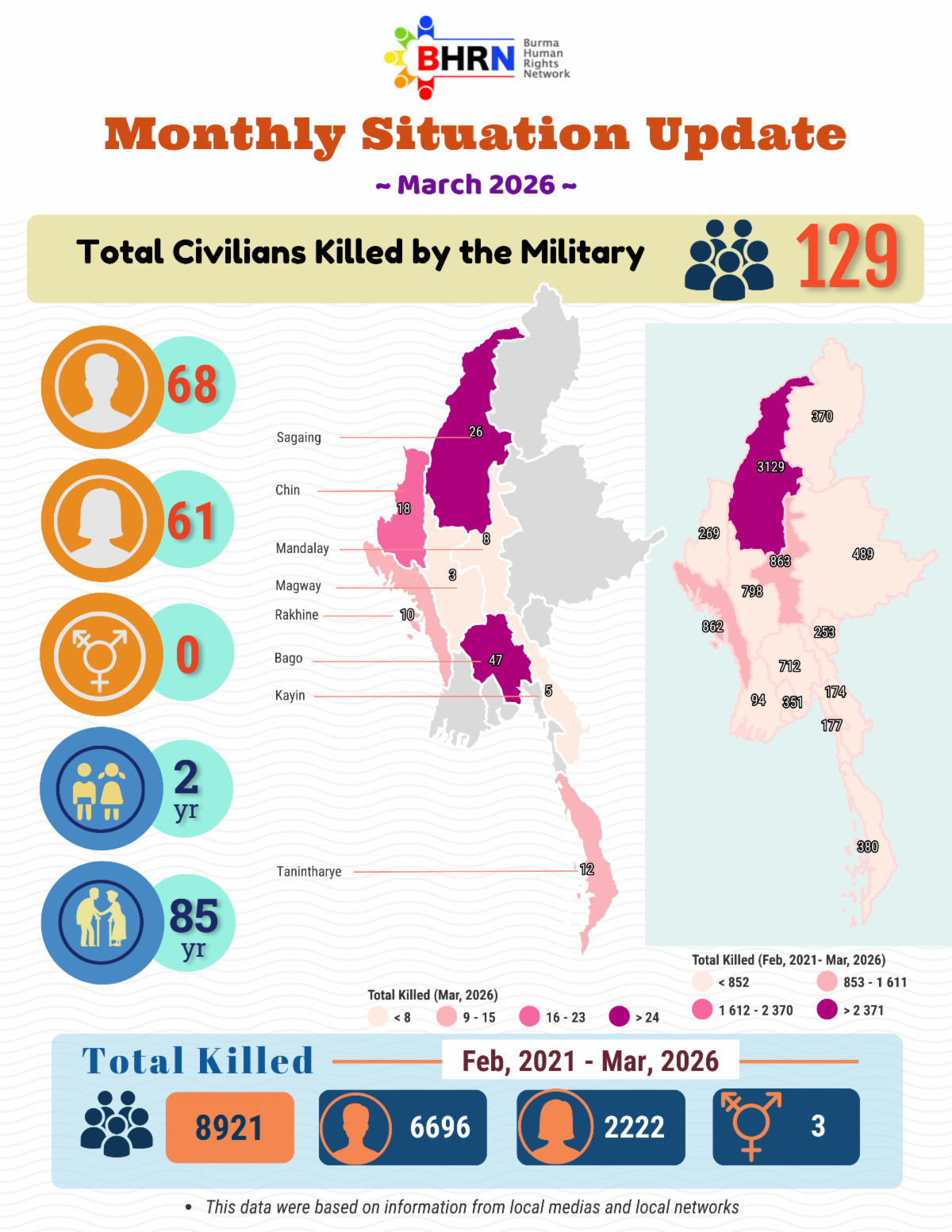
1Info-graphs of BHRN’s Report
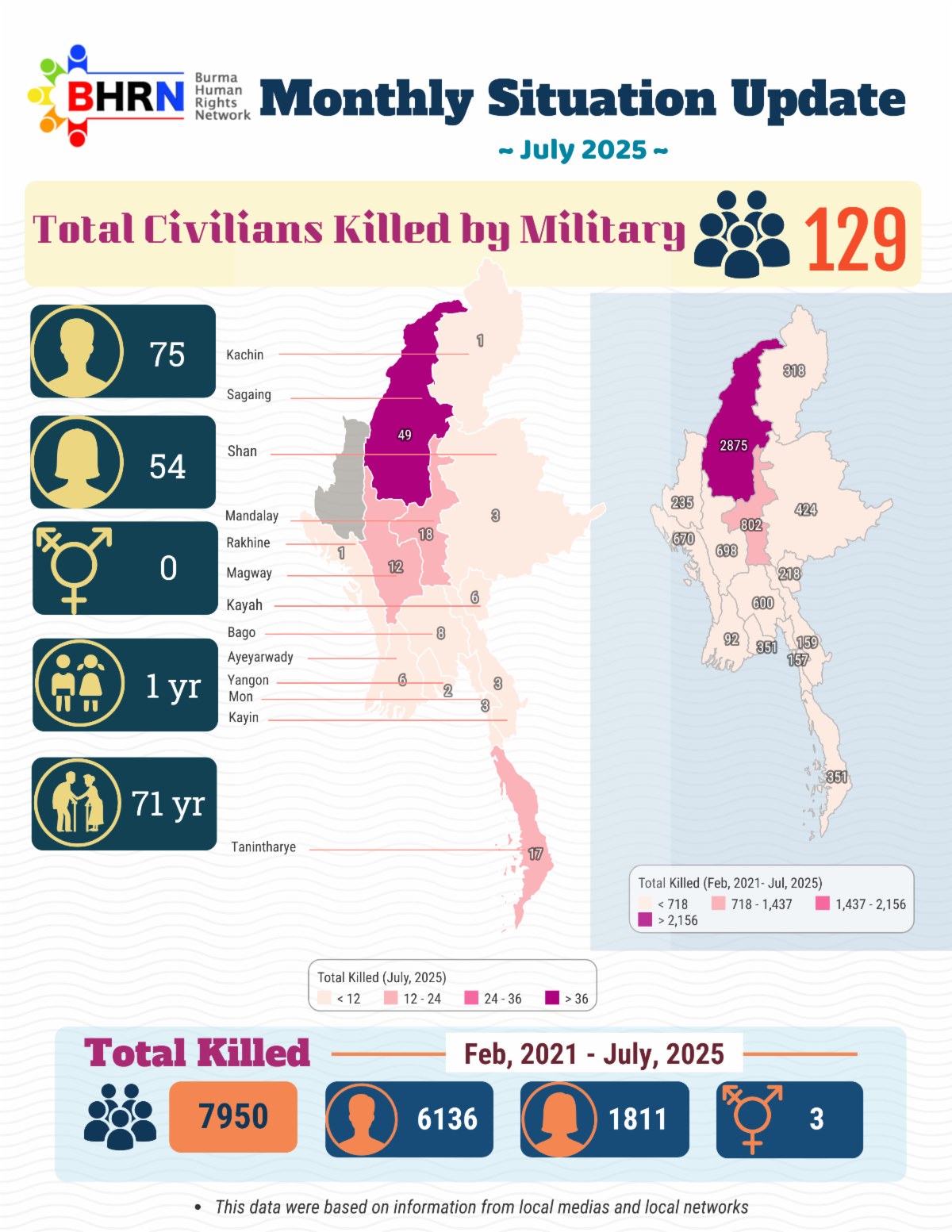
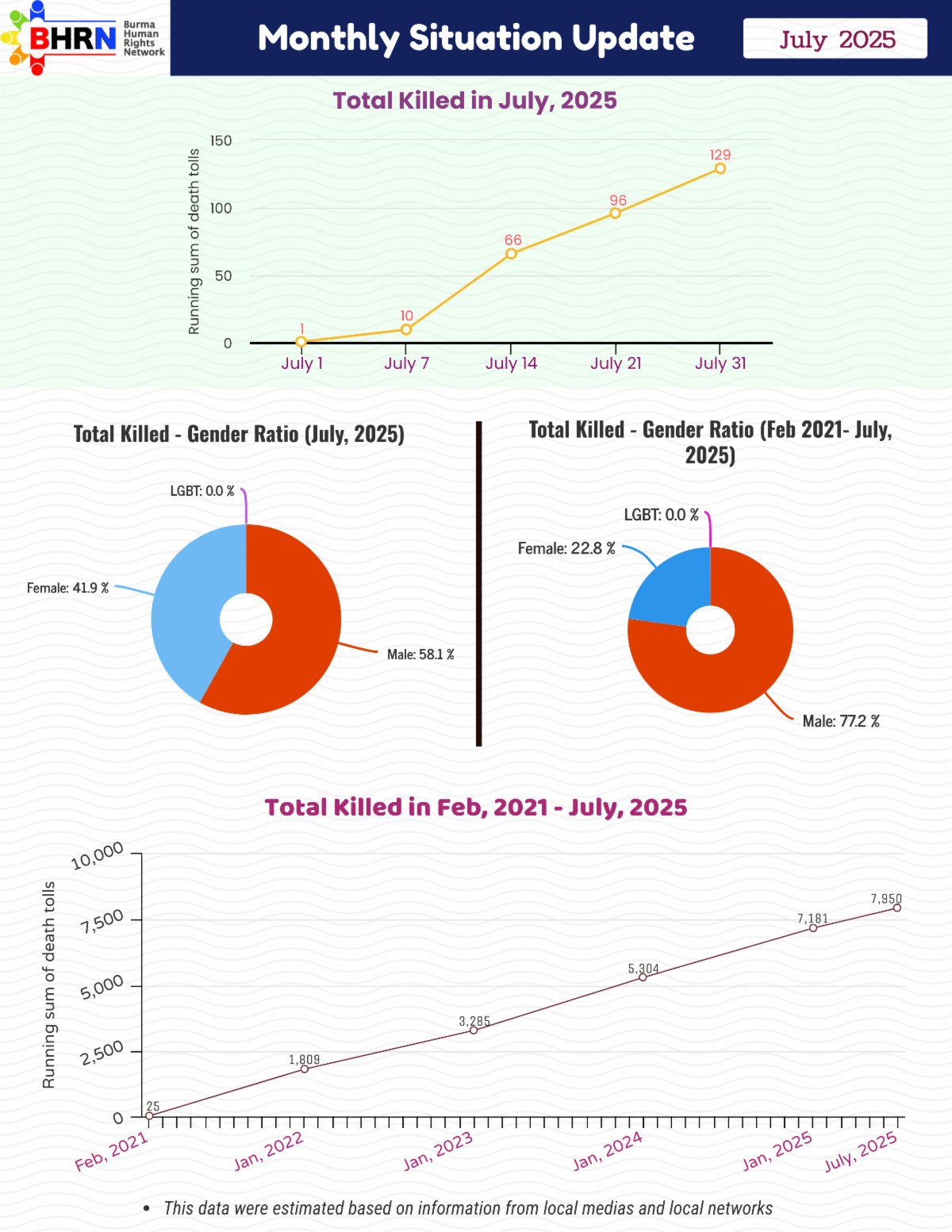
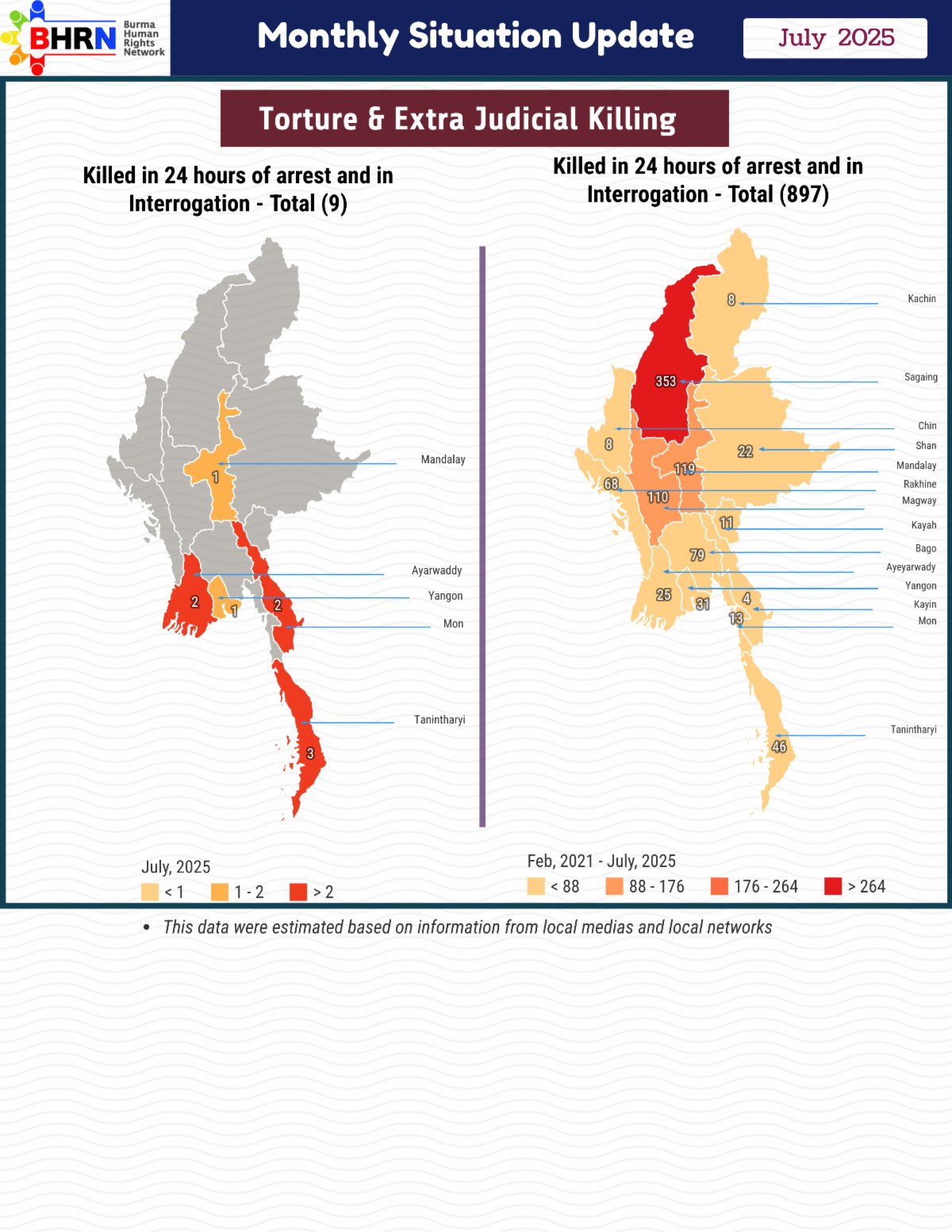

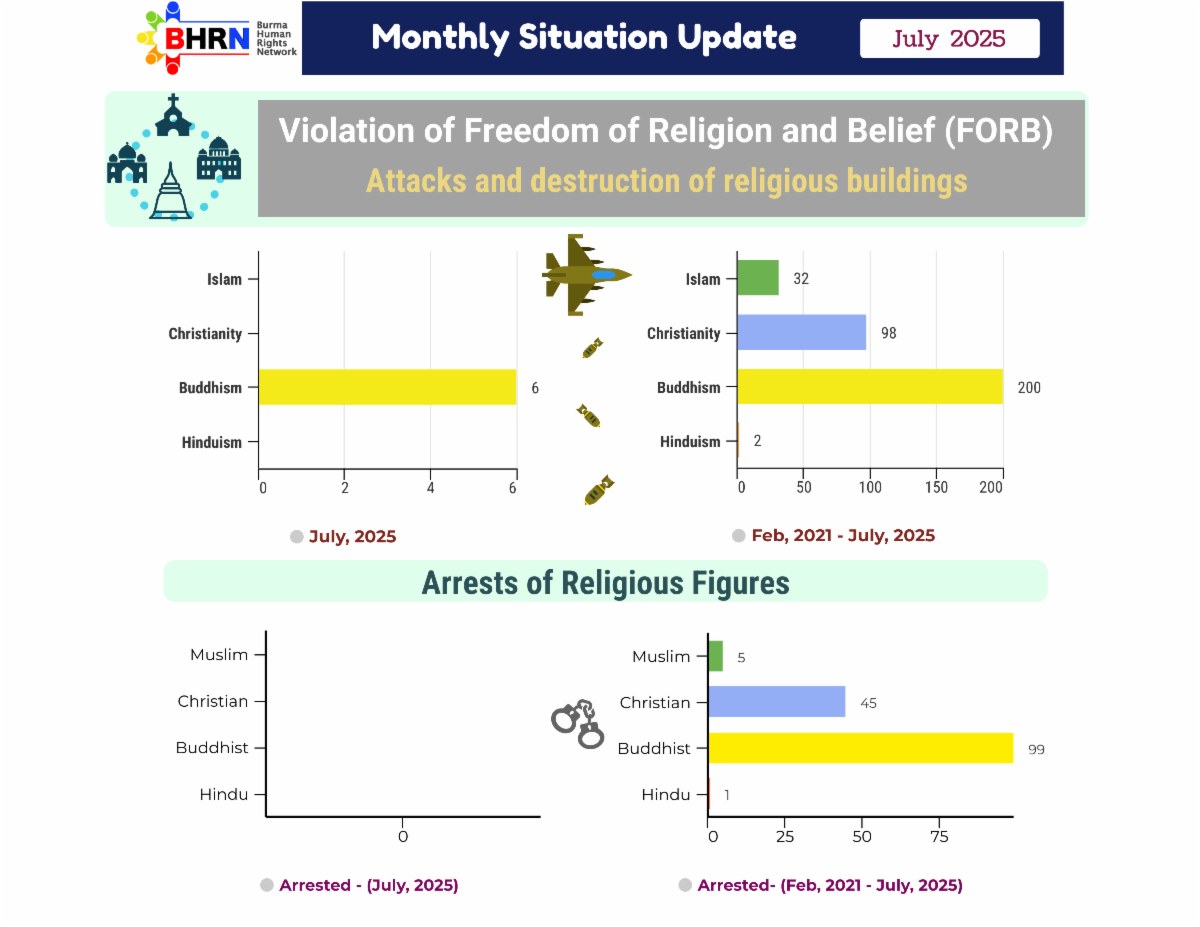
Tap any image to see it full size.
2News Summary and Analysis
This Month in Myanmar – July 2025
In July 2025, Myanmar’s military junta escalated repression through new laws aimed at silencing dissent and tightening control over civic space. The Cybersecurity Law, now in force, grants the authorities broad powers to monitor, censor, and criminalize online activity, including extraterritorially. The newly enacted election “protection” law imposes severe criminal penalties, including the death penalty, for criticism or peaceful opposition to the junta’s planned elections, further undermining political rights and press freedom.
Serious violations of international human rights and humanitarian law continued across multiple regions, including deliberate attacks on civilians, religious and educational sites, and health facilities, as well as arbitrary detention, torture, and forced labor. In northern Rakhine State, new investigations by Human Rights Watch and Fortify Rights document grave abuses by the Arakan Army (AA) against Rohingya civilians, including killings, beheadings, torture, forced recruitment of children, and severe restrictions on movement and livelihoods. These abuses, combined with the junta’s blockade on aid, have driven the largest movement of Rohingya to Bangladesh since 2017.
The humanitarian situation in Bangladesh’s refugee camps is deteriorating sharply. More than 150,000 new arrivals over the past 18 months are straining already limited resources, with the UN Refugee Agency warning of imminent cuts to health and food assistance unless the current 65 percent funding gap is urgently closed.
Regionally, protection for displaced Myanmar nationals is eroding. India has intensified unlawful expulsions of Rohingya refugees in violation of non-refoulement obligations, Thailand’s allowance of the termination of food and medical assistance for over 100,000 Myanmar refugees in its border camps underscores enduring policy deficiencies in addressing long‑term displacement.
International action remained mixed. In the United States, congressional committees advanced legislation 9 (H.R.4140, H.R.3190, and (H.R.4423) to sanction key junta revenue sources, expand accountability measures, and support atrocity-crime investigations. A federal court also struck down restrictions that had blocked advocates from sharing evidence with the International Criminal Court in Myanmar-related cases. At the same time, the U.S. Treasury lifted sanctions on several known junta enablers without clear justification, weakening existing accountability efforts. Meanwhile, Chinese state-owned enterprises continued providing the junta with technical support and materials for weapons production, underscoring the persistence of foreign assistance that enables ongoing violations.
These developments reflect a deepening human rights and humanitarian crisis, driven by repression, impunity, and shrinking protection space. Without coordinated pressure on all perpetrators, sustained humanitarian support, and strengthened accountability mechanisms, violations will continue, and prospects for justice and safe return for affected communities will recede further.
2.1Political, Legal, and International Developments Affecting Myanmar
Junta’s Cybersecurity Law Comes into Effect, Expanding Digital Repression
On 30 July 2025, the junta’s Cybersecurity Law No. 1/2025 came fully into force, imposing a sweeping regulatory regime over domestic and international digital platforms and cybersecurity service providers operating in Myanmar. The law applies extraterritorially, enabling enforcement against Myanmar nationals abroad, and grants the military broad powers to regulate, license, and penalise online activity. Under its provisions, any organisation providing cybersecurity services or operating a digital platform with over 100,000 users must obtain a government license valid for three to ten years. Virtual private network (VPN) services require prior government approval, with non-compliance punishable by up to six months in prison and heavy fines. The law also criminalises “unsolicited communications,” “cyber misuse,” and “online theft,” with vague definitions that allow arbitrary enforcement.
The measure dramatically expands the junta’s capacity for surveillance, censorship, and control over online spaces. It will compel companies to cooperate with the junta’s demands for user data, creating severe risks for journalists, activists, human rights defenders, and ordinary users who rely on digital tools for secure communication. By targeting VPNs, the junta aims to sever one of the last remaining avenues for bypassing censorship and protecting privacy. The law also grants the authorities de facto control over the terms of operation for any major digital platform, positioning the military to weaponise licensing as leverage over foreign and domestic companies.
Why it matters
The Cybersecurity Law institutionalises digital authoritarianism in Myanmar, giving the junta legal cover to surveil, censor, and prosecute dissenters at home and abroad. This move will further close civic space, weaken independent journalism, and heighten risks for those documenting human rights violations. The extraterritorial reach poses challenges for foreign governments and companies, which must decide whether to comply with or resist repressive demands. For the human rights community, the law underscores the urgency of supporting secure, decentralised communication tools and strengthening digital protection measures for at-risk actors inside and outside Myanmar.
Junta Enacts Harsh Election “Protection” Law to Silence Critics and Journalists
In late July 2025, the junta enacted new amendments to its election laws under the guise of “protecting” the integrity of upcoming polls, which it plans to hold despite ongoing armed conflict and widespread repression. The amendments criminalise speech deemed to “distort” or “misrepresent” the electoral process, ban reporting that “discredits” the election commission, and introduce severe penalties for journalists, civil society actors, and political figures accused of “interfering” in election administration. These provisions are deliberately broad, allowing the junta to target virtually any critical commentary on its pseudo ‘electoral process’.
The changes come in the context of the State Administration Council’s efforts to engineer a vote that entrenches military dominance while projecting a façade of legitimacy to domestic and international audiences. The amended laws strip away the minimal space that remained for independent monitoring or media scrutiny, making it impossible for journalists or election observers to report freely. Combined with ongoing arrests of opposition leaders, restrictions on political organising, and the criminalisation of online dissent, the amendments cement an environment in which any form of electoral competition or transparency is functionally impossible.
Why it matters
The so-called election protection amendments expose the junta’s strategy to weaponise legal frameworks to eliminate criticism and control narratives ahead of a sham electoral exercise. By silencing journalists, civil society, and opposition voices, the junta is attempting to pre-emptively legitimise results that will not reflect the will of the people. For policymakers, recognising and rejecting the façade of legitimacy created by such legal manipulations is essential to ensuring that international engagement does not inadvertently endorse or normalise military rule.
Myanmar at the Human Rights Council
In July, the UN Human Rights Council adopted without a vote its latest resolution on the situation of human rights of Rohingya Muslims and other minorities in Myanmar, following an initiative by the Organisation of Islamic Cooperation. The resolution maintains pressure on the junta and calls for enhanced accountability and humanitarian action. SAC-M and other advocacy groups have urged the UN General Assembly to build on this momentum by adopting a plenary resolution on the Myanmar crisis and strengthening its annual resolution on the Rohingya.
During the session, the UN High Commissioner for Human Rights Volker Türk presented a forward-looking report shaped by nationwide consultations, in which communities expressed a unified demand for the military’s exclusion from public life and the creation of a peaceful, inclusive, democratic society grounded in accountability. UN Special Rapporteur on Myanmar Tom Andrews condemned the junta’s exploitation of the March earthquake, its intensification of aerial attacks despite a declared ceasefire, and its plans for sham elections in the current climate of repression. He also warned of the dangerous underfunding of the Rohingya humanitarian response.
Why it matters
The Council’s resolution reinforces international consensus on the illegitimacy of the junta and the urgency of addressing crimes against the Rohingya and other minorities. The inclusion of community visions in the High Commissioner’s report provides a roadmap for a post-junta Burma shaped by the voices of those most affected by the crisis. Diplomats and policymakers should view this resolution as both a political signal and a call to mobilize resources, increase accountability measures, and ensure that any future political settlement aligns with the demands of Burma’s diverse communities.
U.S. Congressional Momentum on Burma Faces Crucial Next Steps
On 22 July, the United States House Foreign Affairs Committee passed the Burma Genocide, Accountability, and Protection Act (H.R.4140s) with strong bipartisan support, alongside unanimous passage of the BRAVE Burma Act (H.R.3190) and the No Funds for Burma Act (H.R.4423) by the House Financial Services Committee. Together, these bills seek to strengthen sanctions on the junta and its enablers, increase U.S. engagement on atrocity prevention, and support transitional justice mechanisms for Rohingya and other ethnic minorities in Burma.
The BRAVE Burma Act would compel the U.S. Administration to sanction state-owned enterprises such as Myanma Oil and Gas Enterprise, Myanma Economic Bank, and foreign actors involved in the junta’s jet fuel supply chain. The Burma GAP Act would formally reject recognition of the junta and authorize USD 9 million annually for five years to fund atrocity crimes investigations, witness protection, and transitional justice initiatives. While these bills represent a rare and united show of congressional support for the Burmese people, they face two significant limitations: they have yet to be introduced in the Senate, and authorizations for funding do not guarantee appropriations. Furthermore, the Administration has previously declined to spend congressionally approved funds for Burma-related programs.
Why it matters
This legislative package is the most comprehensive effort by the U.S. Congress since the 2021 coup attempt to address ongoing atrocities in Burma, including genocide against the Rohingya. The bills, if enacted and fully implemented, could expand the scope of sanctions, disrupt the junta’s revenue streams, and support evidence collection for future prosecutions. However, the delayed legislative process, absence of Senate action, and uncertainties around funding and political will risk diluting their impact. The coming months will be critical in determining whether this momentum translates into concrete measures that can meaningfully constrain the junta’s capacity to commit mass atrocities.
US Lifting Sanctions, Dismissing Accountability
On 24 July 2025, the United States Treasury’s Office of Foreign Assets Control removed multiple Myanmar junta-linked individuals and companies from its sanctions list, reversing years of targeted measures aimed at constraining the military’s access to revenue and weapons. Delisted actors include major arms suppliers, such as Aung Hlaing Oo of Myanmar Chemical and Machinery Group, Sit Taing Aung of Suntac Technologies, and business magnate Jonathan Myo Kyaw Thaung, whose KT Group historically financed military operations during the Rohingya genocide. Several delisted figures remain sanctioned by Canada, the European Union, or the United Kingdom. The U.S. government has provided no transparent justification for these removals, despite evidence that sanctions have reduced the junta’s military imports by over 30 percent from 2023 to 2024.
The decision undermines both the moral and strategic foundations of U.S. policy on Myanmar. It removes constraints on key suppliers of aviation fuel, arms, and financial resources - assets directly linked to the junta’s commission of war crimes, crimes against humanity, and genocide. By weakening economic pressure at a time when the junta faces mounting battlefield losses, Washington risks signalling to both the military and its enablers that accountability is negotiable.
Why it matters
Rolling back sanctions without credible political or legal justification erodes international leverage, emboldens perpetrators, and betrays the demands of Myanmar’s people for sustained pressure on the junta. It also sends an alarming message to other rights-violating regimes that economic penalties can be undone without meaningful behavioural change. For U.S. policymakers, this reversal represents a missed opportunity to strengthen sanctions enforcement. For the international community, it underscores the importance of coordinated, principled sanctions policies that remain tied to measurable human rights and accountability benchmarks.
U.S. Court Agrees Trump Administration’s ICC Sanctions Likely Violate First Amendment Rights of Fortify Rights CEO
On 17 July 2025, a U.S. federal court issued a preliminary injunction in Smith v. Trump, finding that sanctions imposed by the Trump administration on individuals engaging with the International Criminal Court (ICC) likely violate the First Amendment’s protection of free speech. The case, brought by Fortify Rights CEO Matthew Smith and human rights lawyer Akila Radhakrishnan, challenges the executive order that criminalised providing information, legal advice, or evidence to ICC prosecutors. While the U.S. is not a party to the Rome Statute, the order’s reach threatened to obstruct accountability for crimes such as genocide against the Rohingya by preventing American advocates from assisting in ICC investigations.
The injunction temporarily halts enforcement of these restrictions while litigation proceeds, allowing human rights advocates to resume engagement with the ICC without fear of prosecution. The decision affirms that political disagreements with an international tribunal do not override constitutional rights and that advocacy for atrocity victims falls squarely within protected speech.
Why it matters
This ruling safeguards the ability of U.S.-based human rights defenders to participate in global justice processes, setting a precedent against politically motivated restrictions on engagement with international courts. For Myanmar-related accountability, it ensures that U.S. advocates can continue to supply evidence, analysis, and legal expertise to the ICC’s investigation into crimes committed against the Rohingya and other communities. Weakening such engagement would benefit perpetrators by isolating international investigators from credible, on-the-ground information. The case underscores that defending free speech rights domestically can have a direct and tangible impact on the pursuit of justice abroad.
Rohingya Elections in Bangladesh
In mid-July, credible reports indicated that Bangladeshi authorities, including the Directorate General of Forces Intelligence, are overseeing preparations for the formation of a Rohingya leadership body, tentatively referred to as the Arakan Rohingya Unity Government (ARUG). This proposed body, comprising between 150 and 200 individuals, is expected to be presented as the primary representative of Rohingya refugees in Cox’s Bazar in engagements with international actors and Myanmar stakeholders, including the United League of Arakan/Arakan Army (ULA/AA), on repatriation issues. However, multiple sources from within the camps have reported to BHRN that the process is neither transparent nor genuinely community-led. The design, candidate selection, and proposed constitution appear to be directed by Bangladeshi authorities, and several likely candidates reportedly have close links to the State Administration Council, Bangladesh’s security forces, or Rohingya armed actors.
Selecting leaders under such conditions risks sidelining independent and trusted Rohingya voices. If individuals aligned with political or armed interests, particularly those advocating for rapid repatriation without necessary guarantees of safety and dignity, are elevated to leadership positions, it could deepen divisions within the Rohingya community, strengthen perceptions that armed confrontation is an acceptable strategy for engagement with the ULA/AA, and increase the risk of further militarisation in the camps. Such developments could escalate tensions in Rakhine State, place Rohingya civilians there at greater risk of reprisals, and undermine the possibility of meaningful dialogue with the ULA/AA, who now control most of Rakhine State.
The underlying challenge is the long-standing absence of a representative, widely respected, and accountable mechanism for Rohingya communities both in Bangladesh and Myanmar. In the camps, years of armed actor influence, state interference, and severe restrictions on civic space have eroded civil society and left little opportunity for democratic participation. In Rakhine State, fear of retaliation from both the ULA/AA and the SAC stifles open political engagement. In such a constrained environment, attempts by external actors to impose leadership structures risk further entrenching these dynamics, leaving genuine grassroots Rohingya leaders marginalised and weakening the community’s ability to speak with an independent voice.
Why it matters
Leadership that is imposed rather than chosen by the Rohingya community risks reinforcing internal divisions, eroding trust with key stakeholders in Myanmar, and endangering the safety of Rohingya civilians in both Bangladesh and Rakhine State. It risks misrepresenting the community’s needs and aspirations to international policymakers, potentially resulting in policies and decisions that fail to uphold Rohingya rights. For diplomats, humanitarian actors, and human rights advocates, engaging with unrepresentative bodies could inadvertently legitimise militarisation, exacerbate tensions, and jeopardise any future repatriation process that should be voluntary, safe, dignified, and sustainable. Ensuring that Rohingya voices that are free from coercion or manipulation are central to any representative process is critical to protecting the rights and future of the community.
India: End Unlawful Expulsion of Indian Muslim Citizens and Rohingya Refugees
In recent months, Indian authorities have intensified a nationwide campaign of mass verification, arbitrary detention, and forcible expulsion of Rohingya refugees (and Indian Muslim citizens), in violation of India’s international human rights obligations. Following a May 2025 directive from the Ministry of Home Affairs mandating the verification of “illegal immigrants” within 30 days, security forces have carried out mass raids, with thousands expelled to Bangladesh and Myanmar. Official statements have linked this crackdown to retaliatory measures following militant attacks in Jammu and Kashmir, framing it as a national security imperative.
Fortify Rights and other observers have documented a pattern of abuses, including the targeting of individuals with valid citizenship or refugee documentation, use of torture and coercion, and lack of due process in expulsions. Rohingya refugees, already stateless and vulnerable, face heightened risks of refoulement to Myanmar, where they are subject to persecution, and to Bangladesh, where overcrowded refugee camps offer limited protection. Indian Muslim citizens, too, are being stripped of their rights through arbitrary administrative measures that bypass constitutional safeguards.
Why it matters
This campaign represents a dangerous fusion of religious discrimination, anti-refugee sentiment, and securitised migration policy. For the Rohingya, expulsions into hostile or unsafe environments contravene the principle of non-refoulement and compound their displacement crisis. The broader regional risk is the normalisation of mass expulsions, which could embolden other states to adopt similar practices. For the international community, failure to challenge these actions risks legitimising the collective punishment of minority groups and weakening the global refugee protection regime.
Myanmar Refugees in Thailand
Myanmar refugees living in the nine camps along the Thailand–Myanmar border, numbering approximately 100,000 are facing a deepening humanitarian emergency. Years of displacement, coupled with restricted rights to work and move freely, have left residents entirely dependent on humanitarian aid. This dependency is now being weaponised by aid cuts: in July 2025, the Border Consortium, the main humanitarian provider in the camps, ceased food assistance entirely on 31 July, following substantial U.S. funding reductions earlier in the year. Health services provided by the International Rescue Committee in seven camps ended abruptly in January, and educational opportunities have been further constrained.
The Thai government has long described its camp management as “temporary shelter” and has maintained prohibitions on refugees working legally. Yet this restrictive policy, suitable only for short-term displacement, has become untenable after decades of exile. Civil society groups have underscored that refugees possess skills and experience that could contribute to local economies if granted legal permission to work. Instead, current policy entrenches dependency, increases vulnerability to exploitation, and limits the resilience of both refugees and host communities. Without urgent donor engagement to fill the funding gap and Thai policy reform to allow self-reliance, camp residents will face rising malnutrition, deteriorating health, and loss of dignity.
Why it matters
The convergence of aid cuts and restrictive Thai policies risks triggering a protection crisis that could erode decades of refugee support infrastructure along the border. For Myanmar refugees, denial of the right to work and reduced humanitarian assistance means deeper poverty, reduced access to healthcare and education, and increased exposure to trafficking and exploitation. For Thailand, lifting work restrictions could ease the aid burden, generate economic benefits, and foster social cohesion. For the international community, sustained funding is a test of its commitment to protecting displaced populations from protracted crises and preventing conditions that could push refugees into unsafe returns to conflict zones.
SAC-M Investigation on China Enabling Myanmar Military Aerial Bomb Production
On 16 July 2025, the Special Advisory Council for Myanmar (SAC-M) released a detailed investigation exposing how China South Industries Group Corporation, a Chinese state-owned conglomerate, and its subsidiary Hunan Vanguard have been instrumental in enabling the junta’s production of aerial bombs at Defence Industry 21 (DI 21) in Magway Region. According to SAC-M, Hunan Vanguard technicians provided on-site technical assistance between 2014 and 2019, trained junta engineers at facilities in China, and have continued to offer remote production support since 2019. The bombs produced at DI 21, including fuel-air explosives and domestically designed cluster munitions, are deployed by the Myanmar Air Force in strikes on markets, schools, places of worship, displacement camps, and other civilian areas, often constituting war crimes or crimes against humanity.
The report situates this cooperation in a broader pattern of China’s strategic engagement with the junta, highlighting that China South is wholly owned by the State Council of China, meaning such transfers occur with the approval of Beijing. This support has allowed the junta to maintain a high tempo of aerial assaults despite battlefield losses, ensuring that its capacity to target civilians remains intact. SAC-M calls for China to immediately halt all arms transfers and for other states to prosecute companies complicit in sustaining the junta’s weapons production networks.
Why it matters
China’s role in sustaining Myanmar’s aerial warfare capability has profound implications for civilian protection, regional stability, and global accountability norms. By enabling the junta to manufacture the majority of its aerial bombs domestically, Beijing shields it from some of the effects of international arms embargoes and undermines coordinated sanctions regimes. Disrupting this supply chain, particularly by targeting foreign technical support and micro-electronic imports, would directly weaken the junta’s capacity to commit mass atrocities. For policymakers, the SAC-M investigation provides actionable intelligence to justify sanctions, prosecutions, and export controls, and it challenges Beijing to choose between continuing its complicity or aligning with global civilian protection standards.
2.2Resistance Gains
Central Myanmar Ambushes and Base Seizures
PDF units continued to target SAC troop movements and fortified positions across the central Sagaing–Magway–Mandalay corridor:
Myingyan Township, Sagaing Region
PDFs ambushed an SAC convoy, reportedly killing 30 soldiers and capturing four others.
near Salin Town, Magway Region
PDFs attacked an SAC outpost, killing six soldiers.
Shwebo Township, Sagaing Region
PDFs seized three SAC outposts in and near Hin Thar Gyi village.
Myingyan–Nabu Aing Road, Mandalay Region
PDFs attacked an SAC outpost, killing three soldiers.
Chauk Township, Magway Region
PDFs ambushed SAC forces, killing six soldiers.
Singu and Thabeikkyin Townships, Mandalay Region
Mandalay PDF forces attacked an SAC flotilla on the Irrawaddy River, destroying three vessels.
Mandalay Region
Mandalay PDF seized three bases in Htan Pin Kone, Mya Kan Thar, and Thayet Kai villages along the Madaya–Patheingyi border.
Karen National Liberation Army (KNLA) and Allied Gains
In southeastern and eastern Myanmar, the KNLA and allied PDFs expanded their operational reach, seizing long-held SAC positions and advancing in strategic areas:
Hpasawng Township, Kayah State
A Myanmar Air Force FTC-2000 fighter jet disappeared on 1 July; the Karenni Nationalities Defence Force (KNDF) claimed to have shot it down the next day.
Myawaddy Township, Karen State
KNLA Brigade 6 captured the Ou Krita base after 35 years of SAC control, forcing around 100 SAC soldiers into Thailand.
East Bago Region
KNLA troops seized SAC bases in Yin Tike Gone and Lay Bat villages.
Kyaukkyi Township, Bago Region
Resistance forces seized two junta bases in Lapat and Yin Taik Kone, as well as two additional strategic villages, consolidating control in a contested area along the Bago–Karen front.
3On the Ground: Escalating Violence and Human Rights Violations
ITargeted Attacks on Civilians
Under Article 8(2)(e)(i) of the Rome Statute, intentionally directing attacks against civilians in non-international armed conflict is prohibited. Where attacks also involve destruction of civilian property, Article 8(2)(e)(xii) applies. When part of a widespread or systematic campaign, such attacks may also constitute crimes against humanity under Article 7(1)(a), (d), (h), and (k).
Sagaing Region
Khin U Township, Sagaing Region
Beheading of a 27-year-old civilian by SAC troops after capture.
Khunhla Township
SAC airstrikes on Thiri Mon village killed at least two civilians and injured 11 others.
Sagaing Township
SAC airstrikes on Lin Ta Lu monastery sheltering IDPs killed around 30 civilians and injured 50 others.
Wetlet Township
SAC airstrikes killed 21 civilians and injured over 50 others.
Kanbalu Township
SAC and Pyu Saw Htee forces raided Min Ywa Taw and Sin Nin villages, looted food and valuables, burned at least 75 houses, and detained around 100 residents.
Kanbalu Township
SAC airstrikes on a NUG-run hospital killed 15 civilians.
Magway Region
Pauk Township: SAC bombings along the Kamma–Yaepyar road displaced 3,000 civilians.
Pakokku Township
SAC troops raided Nan Gat village and burned 30 houses.
Rakhine State
Myebon Township
SAC bombings killed two civilians.
Ann Township
SAC bombing destroyed a school and damaged homes.
Kyaukphyu Township
SAC airstrikes injured two civilians.
Bago Region (Eastern)
Kyaukkyi Township
SAC drones bombed a school, killing six IDPs.
Karenni State
Hpasawng Township: SAC bombings in Maw Chee village tract killed 11 civilians and injured at least 16 others.
Mandalay Region
Nyaung-U Township
SAC troops burned 100 houses in a village raid.
- 14 July
Thabeikkyin Township
SAC airstrikes killed 6 civilians (5 of them children), injured 2; destroyed 5 homes and 2 cars. (BHRN Interview 08_Thabeikkyin/16July25)
- 15 July
Moegoak Township
Series of airstrikes by SAC killed at least 8 civilians, including a child. (BHRN Interview 06_Moegok/15July25)
Kachin State
Mohnyin Township
Shanni Nationalities Army forces threatened to detain and kill ethnic Kachin villagers along the Indawgyi–Hpakant road, causing over 2,000 to flee.
Northern Shan State
- 9 July
Phekhon Township, Shan State
SAC airstrike on IDP camp killed 3 civilians from one family, injured several others including children and pregnant woman. (BHRN Interview 05_Phekhong/08July25)
Kyaukme Township
SAC artillery fired from Nawnghkio Township killed one woman and destroyed houses.
Mon State
Kyaikto Township
SAC shelling killed a 15-year-old girl and destroyed three houses.
Tanintharyi Region
- July (ongoing)
West Mawtone village, Tanintharyi Region
SAC has imposed a severe blockade on West Mawtone, a Pashu Muslim village of approximately 1,500 residents, since February 2025. The blockade prevents access to food and livelihoods, with even small vendors barred from entering, in violation of Article 8(2)(b)(xxv). In parallel, artillery unit 306 has intermittently shelled the village and conducted drone strikes, placing the 90 percent Pashu Muslim minority population under continuous threat in violation of Articles 8(2)(e)(i) and 8(2)(e)(xii).
IIAttacks on Civilian Objects and Obstruction of Religious and Cultural Rights/Humanitarian Access
Under Article 8(2)(e)(iv) of the Rome Statute, intentionally directing attacks against buildings dedicated to religion, education, health, or humanitarian assistance constitutes a war crime unless the structures are being used for military purposes. When such attacks also kill civilians, they also fall under Article 8(2)(e)(i), and if part of a wider pattern, Articles 7(1)(a), (h), and (k) may apply.
- 11 July
Sagaing Township, Sagaing Region
SAC airstrike on Lin Talu monastery sheltering IDPs killed 22 civilians (7 men, 15 women including 3 children), injured at least 50. (BHRN Interview 04_Sagaing/11July25)
- 14 July
Thabeikkyin Township, Mandalay Region
SAC airstrike on Poe Zar village church killed 6 civilians (5 of them children). (BHRN Interview 08_Thabeikkyin/16July25)
Natmauk Township, Magwe Region
SAC airstrike on Kan Thar Yar village targeted a school and pagoda.
Sahpe Village Clinic, Pauk Township
SAC airstrikes destroyed a clinic, killing two civilians and injuring seven.
Myatshu Monastery, Natogyi Township
SAC drone strikes destroyed a monastery sheltering IDPs, killing at least seven, including four children, and displacing thousands.
Ann Township
SAC bombing destroyed a school.
Between 4–14 July 2025, SAC carried out sustained aerial bombardments in Hsipaw, Mogok, Kyaukme, and Nawnghkio townships, TNLA-controlled since 2024, killing 13 civilians, injuring 31, and damaging over 60 civilian structures, including a hospital, two schools, shops, a hotel, and homes.
IIIArbitrary Arrests, Torture, and Forced Labor
Under Articles 7(1)(e) and 8(2)(a)(vi) of the Rome Statute, arbitrary detention and forced labor may constitute crimes against humanity or war crimes. Torture is prohibited under Articles 7(1)(f) and 8(2)(c)(i).
Thayat Prison, Magwe Region
SAC rearrested 2 political prisoners immediately after release, charged under Counter Terrorism Law 52A.
Yangon Region
SAC arrested 80 civilians, allegedly for conscription; 12 were later released, 13 sent to military training.
Pathein Prison, Ayeyarwady Region
SAC rearrested 20 political prisoners from Rakhine State at prison gates, charged under the Counter Terrorism Law.
Ayeyarwady Region
SAC arrested 109 displaced civilians (including 21 women) on suspicion of PDF links.
Kanbalu Township, Sagaing Region
SAC and Pyu Saw Htee forces detained around 100 villagers during raids in Min Ywa Taw and Sin Nin villages, after looting rice and valuables and burning homes.
Mohnyin Township, Kachin State
Shanni Nationalities Army (SNA) members threatened to detain and kill ethnic Kachin villagers along the Indawgyi–Hpakant road, prompting over 2,000 civilians to flee.
These incidents reflect the systematic use of arrest, intimidation, and forced displacement by state and allied armed actors to exert control over civilian populations.
IVArakan Army Abuses Against Rohingya in Rakhine State
Recent investigations by Human Rights Watch and Fortify Rights detail a pattern of grave abuses committed by the Arakan Army (AA) against Rohingya civilians in northern Rakhine State, in violation of international humanitarian and human rights law. Since regaining significant territory from the Myanmar military in late 2023, the AA has imposed severe movement restrictions, confiscated property, blocked livelihoods, and committed widespread acts of violence against Rohingya communities.
HRW found that the AA’s policies mirror the discriminatory and abusive measures historically imposed by the Myanmar military, including a curfew, permit requirements for inter-village travel, arbitrary detention, forced labor, and extortion. These restrictions, compounded by the junta’s blockade on humanitarian aid, have driven severe food shortages, forcing many to survive through begging or unpaid labor for the AA. Reports also document confiscation of farmland, cattle, and even cemeteries, with orders to use paddy fields for burials.
Fortify Rights documented war crimes, including multiple killings, torture, beheadings, and forced recruitment of Rohingya civilians. Survivors described being abducted and beaten in ad-hoc detention facilities, shackled for months, and denied access to family or religious burial rights for the deceased. In one case, AA forces abducted five Rohingya men in April 2024 from Tha Yet Oak village tract; four were later found beheaded, all showing signs of torture. Other testimonies described detainees being used as human shields on the front lines.
The AA has particularly targeted Rohingya suspected of affiliation with the Arakan Rohingya Salvation Army (ARSA) or the Myanmar military, often on unsubstantiated grounds. Families reported fleeing to protect sons, including minors, from forcible recruitment. In one instance, after a father refused to hand over his son, AA forces burned the family home.
These abuses violate Common Article 3 of the Geneva Conventions, which prohibits murder, mutilation, cruel treatment, torture, and outrages upon personal dignity in non-international armed conflicts. They also contravene Article 8 of the Rome Statute, which prohibits murder, mutilation, cruel treatment, torture, and the recruitment of children under 18 as war crimes.
Both HRW and Fortify Rights have urged the International Criminal Court (ICC) to investigate AA commanders for war crimes and crimes against humanity against the Rohingya, noting that the ICC has ongoing jurisdiction over crimes connected to the Rohingya deportations to Bangladesh.
From Rakhine to Cox’s Bazar: Displacement Worsening Humanitarian Situation in Cox’s Bazar
The AA’s ongoing abuses, alongside the junta’s blockade and persecution, are directly fueling the flight of Rohingya to Bangladesh, where the humanitarian situation is rapidly deteriorating. UNHCR and humanitarian partners are now responding to the needs of up to 150,000 Rohingya who have arrived in Cox’s Bazar over the last 18 months, the largest movement since the 2017 exodus. Most recent arrivals fled AA-controlled areas of northern Rakhine, citing arbitrary arrest, forced recruitment, and severe movement and livelihood restrictions.
Despite the scale of the influx, UNHCR’s USD 255 million appeal for 2025 is only 35 percent funded. Without urgent additional support, UNHCR warns that health services will be severely disrupted by September, and essential food assistance, already reduced by the World Food Programme from USD 12.50 to USD 6 per person per month, could stop entirely by December.
UNHCR has emphasized that targeted violence and persecution in Myanmar continue to force Rohingya to seek refuge in Bangladesh, and that conditions for safe, voluntary, and dignified return do not currently exist. Donor governments have been urged to urgently increase funding to avert the collapse of essential services and to ensure protection for all Rohingya refugees.
4Policy Recommendations
1Address Escalating Digital and Political Repression
- Urge UN member states, regional actors, and technology companies to publicly reject Myanmar’s Cybersecurity Law and Election “Protection” Law and to refuse compliance that facilitates censorship or repression.
- Impose targeted sanctions on junta officials, agencies, and military-linked companies enforcing these laws, including those involved in surveillance technology procurement and deployment.
2Protect Rohingya Civilians in Rakhine State
- Call on the International Criminal Court (ICC) to expand its ongoing investigation into crimes against the Rohingya to include Arakan Army commanders implicated in war crimes and crimes against humanity.
- Press all armed actors in Rakhine to end arbitrary detention, forced recruitment, movement restrictions, and confiscation of Rohingya property, and to allow unfettered humanitarian access.
- Condition international engagement with the Arakan Army and its political wing on a verifiable cessation of abuses against Rohingya civilians.
3Prevent Further Deterioration of the Rohingya Humanitarian Crisis in Bangladesh
- Urge donor governments to immediately close the 65% funding gap in the 2025 Joint Response Plan to prevent the collapse of essential food, health, and protection services in Cox’s Bazar.
- Support measures to expand refugee self-reliance, including legal pathways for employment, education, and resettlement, to reduce dependency on shrinking aid budgets.
4End Regional Refoulement and Forced Returns
- Press India to halt the expulsion of Rohingya in violation of non-refoulement obligations, and to restore access to UNHCR for refugee status determination.
- Urge Bangladesh and other regional states to protect against retaliatory harm to refugees, including from cross-border armed group activity.
5Respond to Cross-Border Humanitarian and Protection Gaps
- Engage the Thai government to reverse cuts to refugee food assistance, expand legal work rights for Myanmar refugees, and align national policy with international human rights obligations.
- Increase cross-border humanitarian aid to Myanmar from Thailand, prioritizing resistance-controlled areas where SAC blockades have created acute humanitarian crises.
6Constrain Junta Capacity for Atrocity Crimes
- Enforce coordinated sanctions on Myanma Oil and Gas Enterprise, Myanma Economic Bank, and aviation fuel supply chains, including foreign suppliers and financiers.
- Target all actors, state and corporate, facilitating the junta’s arms and munitions production, including Chinese state-owned entities named in credible investigations, through sanctions and trade restrictions.
About BHRN
Burma Human Rights Network (BHRN) is based in London, operates across Burma/Myanmar and works for human rights, minority rights and religious freedom in Burma. BHRN has played a crucial role in advocating for human rights and religious freedom with politicians and world leaders.