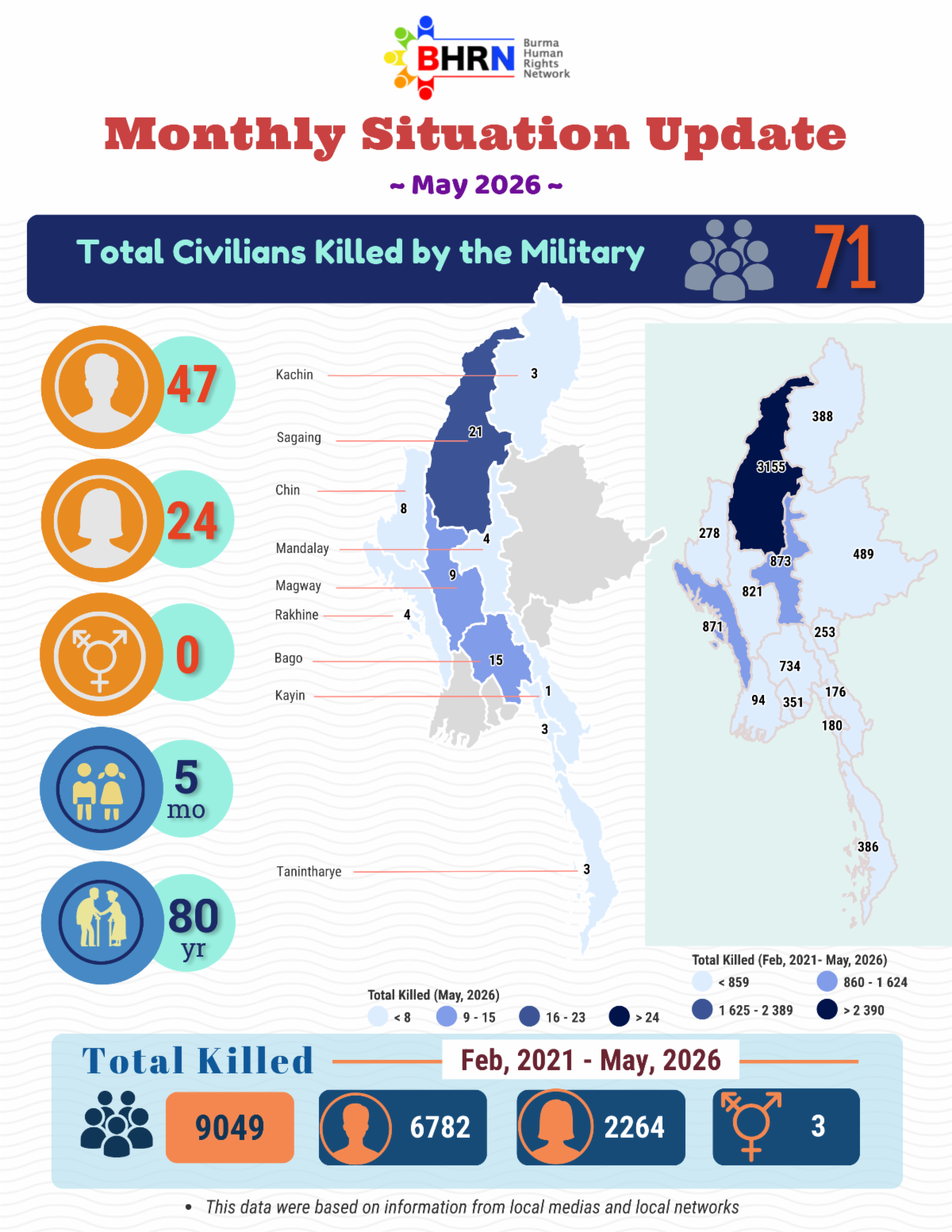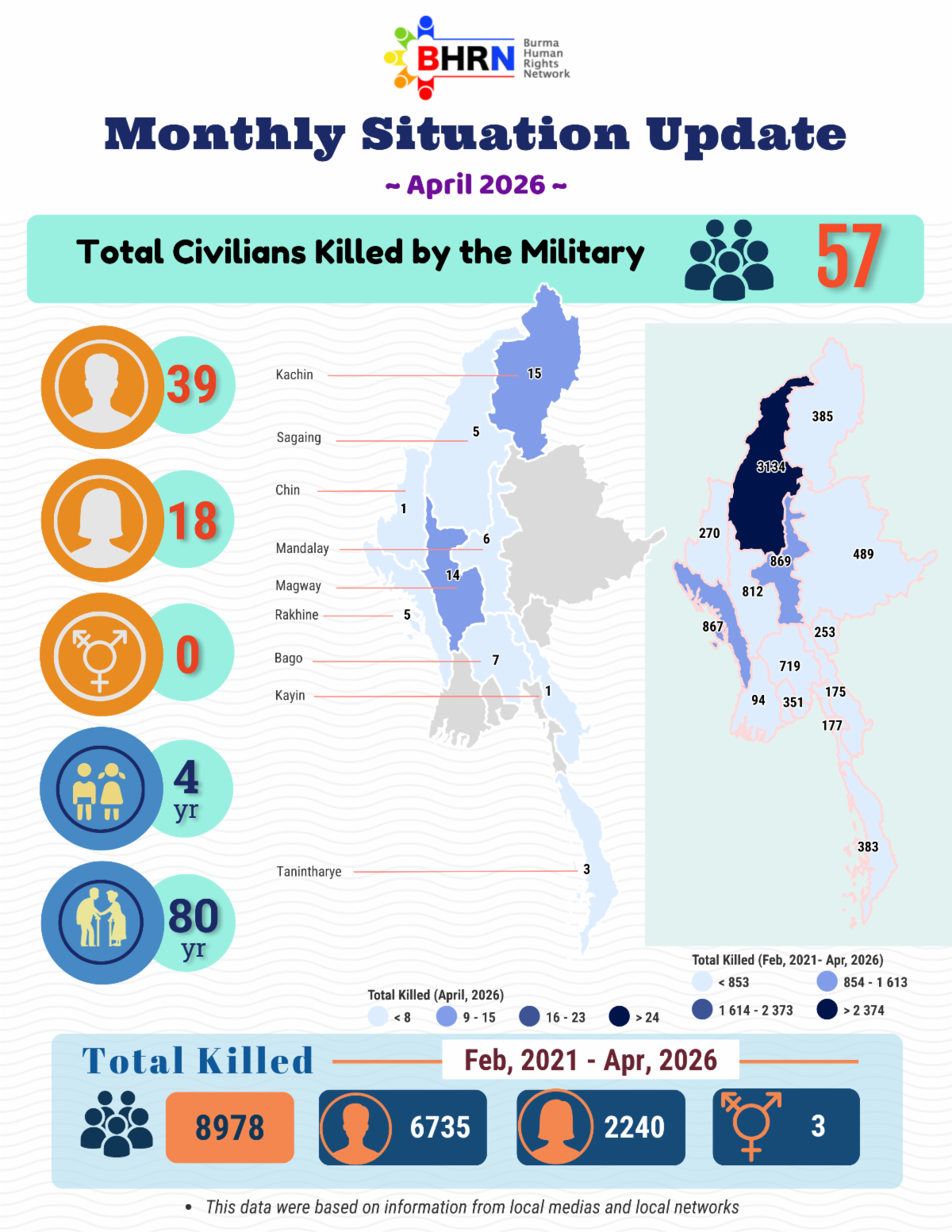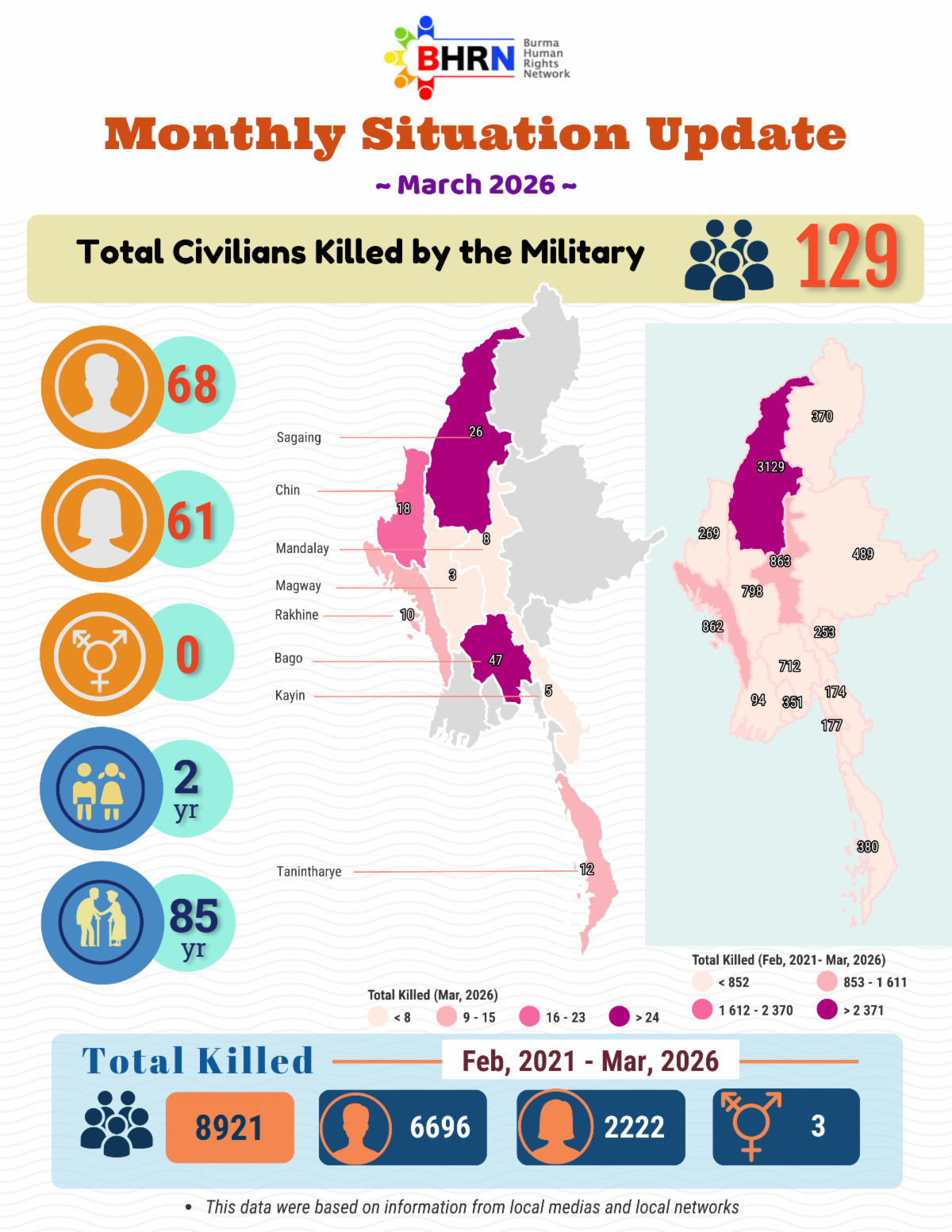

Methodology
Information in this document has been gathered by the BHRN team by primary and secondary research methods. We employed local researchers and local informers across Burma including in Rakhine State, Thai-Burma border and the Bangladesh border monitoring, investigating and documenting incidents of human rights violations. Any information we receive is carefully checked for credibility and authenticity by experienced senior research officers in the organisation. Once the information is approved the editorial team prepares the final document.
1Info-graphs of BHRN’s Report
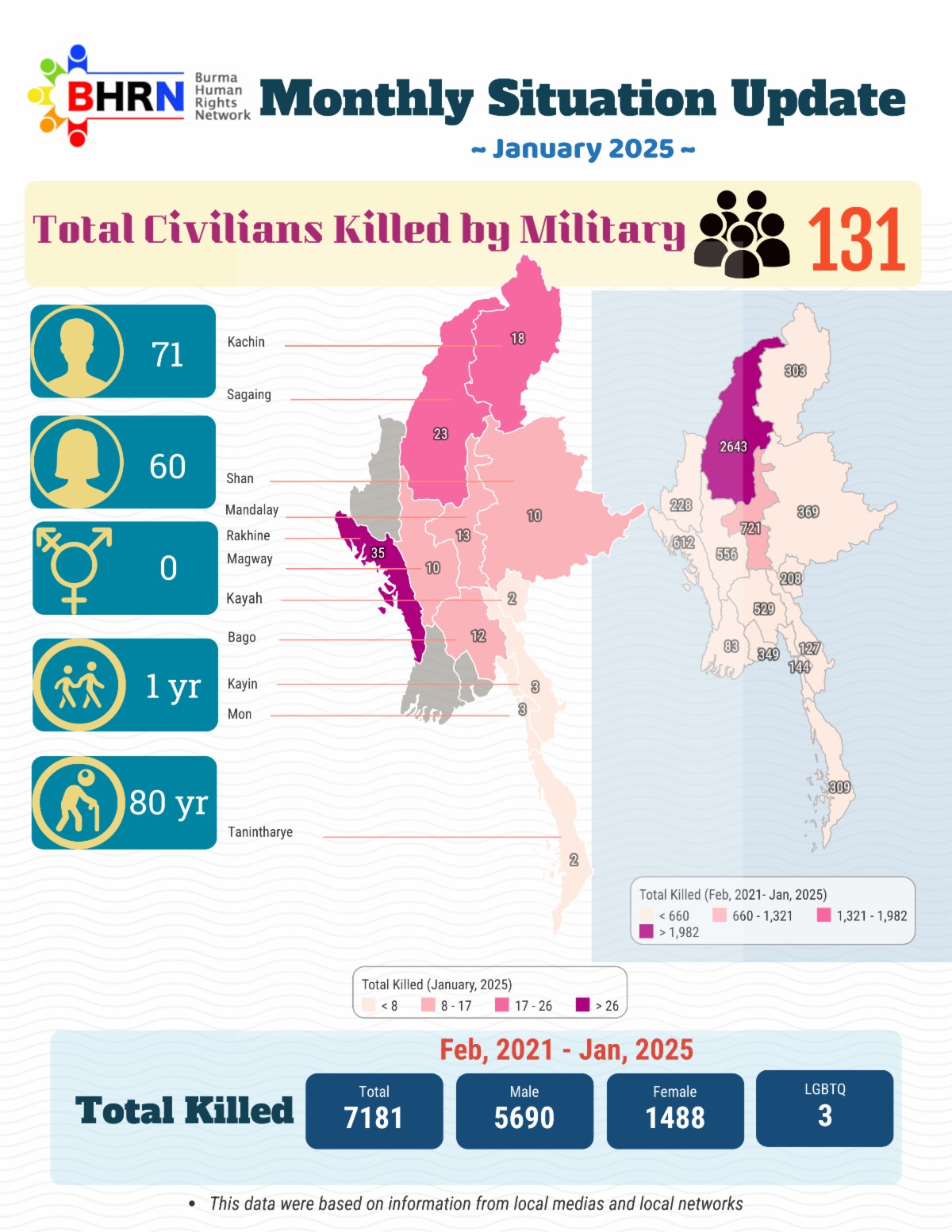
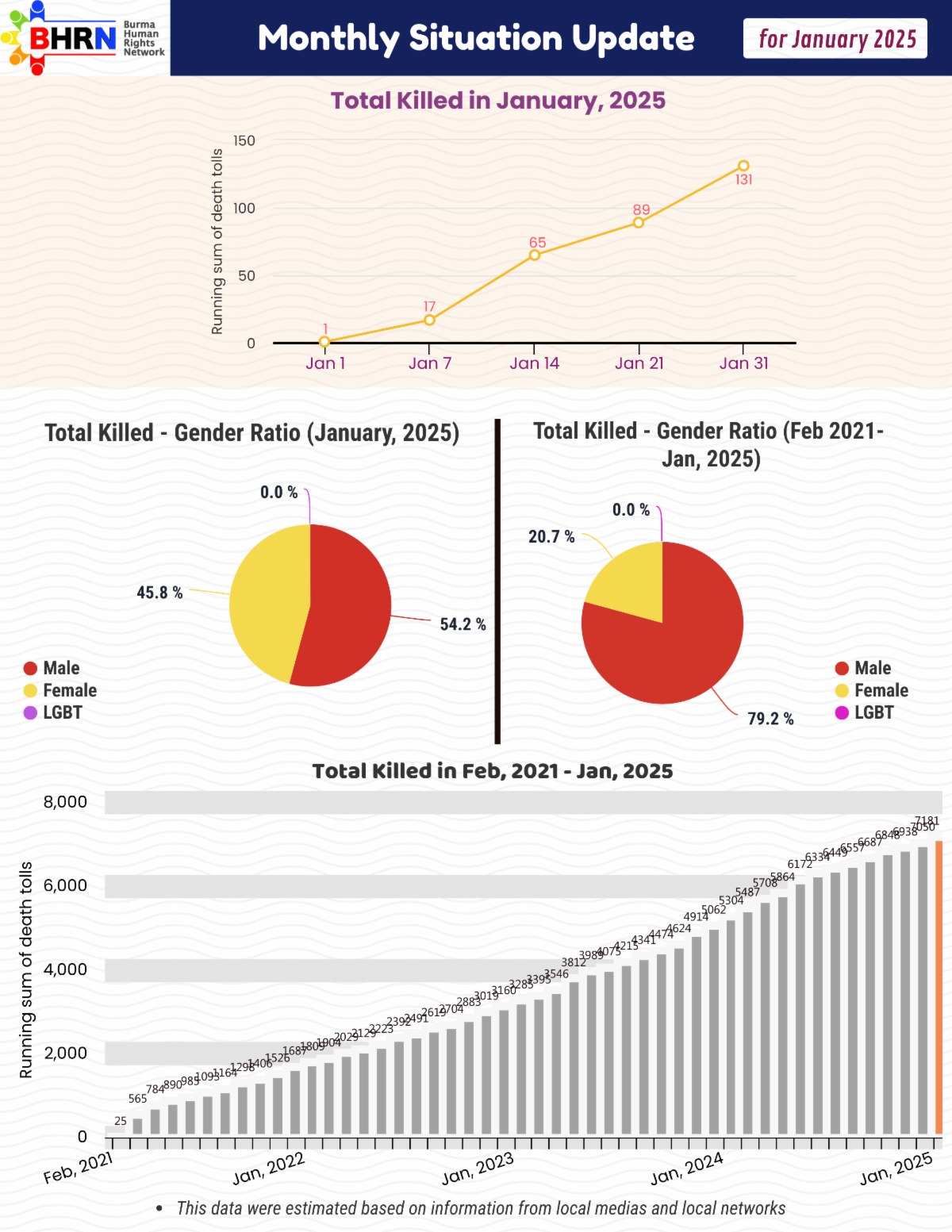

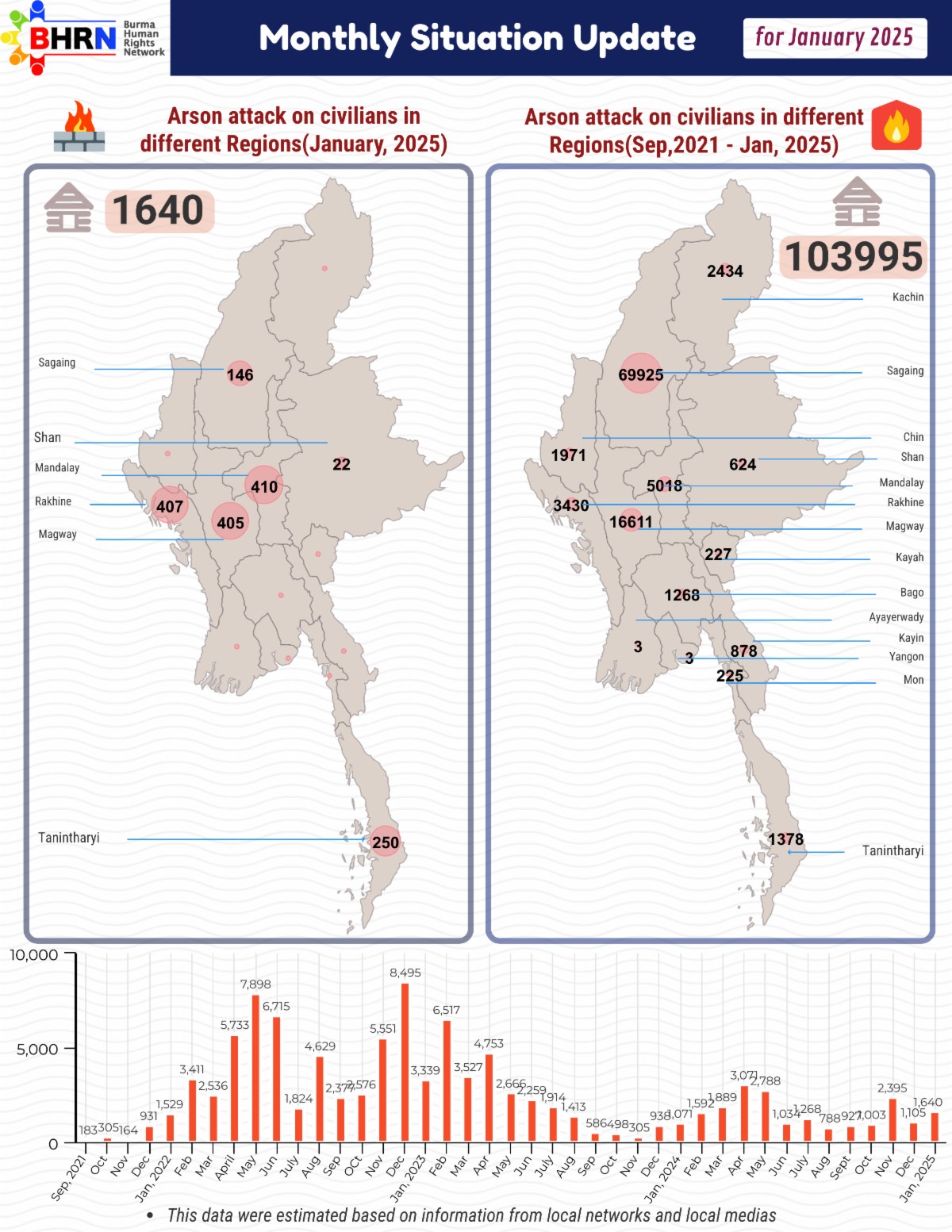
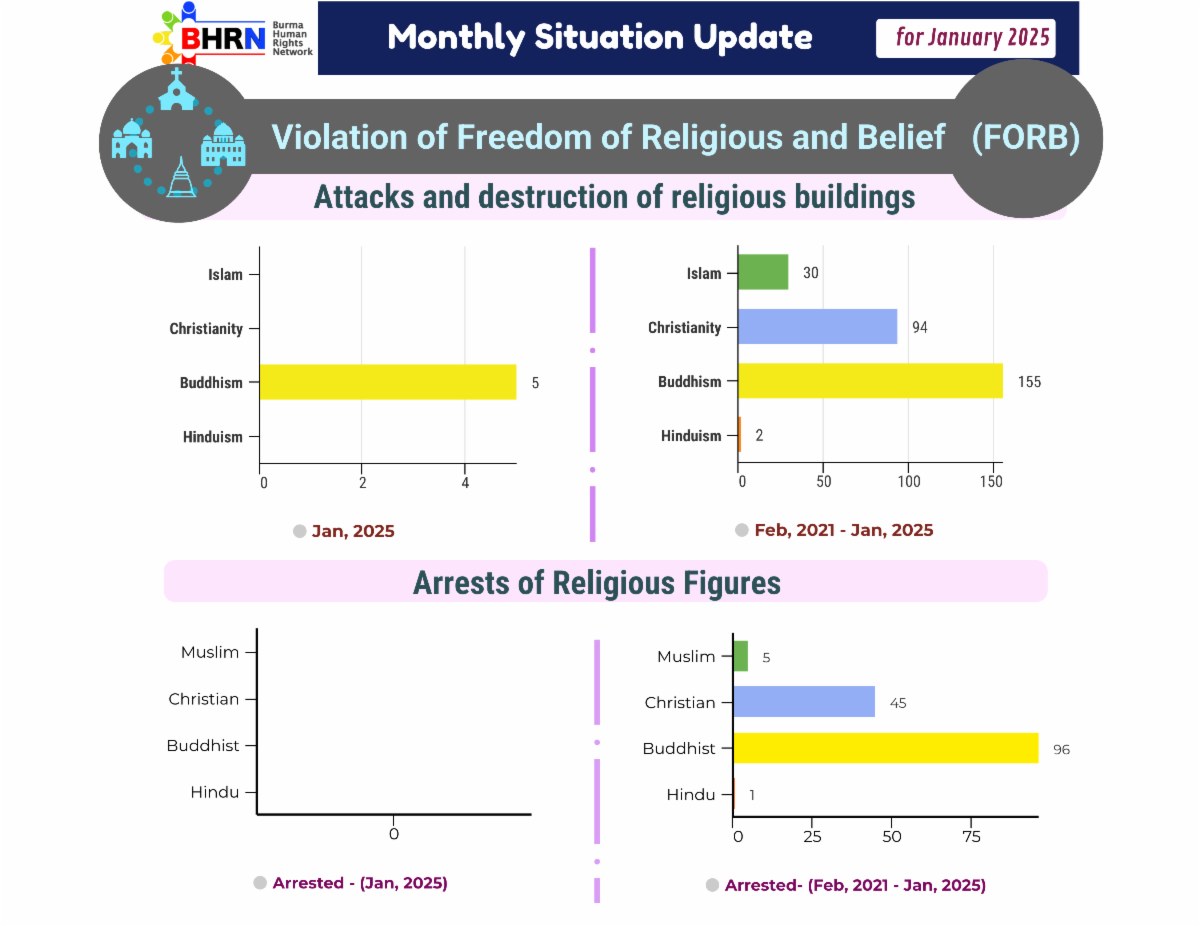
Tap any image to see it full size.
2News Summary and Analysis
Introduction and background
Context
- A deepening political crisis looms in 2025 in Myanmar as the civil war intensifies and the junta increases using airpower to stop rebel offences in several parts of the country. Without any political dialogue, which is highly unlikely to happen in the coming months and with the junta pushing for an election later this year, more violence and instabilities are expected in the coming weeks and months.
- As a consequence of the ongoing conflict in the country, the United Nations warned of acute famine in Rakhine State later this year. The conflict affected food production and a blockade of supplies of food into the state imposed by the junta is likely to create additional challenges for the sustainability of food for the region’s nearly 2 million population.
- The rebel groups continue to make major gains in territories across Myanmar. The Myanmar National Democratic Alliance Army (MNDAA) also known as the Kokang rebel group, a close ally of China celebrated its first Lunar New Year in Lashio, the commercial capital in Northern Shan State which it took over last August. However, its continuing control of the town is uncertain as China is putting pressure on the group to return the control of the town to the Min Aung Hlaing regime, as a part of a ceasefire deal Beijing brokered at the beginning of the year.
- Other rebel groups which are also close to China are continuing to make advances in their respective fights against the junta troops, partially ignoring the pressure from China. One of them, the Arkan Army (AA) is now stretching its control of territory beyond Rakhine and Chin states, AA claimed earlier this month that it took over some territories under the junta’s control in Ayeyarwady, Bago and Magwe regions. Another rebel group the Kachin Independence Army said it has taken over most of the areas in Bhamo, a strategically important town in the Northern part of the country which is crucial for trade with China.
- The central Myanmar region also saw an increasing trend of fighting, where the People's Defence Forces (PDFs) are posing a strong challenge to regime forces. They saw particular success in fighting in Sagaing and Magwe regions. PDFs fight under the command of the exiled National Unity Government (NUG) which said its members will soon be based in the areas under the control of PDF to run a more effective administration.
- A statement issued by the NUG on 4 January said its troops as well as the Ethnic Armed Organizations now control more townships in Myanmar than the junta. The statement said the anti-junta troops have full or partial control of 144 townships across Myanmar compared to 107 by the junta.
- In terms of the territory, the NUG statement said anti-junta groups control about 44 percent of the country compared to the junta’s 32 percent and the conflict is still ongoing in the remaining 24 percent. In another statement from NUG on 25 January said it is preparing to launch an offensive targeting the country’s commercial capital Yangon.
- Amid these concerns, the sudden aid suspension by the United States under an executive order from the new US administration led by President Donald Trump has a direct impact on the refugees and displaced people of Myanmar, both within the country and in the neighbouring countries.
Looming feminine in Rakhine
A recent report published by the United Nations Development Programme (UNDP) said with restrictions on goods entering Rakhine across international and domestic borders, absence of incomes, hyperinflation, significantly reduced domestic food production, and a lack of essential services and a social safety net, an already highly vulnerable population may be on the brink of collapse in the coming months.
The report said without urgent action, food sustainability for 95% of the population will be uncertain, “left to fend for themselves amid a drastic reduction in domestic production, skyrocketing prices, widespread unemployment, and heightened insecurity,” the report said.
“Rakhine could face acute famine imminently. Predictions indicate that domestic food production
will only cover 20% of its needs by March-April 2025. Internal rice production is plummeting due to a lack of seeds, and fertilizers, severe weather conditions, a steep rise in the number of internally
displaced people (IDPs) who can no longer engage in cultivation, and escalating conflict. This, along with the near-total cessation of internal and external trade, will leave over 2 million people at risk of starvation,” the report said.
Under these conditions, the scenario of repatriating over a million Rohingya is simply inconceivable. Despite the majority of Rohingya being forced to flee in the 2017 offensive by the junta troops hundreds of thousands remain in Rakhine State and their situation is going to get even worse due to looming food shortage.
Lashio and MNDAA
A member of the Myanmar National Democratic Alliance Army (MNDAA) administration in Lashio told an exiled media group Democratic Voice of Burma in late January that the town was still under its control, denying media reports that its forces would withdraw by the end of June.
“There are no troop movements, and everything is normal. But we cannot predict what will happen between now and June,” the official told DVB. Lashio is located 107 miles (172 km) south of the Myanmar-China border town of Muse, in northern Shan State, and 243 miles (391 km) north of the Shan State capital Taunggyi in southern Shan.
The MNDAA took full control of Lashio after it seized the Northeastern Regional Military Command (RMC) headquarters on 3 August.
Latest AA advances
The Arakan Army (AA) and its allies have extended operations from Rakhine State into Ayeyarwady Region and are reportedly 62km northwest of the regional capital, Pathein.
The armed group infiltrated Ayeyarwady as well as other regions bordering the state after it seized 14 out of Rakhine State’s 17 townships and Paletwa Township in southern Chin State in November 2023.
There have been several incidents of AA involving in committing atrocities against the Rohingya minorities in Northern Rakhine State.
KIA in the North
In a recent week the Kachin Independence Army (KIA) and allied resistance forces, KIA said it has seized control of the airport and the base of a junta battalion in Bhamo KIA spokesperson Colonel Naw Bu told The Irrawaddy news agency.
Early this month, the KIA and allied forces seized Kachin State’s Mansi Township. They have launched attacks on junta troops retreating from that area, inflicting heavy casualties.
In Central Myanmar challenges for NUG
The NUG said in a media statement released in early January that it has provided more than Kyat 7.7 billion (approx. USD 1.7 million) in terms of humanitarian assistance to communities inside Myanmar. NUG said the majority of its support goes to providing assistance to internally displaced people across the country.
As the NUG foresees a prolonged conflict with the junta, its tactic of raising funds for its operation would be crucial. So far, the NUG said its funding mainly comes from the selling of treasury bonds and cash contributions from the Myanmar diaspora. In recent times their policy of collecting tax from the civilians in the areas where the PDF troops control come under light. Activist groups have voiced concerns about interference by administrative authorities under the NUG.
Challenges in Southern Myanmar
People Defence Forces (PDF) and Karen National Liberation Army facing offensive by the junta forces since last year November, several villages are now facing shortage of medical supplies. Junta has been using fighter jets, drones and heavy artillery attacking civilian targets, causing sharp increasing of IDPs in Taninthari Township. Several ethnic Pashu Muslim villages and ethnic Karen villages are being targeted by the junta so far. Some observers criticised that PDF and KNLA were hesitating to take control of Junta troop’s outpost and bases, the reinforcement of junta troops to these bases and outposts are now getting the biggest challenges for PDF and KNLA. The recent military offensive conducted by the junta targeting religious premises, blocking humanitarian supplies, abducting local youth and forcing them to join the military under conscription law.
Trump Aid suspension impact on Myanmar refugees
Within days of the stop-work order, a range of U.S.-funded healthcare services began grinding to a halt. According to media reports the United States provided $141 million in humanitarian aid to Myanmar. Along the Thai-Myanmar border, nine refugee camps provide shelter to nearly 140,000 people.
In Bangladesh, where more than 1 million Rohingya who fled violence in Myanmar live in chronically underfunded refugee camps, there has been confusion over whether U.S.-funded food programs will continue. Last week, the Bangladesh government said that USAID would continue to provide food aid, but U.S. and U.N. officials appeared unsure where such information originated, according to a report from Benar News.
The agency reports that the pause has also already impacted a number of exile media newsrooms, which rely on small U.S. grants to provide open information in a country where journalists are routinely imprisoned, forcing a number of them to suspend staffers.
Internal regime dynamics
The military regime plans to evacuate the Defense Services Academy (DSA) and Defense Services Technological Academy (DSTA) from Mandalay Region’s Pyin Oo Lwin as fighting from neighbouring Northern Shan State comes closer.
They are to move to the Agricultural University campus in Naypyitaw.
News of the planned move came after the defence line was pushed to the vicinity of Pyin Oo Lwin by ethnic armed groups based in northern Shan State. Ethnic rebels have seized almost all of the state, and the Ta’ang National Liberation Army has been fighting the regime in an area which is a two-hour drive from Pyin Oo Lwin.
The junta extended its term by six more months and a government reshuffle was announced on 1 February marking the 4th year of the coup, the junta removed Home Minister General Yar Pye from the position replacing with a royalist of a junta head. The Home Ministry is key which supports the junta in its operation of political opponents.
Observation and analysis
- The junta’s plan to conduct the elections later this year under pressure from China, without holding a political dialogue with the opposition group. It could lead to further intensification of conflict as the regime holds less than 50 percent of the territory the analysts see its election as a useless ploy to win legitimacy.
- NUG said it needed to have more ground presence to support the fight against the regime forces. It has yet to articulate what different governance systems it could offer. Also, it is still not clear how it will win support from the ethnic groups.
- To be effectively governed the NUG needs to explain to its supporters what alternative form of government it can offer for the people of Myanmar, especially what it can guarantee equality for the ethnic and religious minorities. Under the changing political context in the country, a government with a pro-Bama agenda is likely to be hard to survive.
- The NUG's current policies seem to be more of the same as the policies that have ruined Myanmar politically and economically since the country’s independence.
- Also, a looming famine in Rakhine is indeed worrying for all civilians in Rakhine State, however, with the culture of discrimination against Rohingya Muslims existing in the state, they are likely to suffer more than their Buddhist counterparts.
3Rohingya Issue
3.1Rohingya in Rakhine Updates
-
1 January
In Sittwe, Rohingya villagers in Bu May, Magyi Myaing village, Basara village, and Basara camp continue to face movement restrictions due to SAC checkpoints. To travel to other Rohingya villages, they must pass through 5-8 checkpoints and pay 1,000-3,000 kyats per checkpoint for motorbikes and 3,000-5,000 kyats for tuk-tuks (taxis). However, INGO staff, students, and volunteer teachers are exempt from these fees. Additionally, Rohingya people sometimes have their motorbikes taken by the military for 1-2 hours. SAC restrictions have increased in Sittwe, and police, BGP, and military often extort money from and abuse Rohingya people, particularly at Thet Kay Pyin IDP camp's checkpoint and Bawdupha village. Despite requests to senior officers, no action has been taken to address these issues.
Source: BHRN -
1 January
At least 2000 Rohingya Muslims are currently serving prison terms in various jails across Myanmar, a rights group the Political Prisoners Network- Myanmar (PPN-M) said in a report published on 31 December 2024. The report said most of the Rohingya Muslims are imprisoned on immigration offenses including for attempting to flee the country. The PPN-M report said the Rohingya prisoners are held in Yangon’s Insein Prison as well as in jails in Pathein, Myaungmya, Maubin and Pyay jails. The report said at least 1000 prisoners are held in Pathein jail as well as 500 in Insein, 352 in Myaungmya, 60 in Pyay in Bago Region and 38 in Maubin jail in Ayeyarwady Region. It said 4 Rohingya Muslim prisoners were killed in 2024 due to lack of sufficient medical care. The report said 150 Rohingya Muslims are still held in Myaungmya prison despite having fully served their prison terms. The PPN-M source said on 4 January that Rohingya prisoners who were granted amnesty marking the country’s Independence on the same day were not allowed to leave the prison.
Source: Arakan Express -
2 January
Tens of thousands of internally displaced Rohingya Muslims are unable to return to their homes due to ongoing armed conflict in Rakhine State, Radio Free Asia (RFA) reported quoting a Rohingya source. U Satar Alam a former resident of Buthitaung Township told RFA that the international aid to Rohingya Muslims was stopped and many of them have to engage in begging to survive. He said all the residents of his village were evacuated in April where the fighting has intensified. U Satar Alam said many of them are seeking refuge in the schools and the homes of their relatives. He said due to the conflict situation in the region, livelihood opportunities are so scarce and due to the stop of aid by the international community, they are in urgent need of food shelter and warm clothes.
Source: RFA -
3 January
A media report said more than 5000 Rohingya Muslims in a camp in Pauktaw Township in Rakhine State are in urgent need of food and medicines after international assistance was cut to their community more than a year ago, Radio Free Asia (RFA) reported quoting a local source. The source who declined to be named in the report said many of the displaced Rohingya Muslims in Ah Nauk Ye camp are facing severe food shortages and they are surviving on porridge for several months. He said a pregnant woman, an elderly person and a child in the camp died in December last year due to malnourishment, the RFA report said.
Source: RFA -
9 January
At least 41 civilians died and more than 50 were injured in an air raid by the junta troops on a village in Ramree Township in Rakhine State on 8 January. A local source told Burma Human Rights Network (BHRN) that more than 500 homes in Kyauk Ni Maw village were destroyed in the airstrike. He said many homes destroyed in the raids belonged to the Kaman Muslim community, who are the majority of the inhabitants in the village. The source said the junta’s move was a deliberate attempt to target the civilians as the air raid came at a time when there was no active conflict in the area. The village has been under the control of a rebel group Arakan Army (AA) since early 2024.
Source: BHRN -
15 January
In Buthidaung, military officials met with Rohingya leaders and educated youths. The ULA officials warned against relations with Rohingya armed groups and asked them to request that the armed groups cease attacks in Rakhine state. They promised that if Rohingya armed groups refrain from offensives, Rohingya people would gain some rights under the Rakitta course. Otherwise, they threatened to expel Rohingyas from Arakan.
-
15 January
Since the AA lunch offensive, the SAC has blockaded roads to Sittwe, canceled TA for INGOs, and restricted INGO/NGO access to IDP camps. This has led to a lack of healthcare in Rohingya IDP camps, forcing IDPs to seek expensive private care. Additionally, the SAC has restricted medicine imports, causing shortages in Sittwe and Buthidaung. While the ULA provides limited healthcare in Buthidaung, serious cases face challenges crossing the border for treatment due to Bangladesh officials' crackdowns on border crossings.
-
22 January
42 Rohingya Muslim refugees who were trafficked from Bangladesh were rescued by police in the southern Thai resort island of Phuket on 21 January, according to a Thai media source. It said 23 women, 19 men and 12 children were rescued from a boat drifting in the seas near Phuket. The media report said the Rohingya victims were starved when they were found by local people. It said they were provided with food and water before the officials sent them to a nearby police station. The Thai media said they left Bangladesh on 16 December with a plan to go to Malaysia. However, they were abandoned after many of the trafficked victims, which included several pregnant women, became sick and injured. The victims told the media that many among the group were killed due to beating and other kinds of abuse committed by their traffickers, the media report said.
Source: Arakan Express -
22 January
A civil society group in Myanmar which works for freedom of expression said the junta has arrested 32 people during the past two months, for expressing their critical views on the regime. The group Athan said in a statement issued on 21 January said among those arrested during November and December last year included a child, a religious leader and businessmen, and the rest were normal working people. The statement from Athan quoted a local source in Mandalay saying that the arrests are to remind the people not to express their points of view. “The regime wants us to stay silent. As the military is an institution which does not understand the value of freedom of expression, it is easier for them to violate such rights,” the source said. The Athan Statement said among those arrested during the past two months 21 were from Ayeyarwady Region as well as three from Yangon Region and two each in Mandalay Region and Mon and Shan States. Also, one from the Tanintharyi Region was arrested, the statement said. It said the junta authorities charged them with criminal deformation offences.
Source: Mizzima -
29 January
More than 75 Rohingya Muslims arrived at the shore of the Western Indonesian Island of Aceh on 29 January, a French news agency AFP reported. It said the Indonesian authorities refused to allow the Rohingya to disembark from their boat. A local official, Rizalihadi, told AFP that four children are in the group. The Indonesian authorities told the Rohingya Muslims to remain onboard until the officials from the UN refugee agency UNHCR and the International Organisation of Migration (IOM) arrived at the scene to verify their status.
Source: RFA -
29 January
About 5,000 residents have reportedly returned to their homes in Maungdaw Township. According to Radio Free Asia, those returning were about 3,000 Rohingya and 2,000 Rakhine. Despite this, accounts from the ground continue of AA forcing Rohingya away from their homes.
Source: BHRN, RFA -
31 January
The Rohingya village of Nann Chaung in Maungdaw is being forcibly displaced by the ULA/AA, who claim the village area is crucial for their security. Despite two warnings in January, the Rohingya remain and are seeking discussion with ULA officials.
-
31 January
The ULA/AA has reportedly arrested over 1,000 Rohingya in Buthidaung, including religious leaders and educated youths, accusing them of collaborating with the SAC and Rohingya armed groups and supporting forced conscription. Some were released after paying extortion.
-
31 January
In January, INGOs and NGOs began working from home to improve accessibility for IDPs reporting challenges. However, many IDPs, reliant on aid for over a decade, now face food insecurity and shortages due to lack of income and restricted movement. This has resulted in a focus on daily food needs over education and health, negatively impacting children, pregnant women, and the elderly.
3.2Rohingya in Bangladesh Camp
-
1 January
On December 30th, a local gang kidnapped 19 Rohingya daily laborers who were residents of camp-27, Zadi Mura, Teknaf. The victims were abducted while returning home from working in a local forest. The families of the victims reported the kidnapping to the nearest police station. On January 1st, the kidnappers contacted the families and demanded a ransom of one lakh taka per victim, threatening that the police and RAB were powerless to help. The families, being daily workers with limited savings, were deeply distressed by the ransom demand, fearing that their loved ones would be killed or tortured if they failed to pay. After a few days of negotiation, the gang agreed to reduce the ransom to 15,000 taka per victim and subsequently released them.
Source: BHRN -
6 January
The Bangladeshi border guard arrested 36 Rohingya Muslim refugees from Myanmar for crossing into Bangladesh, a local newspaper report said. The Daily Star newspaper reported that among the Rohingya Muslims arrested 15 are women and children. The newspaper report said the Rohingya Muslims were arrested at a port in Teknaf, where they arrived after crossing the Bay of Bengal. The Daily Star report said the Bangladeshi border guard is planning to send the Rohingya Muslims back to Myanmar. The newspaper report said the refugees traveled to Bangladesh for five days after they fled Northern Rakhine State, which is now under the control of a rebel group the Arakan Army (AA). The newspaper reported that the refugees said they decided to flee the country as the conflict intensified in the region and to avoid persecution by AA troops.
Source: Arakan Express -
8 January
In Bangladesh, a 7-year-old boy named Mohammed Arakan was kidnapped from his home in Camp-19. The kidnappers demanded 8 lakh taka as ransom from the boy's parents. When the ransom was not paid, the kidnappers buried the boy up to his neck and sent a video of the act to his parents. The video quickly went viral on social media. Eventually, the boy was released after his parents paid a ransom, rumored to be around 2 lakh taka. Shortly after, two suspects were arrested by APBN police.
Source: BHRN -
8 January
The UN refugee agency UNHCR said it is planning to issue refugee registration cards to persecuted Rohingya Muslims who fled to Bangladesh in 2024 to avoid the fighting between the junta troops and a rebel group Arakan Army (AA). The UNHCR office in Bangladesh said the camps in Bangladesh are aimed at providing a safe haven for the Rohingya refugees from Myanmar. It said the Rohingya refugees and their families will be provided with biometric cards. However, UNHCR said the new biometric cards are only for the new arrivals in 2024. UNHCR said that those who are already in Bangladesh can not benefit from the new system.
Source: Arakan Express -
9 January
A landslide in Rohingya Refugee Camp Block H89 injured three family members. The mother is in critical condition, while her two children also sustained injuries. Fellow refugees rescued the victims from the mud and they were transported to a hospital for treatment.
Source: BHRN -
12 January
The Bangladeshi border guards have arrested 58 Rohingya Muslims from Myanmar including women and children near the Buchitong border in Alikadam Upazila’s Nayapara Union, Bandarban on 11 January, a local source said. The Alikadam Battalion conducted the operation in the early hours of Saturday. He told the police from the Alikadam sub-office of police were involved in the arrest and the arrested Rohingya Muslims are held in the police station in Alikadam. The source said the police also arrested 5 people who are accused of trafficking the Rohingya Muslim refugees into Bangladesh.
Source: Arakan Express -
15 January
38 Rohingyas, including 30 children from Arakan State, Myanmar, were arrested by the Border Guard Bangladesh (BGB) in Baharchara village, Bangladesh near the border.
-
16 January
A fire in Camp-26 of the Rohingya refugee camp on 16 January 2025 destroyed 61 shelters completely and 52 partially, along with 12 infrastructures. This has left dozens of refugees homeless. UNHCR and other humanitarian actors are providing essential aid, including blankets, hygiene kits and solar lamps, to those affected.
Source: BHRN -
16 January
the Bangladeshi Border Guard Force has arrested 38 Rohingya Muslims (including 30 Children) near the cost in Bangladesh’s Teknaf Province, a local news agency reported. They were arrested while trying to enter Bangladesh using the land border between the two countries, The report said they were trafficked into Bangladesh by human traffickers and had to walk for five days to reach Bangladesh. They are fleeing the fighting between the junta troops and the Arakan Army (AA) in their home state of Rakhine in Myanmar. The media source quoting the Bangladeshi officials said they were arrested at Baharchara in Teknaf province, and the relevant authorities will consider follow-up actions against the arrested Rohingya Muslims.
Source: Arakan Express -
16 January
A Rohingya Islamic scholar was abducted and tortured by unknown kidnappers on January 15 at approximately 8 PM while having dinner in a mosque located at Block F4 of Camp 3 in Kutupalong, Ukhiya, Cox's Bazar district, Bangladesh. The kidnappers reportedly entered the mosque suddenly, abducted the victim, and brutally tortured him by severely beating him and cutting his face with a blade. They also seized his phone, money, and watch. He was released after one hour of captivity.
Source: BHRN -
16 January
Bangladesh authorities issued security warnings due to increased human trafficking activity by gangs in the Ali Kadam border region and Cox's Bazar Rohingya refugee camps. Local law enforcement arrested 12 traffickers between November 28, 2024, and January 11, 2025, and 398 Rohingyas were arrested and sent back between 2024 and January 15, 2025. The Border Guard Bangladesh is working to dismantle smuggling routes, and reports indicate that traffickers demand ransoms of 10,000 to 25,000 Bangladeshi Taka per person. Due to conflict and poor conditions in Arakan State, Rohingyas are fleeing to Bangladesh, and activists are urging authorities to provide temporary refuge instead of immediate repatriation. Reports indicate that nearly 2,000 people from Buthidaung are stranded at the border without food, clean water, or entry into Bangladesh.
Source: BHRN -
16 January
A Rohingya Muslim refugee child was kidnapped in a large refugee camp in Bangladesh on 8 January a local source said. It said a 7-year-old unnamed child was kidnapped by a local bandit group in Tangkali refugee camp which is the largest refugee camp in the world. The source said the kidnappers are asking for Taka 700 000 in return for the release of the child. He said the child is facing atrocities at the hands of the kidnappers, adding that he was beaten up on his head while his body was kept buried in the soil. The source said even though the family of the child could not afford the sums demanded by the kidnappers, they were ready to pay Taka 200 000 in return for the release of the child. However, as they are still collecting the money they fear the life of the child. There are increasing incidents of trafficking and kidnapping of Rohingya refugees in the camps in Bangladesh. The Rohingya Muslim community are calling for the Bangladeshi and international community to increase support for the safety of the refugees.
Source: Arakan Express -
17 January
A kidnapper was caught by Rohingya community members in Camp 5 while attempting to kidnap a 6-year-old child. The kidnapper was severely beaten by the community and then handed over to the nearest police post.
Source: BHRN -
18 January
Despite an announcement by an ABPn officer that camps would be monitored 24/7 to address escalating kidnappings, no significant action has been taken and kidnappings continue, causing fear among camp residents.
Source: BHRN -
19 January
Seven-year-old Mizanur Rahman was kidnapped from camp-2W. The following day, an unknown person contacted Mizanur's father, demanding a ransom of two lakhs taka and threatening to kill the child if the ransom was not paid.
Source: BHRN -
19 January
A 25-year-old Rohingya refugee, Muhammad Kasim, was kidnapped from Jamtoli refugee camp 16 in Bangladesh and taken to the Myanmar border. The kidnappersransomed him for 200,000 taka. There is speculation that the kidnappers were connected to the Arakan Army.
Source: BHRN
20 Jauary - A 5th-grade student, Azizur Rahman (14), was attacked and restrained with ropes by kidnappers while walking home from school in Camp 4, Kutupalong. The abductors assaulted him but failed to take him away. Azizur, son of Hashim Ullah and Minara Begum, is currently hospitalized in Cox's Bazar for treatment. Source: BHRN
-
21 January
The Bangladesh Navy arrested 17 Rohingyas attempting to migrate to Malaysia. The group, which included a Rohingya broker and two Bangladeshis, was apprehended in Teknaf during a navy operation. They were later handed over to local police. The navy regularly patrols the area to counter illegal activities and maintain order.
Source: BHRN -
24 January
Police in Cox's Bazar, Bangladesh, rescued 15 people (10 Rohingyas and 5 Bangladeshis) who were kidnapped and held for ransom in the Baharchhara Kachhapia Gahin Hills of Teknaf. Two kidnappers, Haroon (25) and Nur Mamat (19), were arrested during the raid. The kidnappers lured victims with promises of passage to Malaysia, then demanded ransoms from their families. Legal action is being taken against the arrested kidnappers.
Source: BHRN -
24 January
in Rohingya camp 14, Block A2, a young woman was brutally beaten. According to the victim, the perpetrators were members of the Rohingya Solidarity Organization. They were allegedly searching for ARSA members, and when they didn't find them, they looted the family's belongings and beat the woman, breaking her leg and hand. This kind of incident is increasing in frequency, causing great worry and tension among camp residents.
Source: BHRN -
27 January
A Rohingya refugee youth was found dead in Camp 2W, Kutupalong, on January 27. The cause of death is unknown. Kidnappings and abductions are increasing in the area, with victims facing severe consequences if ransoms are not paid. This has led to growing fear and insecurity among refugees.
Source: BHRN -
27 January
Head Mazi Anayat Ullah, from camp-8, was severely beaten by members of the Arakan Rohingya Army (ARA) on the evening. The ARA members were reportedly upset with Ullah for allegedly supporting the Rohingya Solidarity Organization (RSO). This incident is similar to others in the area, where armed groups attack individuals and accuse them of being linked to opposing factions.
Source: BHRN -
28 January
A fire that destroyed numerous shelters and displaced families broke out in Camp-11 under suspicious circumstances. Many believe the fire was intentionally set to escalate tensions or displace specific groups within the camps.
Source: BHRN -
28 January
A 13-year-old Rohingya boy, Jonnat Ullah. The kidnappers demanded a 5 lakh taka ransom, threatening to kill Jonnat if the family didn't pay. The family managed to raise 4 lakh taka but requested to speak with Jonnat to confirm he was alive. The kidnappers refused, and the ransom was not paid. Jonnat's whereabouts remain unknown.
Source: BHRN -
30 January
A fire broke out in camp-18, Block-B52 around 7:30 AM. The fire destroyed three shelters and damaged several others before being brought under control. The community's quick response limited the damage caused.
Source: BHRN
4Violations of Freedom of Religion and Belief
-
11 January
A monk was killed in an airstrike by the junta troops on a village in Pathein Township in Ayeyarwady Region. A police officer with the Special Branch of Police in Pathein told Yangon Khitthit Newspaper that the junta troops targeted the village near a beach resort town Ngwe Thaung Yan close to Pathein three times between 8 and 9 January. He said the junta troops targeted three villages near the resort town- Kular Chaung, Pauktuutit and Magyi Zin Phyar- in which one monk along with a police officer was killed. The airstrike comes as the junta troops engaged in a fighting with a rebel group, the Arakan Army (AA) in the area, the source said. He said many civilians are fleeing to a nearby town called Thabaung to avoid the fighting.
Source: Khit Thit Media -
16 January
A Buddhist congregation hall and a police station were destroyed in an airstrike by the junta troops in Hishseng Township in Southern Shan State on 14 January, a local rebel news source linked to a rebel group said. The PaO National Liberation Army News (PNLA News) said the junta troops conducted two rounds of raids on the town in which the religious and police facilities were completely destroyed.
Source: BHRN -
17 January
At least six civilians, including a monk, were killed in an airstrike by the junta troops on Khampat Town in Sagaing Region on 16 January, a local news source said. It said the attacks were carried out at nighttime when most of the people were in their homes. It said two children were among those who were killed in the airstrike.
Source: BHRN -
29 January
Three civilians were injured and several Buddhist idols for worship were destroyed in an airstrike, artillery and drone attacks on a monastery by the junta troops in a village in Shwe Kyin Township in Bago Region on 27 January, a local resistance group told Yangon Khint Thit media, The source said the junta’s fighter jets attacked the monastery in Nyaungbingyi village for three times on the day and fired at least 20 rounds of artillery shells and it was also targeted for six times by drones, the source said. He said the attacks come at a time when there is no active conflict in the area. It said in addition to human casualties two buildings inside the monastery compound were destroyed in the attacks.
Source: Khit Thit Media -
31 January
An elderly woman was killed and several civilians fled villages due to ongoing fighting in the villages in Nyaunglebin Township in Bago Region, a source close to the People Defence Force (PDF) said. In an airstrike by the junta troops on a monastery in the Nyaungbingyi village on 27 January a platform of a pavement and a wall that covered a pagoda inside the monastery compound, were destroyed. The source said the junta also targeted another monastery in the same village and a new airstrike was carried out on the next day. It said two buildings as well as a place for worship inside the monastery were destroyed along with a civilian home situated close to the monastery. The PDF source said on the same day as the junta troops carried out air strikes on the monastery in Nyuangbingyi village, they were also involved in a drone attack on a monastery in Pyin Ye Ah Nauk village which is situated about 2 miles north of Nyaungbingyi village.
Source: Myanmar Now
5Human Rights Violations
-
31 January
The junta committed a total of 108 cases of human rights violations in Kayah State during 2024, the pro-democracy interim administrative council of the state said in a statement issued on 3 January. The statement said the junta has conducted 36 drone attacks as well as 46 times shelling on civilian targets and 26 cases of arbitrary killings during last year. It said 41 men, 26 women and 36 children were killed in these attacks. It said 288 civilians including 39 children and 48 women were also injured in the attacks. The report was compiled by the council based on the documentation done by the local human rights groups.
Source: BHRN
5.1Rape as War Crime (Committed by Junta Troops)
-
16 January
A member of a pro-junta, the Union Solidarity and Development Party (USDP) committed rape of a high school student in a village in Nyaung U Township in Mandalay Region, Yangon Khint Thit News agency reported quoting a local source. Myint Soe who is a party worker for USDP in Htanaungsu village and a member of the trustees of the local pagods later asked the family of the victim not to complain to police in return for Kyat 7 million compensation. The source said 60-year-old Myint Soe committed the rape of a grade 12 student in a remote location near the village where the girl lives. The source said the family of the victim refused to take compensation and complained against Myint Soe at a local police station. “We want to ask him if it is his daughter is a victim will he settle the matter in return for the financial compensation of Kyat 7 million? He committed a crime against a girl who may be of his granddaughter’s age,” a local source was quoted as saying in the Yangon Khit Thit report. The source said the police, however, refused to open a complaint against Myint Soe, on the grounds that there was no evidence against him.
Source: Khit Thit Media
5.2Extra Judicial Punishment
5.2.1Arbitrary arrests and imprisonment
-
3 January
At least 100 civilians were arrested in a village in Monywa Township in Sagaing Region on 12 January, a local news source said. The source said the junta troops readied Kan Ma village to arrest the civilians after which they burned down the entire village. “They first entered the village around 9 p.m. and started to burn down the village around 11:30 p.m. In my estimate there were about 100 civilians arrested during the raid, I still do not know the exact number,” a local source said. He added that the junta soldiers entered the village in three FAW-brand trucks and they raided the homes and stole precious things from the civilians. The source said among those arrested included a 98-year-old elderly person as well as children, pregnant and sick people.
Source: BHRN -
5 January
The junta troops arrested 9 civilians in Min Hla Township in Bago Region after a local head of a junta-affiliated militant group Pyu Saw Htee was killed, a local source told Burma Human Rights Network (BHRN). He said the arrest comes a day after Pyu Saw Htee head of Min Hla Township U Shwe was killed. The source said the identities of the civilians arrested in connection with U Shwe’s murder are still unknown.
Source: BHRN -
6 January
The junta arrested 40 civilians in a village Wetlet Township in Sagaing Region after a raid, the spokesperson of Wetlet Information Network said. He said the junta troops arrested the civilians during a raid on Ohnwe Boat village on 4th January. The troops were holding arms during the raid the spokesperson said. He said the junta troops had also been involved a day earlier in a raid on Sartaung Town, which is situated near Wetlet Township. The spokesperson said the junta troops had recently launched an attack on Wetlet Region.
Source: BHRN -
12 January
The junta troops abducted several civilians during a raid on a village in Monywa Township in Sagaing Region on 11 January, a local source told Burma Human Rights Network (BHRN). He said the abducted civilians from Zalok village are expected to be used as human shields in fighting by the junta against the People Defence forces (PDF). The incident took place on 11 January when the junta troops based in the area came under attack and the other troops who were sent to the area as reinforcement abducted the civilians in the Za Loak village. The source said he still cannot confirm the number of civilians abducted in the raids.
Source: BHRN -
17 January
The junta troops abducted 4 laborers in Okpo Township in Bago Region, a local resistance source told Burma Human Rights Network (BHRN). He said the junta troops that came to the Chaung Gaung village tract in Okpo were involved in the abduction of the four civilians on 17 January, the source said. “Four civilians were abducted, two of them are father and son they are from Sin Myint village and other were one each from Sai Ywa and Mi Chaung Tin villages. The junta troops came into the area around 5 in the morning,” the source told BHRN. He said this is one of several incidents in the region where the junta troops abducted civilians, which forced many to flee the region.
Source: BHRN -
21 January
The Arakan Army (AA) abducted 91 civilians including minors as conscripts, a report in Chin Media said. It said the victims are from Maungtaw Township in Northern Rakhine State and among them include the members of the Myo ethnic group. The media report said the incident took place on 24 December and among the abductees 50 who are aged only 13. It said also some of the victims were heads of the family and some with poor health conditions. The family members of the victims said they could not get any communication with their loved ones since their arrest by AA, the report said.
Source: Arakan Express -
24 January
The junta troops abducted 149 migrant workers in Kawthaung Township, in Tanintharyi Region which is situated on Myanmar Thai border on 22 January, a local source told Burma Human Rights Network (BHRN). He said the victims were Myanmar migrant workers who were repatriated back to the country by the Thai authorities on the same day. The source said at least half of them were sent for military training to later serve in the military as conscripts. The source said they were sent to a training school in Palauk Town in Tanintharyi Region. As the repatriated Myanmar workers have nowhere else to go, they are forced to serve in the military and many are expected to lose their lives, the source said. “The actions by the Thai authorities are supporting the junta’s rights abuse,” the source told BHRN.
Source: BHRN
5.3Issues of Political Prisoners
-
1 January
At least 35 women political prisoners are serving prison sentences in the jails across Myanmar together with their young children, a rights group the Political Prisoner Network -Myanmar said. The report said many women were arrested for their political activism during the time they were pregnant. It said most numbers of the women political prisoners held together with young children are in Oh Bo prison in Mandalay where 27 female prisoners with young children are held. It said the others were five in Deik U prison in Bago Region as well as one each in Tharyarwaddy and Paungdae prisons in Bago Region and in Moneywa Prison in Sagaing Region. The report said there are currently 7 female pregnant women prisoners in Oh Bo prison.
Source: BHRN -
12 January
A political prisoner has died in Deik U Prison in Bago Region after he was denied sufficient medical treatment, a rights group the Political Prisoner Network- Myanmar (PPN-M) said. It said Ko Myo Min Oo, who was serving an 11-year sentence, passed away on 10 January after he was denied permission to take treatment outside of the prison for his kidney condition. Ko Myo Min Oo was arrested in Yangon in October 2022, and he was sent to Insein Prison and charged with criminal defamation offenses. He was moved to Deik U prison in May 2023.
Source: Mizzima -
15 January
Several political prisoners were re-arrested after they were granted amnesty from Shwe Bo Prison in Sagaing Region in early January, a right group the Political Prisoner Network Myanmar (PPN-M) said. The group said the political prisoners who were released under the amnesty announced on 4 January marking the country’s Independence Day were re-arrested to face country terrorism charges shortly after their release, PPN-M said. It said the families of the prisoners were not informed about their re-arrest. The group said the junta officials have been rearresting political prisoners who were granted amnesty since October 2024. PPN-M said the number of political prisoners who were re-arrested after the early January amnesty was 7 and they are held in the police stations without being charged.
Source: BHRN -
30 January
The family members of political prisoners say they are facing sexual harassment by the authorities of Kalay prison in Sagaing Region, a spokesperson of a rights group the Political Prisoners Network (Myanmar) said. He said the prison authorities offer a reduction of prison terms for political prisoners in return for sexual favours from the women members of the prisoner’s family. “A letter I received from the wife of a political prisoner said she received a phone call from the prison superintendent of Kalay prison who said her husband’s prison sentence could be reduced if she had sex with him. Other family members of political prisoners told PPNM that they are also experiencing similar offers from the prison authorities. The spokesperson said the superintendent of the Kalay prison Aung Moe Hein and prison security chief Han Win Aung are involved in sexual harassment of the female family members of the political prisoners.
Source: RFA
5.4Extra Judicial Killings and Enforced Disappearances
-
2 January
A civilian was killed in an attack by the junta troops in a village in Butalin Township in Sagaing Region on 1 January, a local source told Burma Human Rights Network (BHRN). He said the victim was a 25-year-old Ko Thaw Zin Phyo from Tathling village. The source said his body was found near the village. The source said he was abducted by the junta troops to be used as a human shield, and he seemed to be shot dead by the junta troops after the fighting.
Source: BHRN -
5 January
The junta troops killed 6 civilians and abducted two civilians including a 14-year-old girl in Mingin Township in Sagaing Region, a spokesperson of a local resistance group the Upper Chindwin River Revolution Force (UCRRF) told Yangon Khit Thit newspaper. He said the incident took place on 3 January when a group of 80 junta soldiers attacked Mingin township from the two fronts. The source said the civilians killed were from Tu Mara village near Mingin township and two civilians abducted were from Ma Oh Kaine village, their whereabouts is still unknown.
Source: Khit Thit Media -
8 January
A local head of the National Unity Government (NUG) was shot dead in a village in Kanbalu Township in Sagaing Region on 6 January, a local source told Radio Free Asia. He said a member of NUG’s local administration group U Ngwe Thein was killed by two armed men who entered his home in Tin Ngot Gyi village, the source told RFA. He said the village, which is situated on a highway between Shwe Bo and Myitkyina in Kachin State has more than 1000 households, and it is under the control of pro-democracy militia group the People Defense Forces (PDF).
Source: RFA -
14 January
The junta troops shot dead a civilian in a village in Kawkareik Township in Kayin State on 10 January, a local source told Burma Human Rights Network (BHRN). The source said Ko Wai Yan Oo was shot dead after the junta troops were attacked by a group of People Defense Forces near Kawkareik Township on 10 January. The source said two soldiers were also killed in the attack. And their bodies were taken away to Kyondoe Township in Kayin State. “Ko Wai Yan Oo was killed in a crossfire; his body was not returned to the family. The family went to ask for the body, but they were refused,” the source said. He said the head of local administration told the parents that 40-year-old Ko Wai Yan Oo was shot mistakenly as a combatant from PDF.
Source: BHRN -
17 January
the junta killed nearly 700 children across Myanmar since it came to power in a military coup four years ago, a civil society group the Association for Protection of Political Prisoners (AAPP) said in a statement released on 17 January. AAPP said its statistics cover the period of 1 February 2021, when the junta staged the coup and 31 December 2024. The statement provides a yearly number of deaths of children. The statement said 101 were killed in the first year of the coup and 136 in the following year and 208 and 248 children were killed in 2023 and 2024 respectively. It said at least 228 children were killed in airstrikes and 209 due to shelling by the junta troops in civilian positions.
Source: RFA -
20 January
The junta troops committed killings of more than 10 civilians during a series of attacks on the villages in Nattalin Township in Bago Region in mid-January, a local source, who is an eyewitness of the incident, told Burma Human Rights Network (BHRN). It said the junta troops fired heavy artillery shells on Sisone Kone village on 15 January which led the entire village to flee and those who were trapped were taken away by troops and were later shot dead in groups. The source said the troops entered the village on the next day and arrested those who were unable to flee, they included mentally retarded persons who remain in the village to guard their homes. “They were taken away and shot dead on a street with their hands tied in their back,” The source said among those killed were Ko Chat Phaung, Ko Min Hteik, Ko Kyaw Kyaw Ko Than Zaw Oo, who were from Si Kone village, and they remain in the village to guard their homes, the source said. “I saw these people as well as others taken away by the junta troops. I counted as much as I could see from a distance. I do not know how many exactly were killed and also not sure if any more civilians were killed inside the village,” the source told BHRN.
Source: BHRN -
20 January
At least 50 civilians were arrested in several places in the Ayeyarwady Region, amid ongoing fighting in the region between the junta troops and a rebel group Arakan Army (AA), a local source told Radio Free Asia. He said those arrested were civilians holding citizenship cards issued in Rakhine State. The source who declined to be named in the report said among those arrested included youth and middle-aged people and they were detained in the provincial capital Pathein as well as other towns in the region, Yekyi, Ngathaingchaung and Kyonpyaw townships with the citizenship cards issued in Rakhine State were arrested. “Instructions were issued to the local authorities asking them not to allow the guests from Rakhine State to stay in their villages. The junta told the village heads to inform them if there was anyone coming in from Rakhine State. In some cases, the troops arrested them and extorted money from them,” the source told RFA.
Source: RFA -
21 January
A women's rights group the Burma Women Union (BWU) said four women died every three days due to conflict in Myanmar in 2024. The group said in its report that at least 478 women were killed during the year due to airstrikes, rights violations by armed groups, as well as due to sexual exploitation. It said the largest number of women 257 in number were killed in the airstrikes as well as 142 died in shelling on civilian targets and one woman who was hanged by the Myanmar National Democratic Alliance Army (MNDAA), BWU’s report said. It said other 66 were arbitrarily killed, 7 due to landmines and 6 had died due to sexual assaults by the members of the armed groups.
Source: BHRN
5.5Violence attacks by pro-junta thugs
-
3 January
The civilians in Gyobingauk Township in Bago Region are forced to pay monthly fees to support the conscripts to the Myanmar military and they are facing immense hardships, a local source told the Burma Human Rights Network (BHRN). The source said the civilians are forced to pay up to Kyat 100 000 per household as support to the conscripts. “Either if you call it funds to support the conscripts or to avoid being recruited as conscripts, they are robbing us blatantly. Some youths were abducted and forced to serve in the military despite their family paying the funds regularly. As my son is abroad, I have to pay Kyat 200 000 every month,” a woman in the town told BHRN. “So, I have to keep the funds to pay them before considering household expenses. Now I have been paying this money to them for the past 10 months, she said. Other civilians in the region BHRN has spoken with also complained that they have been forced to pay a monthly fee to avoid conscription of their family members for the past year. The source said the local communities are taking up hard labour to be able to pay the funds to avoid their family members being conscripted.
Source: BHRN -
23 January
The pro-junta groups in Hpa-An in Kayin State are forcing the local communities, including those who are living in the town in rented homes and as the internally displaced people, to pay fees in return for exemption from conscription, a local source said. He said only those who are house owners in the town were asked to pay in the past. “Before those who were living in rented homes and IDP were not summoned to pay. Now they have introduced a new system in which the homeowners are required to pay Kyat 10 000 per month and those who are in rented homes are asked to pay half of that amount per month. So, there are a lot of difficulties causing them. The cost of living and high inflation are causing extra problems for the local people. For IDPs their survival is very difficult, they have to do petty work for their survival,” the source said. He said the town elders told the junta authorities not to collect funds from the IDPs. The source said there are many IDPs who are from Kawkareik, Kamamaung and Hpapun townships who fled fighting in their towns and taking refuge in the provincial capital Hpa An.
Source: BHRN -
29 January
The junta officials and members of its affiliated groups in Shwebo Township in Sagaing Region are increasing extortion of money in return for exemption from conscription, a local source told Burma Human Rights Network (BHRN). The source said in a recent incident the local authorities extorted Kyat 13 million from a nephew of the Commander of the local military command and they were forced to replay the extorted money. The source said the people are afraid to report the incidents of extortion to the police. “Some of them have to pay up to Kyat 20-30 million. They arrested youths at nighttime and asked their families to pay extortion money in return for their release. These incidents are highest in Shwebo, township” the source told BHRN.
Source: BHRN -
30 January
The junta troops abducted more than 40 civilians in Kanbalu Township in Sagaing Region on 29 January, a local source said. “They abducted at least 30 people in Zigone town near Kanbalu and others were arrested from Nagar village. Some of them were later released, a local source said. He said a leader of Pyu Saw Htee militant group affiliated with the junta and a monk U Wathawa were instrumental in the abduction and extortion of the funds from the local communities. He said the number of abductions of youth for conscription has intensified since 15 January this year.
Source: BHRN
About BHRN
Burma Human Rights Network (BHRN) is based in London, operates across Burma/Myanmar and works for human rights, minority rights and religious freedom in Burma. BHRN has played a crucial role in advocating for human rights and religious freedom with politicians and world leaders.