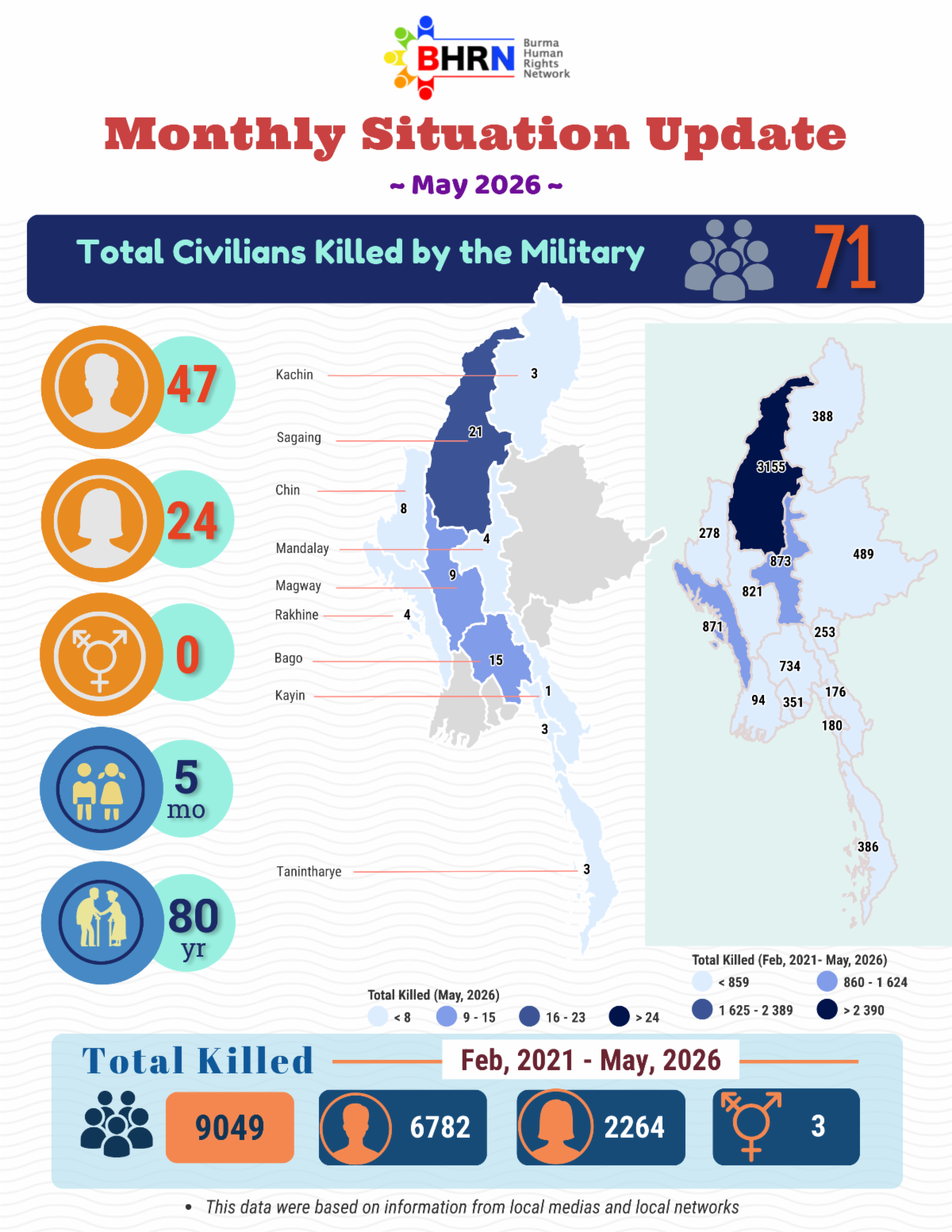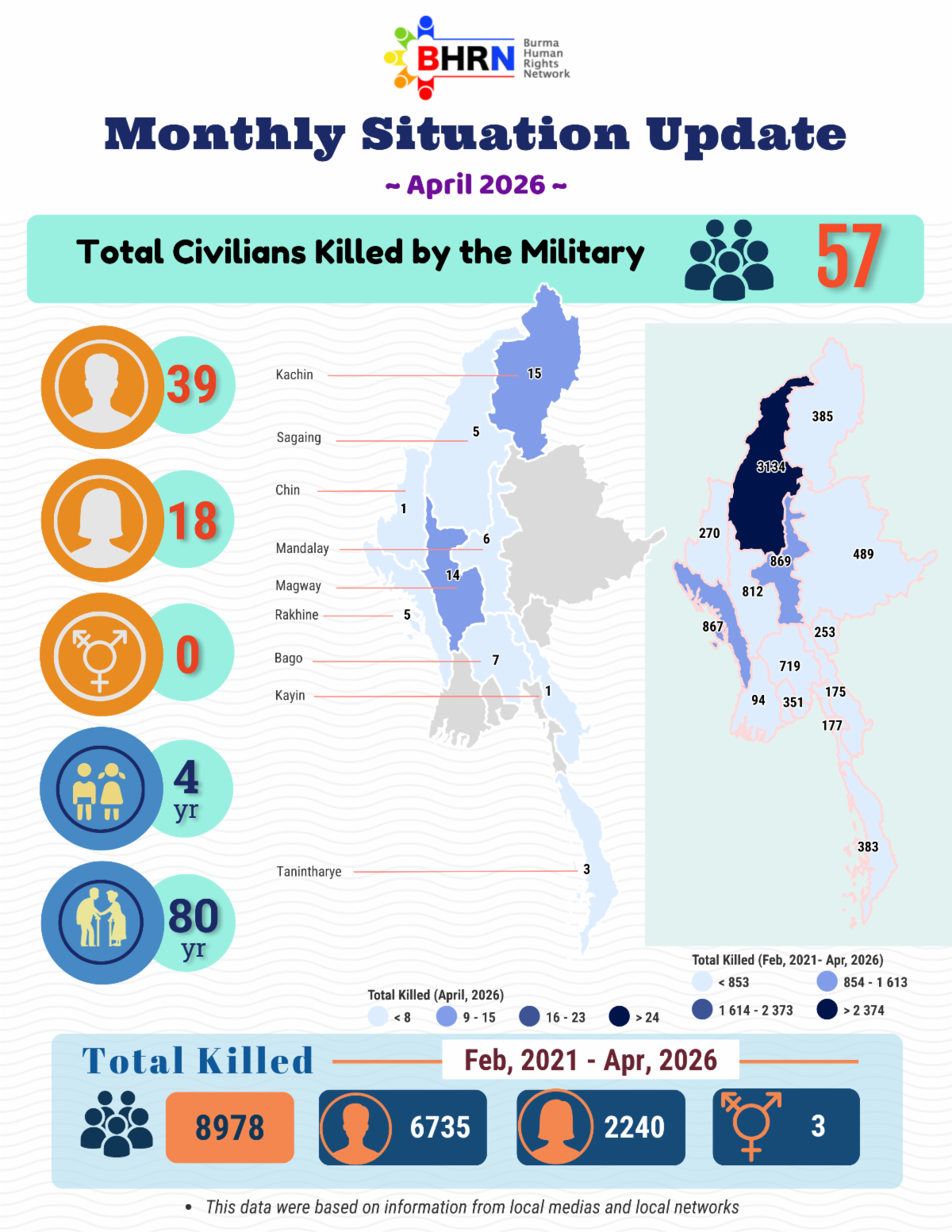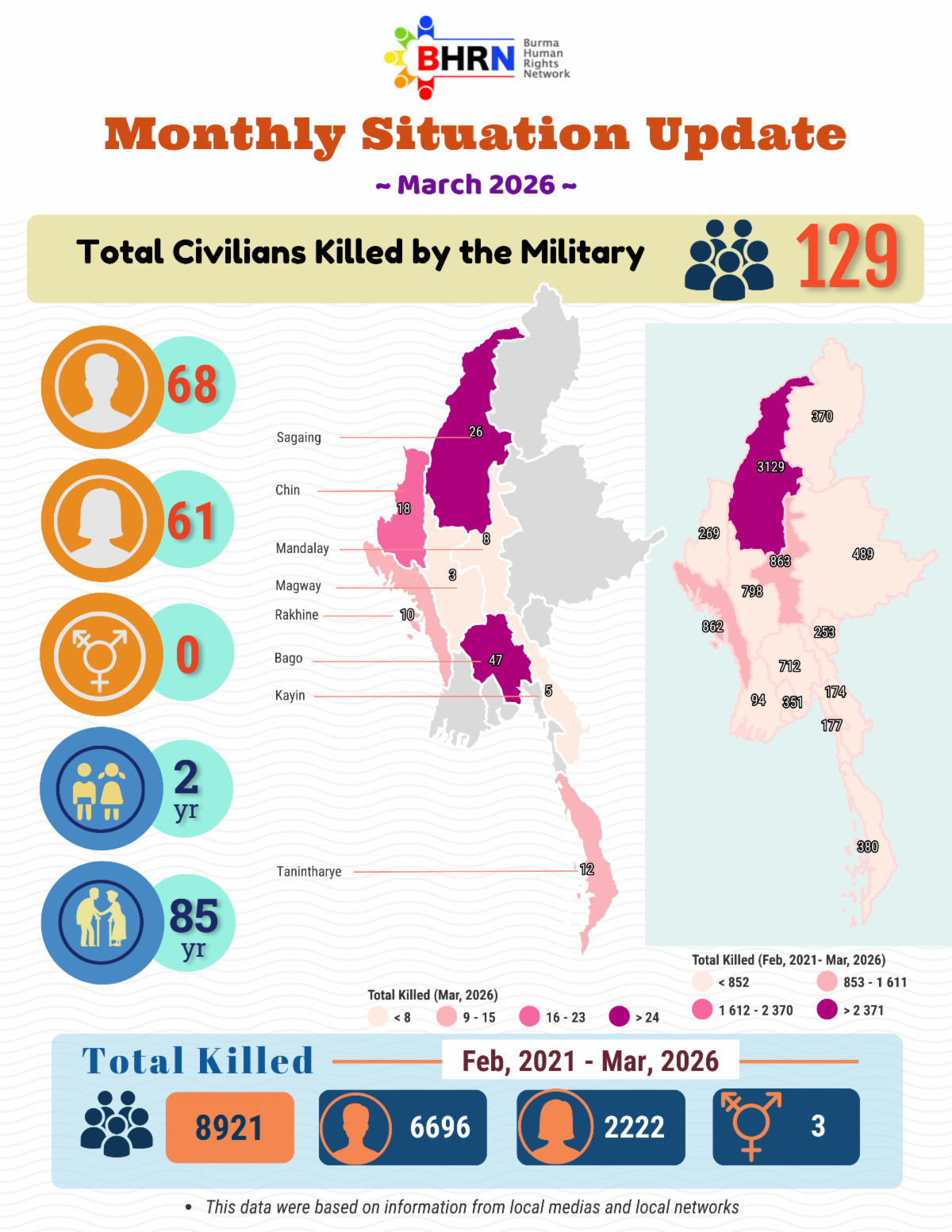
Methodology
This report is based on primary and secondary sources, including on-the-ground documentation by BHRN and other human rights groups and media reports from trusted national and international outlets. It provides a detailed analysis of key events during the month, situating them within international legal frameworks and offers policy recommendations to guide international responses, humanitarian action, and justice efforts.
1Info-graphs of BHRN’s Report
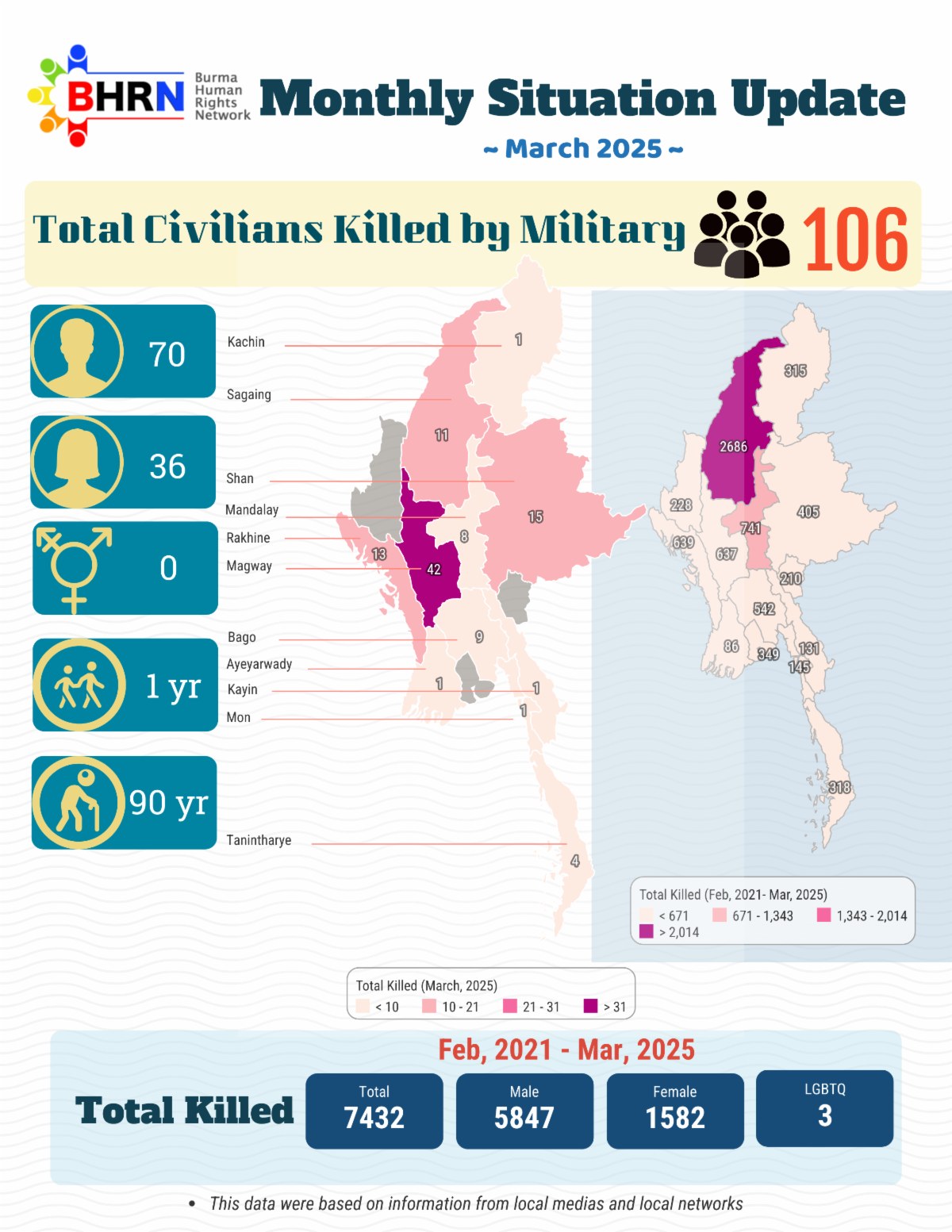

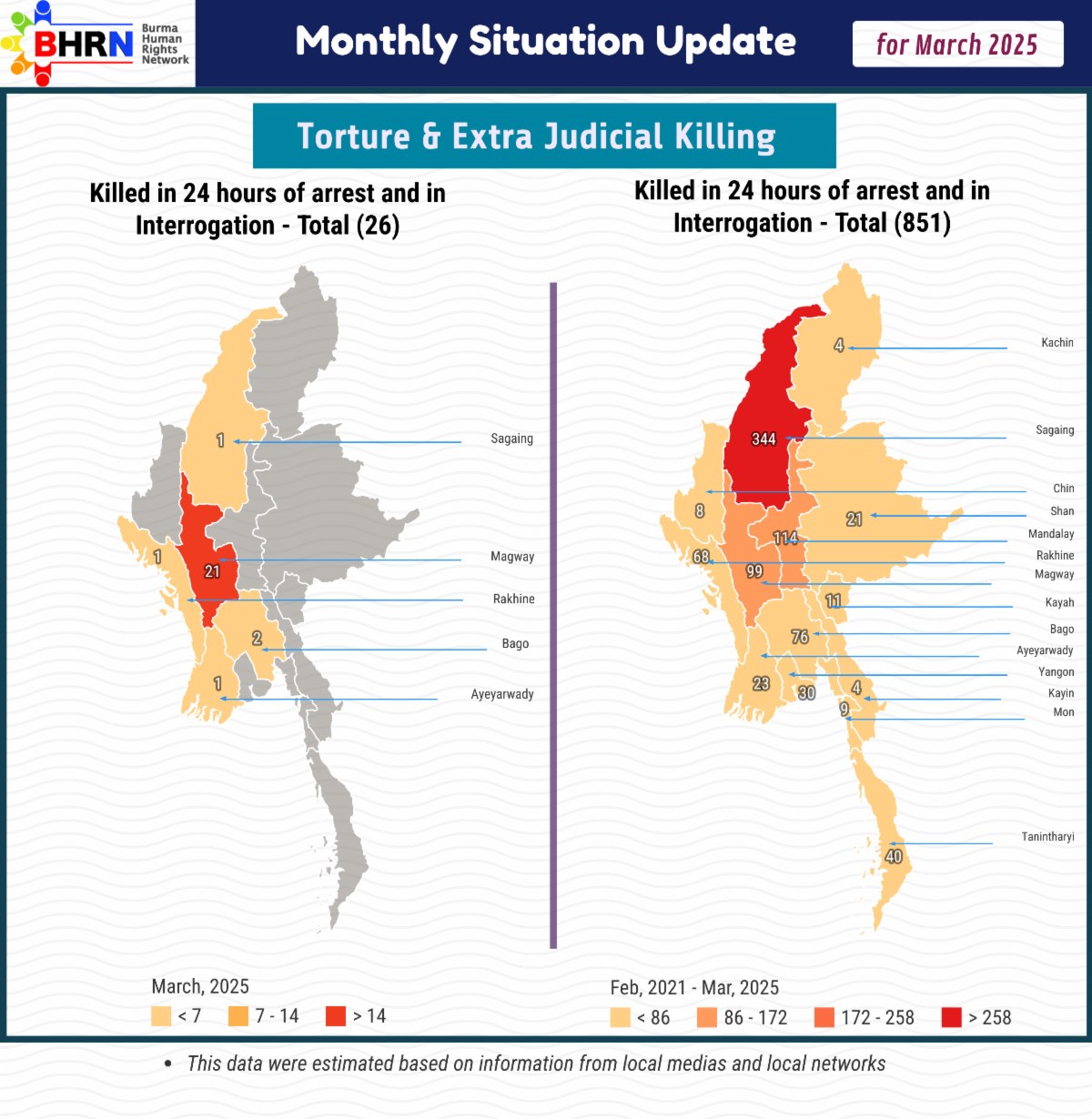

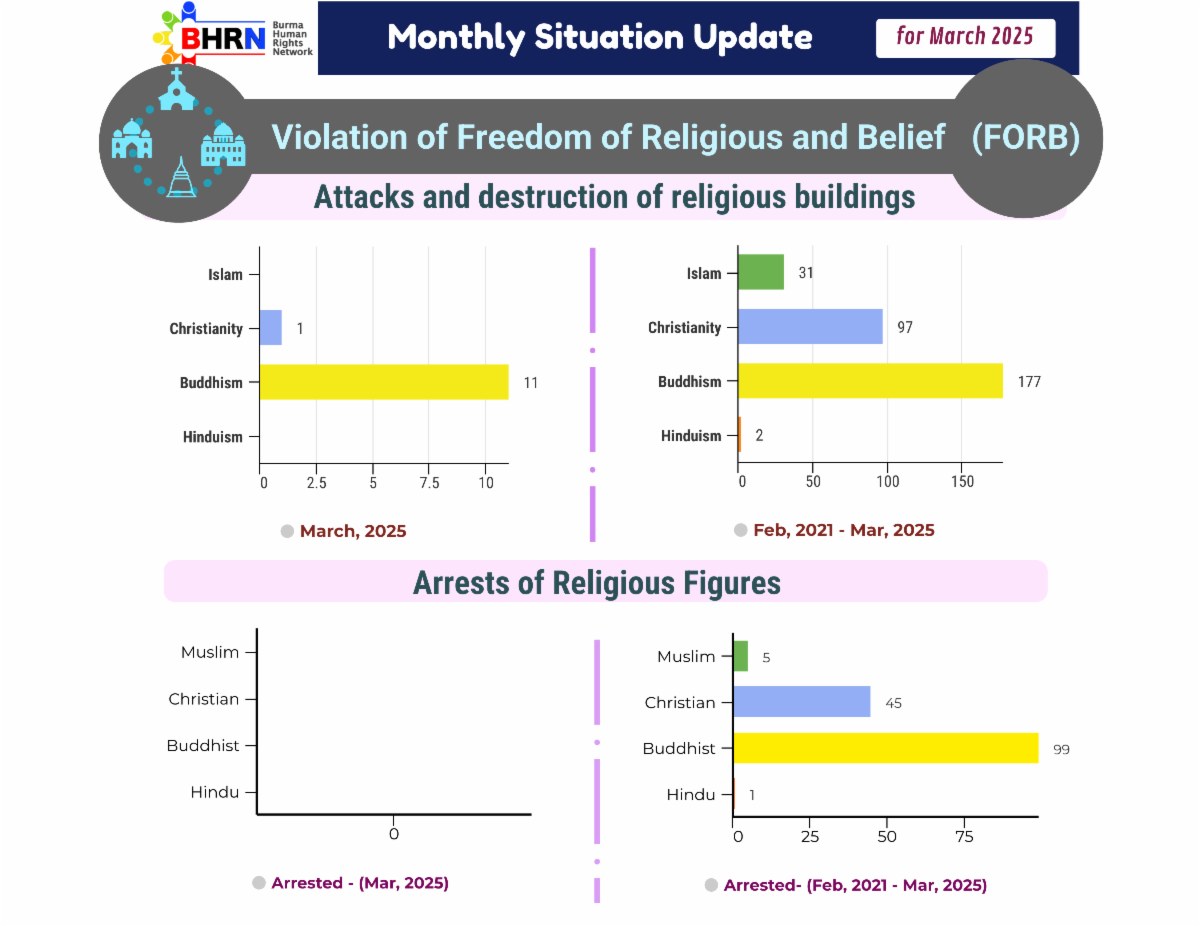
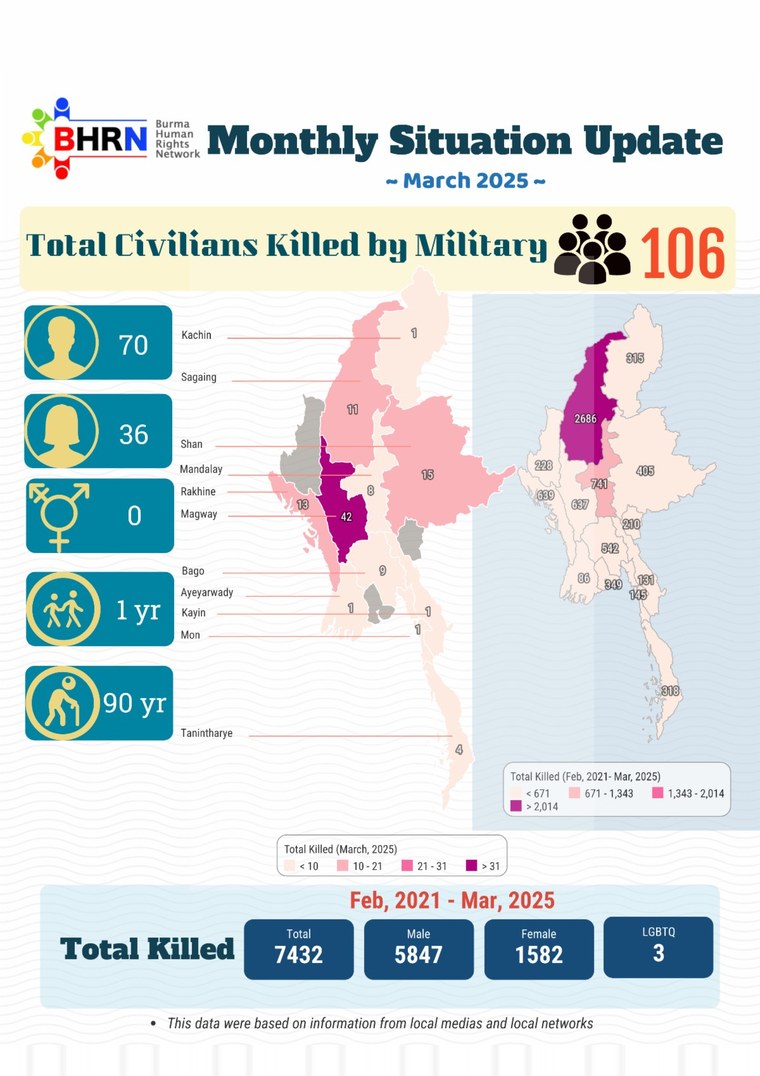
Tap any image to see it full size.
2News Summary and Analysis
This Month in Myanmar – March 2025
Summary
Myanmar’s military junta continued to terrorize civilians throughout March 2025, even as a devastating 7.7 magnitude earthquake struck the country. The disaster, which killed thousands and displaced tens of thousands more, was met not with aid but with obstruction: junta forces blocked humanitarian access, denied entry to earthquake affected opposition-held areas, and even launched fresh airstrikes on communities struggling to survive.
While pro-democracy forces declared ceasefires to facilitate relief efforts, the military pressed ahead with attacks in Sagaing, Bago, Magway, and Shan States. Junta air raids killed dozens of civilians and destroyed schools, homes, and religious buildings. Monasteries were bombed, clergy killed, and churches burned, part of a growing pattern of attacks on protected places and people.
In Rakhine State, the Arakan Army escalated its crackdown on the Rohingya. BHRN documented mass evictions, bans on Rohingya identity, and property seizures. A fire in a displacement camp in Sittwe left over 2,000 people homeless. Landmines, believed to be planted by the military junta, injured a Rohingya man near Maungdaw.
The junta’s campaign of forced conscription intensified. Children and youth were abducted from streets and homes, beaten, and dragged into military service. In some cases, those who resisted were killed. Meanwhile, pro-junta militias like Pyu Saw Htee continued to loot villages, extort civilians, and abduct farmers for ransom.
Extrajudicial killings surged, with victims tortured, executed, and dumped in roadsides and latrines. Junta forces raided villages in Magway and Bago Regions, leaving behind beheaded bodies and propaganda blaming resistance groups.
International pressure on the junta gained some ground. Switzerland finally sanctioned Myanma Oil and Gas Enterprise. Canada imposed new sanctions on military institutions. Sweden’s state pension funds divested from Indian arms exporters. At the same time, the credibility of the UN came under fire after revelations about the Myanmar envoy’s ties to Chinese-backed firms operating in the country.
As the junta touts sham elections and tightens its grip, millions across Myanmar are suffering from war crimes, forced conscription, displacement, and starvation. The military’s impunity is emboldened by global inaction, and it is civilians who continue to pay the price.
For more information about any of the incidents documented in this report, or to request interviews or supporting materials, please contact Kyaw Win, Executive Director of BHRN at
International Legal and Political Developments
Switzerland Closes Sanctions Loophole by Targeting MOGE
On March 7, Switzerland imposed sanctions on Myanma Oil and Gas Enterprise (MOGE), aligning with the European Union’s 2022 measures. MOGE remains the junta’s most critical revenue source, used to procure aviation fuel and weapons. The decision followed sustained pressure from civil societies, including Justice For Myanmar’s formal request under the Freedom of Information Act.
Why it matters
Switzerland’s action fills one of the final gaps in the international sanctions architecture targeting MOGE. The United States, United Kingdom, and Canada had already taken steps to sanction or restrict financial transactions with the company, but Switzerland’s delay created a backdoor for revenue to flow to the junta through European-linked financial institutions. While the Swiss sanctions mark significant progress, Australia and a handful of other countries have yet to impose measures targeting MOGE. Without globally coordinated sanctions on Myanmar’s state-owned enterprises, including oil, gas, and banking, efforts to cut off the junta’s access to capital will remain partial and insufficient.
Canada Imposes Sanctions on Military, Ministers, and Propaganda Arms
Also on March 7, Canada issued its first Myanmar-related sanctions of 2025. The measures target the military as a whole, including the notorious 33rd Light Infantry Division, as well as government ministries responsible for surveillance, propaganda, and repression. Several senior officials with ties to China and Russia were individually designated.
Why it matters
By sanctioning the military as an institution, Canada sends a powerful message: responsibility for atrocity crimes does not rest only with individuals but also extends to the entire apparatus of command and control. The move heightens risk for companies, governments, and arms suppliers that continue doing business with the military, raising the cost of complicity.
Sweden Divests from Indian Arms Exporter Supplying Junta
Sweden’s Council on Ethics confirmed it had divested from Bharat Electronics Limited (BEL), a state-owned Indian defense company actively supplying equipment to Myanmar’s military since the 2021 coup. BEL has provided radar systems and other military technology linked to surveillance and weapons targeting that may be used in war crimes and crimes against humanity.
Why it matters
The divestment draws international attention to India’s complicity in arming the junta and raises expectations for institutional investors to cut ties with companies aiding military atrocities. It also exposes India’s dual role as a regional power and enabler of repression, urging foreign governments to reconsider defense partnerships with New Delhi.
UN Special Envoy’s Business Ties Undermine Credibility
Julie Bishop, the UN Secretary-General’s Special Envoy on Myanmar, was revealed to be advising Energy Transition Minerals (ETM), a company linked to Chinese state-owned firms operating in Myanmar’s extractive sector. ETM’s partners include Shenghe Resources and China Communications Construction Company, both involved in rare earth mining and infrastructure projects that directly benefit the junta.
Why it matters
The revelations call into question Bishop’s impartiality and compromise the UN’s credibility. As China continues to bankroll and arm the junta, any financial or advisory ties between the UN envoy and Chinese-backed firms threaten the integrity of international diplomacy on Myanmar. Civil society groups are calling for an independent investigation and a full divestment from conflict-linked entities.
Junta Courts Belarus and Russia to Legitimize Sham Elections
Junta chief Min Aung Hlaing announced plans in early March to hold national elections by January 2026, a transparent attempt to cloak military rule in the language of democracy. He traveled to Belarus and Russia later that month, inviting both governments to send election observers. Belarus accepted, despite its own track record of electoral fraud, while junta-controlled media claim Russian backing for the polls.
Why it matters
The junta’s election plans are a transparent attempt to legitimize military rule amid ongoing repression and territorial loss. Endorsements from authoritarian allies do not confer legitimacy but rather reinforce the need for democratic states to reject the process outright and support a genuine democratic transition led by the people of Myanmar—not legitimized by dictators abroad. The military’s efforts to stage sham elections while continuing to bomb civilians and block aid expose the absurdity of its claims to political authority.
Resistance Gains
Ceasefire Calls from Resistance, Continued Violence from Junta
Following the earthquake, the National Unity Government, People’s Defence Force, and the Three Brotherhood Alliance declared unilateral ceasefires to allow humanitarian aid and search and rescue efforts to proceed. The junta, however, continued its military campaigns unabated, carrying out airstrikes and shelling in earthquake-hit areas in Sagaing, Bago, and Karen States. It was not until April 3 that the junta belatedly announced a limited ceasefire, set to run through April 22, but has since continued its attacks.
Why it matters
The opposition’s coordinated ceasefire reflects a commitment to humanitarian principles and demonstrates increasing political maturity among resistance forces. The junta’s decision to escalate attacks, even in disaster affected areas, underscores its entrenched disregard for civilian life. Far from restoring order, its actions further expose the illegitimacy of its rule and its ongoing failure to act in the interests of the people of Myanmar.
Mobye: Strategic Battleground in Southern Shan-Karenni Corridor
In early March, the Karenni Nationalities Defence Force (KNDF) launched a major offensive to reclaim Mobye, a critical town near Loikaw seized by junta forces in December 2024. The assault sparked intense clashes that extended into nearby towns including Hpasaung and Bawlakhae. Both sides suffered heavy casualties, and the battle remains a flashpoint in the southern Shan-Karenni theater.
Why it matters
Mobye is strategically located along critical supply routes into Karenni State. Resistance success here would significantly undermine junta control in eastern Myanmar and potentially shift the military balance in favor of opposition forces in the region.
Arakan Army Expands Operations in Rakhine and Irrawaddy Regions
The Arakan Army (AA) intensified operations in March, attacking junta forces near the Danyawaddy naval base in Kyaukphyu (March 1), entering Lemyethna Township in Irrawaddy (March 26), and capturing several villages. On March 30, the AA laid siege to a junta outpost in Kyaukphyu.
Why it matters
The AA’s expansion into new regions, including Irrawaddy, signals its growing operational reach and the junta’s inability to secure peripheral areas. Control over highway corridors and naval installations could further isolate junta forces and disrupt military logistics along the coast and riverways.
Significant Resistance Gains in Central and Northern Myanmar
- March 9
Natogyi PDF killed nearly 50 junta soldiers and detained 14 others in Mandalay Region.
- March 11
Junta retook Taung Hkam from TNLA and PDFs in Nawnghkio Township, Shan State.
- March 17
AA and allies attacked a key junta base in Nyaungyo, Bago Region.
- March 18
Katha PDF repelled a junta advance, killing 40 and capturing 29 troops.
- March 28–31
Junta airstrikes targeted resistance-held areas in Pauk, Singu, and Ponnagyun townships, despite earthquake devastation.
Why it matters
The volume and scale of resistance operations across the country point to the junta’s dwindling control and increasing territorial loss. Resistance attacks on military bases tied to arms production and logistics infrastructure weaken the junta’s warfighting capacity. Despite continued air superiority, the junta’s ground losses are mounting.
2.1BHRN's Comments on Earthquake
Myanmar is a deeply divided country politically, ethnically and racially. They become more evident in the aftermath of the latest natural disaster. Some use social media to express their divisive point of view, and some even rejoiced at the death of Muslims and destruction of mosques. Whereas some keep aside the differences and building unity and showing empathy to each other.
The time the earthquake struck coincided with tens of thousands of Muslims being in mosques across the country for prayers on the last Friday of the holy month of Ramadan. BHRN ha documented that there were 77 mosques and 4 Madrassa destroyed and 767 Muslim worshippers were killed.
Muslims blamed the regime for not allowing repair work for the mosques from the decade that has led to the death of many Muslims during the earthquake. Since 1962, according to unwritten state policy, for Muslim and Christians, building new mosques and churches and repairing or conducting maintenance have been banned.
Divisions were seen in sharing sympathies for the victims of the earthquake. Buddhists, in their social media posts, expressed their concerns only for the monks and Buddhists killed in the disaster, not for other victims belonging to members of ethnic and religious minorities. Some Muslims used this development to appease the Buddhist monks, who held animosity against Muslims, by providing relief funds to the monks affected by the earthquake.
While the relief efforts were ongoing, wealthy Buddhist businessmen went to Buddhist monasteries and publicly made vows to rebuild the Buddhist monasteries by using billions of kyats. Such funds could be prioritised for the relief and recovery work for the victims of the earthquake.
When the earthquake struck on the 28th of March, Myanmar was found absolutely unprepared to deal with a massive earthquake. It is despite the fact that most of the major cities in the country with a large urban population are situated along the Sagaing fault line, which is one of the largest sources of earthquakes in the country, having produced deadly quakes in the past centuries.
The largest quake along the fault line was in 1912, and there have been predictions by several experts that a major earthquake along the fault line is inevitable in this century.
The latest earthquake struck the central Myanmar region, with the worst hit cities being Mandalay and Sagaing, which are the centers for the Buddhist religion and culture while several historical mosques and Sufi Shrines along with Burmese Muslim heritage co-exist.
Sagaing and Mandalay are home to the country’s most famous pagoda and cultural sites. Among the hardest hit sites is Masoeyein Monastery in Mandalay. Most of the buildings in the vast monastery compound were reduced to rubble.
Masoeyien Monastery, where the ultra-nationalist monk Wirathu is based, and which has been the nerve centre for the monks who spread anti-Muslim rhetoric since 2012. As the result of hate messages spread from Masoeyein, several hundreds of Muslims were killed and displaced. Their action are also responsible for the genocidal attack against Rohingya Muslims in the Rakhine State.
The majority of Buddhists in Myanmar cheered the ideology spread from the Masoeyein monastery to kill and banish Muslims from Myanmar. And when the monastery was reduced to rubble in the earthquake, several Buddhists in Myanmar came up in support of the monastery. One wealthy businessman in Mandalay offered to rebuild the monastery and he vowed to spend up to Kyat 10 billion for the reconstruction. This shows that Myanmar is still not a united country even at a time of tragedy and grief.
One ideology spread from the Masoeyein monastery is that there is no ethnic Burmese who belongs to the Islamic faith. Most of the people of Myanmar believe in this false narrative. In the aftermath of the earthquake, it was revealed that most of the Muslims affected by the earthquake in Amarapura Township (derived from the original Hindi name Aamarapuur) are Burmese Muslims, and their villages were established during the time of the Konbaung Dynasty (1783-1885).
The ideology spread by the Masoeyein monastery not only stopped there by calling Burmese Muslims intruders, but they also committed severe insult to Islam and its Holy Book Quran. As a part of political reconciliation, it is important that the ethnic and religious identities of the ethnic and religious minorities are recognized. Also, a nation cannot achieve peace unless it ends the culture of segregation of minority groups and shuns the ideology of the zero-sum game by all the parties in Myanmar, including Muslims and other minorities.
On the other hand, several Buddhist individuals, including monks, showed solidarity after many Muslim worshippers were killed during the earthquake. Some even offered money to help rebuild mosques. In various locations, faith groups, businesspeople, wealthy individuals, and religious organizations—including Muslim, Christian, Hindu, and Buddhist communities—offered donations without discrimination, supporting each other regardless of religion. This is how Burma was, and this is how Burma should be. Such unity is only possible by rejecting any ideas or narratives that seek to divide these communities.
3On the Ground: Escalating Violence and Human Rights Violations
ITargeted Attacks on Civilians
Attacks intentionally directed against civilians not taking direct part in hostilities may constitute war crimes under Article 8(2)(e)(i) of the Rome Statute. When committed as part of a widespread or systematic attack against a civilian population, such acts may also amount to crimes against humanity under Article 7.
- 18 March
Approximately 40 youths were rounded up and sent for military training in Kalay Township, Sagaing Region, between 1 and 17 March, a local source told Radio Free Asia (RFA). He said the youths were abducted by junta troops for conscription. The victims were sent to No. 10 Military Training School, based in Kalay Township. In a single incident on 13 March, at least 10 youths who were playing a sepaktakraw game were rounded up and taken away by junta troops. “As they are not at the eligible age to be sent as conscripts, their families tried to secure their release,” the source said. The parents are currently being held in a government office, the source told RFA.
- 22 March
At least 10 civilians were killed in an air raid on a village in Gangaw Township, Magwe Region, on 22 March, a witness of the raid told BHRN. Among those killed in the air raid on Hnan Kha village were a doctor and his family, as well as some of his patients who were in the doctor’s home at the time. The victims included five children and an elderly woman. The source said that internet connections in the village were cut off; so far there is no detailed information on the extent of the damage. (BHRN Interview 008_220325)
- 24 March
The bodies of four civilians were found in a village in Salin Township, Mandalay Region, on 7 March, a member of a local pro-democracy resistance group told Radio Free Asia (RFA). He said the victims were believed to have been killed during a raid by junta troops on their village. The bodies were found in a pit latrine. The source said that as the bodies were not in a position to retrieve, they were buried in the same place by using sand,” the source told RFA.
IIAttacks on Religious Sites and Clergy
Attacks intentionally directed against religious buildings and protected personnel may constitute war crimes under Article 8(2)(e)(iv) of the Rome Statute. When committed as part of a broader pattern of persecution, they may also form part of a crime against humanity under Article 7(1)(h).
- 6 March
An elderly monk was killed in an airstrike by the junta in an area under the control of the Karen National Union (KNU) on 5 March, a witness of the attack told the Irrawaddy News. She said 62-year-old abbot, Ahnanthi Wuntha, was killed after a bomb dropped by the junta’s fighter jet hit his monastery in Kama Maung Township, which is under the control of the KNU’s No. 5 Brigade. “He died on the spot,” she said. She said two junior monks in the monastery were also injured in the attack.
- 18 March
Junta troops raided and ransacked a church in Bhamo Township in Kachin State on 16 March, a witness of the raid told BHRN. The witness said St. Patrick Catholic Church in Bhamo’s Paukkone ward was burned down after the raid. A clergy of St. Patrick Church told BHRN that the junta is attacking the religious sites of all religions in a bid to consolidate their military power saying, “They will kill and destroy religious buildings and clergies of all the religions irrespective whether they are Buddhist, Muslim, Christian or Hindu, are being targeted if their authorities is challenged. They are using any religion for their propaganda purposes”. (BHRN Interview 005_180325)
- 18 March
Several homes and monasteries were destroyed in an air attack by junta troops on a village in Taungtha Township in Mandalay Region on 18 March, a witness of the attack told BHRN. The witness said that apart from the destruction of homes and monasteries, there were no civilian casualties reported. The witness also added that the attack was carried out using weapons attached to a parachute. (BHRN Interview 006_180325)
- 21 March
A monk was killed and two others injured in a shelling by junta troops on a religious site in Kyaik Hto Township in Mon State on 21 March, a rebel group operating in the region, the Karen National Union (KNU), said in a statement . The KNU said the shells were fired from a junta base in Waw Township and fell on the monastery situated in Khaywe Ywa Myauk village in Kyaikto Township. The statement said the monastery building was destroyed in the attack.
- 24 March
An elderly monk was killed in an airstrike by junta troops in Gwaygon village, Salin Township in Magwe Region on 24 March, a witness of the airstrike told BHRN. The witness said a 75-year-old monk was killed in the attack on the Shwe Say Yan monastery. According to the witness, the monk died as he was preparing to leave the monastery together with two of his assistants to go to a medical facility for treatment. He said the monk’s two assistants were injured in the attack. (BHRN Interview 009_240325)
- 31 March
Two civilians, including a monk, were killed in a shelling by junta troops in Kyaukphyu Township in Rakhine State on 31 March, a witness of the attack told BHRN. Seven other civilians were also injured in the attack as the shells hit the fence of a monastery in Zin Chaung Kone village and the Aung Minglar ward in the village, the witness said. The monastery building and congregation hall situated inside the monastery compound were destroyed in the attack. (BHRN Interview 010_310325)
IIIExtrajudicial Executions and Terror Killings
The intentional killing of civilians, including through summary executions or targeted raids, constitutes a serious violation of international humanitarian law and may amount to war crimes. Where such killings are widespread or systematic and directed against a civilian population, they may also constitute crimes against humanity under Article 7(1)(a) of the Rome Statute.
- 2 March
Police killed a stuntman in Laymyathna Township in Ayeyarwaddy Region on 2 March, a witness of the killing told Mizzima. The unnamed victim was reportedly shot dead by two police officers, who were reportedly intoxicated at the time of the incident. The witness said the victim was present at the scene where the officers from Laymyathna police station were collecting bribes from civilians.
- 4 March
A youth was killed after junta troops and members of their affiliate Pyu Saw Htee militia abducted him and another civilian in Moe Nyo Township, Bago Region, a witness of the abduction told BHRN on 4 March. The incident occurred on 24 February in Thakhin Hla Shein ward in Moenyo, where the two victims—Ko Ah Nge Lay and another unnamed youth—were arrested by the two groups and forced into military service. “After their arrest, Ah Nge Lay was killed as he and the other youth planned to run away from their captors. They were beaten up in the General Administration Office, during which one of them died,” the witness told BHRN. (BHRN Interview 002_040325)
- 9 March
The bodies of six civilians were discovered in Yesagyo Township, Magwe Region, on 8 March, according to a member of the Yesagyo Information Committee, who spoke to Yangon Khit Thit News agency. The report said this was the second time bodies had been found in the area since junta forces raided villages in the region on 2 March. “We found the bodies of 11 civilians since the junta raided the area. 9 are from Myay Sun Taw village, and two are from Malakar Chan village,” the source said.
- 13 March
Junta troops killed two civilians in Nattalin Township, Bago Region, a local source told Yangon Khit Thit News agency . The attackers left a sign labeled “black death squad” on the bodies of the two victims. “The police from Taungnyo police station and the junta troops dropped the bodies on the road around 3 a.m., they carried the bodies on a civilian car,” the source said. The report noted that pro-junta media falsely claimed the attackers were members of the People's Defence Forces (PDF).
- 14 March
The bodies of six civilians were found in a village in Yesagyo Township, Magwe Region, after a raid by junta troops, the Yesagyo Township Information Committee said in a statement issued on 14 March. The statement said one of the six bodies, found in Thargaung Ywa Ma village, was beheaded and found in a sitting position. The junta troops had reportedly raided the village on 7 March and remained there for five days. The six civilians are believed to have been killed during that time, the Committee said.
IVUse of Landmines Against Civilians
The use of landmines in civilian areas violates the principles of distinction and proportionality under international humanitarian law and may constitute a war crime. When used systematically or as part of a widespread attack against a civilian population, such acts may also amount to crimes against humanity under Article 7(1)(k) of the Rome Statute.
- 19 March
A Rohingya Muslim man was severely injured in a landmine explosion in Maungtaw Township, Rakhine State, on 18 March. The landmine witness told BHRN the mines that injured him are believed to have been planted by junta troops. The victim’s left leg was amputated due to the blast and he also sustained injuries to his right leg. (BHRN Interview 007_190325)
VLooting, Extortion, and Terror by Pro-Junta Militias
The deliberate targeting of civilians for looting, extortion, and terror undermines protections afforded under international humanitarian law and may amount to war crimes. If carried out as part of a widespread or systematic attack against a civilian population, such acts may also constitute crimes against humanity under Article 7(1)(h) of the Rome Statute.
- 17 March
Members of the pro-junta militant group Pyu Saw Htee are accused of looting Muslim-majority villages in Kanbalu Township, Sagaing Region, a witness of the looting told BHRN. The witness said members of the militant group are stationed near the villages under orders from junta troops to steal civilians’ property and carry out extortion. “They give an excuse that they are taking position in these villages to protect civilians, as they have intelligence about attacks by pro-democracy militia groups - the Peoples’ Defense Forces,” the source said. The source added that Pyu Saw Htee members are abducting farmers working in their fields and demanding large bribes in exchange for their release. (BHRN Interview 004_170325)
VIPersecution and Forced Displacement of Rohingya
The targeting of Rohingya civilians through arbitrary evictions, confiscation of property, prohibitions on identity, and restrictions on return may constitute persecution under international law. If these acts are part of a widespread or systematic attack against the Rohingya population, they may amount to crimes against humanity under Article 7(1)(h) of the Rome Statute.
- 1 March
More than 2,000 displaced Rohingya Muslims were affected by a fire in a camp in Sittwe Township, Rakhine State, on 1 March. An announcement by the military junta stated that the fire at the camp in Khaung Dokkha village destroyed 34 building blocks containing a total of 272 rooms that housed 324 households. The announcement was published in the state-owned Myanma Alin newspaper(Pg.10) two days after the incident.
- 3 March
The Arakan Army (AA) sealed off the homes of affluent Rohingya businessmen in Maungtaw Township, Northern Rakhine State, according to a report by the online news site Arakan Express News (AEN), which quoted a local source. The report stated that at least 50 homes belonging to Rohingya businessmen who fled the town after the AA captured it last year were taken over by the AA.
- 7 March
The Arakan Army (AA) is forcibly relocating Rohingya villages in Buthitaung Township, Northern Rakhine State, according to a report by the local online news site Arakan Express News (AEN). The report stated that the AA confiscated farms and gardens owned by Rohingya communities. “AA told us that we do not have permission to return to our villages,” a source told AEN. The report added that the AA had forced civilians from at least 12 Rohingya villages to leave and is planning to relocate them to the eastern parts of the May Yu River.
- 8 March
The Arakan Army (AA) has prohibited the use of the term "Rohingya" in areas under its control, according to a report by the local online news site Arakan Express News (AEN). The report stated that AA officials issued a verbal order declaring that anyone who uses the term will face severe punishment. A legal expert, U Min Lwin, said the Rohingya Muslim community in Rakhine State, which is the second-largest ethnic group in the state by population, has been legally referred to as Rohingya since 1948. However, AEN reported that household registration documents issued by the AA after it took control of the region listed Rohingya only as "Muslims."
- 17 March
Seventy Rohingya Muslim households in Maungtaw Township, Rakhine State, were evicted from their homes by the rebel group controlling the area, according to a report by Arakan Express News (AEN). The report stated that the Arakan Army (AA) forced the Rohingya community to relocate after conflict erupted in the region last year. “Initially, we thought AA asked Rohingya Muslims from Myawtaung village to relocate to avoid the conflict. They were asked to move to the northern parts of the town. But later, AA refused to allow them to return to their homes, even for a short period to take essential items from the homes,” a source familiar with the situation told AEN. The news agency reported that the AA forcibly relocated local communities after taking control of Maungtaw and other parts of Northern Rakhine in late 2024.
Rohingya in Bangladesh Refugee Camp
- 5 March
Border Guard Bangladesh (BGB) detained 20 Rohingya refugees, including children, at the Alikadam Upazila bus stop in Bandarban district as they entered from Myanmar. They were forcibly pushed back through the Poamuhuri border the same night, violating international human rights and refugee protection laws. A week later, they managed to reach the camp by bribing BGB and local brokers with 12,000 taka each.
Source: BHRN - 5 March
The World Food Programme (WFP) announced a severe cut in food rations for Rohingya refugees in Bangladesh due to a funding shortfall. The rations were to be reduced from $12.50 to $6 per person per month, leaving each refugee with only 20 cents per day for food. This decision followed previous ration cuts in 2023 and raised concerns about malnutrition, hunger, and health crises among the nearly one million Rohingya refugees in Cox's Bazar. However, following a visit from UN Secretary-General António Guterres and Nobel Laureate Muhammad Yunus, the WFP temporarily restored the food assistance to $12.50 per person per month. Despite this, the WFP cautioned that future assistance depends on consistent international funding.
Source: BHRN - 30 March
A 22-year-old Rohingya man named Muhammed was kidnapped from Kutupalong Market by a Bangladeshi gang. The kidnappers contacted Muhammed's family, demanding a ransom of 500,000 BDT, and sent a video of Muhammed being tortured. Despite filing complaints with the police and UNHCR, the family has received no assistance and is struggling to raise the ransom, leaving Muhammed's fate uncertain.
Source: BHRN
VIIViolations of the Right to Life at Sea
The death and disappearance of refugees fleeing persecution, when caused by the deliberate denial of safe migration routes and failure to rescue, violate the right to life under international human rights law. When states or non-state actors create conditions that systematically force civilians into life-threatening journeys, these acts may constitute crimes against humanity under Article 7(1)(h) (persecution) or 7(1)(k) (other inhumane acts) of the Rome Statute.
- 21 March
At least 25 Rohingya Muslim refugees are missing after a boat carrying them capsized on 21 March, Bangladeshi news reported. According to the reports, the incident occurred near Shahpori Island, close to Teknaf Province in Bangladesh. The boat was carrying at least 50 Rohingya Muslim refugees at the time of the incident, and half of them were rescued by the Bangladeshi Border Guard Forces(BGB). One member of the border guard force is also believed to be missing in the incident, according to Bangladeshi news agencies
VIIIArbitrary Arrests and Forced Conscription
The arbitrary arrest and forcible conscription of civilians, including children, violates international human rights law, particularly the prohibitions on arbitrary detention, cruel and inhuman treatment, and the recruitment of children. When such acts are committed systematically or as part of a state policy, they may amount to war crimes or crimes against humanity under Articles 8 and 7 of the Rome Statute.
- 1 March
The junta arrested two civilians in Thoneze Township in Bago Region on 1 March, a witness of the arrests told BHRN. The witness said the two youths were abducted and forced to serve in the military. The two initially argued that they should not be conscripted because they had been paying a monthly bribe of Kyat 100,000 to local authorities to avoid military service. “Despite they made plea, and argument they were beaten up and taken away,” the witness said. (BHRN Interview 001_010325)
- 10 March
The junta abducted eight civilian youths during a series of raids on villages in Okpo Township in western Bago Region, according to Ko Dewa , a spokesperson of the local resistance group, the Okpo Underground Guerrilla Group told RFA. “The situation was very bad yesterday, all 8 youths were taken away,” he said.
- 18 March
At least 30 civilians were killed in a village in Singu Township in Mandalay Region during a series of air raids carried out by junta troops, a spokesperson for the local pro-democracy resistance group People’s Defense Force–Mandalay (MDY-PDF) said to RFA. He reported that the victims were from Latpan Hla village, which suffered three air raids in one month. “The air raids on the villages took place on the 14th and 17th of March. We see it as a deliberate targeting of civilians,” the group said.
- 10 March
Junta troops abducted six youths working as waiters in a restaurant in Minhla Township in Bago Region on 10 March, a witness of the abductions told BHRN. He said the group was arrested after they refused to serve alcoholic drinks to a group of soldiers. “They politely told them that they could not sell the drinks as the shop owner was not present in the restaurant at that time. They were later arrested. The restaurant owner had to bail them out, after paying a bribe of 20 million to the local authorities,” the witness said.(BHRN Interview 003_100325)
About BHRN
Burma Human Rights Network (BHRN) is based in London, operates across Burma/Myanmar and works for human rights, minority rights and religious freedom in Burma. BHRN has played a crucial role in advocating for human rights and religious freedom with politicians and world leaders.