
Methodology
Information in this document has been gathered by the BHRN team by primary and secondary research methods. We employed local researchers and local informers across Burma including in Rakhine State, Thai-Burma border and the Bangladesh border monitoring, investigating and documenting incidents of human rights violations. Any information we receive is carefully checked for credibility and authenticity by experienced senior research officers in the organisation. Once the information is approved the editorial team prepares the final document.
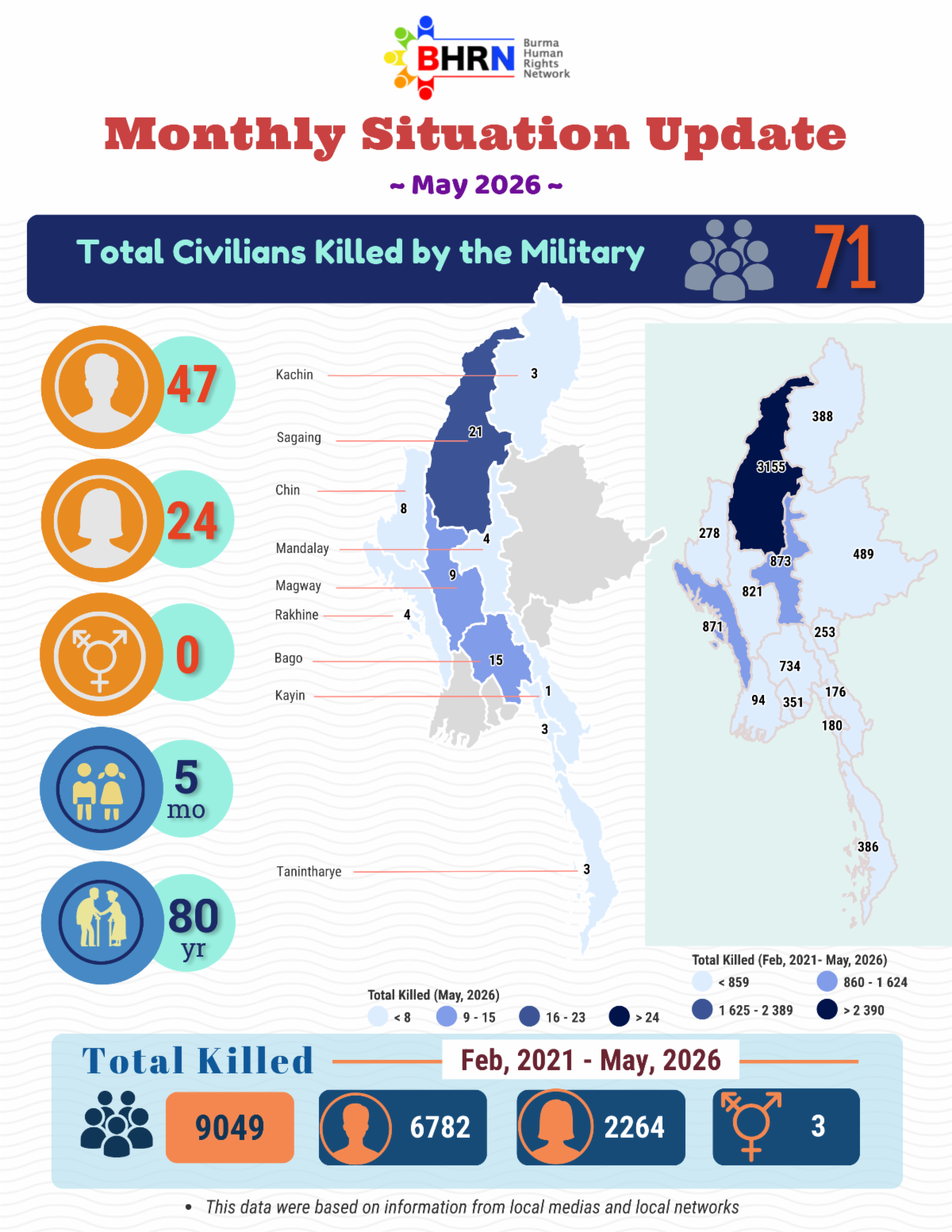
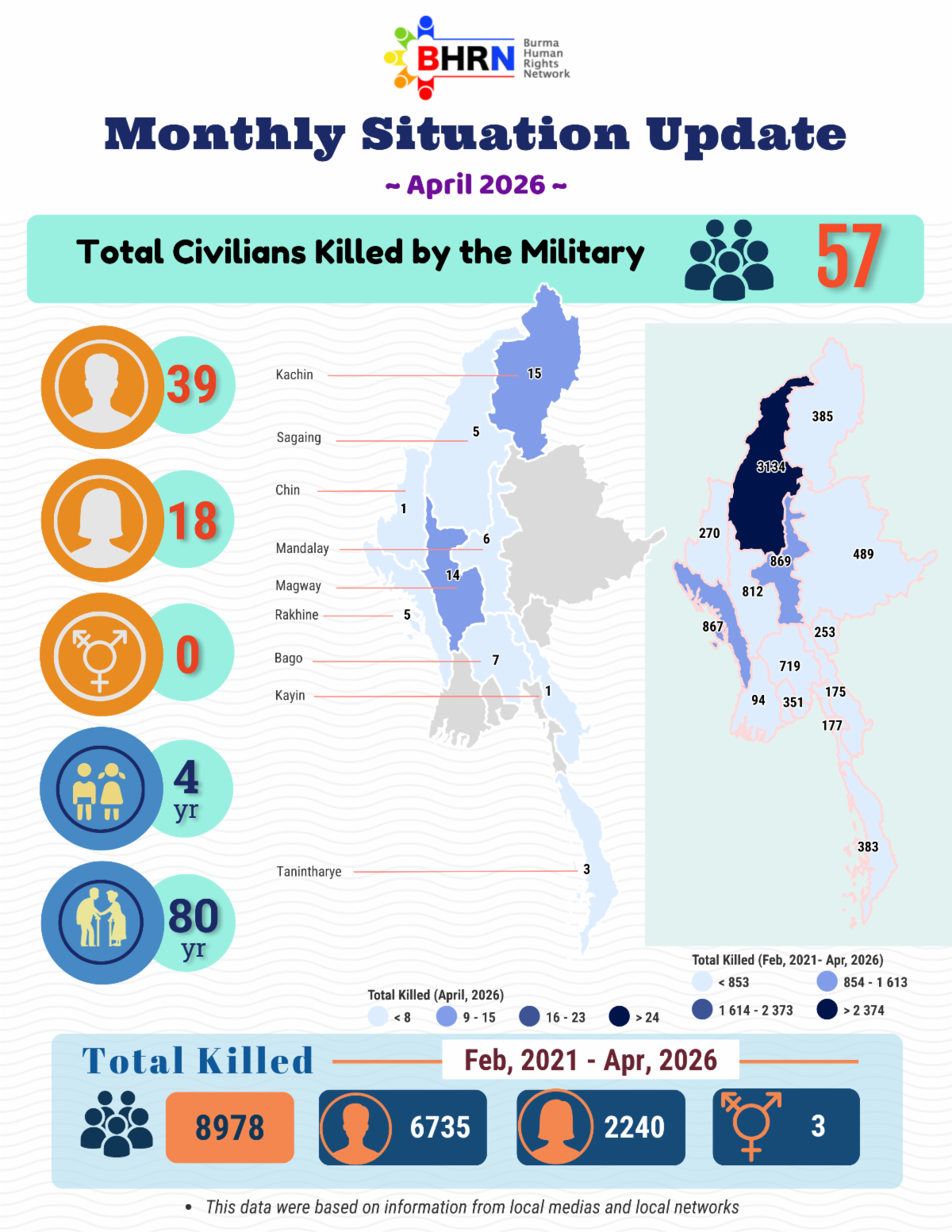
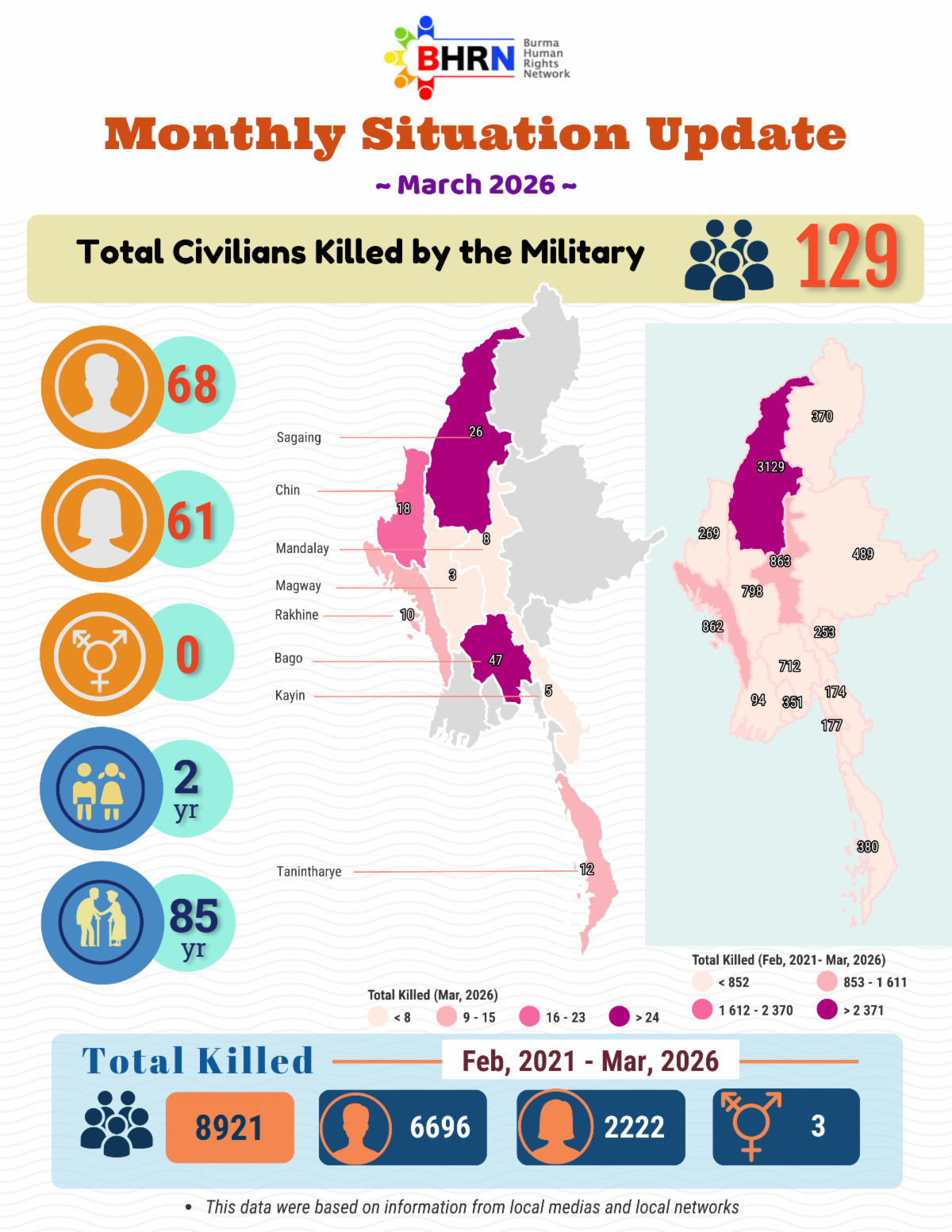
1Info-graphs of BHRN’s Report

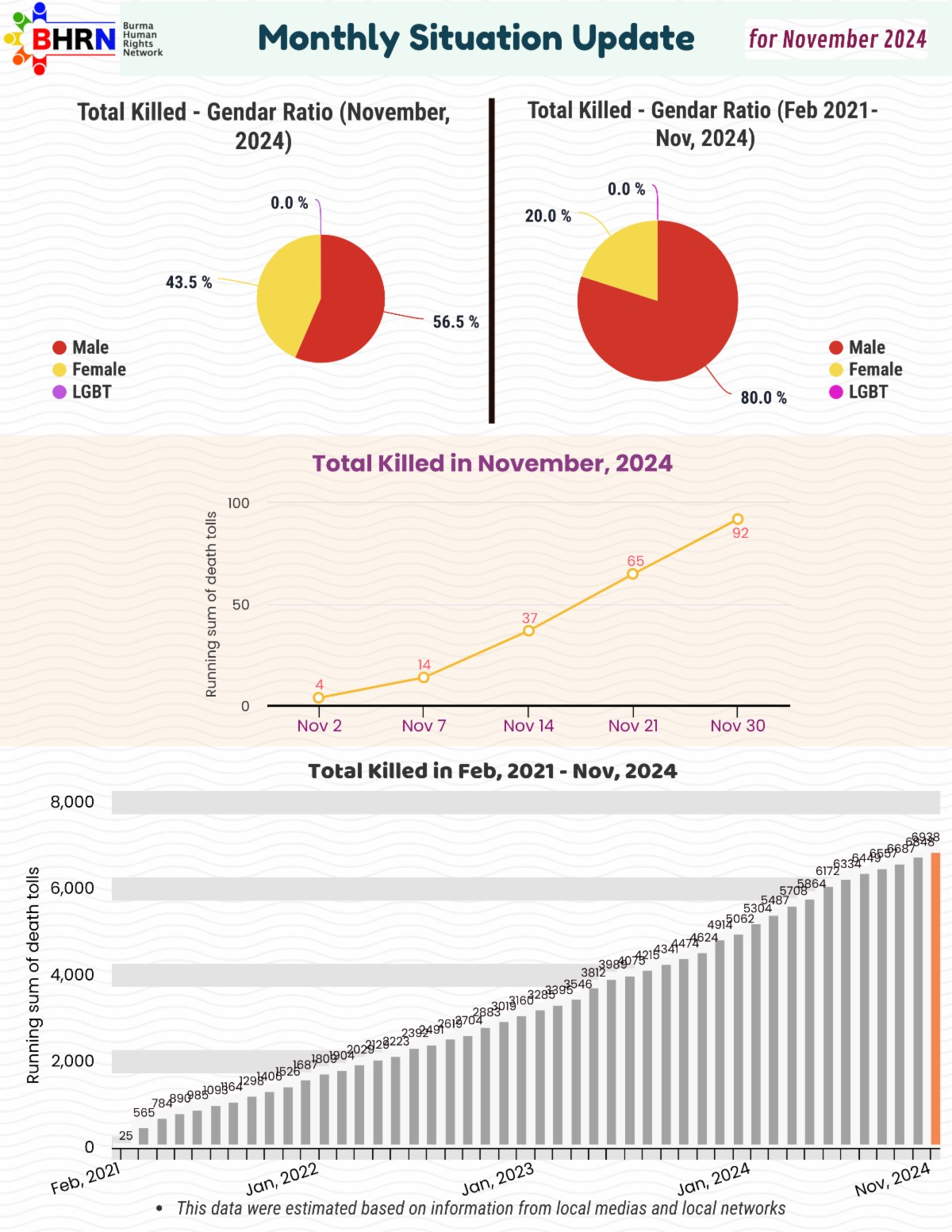

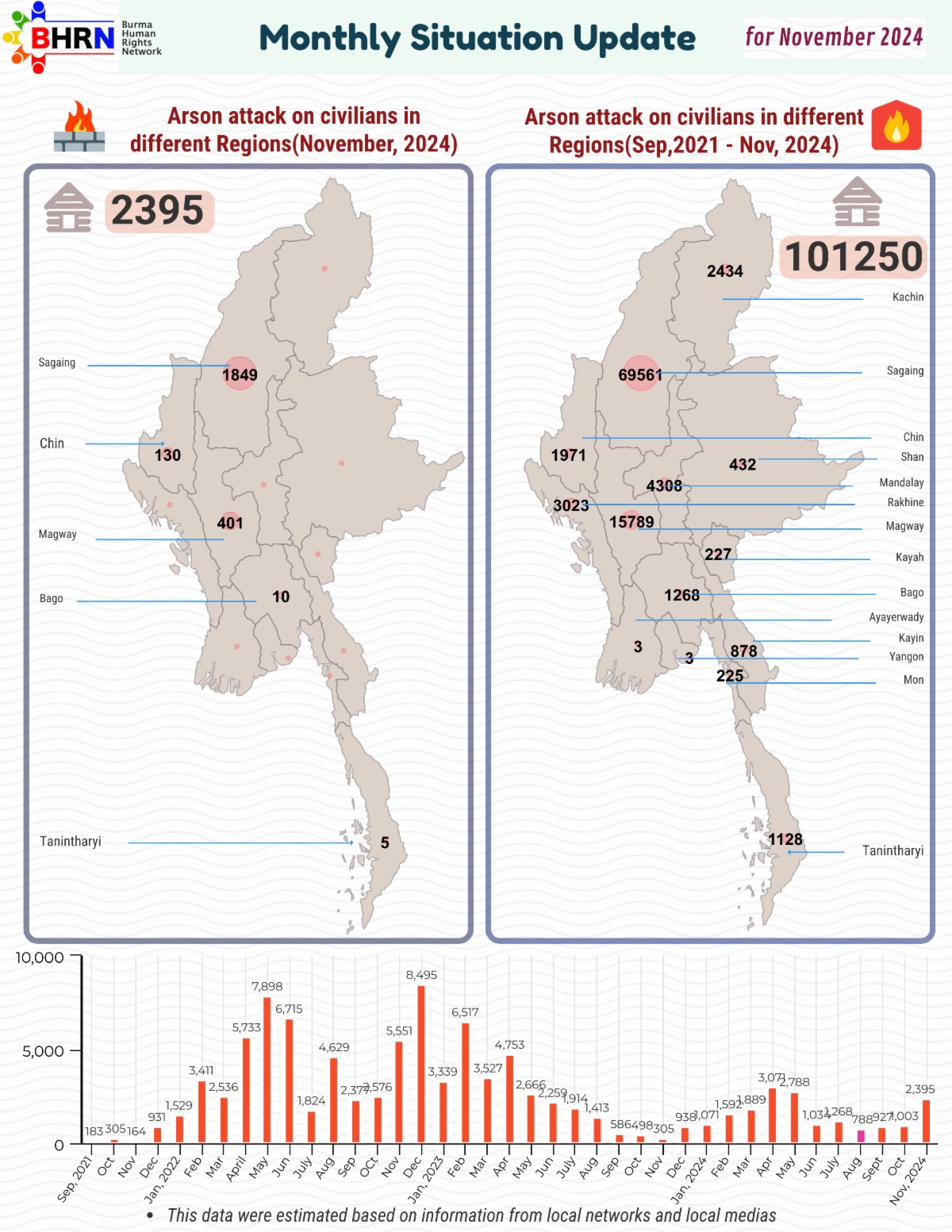

Tap any image to see it full size.
2News Summary and Analysis
Introduction
There has been a long-held perception among international experts that China’s intervention in Myanmar’s internal affairs has adversely affected the peace, stability, and reconciliation in the Southeast Asia country. However, China officially says frequently that it has no intention to do so, but wants to see peace, and stability in Myanmar.
However, the events unfolding during the past few weeks not only reinforced a notion of how China’s intervention in Myanmar’s internal affairs is having an adverse effect on the country but they also indicated that China is using Myanmar as a pawn to meet its ambition to become a global power.
These developments also tend to indicate that China may be pushing Myanmar toward a fragmented failed state so that it can expand its sphere of influence on the country.
These developments included a call by China to end the second phase of Operation 1027 led by pro-Chinese rebels. That caused a major setback for the rebel group. The call by China comes as the rebel groups tried to forge a closer tie with the National Unity Government (NUG), which is widely perceived as pro-Western.
NUG was offered to open its office in Lashio, near the Sino-Myanmar border, by the Myanmar National Democratic Alliance Army (MNDAA), which has controlled the city since August this year. After that, Beijing abruptly told the rebel group to cease its operations in the region and even told the group to return the control of Lashio to the military regime.
MNDAA along with its allies Taung Palaung Liberation Army (TNLA) and the Arakan Army which forms the Three Brotherhood Alliance launched Operation 1027 a year ago with the apparent blessing of China.
The abrupt change of strategy from China did not come without a reason, it is apparently driven by its geopolitical interest. With looming tougher trade and foreign policies to be directed toward Beijing by the new Administration in the United States, China needs more reliable partners in the region to counter them. Myanmar, which provides China with a stable way to the Indian Ocean is increasingly seen as a strategic partner.
To secure the route to the Indian Ocean, China has already invested heavily in infrastructure projects in Myanmar.
At the same time, China learned from the experience of the past that relying on one group in Myanmar is not a strategic move (an example of ceasing the Myitsone dam project in 2011 by a previous regime in Myanmar supported by the Chinese government), so it is placing its support on different groups, including the Min Aung Hlaing regime. China initially maintained lukewarm with the new military regime.
Also, China seems to be pushing Myanmar towards a failed state to justify the deployment of its security apparatus in the country to protect its interests. It has become evident China wants to maintain its influence on Myanmar not only to control its internal politics in favour of Beijing but also to push Myanmar toward the centre of its power struggles with the Western powers, particularly the US.
The questions may arise why access to the Indian Ocean is so important for China how Myanmar can help China meet that ambition and how China lay the groundwork in Myanmar to allow it to get stable access to the seas?
Importance of Access to the Indian Ocean for China
According to a US-based Think Tank group The Carnegie Endowment for International Peace China imports 80 percent of its crude oil supply passing through the Indian Ocean and the Strait of Malacca, energy security is an important motivator for China’s presence.
A research report by the group published last year said while China has increased crude oil imports from Russia, it still depends on energy imports from Saudi Arabia, Iraq, Oman, and Angola. It said China is the top import partner for twenty-four countries in the Indian Ocean and the top export partner for thirteen countries.
The research report also said China’s military presence in the region has matched its economic engagements and increased steadily.
Why Myanmar is important?
An online publication The Maritime Executive reported that in Myanmar, China sees an opportunity for direct access to the Indian Ocean, significantly expanding its sea power beyond its influence in the Pacific region.
A news report published by the Maritime Executive in October last said partly, this ambition is anchored on China’s bilateral partnership with Myanmar. “In 2018, China signed an MoU with Myanmar to establish the China-Myanmar Economic Corridor (CMEC). In January 2020, during a two-day visit by President Xi Jinping to Myanmar, 33 projects were identified to operationalize CMEC. This included the development of Kyaukpyu Port and Special Economic Zone, Myanmar’s first deep-sea port in Rakhine State,”
“The CMEC is a 1700-kilometre, inverted y-shape corridor featuring strategic assets including roads, railways and ports, which are expected to connect Kunming in Yunnan Province to Myanmar’s Yangon and Kyaukphyu,”.
In addition, a railway line connecting Southwest China’s Chongqing Municipality to Mandalay, southern Myanmar, officially started operation in May, according to a report by China’s Community Party-affiliated Global Times newspaper,” the report said.
Chinese security Company
Recent media reports suggest that China is collaborating with the Myanmar military junta to establish a joint security company to protect Chinese investments and personnel in Myanmar.
A news release by the military regime’s information ministry in late November said the junta formed a working committee in late October to draft a memorandum of understanding (MoU) for the initiative, reflecting China’s growing concerns over the security of its projects, particularly those under the China-Myanmar Economic Corridor.
The move could be in response to recent threats to Chinese interests in Myanmar including oil and gas pipelines. Notably, in January 2022, a local People’s Defense Force attacked a nickel processing plant in Sagaing Region. More recently, the Chinese consulate in Mandalay was damaged in a bombing attack last month.
Internal crisis
By observing these facts, it can be said that the influence of China is likely to keep Myanmar in a protracted conflict and political stalemate.
And despite the recent military debacles the junta seems to be untied, however, its unity could be tested if and when the International Court of Justice issues an arrest warrant against Min Aung Hlaing.
It is reported that the ICJ prosecutors requested the court a few weeks ago to issue an arrest warrant against Min Aung Hlain in the ongoing case of genocide Myanmar is facing in the Hague-based ICJ. The initial response from the junta is since it is not a member of the court it does not recognize the arrest warrant.
Fighting with ethnic armed organisations
Due to China’s disapproval of the offensive in the Northeastern parts of the country which until October seems to have advanced toward controlling major cities like Pyin Oo Lwin and Mandalay.
However, it has stalled due to China’s intervention to stop fighting. In spite that the offensives by the rebel groups in Rakhine and Kachin states have made further progress.
It is likely that the focus of the attention of the conflict in the coming months will be Rakhine and Kachin states, where the rebel groups are likely to gain control of more territory from the junta.
In Rakhine State, the Arakan Army (AA) is on the verge of taking over the headquarters of the junta’s Western military command based in Ann Township. As the AA continues to expand the areas under its control, the situation of Rohingya Muslims in the areas under its control comes under the spotlight. So far there are reports of AA committing violations of the rights of Rohingya communities including imposing travel bans on them, and many Rohingya Muslims continue to flee Rakhine State.
The developments in Rakhine State in particular where minority Rohingya Muslims continue to face oppression under the leadership of AA, this issue could be of intense international attention in the coming months.
In Kachin State Kachin Independence Army has made further territorial gains near the Myanmar border, and last month they took over a strategically important town of Pangwa, which was under the control of a pro-junta militia group The New Democratic Army-Kachin (NDA-K)
Sham elections?
The junta is trying to reach out to its neighbours to sell its plan of political transition by conducting an election.
China as well as India and the Association of Southeast Asia Nations (ASEAN) seem to be supportive of the junta’s transition plan. They express their support for sponsoring a dialogue with the junta and opposition groups on how to support the process.
However, the junta failed to make any political overture to allow the opposition to join the political process.
Amid the political stalemate, the National Unity Government (NUG) continued to fail to get official recognition from the international community despite its attempt to secure recognition from several Western powers. The NUG’s belief in the armed struggle to restore democracy could be the reason for the Western powers not granting official recognition to it. This is despite the fact that most of the members are elected politicians from the former government led by the National League for Democracy (NLD).
In some move to win more support from the people of Myanmar, the NUG office in Seoul recently issued an extension of the passport of Myanmar nationals based in South Korea. This could be done as the South Korean government granted recognition of the NUG to support Myanmar workers in the country.
Anti-Muslim sentiment
Across Myanmar, the influence of ultra-nationalist monks seems to be active as the junta always use anti-Muslim sentiments to ignite religious violence in the country when it is facing attacks from opposition in the country. The junta in the past used anti-Muslim sentiments among the Buddhist community in the country for its political gain. This theory is proved successful for the junta to divert the public attention whenever they are in trouble. Since dictator Ne Win to the current junta, they have heavily invested time and money on state sponsored institutionalised Islamophobia and it is not easily disappearing.
Observation and analysis
- Myanmar faces unprecedented challenges not only from internal political dynamics but also from China’s attempt to use the country as a pawn in its quest to become a global economic power. With China wanting to increase its sphere of influence in the region it is inevitable that China may use a vulnerable country like Myanmar as a part of its plan.
- As the trade war with the US is likely to intensify it is likely that China will more aggressively pursue expansion of its sphere of influence across the world with particular focus on its neighboring countries.
- In such a situation Myanmar may be forced to change its foreign policy of neutrality, and there is a possibility that Myanmar as a failed state, sided with China. There will be a danger of the country being used as the ground for a power struggle among the superpowers, which the country is able to avoid due to its non-aligned foreign policy.
- China may push for the elections in Myanmar, and it is likely to support the elected government coming to power through elections to be organized by the junta in some time in 2025. The election is likely to push the country into a deeper political crisis, instead of resolving it. As a significant portion of the country is under the control of rebel groups and the opposition parties are likely to boycott the polls without their leaders being released from detention.
- At this stage it will be unrealistic to talk about the elections, and political reconciliation, while the junta continues to hold hundreds of political prisoners including the key leaders of the opposition.
- There is an urgent need for international attention to the situation of Rohingya Muslims both in Myanmar and Bangladesh, as those in Myanmar are likely to face further threats from the rebel group AA which now controls the entire Northern Rakhine State. Also, the new government in Bangladesh wants to expedite the process of repatriating them back to Rakhine State.
- It remains to be seen if the junta will continue to be united after the ICJ issued an arrest warrant against Min Aung Hlaing. Even though it is unrealistic to arrest him in the coming months, it could make his political position at home more untenable.
3Rohingya Issue
3.1Rohingya in Rakhine Updates
- 9 November
The junta is forcing Rohingya Muslim youths from northern Rakhine State to join the fighting a rebel group the Arakan Army (AA) in Taunggyup and Ann townships in the southern parts of the state, a military analyst said. He said the junta deployed Muslim youths to the frontline after a short military training. The source said hundreds of Muslims were forced to join the fighting in two villages near Ann Township, where the junta’s Western Command is based. The source said several Muslim youths were also forced to fight alongside the junta troops in Taunggyup Township. He said Muslim youth who joined the fighting in Taunggyup were recruited from the Kyauktalone camp for Muslim displaced people, which is located in Kyaukphyu Township. Amid fierce fighting in Rakhine State with AA the junta is forcing not only Muslim youths based in the state as well as those who fled to Bangladesh to join the fighting, the source said, adding that Muslim youths were deployed to the frontline areas after providing 45 days military training.
Source: Narinjara - 13 November
A rebel group Arakan Army (AA) is accused of killing a Muslim youth in Buthitaung Township in Rakhine State, a local source said. He said 23-year Rafi Kadir son of U Rafi has died while he was under detention by AA. His body was delivered to his family on 11 November. Rafi Kadir was arrested in late October from his home in ward no 5 in Maungtaw Township, the source said, adding that the reason for the arrest was unknown. The source said AA has stepped up its attack on educated wealthy Rohingya Muslim families after it took over control of the town in May. The incident involving Rafi Kadir is one such incident where AA targeted local Rohingya communities.
Source: Arakan Express - 16 November
The Thai authorities intercepted a boat carrying 70 Rohingya refugees near Phang Nga island in Southern Thailand, a media report said. Reuters news agency quoting Thai authorities said about half of arrested Rohingya Muslims on the boat in the incident were children. The Governor of Phang Nga District Supoj Roddrung told Reuters news agency that the boat was on its way to Malaysia. He said an investigation will be launched against the illegal immigrants.
Source: Arakan Express - 18 November
At least 174 Rohingya Muslim refugees were killed in a boat incident in Hain Gyi Island in Ayeyarwady Region on 10 November. The incident was reported by a UK-based pro-Rohingya group Burma UK Rohingya Association (BROUK) on 18 November. It said only six people on the boat survived. It said they were rescued by a foreign ship and were handed over to the junta forces. BROUK said most of the victims in the boat incident were Rohingya Muslims from Northern Rakhine State, who are trying to flee conflicts in their region.
Source: RFA - 19 November
The junta arrested more than 80 Rohingya Muslims in October in Ayeyarwady Region, a source close to the junta said. It said 32 women and 49 men who were trying to flee conflict in Rakhine State were arrested, the source said. He said they were arrested while trying to flee to Malaysia. They are held in police stations and expected to face legal action by the junta.
Source: DVB
3.2Rohingya in Bangladesh Camp
- 1 November
A refugee civilian was abducted in Camp 4 at around 9 PM. He was reportedly abducted by the RSO. Community members said the man was held for 100,000 Taka ransom. His family was unable to pay the ransom, and he was beaten. The man was released, and his family sought medical care from an NGO in the camps.
Source: BHRN - 4 November
The bodies of seven dead Rohingya were brought to Bangladesh from Jaliadwip Island, where they were believed to have been held captive by the RSO. Another woman was also brought from the island to Bangladesh for treatment after her family paid a ransom of 160,000 Kyat to the group. She was taken to hospital and discharged. Another group of five injured Rohingya from Maungdaw Township, Rakhine State, were brought to Teknaf for medical treatment. These five are also believed to have been held captive by the RSO on Jaliadwip Island.
Source: BHRN - 5 November
Rohingya armed groups held a meeting to discuss a ceasefire inside the camps, but the negotiations stalled, reportedly because ARSA was unrepresented at the meeting. The meeting was moved to another location where ARSA could attend, and some progress was made in discussions.
Source: BHRN - 9 November
A final meeting between armed groups was held in the border area commonly referred to as No Man’s Land. The meeting led to some progress and a tentative deal to maintain peace in the camps.
Source: BHRN - 10 November
A gunfight between members of ARSA and RSO broke out in Camp E8 after an argument between parties escalated. No one was injured in the attack, and the situation was reportedly resolved through negotiation.
Source: BHRN - 10 November
Members of the RSO in Camp 2W, Kutupalong, reportedly beat a Rohingya family. The father of the family, his wife, daughter, and sister were all attacked. The daughter was stabbed and suffered minor injuries that were later treated by a nearby NGO. The motivation of the attack is unclear, but among the accused perpetrators is a local camp leader.
Source: BHRN - 10 November
Indian Border Security Forces shot a Rohingya woman and child on the India-Bangladesh border while crossing into Bangladesh. The woman and child were part of a family trying to sneak into Bangladesh. They were taken to a hospital by locals, where they received treatment for their injuries.
Source: Dakha Tribune - 11 November
ARSA released a video of the group's spokesperson saying that there was an agreement for peace in the camps but that the agreement did not extend to Rakhine State. The video gave instructions for peace in the camps and suggested there was room for cooperation in Rakhine State, but also warned against those entering Rakhine with “other intentions” than fighting AA or the Burmese Military.
Source: BHRN - 11 November
An armed group named after its leader, Abdul Hakim, attacked a refugee family in Camp 7, Kutupalong. A 65-year-old man and a 30-year-old woman were injured in the attack. The men accused of committing the attack were armed with pistols and other guns and entered the family’s shelter and beat them. The victims were taken to a local hospital and are still receiving treatment. The motivation for the attack is not yet known.
Source: BHRN - 11 November
A boat carrying Rohingya refugees sank near Hai Gyi Island, Ayeyarwady Township. It is believed that 180 Rohingya were on board when the boat sank. Six refugees managed to survive, but the rest are believed to have died. The refugees on board the boat were shuffled from Buthidaung Township to Ponnagyun Township before being transported to a boat and entering the sea.
Source: BHRN - 12 November
Bangladeshi authorities arrested more than 80 Rohingya Muslim refugees, near the Myanmar-Bangladesh border on 11 November, a Bangladeshi newspaper the Business Standard reported. The report said among the arrested Rohingya Muslims 30 were children who had fled the conflict in Northern Rakhine State into Bangladesh. The refugees have been handed over to the Border Guard Bangladesh (BGB), which will contact Myanmar authorities and process their return as per the normal procedure, the Business Standard reported.
Source: Arakan Express - 16 November
A boat carrying 70 people, including 30 children, was stopped by Thai authorities who said those on board were Rohingya, and it was believed that they were traveling to Malaysia.
Source: Reuters, BHRN - 17 November
A fire broke out in Camp 2W Block D4. The fire began in a shelter at around 9 PM and spread to two other shelters nearby. All three were destroyed. Rohingya firefighters were able to put out the fire before it spread further.
Source: BHRN - 19 November
A 35-year-old Rohingya refugee from camp 8W was abducted by kidnappers who are believed to be Bangladeshi. The captors are demanding ransom and reportedly sent a video of the man being beaten to his family.
Source: BHRN - 22 November
Robbers kidnaped two Rohingya men from Camp 19 in Teknaf in the morning time. The two men were out seeking work.
Source: BHRN - 26 November
The number of violent incidents has increased in Rohingya refugee camps in Bangladesh’s Cox’s Bazar district in recent weeks, Reuters news agency reported on 25 November. It said the incident of conscription of Rohingya youths in the refugee camps has also increased, as two pro-Rohingya groups, the Rohingya Solidarity Organization (RSO) and the Arakan Rohingya Salvation Army (ARSA), which are fighting the Arakan Army (AA), forced refugees to join the fighting. The junta has also been forcibly recruiting Rohingya Muslims, by providing them with weapons, military training, and financial support, as well as offering them citizenship cards. Many of them have been forcibly recruited, including children as young as 13, the Reuters report said.
Source: RFA
4Violations of Freedom of Religion and Belief
- 1 November
More than 700 homes as well as a school and two monasteries were destroyed in raids by the junta troops on two villages in Kanbalu Township in Sagaing Region on 30 October a spokesperson of a group called itself Kyun Hla-Kanbalu activist group. The junta troops along with its affiliated group Pyu Saw Htee, were involved in the attack on Kyi Su and Kyauktaing villages, the source said. He said at least 400 homes as well as two monasteries were burned down in the attack on Kyi Su village and another 300 houses and a school were destroyed in the raid on Kyauktaing village.
Source: BHRN - 1 November
A church was damaged in a drone attack by the junta troops in a village in Khin U Township in Sagaing Region, a local resistance group People's Defence Comrade said. It said the incident of the attack on the Church in Sanpya village took place on October 30, causing damage to the exterior of the bell tower and the roof of the church. The source said the attack followed a raid on the village by a group of 100 junta soldiers. He said the junta forces attacked the village with the help of local militant groups led by a monk, Wathawa.
Source: BHRN - 3 November
The junta troops aided by a local militant group destroyed a mosque in a raid on a village in Kanbalu Township on 30 October, a local source told Burma Human Rights Network (BHRN). It said a group of 160 junta soldiers supported by the members of a militant group Pyu Saw Htee, raided Kyi Su and Kyauktaing villages using the drones. In the attack, a mosque in Kyi Su village was destroyed. The source said the mosque is a place of worship for Muslims and the attack created anger among the local communities. This is the third time Kyi Su village, which has a majority Muslim population, come under attack by the junta troops during the past two years. Also, Kyauktaing village came under attack twice during the same period.
Source: BHRN - 5 November
The junta troops abducted 29 children from an orphanage in Gyobin Kauk Township in Bago Region on 1 November, a local source said he said. He said although some children were later released, some children are still under arrest. This is the second time that the junta raided the Thakhayine Orphanage, the source said.
Source: Khit Thit Media - 7 November
Twin buildings including a school and church were destroyed in an air raid by the junta troops on a village in Mindat Township in Chin State on 6 November, a local source said. The junta troops bombed the None Bone village, destroying at least ten buildings, including a school and a church, according to a Mindat resident. He said the village which was targeted in the air strike was not a battleground and was inhabited by residents and displaced civilians who fled their homes due to conflict, the source said.
Source: RFA - 13 November
The junta troops targeted two monasteries in an air strike on Buthitaung Township in Rakhine State on 10 November in which two civilians including a monk were injured, a local source told Burma Human Rights Network (BHRN). The source said the junta targeted the Mya Sein Rang and Lanman monasteries, situated in ward no 5 of Buthitaung township. He said the monasteries are being used as shelters by displaced people.
Source: BHRN - 16 November
9 civilians were killed in an airstrike by the junta troops on the Kachin Baptist Convention Church in the Kon Law Ywa refugee camp in Montauk Township, Kachin Station 15 November, a local source told Burma Human Rights Network (BHRN). He said the majority of those killed were children, as the children were playing in the church compound when the church was attacked.
Source: BHRN - 23 November
A junta affiliate militant group Pyu Saw Htee is reportedly forcing the youths from the Muslim community in a village in Myeik Township in Tanintharyi Region, to join the military as conscripts, a local source told Burma Human Rights Network (BHRN). The source said the militant group are forcing members of trust of a mosque in Tanyat village in Myeik Township to ask Muslim youths to join the regime’s army. They also forced the members of mosque trustees to take the list of Muslim youths who could serve in the military, the source said. He said Pyu Saw Htee members are also forcing Muslim families who have members aged between 18 and 35 to pay Kyat 50 000 monthly and other Muslim families are forced to pay Kyat 30 000 per month, together with food rations for Pyu Saw Htee members.
Source: BARN - 24 November
A Buddhist monk and his associates who are the members of a pro-junta militant group Pyu Saw Htee are stopping the mosque in a village in Myeik Township in Tanintharyi Region from using loudhailer for call for prayers during a Buddhist religious period, a local source told Burma Human Rights Network (BHRN). He said the mosque of Tanyin village was told not to use loud hailer during a Buddhist festival in Kathina. The source said Buddhist revelers for the Kathina festival were allowed to use loud hailers.
Source: BHRN - 26 November
A monk was killed in a shelling by the junta troops on a village, Nawnghkio Township, northern Shan State on 24 November, a rebel group Taung Palaung National Liberation Army (TNLA) said. It said the junta troops targeted the monastery in In Waing village, where the monk had lived, with two heavy weapon shells.
Source: BHRN - 27 November
At least six villagers were killed when the junta troops attacked a church and clinic in a village, in Falam Township, Chin State 26 November, a local source said. He said six buildings, including the church and clinic in Lum Thae village, were destroyed in the attack.
Source: BHRN - 28 November
Three civilians were killed in a drone strike by the junta troops on a village, in Madaya Township, Mandalay Region, according to a local resistance group called itself MDY People Defence Force. It said the monastery Lak Kaung Gyi village was attacked without having any active conflict in the area. The source said two women and a man were killed in the attack.
Source: BHRN
5Human Rights Violations
5.1Rape as War Crime (Committed by Junta Troops)
- 6 November
The members of the junta army and its affiliated group the Red Shan National Army (SNA) are accused of committing sexual violence against dozens of women in Indaw Township in Sagaing Region, a spokesperson of a local resistance group Indaw People Defence Force said. He said the victims were among the civilians abducted by the two groups and they were held in a monastery. According to a former abductee, at least 800 civilians were arrested by the two armed groups after fighting in the area. Some of the abducted civilians were released, however, 140 remained under detention, the former abductee who was released in October said. He said the junta and SNA troops select a woman every night to sexually abuse. He said among them are married women, who are being abused by the junta troops in front of their families. The Indaw People Defence Force said many civilians have been held in the same monastery since August. The region is situated in a strategic location as it serves as an entrance into Kachin State from Sagaing Region.
Source: Irrawaddy Burmese
5.2Extra Judicial Punishment
5.2.1Arbitrary arrests and imprisonment
- 2 November
The junta troops arrested 9 civilians in raids on two villages in Kanbalu Township in Sagaing Region, a local source told Burma Human Rights Network (BHRN). He said the junta troops raided Wattoe village on 1 November from where the civilians were abducted and the village was put on fire. The families of the victims said they are worried about the safety of their loved ones. The source said the junta troops also raided Myauk Ywa village, which is situated close to Wattoe village.
Source: BHRN - 4 November
The junta abducted four youths in Myitthar Township in Mandalay Region and asked for bribe from their families for their release, a local source told Yangon Khitthit news agency. The news agency reported that the incident took place on 2 November when 27-year-old Maung Ko Ko Gyi and three other youths were arrested and sent to the General Administration Office of Myitthar Township. The news agency reported that the junta troops asked the families of youths to pay Kyat 5 million to secure their release. It said the victims belonged to poor families who could not afford to pay the bribe. Maung Ko Ko Gyi is a worker on daily wages. The news agency said the plight of the arrested youths is unknown. It reported that incidents of abduction by the junta have been on the rise in the area since early November. There are several similar incidents reported in the nearby towns of Tada U and Amarapura, which are close to Mandalay, a major city in the country.
Source: Khit Thit Media - 4 November
The junta arrested 143 social media users over the past three months for their posts critical to the junta, a civil society group working on digital rights issues Myanmar Internet Project said in a report released on 3 November. The report said 57 social media users were arrested in August this year and 58 in September and 28 October. The report said they were arrested for putting up posts that were critical to the junta on their social media sites and also for sharing critical comments against the junta. The Myanmar Internet Project said the junta has focused its target on a popular social media site Tik Tok. The report said the highest number of those arrested over the three months were from the Mandalay Region and Bago Region stands in the second place. The Myanmar Internet Project in its report strongly criticised the junta for violating the digital rights of the civilians.
Source: RFA - 5 November
The junta troops reportedly arrested more than 90 civilians from several villages in Kanbalu Township during the past few weeks, a local source told Burma Human Rights Network (BHRN). He said among those arrested were 50 from Bugyi village, 37 civilians from Eine Pauk Chaung village, as well as five from Karboe Station. He said the arrests were made in a series of raids by the junta troops on several villages in the area. The source said more than 150 junta troops were involved in the attacks on the villages in Kanbalu Township which include the burning of civilian homes.
Source: BHRN - 20 November
A prominent Muslim pro-democracy activist in Meiktila Township in Mandalay Region was re-arrested, a local source told Burma Human Rights Network (BHRN). He said Haji Myo Htun, was arrested from his home on 20 November. He previously served a lengthy prison sentence on trumped-up charges related to the killing of a monk during the sectarian violence in Meiktila in 2013. The source said his latest arrest could be likened to a role played by Haji Myo Htun in a pro-democracy protest soon after the military coup on 1 February 2021. He participated in a protest against the junta organised in front of the hospital in Meiktila. He evaded the arrest on charges of criminal deformation put out against him by the junta for his role in pro-democracy protest. He has so far not faced arrest after he bribed the authorities to withdraw the case. Haji Myo Htun was put on trial along with his two brothers on the allegation of killing a monk during a major sectarian violence in Meiktila, he was convicted and sentenced to 16 years. His brothers were not convicted and later released.
Source: BHRN - 20 November
the junta is accused of recruitment of more than 2000 child soldiers in the Myanmar military since the coup in 2021, a minister in the National Unity Government (NUG) said quoting a report published earlier by the United Nations. Naw Susana Hla Hla Soe made the comment in a message marking the 35th World Children's Day on 20th November. She said the junta arrested and tortured more than 800 children. Naw Susana Hla Hla Soe added that children are dying in airstrikes the junta is carrying out on a daily basis. She also accused the junta troops of committing sexual violence against the children. In the message, Naw Susana Hla Hla Soe called on the International Community to stop selling aviation fuel to the junta to prevent the indiscriminate killing of civilians.
Source: Mizzima
5.3Issues of Political Prisoners
- 20 November
A media report said some political prisoners who are held in Tharyarwaddy Prison in Bagon Region are being attacked by a criminal who is also held in the same prison, a local newspaper Tharyarwaddy 8 City said. It said a prisoner named Phoe Lae, who is a convicted for murder charge and held in the Tharyarwaddy prison since October this year is committing physical attacks and sexual abuse on political prisoners. The source added that the prison authorities are not trying to stop the attacks. Phone Lae is the son of a wealthy rice mill owner U San Shwe from Okpo township in Bago Region. He is facing a lengthy prison sentence on a murder charge. The source said the prison guard ignored the abuse committed by Phoe Lae, as he bribed them.
Source: BHRN - 23 November
A civil society group the Association for Assistance of Political Prisoners (AAPP) said at least 108 political prisoners have died since the military coup in February 2021. The group said in its latest report released on 22 November that 108 prisoners including 8 female prisoners have died since the coup. AAPP said it could release the names of individual prisoners who were killed due to unfair treatment by the junta.
Source: DVB
5.4Extra Judicial Killings and Enforced Disappearances
- 3 November
The junta troops are accused of killing three civilians including a monk in a village in Pauk Township in Magwe Region, a local resistance group the People Defence Force said in a statement issued on 3 November. It said the bodies of the victims were found naked and abandoned on a road. The statement said the bodies were recovered by PDF while they were conducting an operation. The statement said two of them were identified as Daw Thida Htwe and Ko Nga Chan, the name of the monk could not be known. It said they could be among the 18 civilians whom the junta abducted from a village in Pauk Township on 28 October. The statement said the monk and two civilians Daw Thidar Htwe and Ko Nga Chan were killed on 31 October.
Source: Mizzima - 7 November
Three members of the family of an education officer who worked for the National Unity Government (NUG) were killed in Kani Township in Sagaing Region on 5 November, a local source told Burma Human Rights Network (BHRN). He said among those killed included a child who was believed to be only a few months old. The source said the reason for the brutal killing of the family was unknown. The police said it was still working to find the suspects involved in the murder.
Source: BHRN - 9 November
The junta troops killed 2 men during a raid on a village in Kyun Hla Township in Sagaing Region on 8 November, a resistance group called itself Kyun Hla-Kanbalu Resistance Group said. It said another three civilian women were abducted after the raid on Ba In Thayat Taw village. He said the soldiers from no 6006 battalion were involved in the raid.
Source: BHRN - 12 November
A political activist Ko Lin Htet Aung was killed during an interrogation by the military intelligence after his arrest on the charges of opposing the military junta, a source close to the victim said. He said 24-year-old Ko Lin Htet Aung was arrested on 16 September and he died three days later during an interrogation being conducted by Kaung Myat and Thura Win, both holding the position of captain in the military intelligence. The source said the victim could have faced severe torture during the investigation as severe injuries were found on the victim’s body. They include displaced eyeballs and broken ribs as well as wounds on his abdomen area. He said there were also wounds of burns by cigarette found on the victim’s body.
Source: DVB - 15 November
The junta troops brutally killed three women in a raid on a village in Pakokku Township in Magwe Region on 14 November, a local source said. He said the troops burned the bodies of the three victims who were abducted during a raid on Hnaw Kone village in Pakokku Township. The source said the junta troops are continuing their operations in Pakkhou Township.
Source: Khit Thit Media - 20 November
An international anti-mining group said Myanmar recorded the highest number of casualties due to landmine explosions last year. The International Campaign to Ban Landmines (ICBL) said in its latest report released on 20 November that more than 1000 civilians were killed in Myanmar last year, which is the highest number of deaths reported in a calendar year due to land mine explosions in any country in the past. The New York-based organisation said nearly 6000 civilians were killed across the work due to landmine explosions last year.
Source: RFA
5.5Violence attacks by pro-junta thugs
- 12 November
The junta reportedly ordered the local authorities to collect 100 conscripts from Hline Bwe Township in Kayin State, a local source told Burma Human Rights Network (BHRN). He said the junta wanted recruits to enroll them in the 7th batch of training for the conscripts. However, the source said the local authorities could collect only 4 people from Hline Bwe Township for the training. The source said the junta issued a nighttime curfew in Hline Bwe and the other parts of Kayin State and those who alleged to have violated the curfew were arrested and sent them as conscripts, the source said. The junta issued an order in February this year that is going to enforce the mandatory military service of 5 years for youth between the ages of 18 to 25. Since then, the junta said it has conducted a series of training for the conscripts.
Source: BHRN - 13 November
A militant monk Wathawa reportedly ordered his followers to force Muslims in Kanbalu Township in Sagaing Region to join a pro-junta militant group Pyu Saw Htee, a local source told Burma Human Rights Network (BHRN). The source said Muslim-majority villages such as Sakone, Sakine, Rathitkone, Hmaw Taw, Thabut Kone, and Bu Gyi villages were targeted by Wathawa and his followers and many of the Muslims in these villages became the members of Pyu Saw Htee. The source said Muslims joined not because they supported the militant group but because they were afraid of reprisal by Wathawa and his group if they did not follow orders from the group. Apart from the Muslim villages Wathawa and his group succeeded in encouraging the villagers from 10 other villages in Kanbalu Township to join the militant group.
Source: BHRN - 20 November
The junta-affiliated militant organisation Pyu Saw Htee has sponsored and established a vigilante group in Myeik Township in the Tanintharyi Region, a local source told Burma Human Rights Network (BHRN). The group was established on 19 November and includes 100 members, most of whom are junta-appointed heads of local administration. The source said the group was established with an aim to promote peace and security in the town. He said the group will be led by the head of local administration from Ka Lwin village in Myeik Township, Zaw Naing Oo.
Source: BHRN
About BHRN
Burma Human Rights Network (BHRN) is based in London, operates across Burma/Myanmar and works for human rights, minority rights and religious freedom in Burma. BHRN has played a crucial role in advocating for human rights and religious freedom with politicians and world leaders.