Methodology
This report is based on primary and secondary sources, including on-the-ground documentation by BHRN and other human rights groups and media reports from trusted national and international outlets. It provides a detailed analysis of key events during the month, situating them within international legal frameworks and offers policy recommendations to guide international responses, humanitarian action, and justice efforts.
For more information about any of the incidents documented in this report, or to request interviews or supporting materials, please contact Kyaw Win, Executive Director of BHRN at
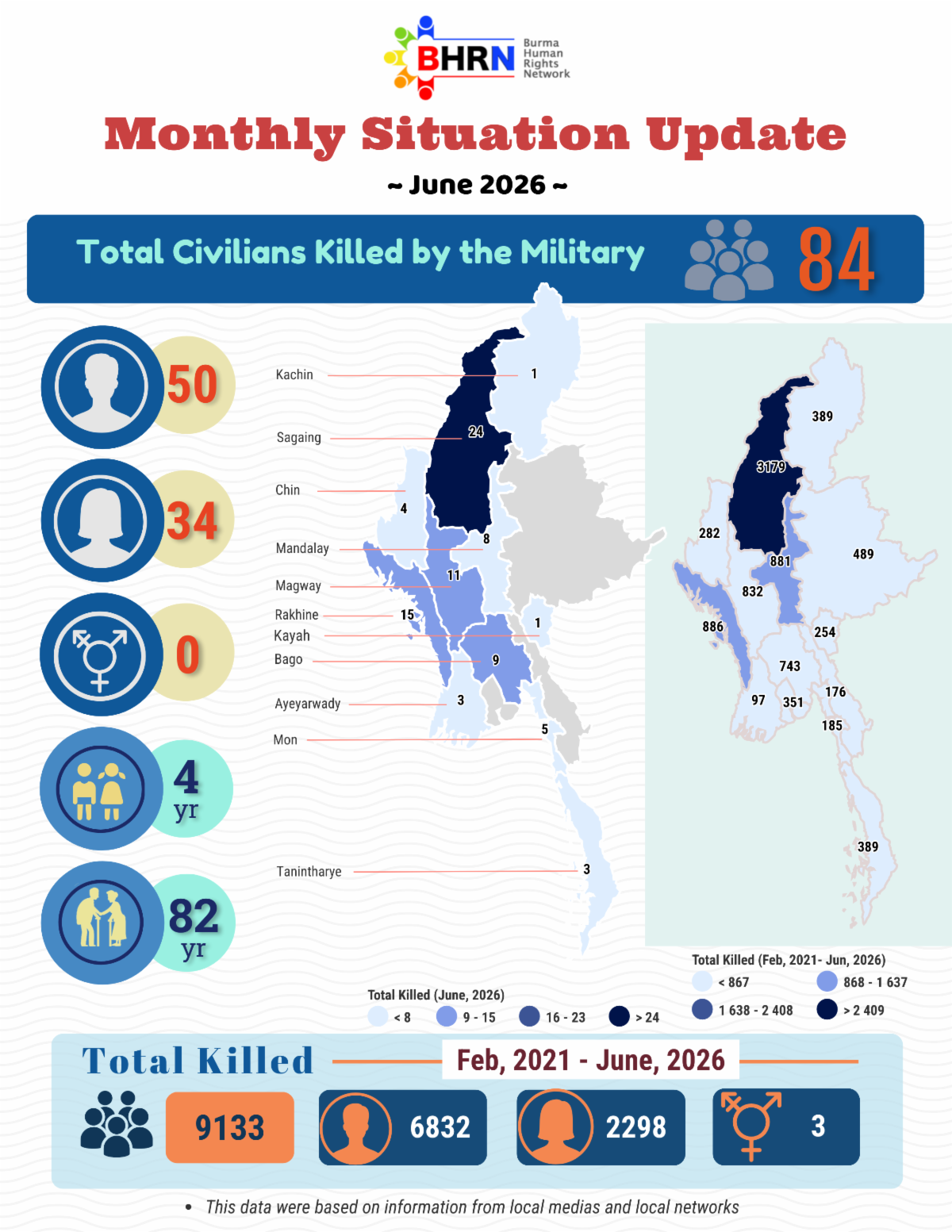
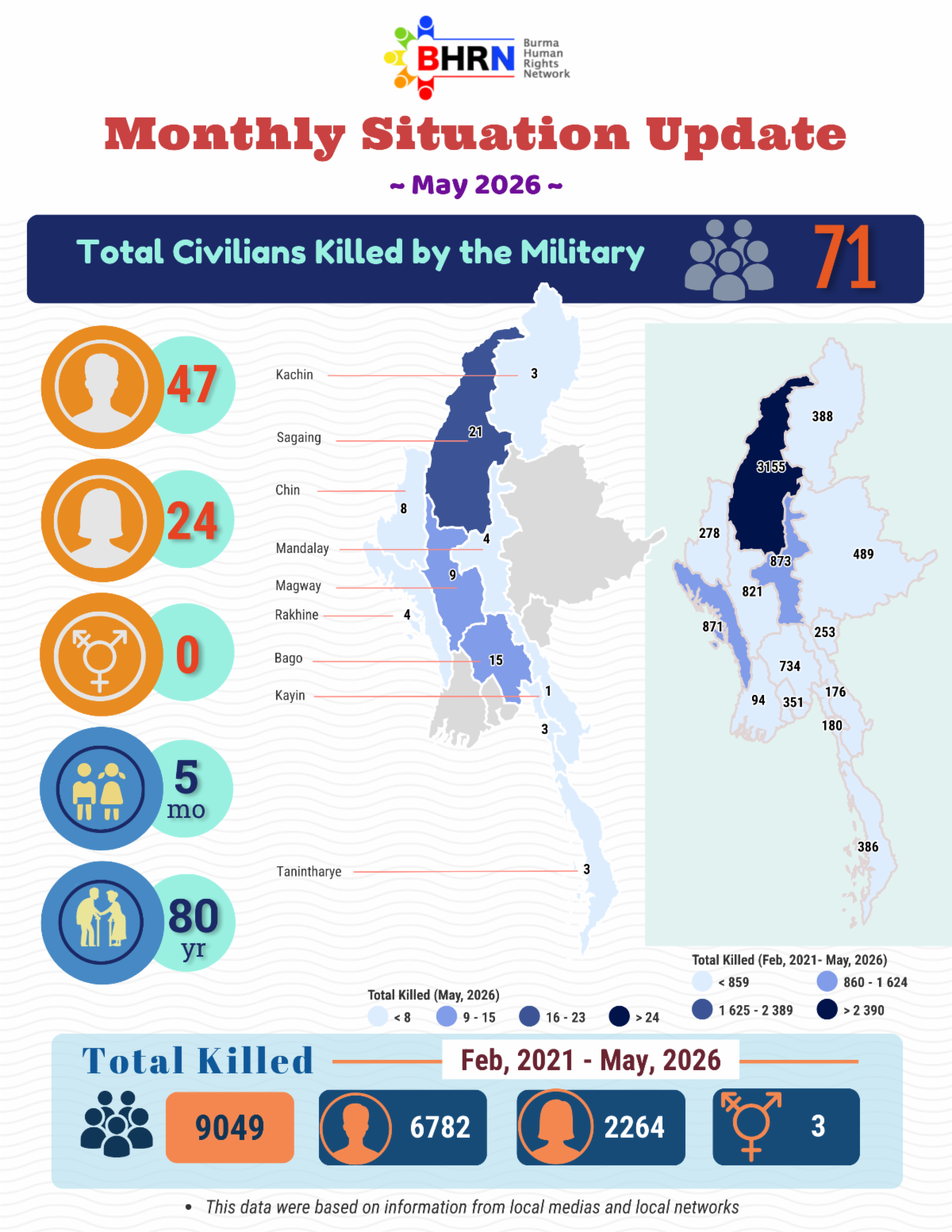
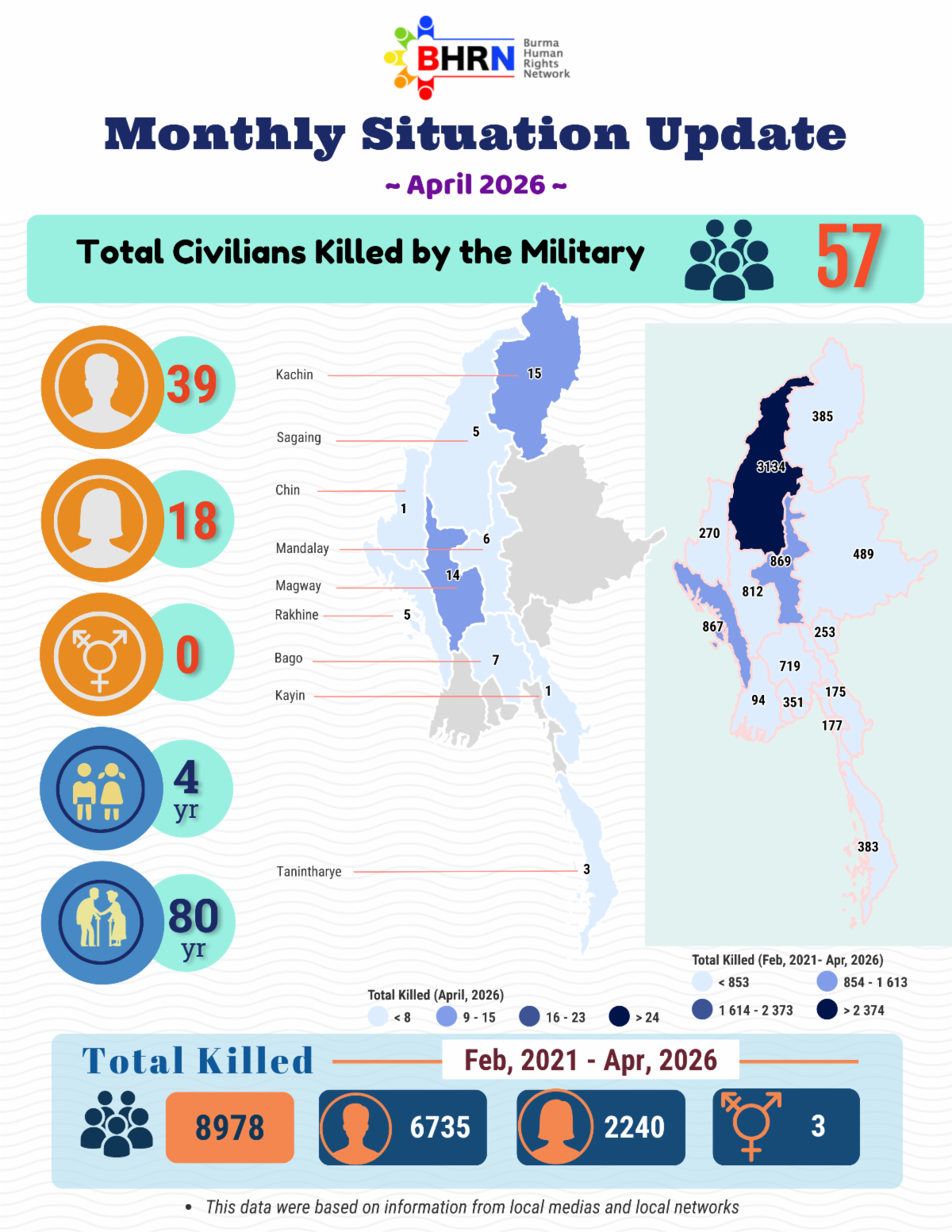
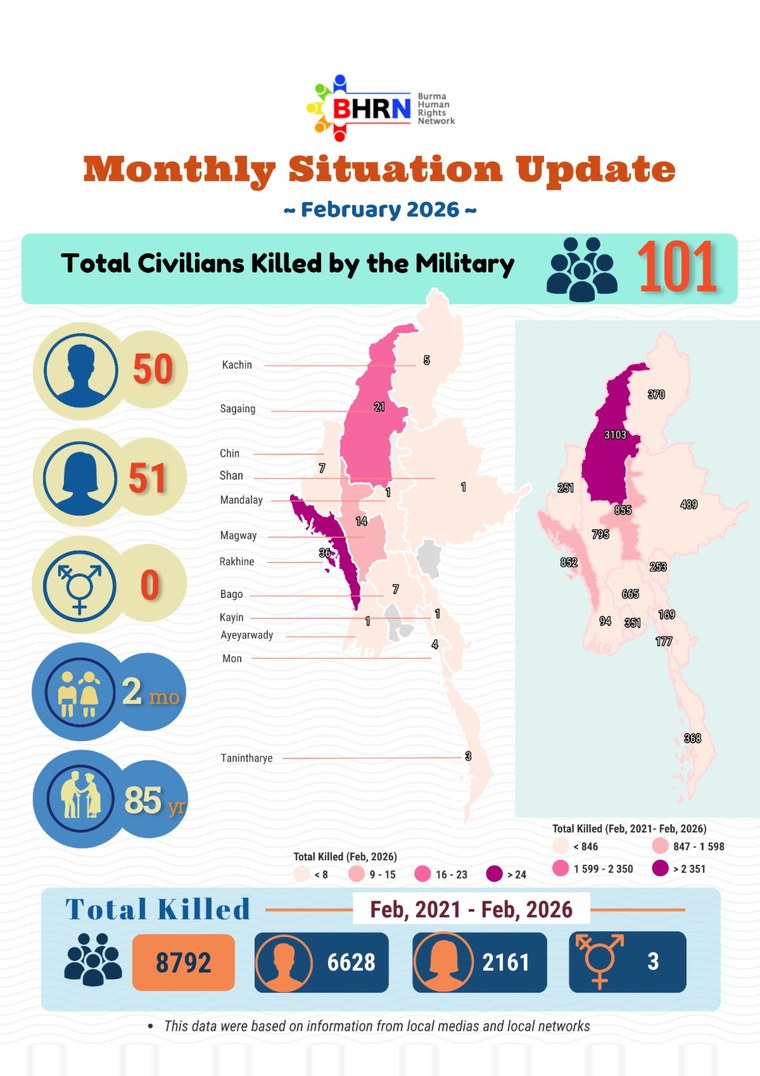
1Info-graphs of BHRN’s Report

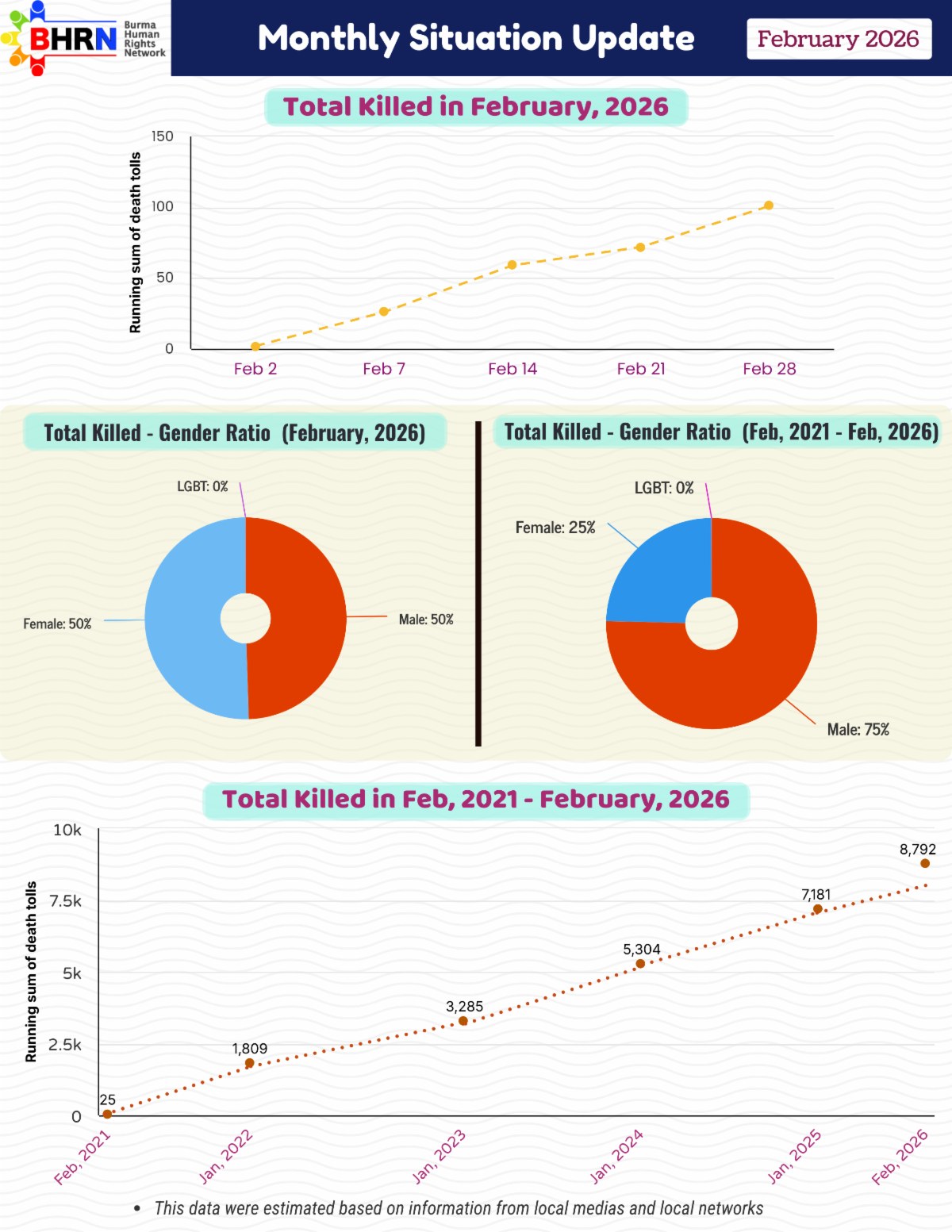
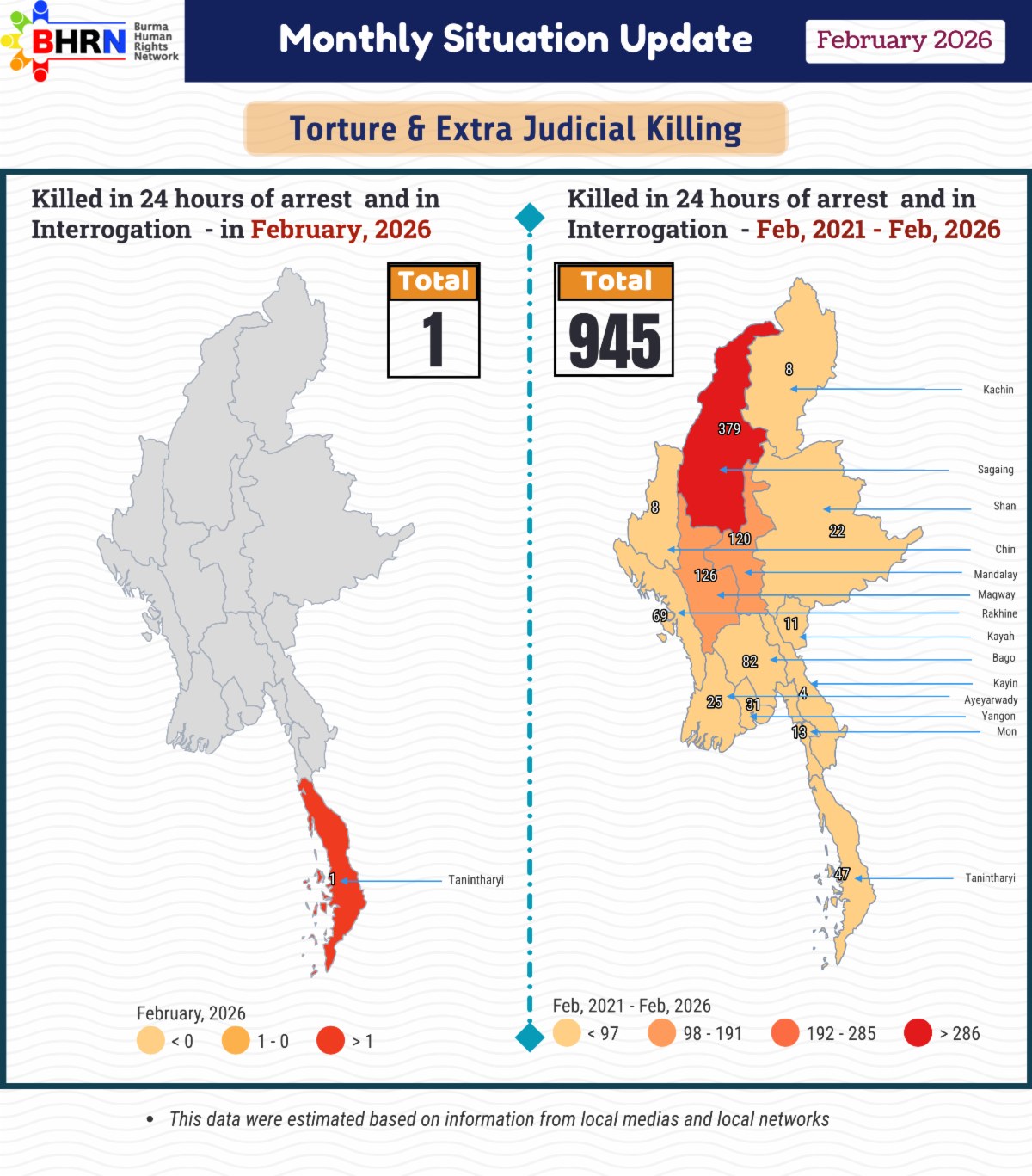
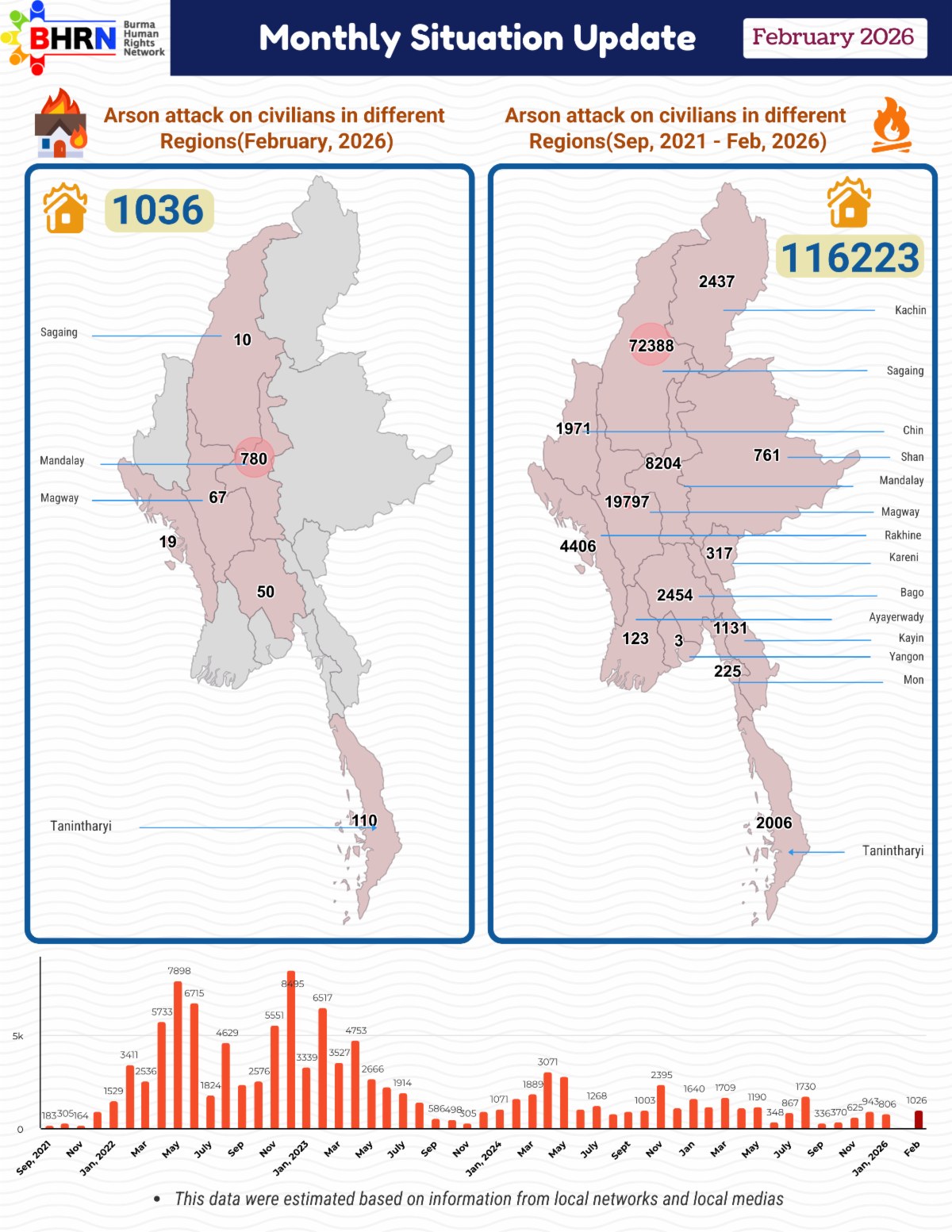
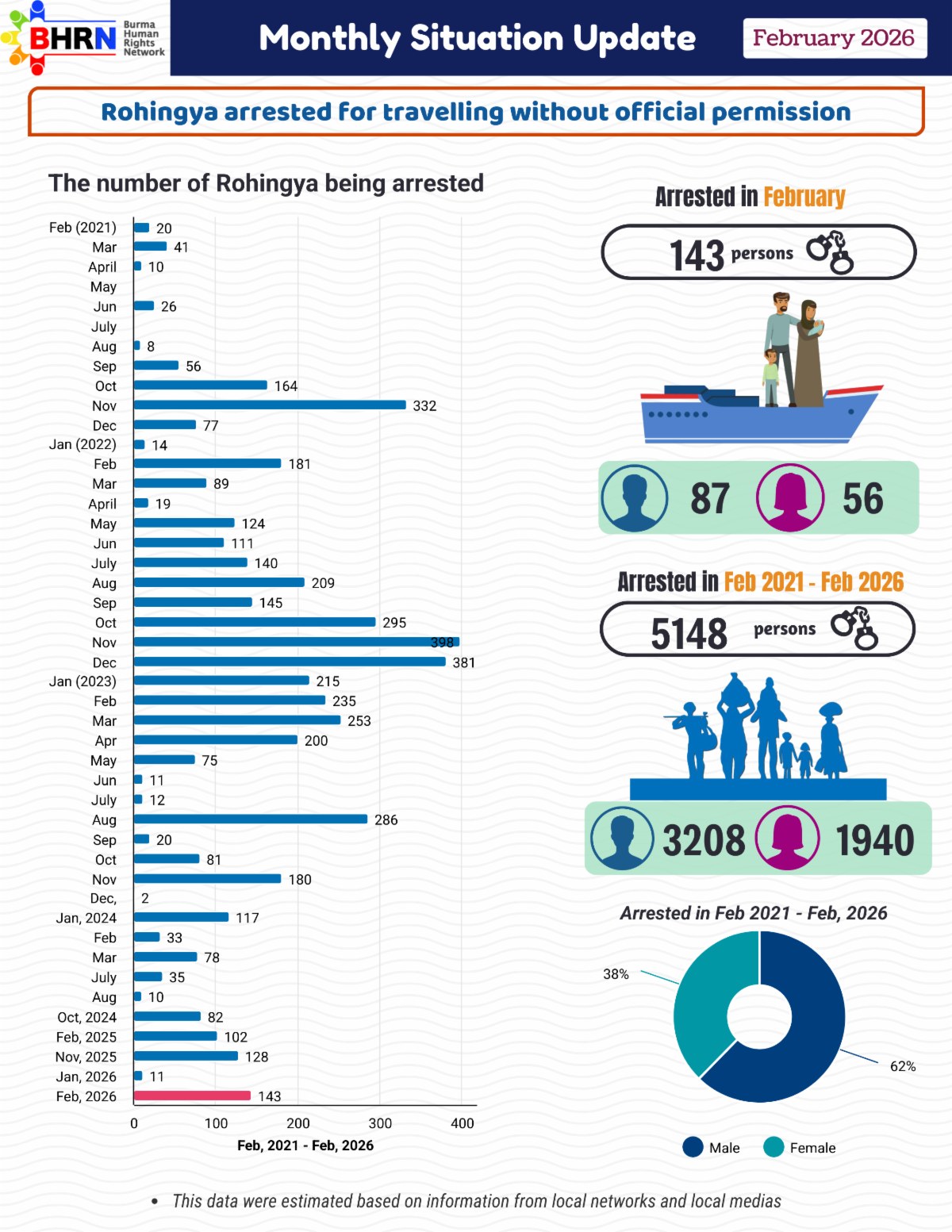
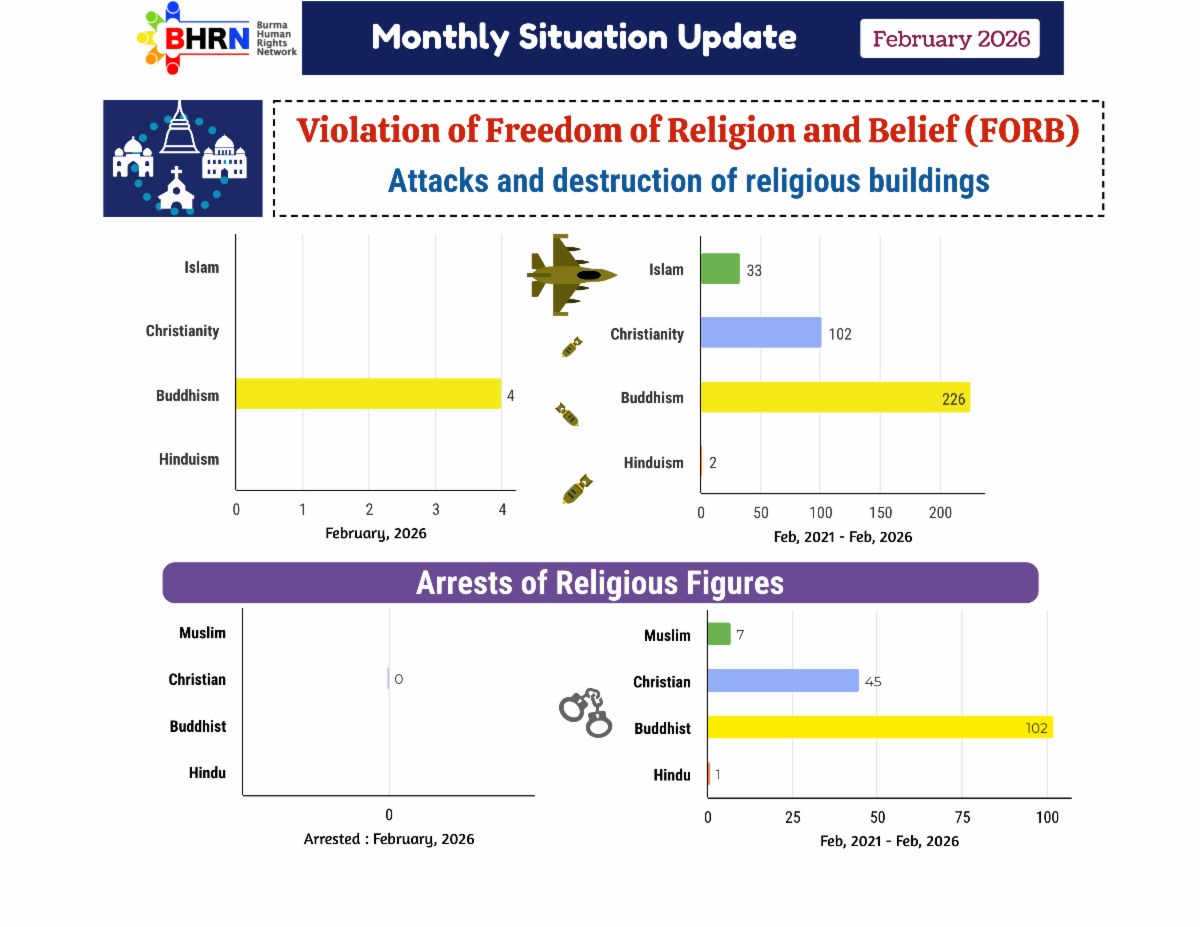
Tap any image to see it full size.
2News Summary and Analysis
This Month in Myanmar – February 2026
Having concluded its sham elections in January 2026, the Myanmar military junta moved in February to consolidate the power structures that will keep Min Aung Hlaing in command. He signed a law that placed himself above all branches of government, while the military and its proxy party held 505 of 586 parliamentary seats. Regime authorities simultaneously burned the records of the 2020 elections and the NLD government's parliamentary archive, destroying material relevant to ongoing proceedings at the ICC and ICJ. More than 110,000 civil servants rejected the junta's offer to return to work and remained active in the Civil Disobedience Movement. Internationally, Timor-Leste became the first ASEAN member to open criminal proceedings against a fellow member, filing a case against the junta for war crimes and crimes against humanity in Chin State, while Thailand declared its intention to reintegrate the junta into ASEAN despite five years of non-compliance with the Five-Point Consensus.
Throughout the month, junta forces bombed, shelled, and burned civilian areas across Sagaing, Arakan, Magway, Kachin, Kayah, Karen, Chin, and Tanintharyi, killing and injuring civilians, including children. The Burma Air Force struck an Arakan Army detention facility holding regime soldiers as prisoners of war for the fifth recorded time. Arakan Army fighters abducted three Rohingya girls in Buthidaung Township as they tried to flee to Bangladesh. Resistance forces reported significant gains, including a joint operation in Kanbalu Township that reportedly killed 96 soldiers and captured 101, and the recapture of a hilltop outpost in Falam Township within 24 hours of its seizure by regime troops.
3Political, Legal, and International Developments Affecting Myanmar
Timor-Leste Opens Legal Proceedings Against the Junta
On 2 February, Timor-Leste's judiciary opened legal proceedings against the Myanmar military, including Senior General Min Aung Hlaing, for war crimes and crimes against humanity. The case was brought on evidence submitted by the Myanmar Accountability Project (MAP) and the Chin Human Rights Organization (CHRO) documenting rape, murder, and the massacre of civilians in Chin State, as well as indiscriminate strikes on a hospital and systematic attacks on Christian churches and civilian infrastructure. A senior Timorese prosecutor was appointed to examine the submissions. The junta responded by expelling Timor-Leste's charge d'affaires and accusing Dili of violating ASEAN's non-interference principle.
The proceedings are significant on two counts. They are the first time an ASEAN member has initiated legal action against a fellow member, and they come within the opening months of Timor-Leste's ASEAN membership. The Special Advisory Council for Myanmar noted that Timor-Leste acted on its stated commitments to peace almost immediately upon joining the bloc. The junta's response, expelling a diplomat rather than engaging the substance of the allegations, indicates how seriously it regards the development.
The Timor-Leste case is one part of an accountability architecture that has expanded considerably over the past year. An Argentine court issued arrest warrants for 25 senior junta officials in February 2025. The ICC prosecutor requested an arrest warrant for Min Aung Hlaing for crimes against humanity against the Rohingya in November 2024. The ICJ concluded oral hearings in The Gambia's genocide case in January 2026, at which Rohingya survivors testified directly before the court for the first time.
Why it matters
Timor-Leste's initiative changes the terms of the debate within ASEAN. The junta's claim that non-interference norms place it beyond regional scrutiny is harder to sustain when a fellow member has formally rejected that framing and acted on it. For policymakers engaging with ASEAN on Myanmar, Timor-Leste provides a concrete reference point: states that have demonstrated support for international legal processes elsewhere should be expected to apply the same standard consistently.
The Philippines, as the current ASEAN chair, faces particular scrutiny in this regard. Its cooperation with the ICC in facilitating the arrest and transfer of former President Duterte establishes a precedent against which its approach to Myanmar will be measured. Should the ICC issue an arrest warrant for Min Aung Hlaing, the Philippines' response will be closely watched.
Junta Establishes Supra-Governmental Council to Retain Control After Elections
On 4 February, Min Aung Hlaing signed a law establishing a five-member Union Consultative Council with authority over the government, the military, national security, and the legislative process. Structured to allow Min Aung Hlaing to retain ultimate authority without assuming the presidency, the body creates a command structure above the executive, legislative, and judicial branches, insulating decision-making power from any constraints the formal post-election government might otherwise impose. The electoral process, which sits above, produced predictable results: the military's constitutionally guaranteed 25 percent of parliamentary seats were filled by 166 appointed soldiers, and the military-proxy USDP won 339 of the remaining seats during polling that concluded on 25 January. The junta and its aligned parties will hold 505 of 586 total parliamentary seats, well in excess of the 294 required to appoint the president. The incoming cabinet will likely be dominated by recently retired military officers, including the posts of president and ministers for foreign affairs, planning, and finance. Both chambers of parliament are scheduled to convene in Naypyidaw in mid-to-late March.
Why it matters
The Union Consultative Council sits above every branch of government, answerable to no one but Min Aung Hlaing. A parliament in which the military and its proxies hold 505 of 586 seats, operating beneath that council, is not a civilian government by any meaningful definition. Governments and institutions that treat the incoming bodies as legitimate civilian counterparts, in diplomatic engagement, economic relations, or humanitarian coordination, are providing cover for a structure built to place the military beyond democratic accountability. How states and institutions respond to that question bears directly on the coherence of existing sanctions frameworks and the integrity of ongoing legal proceedings at the ICJ and ICC.
Regime Orders Burning of 2020 Election Records and NLD Parliamentary Archives
In early February, regime authorities ordered the systematic destruction of documents from Myanmar's 2020 general elections and from the parliamentary record of the National League for Democracy government, which held office from 2016 until the coup of 1 February 2021. On 4 February, staff from the General Administration Department and Union Election Commission personnel burned paper election records across multiple Yangon Region townships, with destruction proceeding simultaneously across eight townships of Naypyidaw. Officials in Twantay, Dala, Kungyangon, and Kawhmu townships were reportedly reprimanded for delays in compliance. No one was permitted to read or photograph the documents before burning.
The operation was conducted under a 14-member committee established by the junta following the conclusion of its electoral process, with an explicit mandate to erase the 2020 election results, associated records, and the NLD administration's governance record. The Ministry of Home Affairs issued the destruction order for Yangon Region on 4 February. Burning continued into 10 February.
Why it matters
The 2020 elections, won decisively by the NLD, represent the last democratic mandate of the Myanmar people and form part of the evidentiary record for ongoing proceedings at the ICJ and ICC, as well as any future transitional justice process. The committee's mandate was to foreclose documentary challenges to the junta's claim to governance, degrade the material available to international prosecutors, and eliminate the institutional record of democratic rule.
The destruction order itself, issued under explicit ministerial authority, should be documented and preserved as evidence of the junta's pattern of obstructing accountability. Governments and international bodies should treat this as a prompt to accelerate preservation of all remaining documentation of the 2020 elections and NLD administration held outside Myanmar, including records held by electoral monitoring bodies, diplomatic missions, and civil society organisations.
Civil Disobedience Movement Rejects Regime's Offer to Return to Work
On 31 January, the regime's National Defense and Security Council issued an offer to former civil servants who joined the Civil Disobedience Movement following the coup, inviting them to return to government offices without fear of repercussion unless they had committed a crime. The offer was broadly rejected. CDM members cited deep distrust of the assurance and the risk of prosecution, and characterised the offer as a sign of the regime's weakness. The NUG's CDM Success Committee reported that more than 110,000 civil servants remained active in the movement as of June 2025, out of the 295,802 who initially refused to work under military rule.
Why it matters
The offer is an indicator of administrative strain. Five years on, the junta has been unable to replace the civil servants who walked out in 2021, and its decision to issue the offer in the same month it constituted a new parliament points to the distance between its institutional ambitions and its actual governing capacity. The movement's collective rejection, at considerable personal risk to its members, is itself a measure of continued non-compliance with military rule.
For international actors engaged in governance programming in Myanmar, the CDM's continued organisation matters. Institutional knowledge and professional experience within Myanmar's public sector sit with the people who left in 2021.
Thailand Moves to Reintegrate Junta Into ASEAN Following Staged Elections
On 18 February, Thai Foreign Minister Sihasak Phuangketkeow met junta Foreign Minister Than Swe in Phuket and stated that Thailand intends to serve as a bridge for reintegrating Myanmar's military leadership into ASEAN. He told the media that Myanmar must begin a dialogue process, reduce violence, and avoid attacks on civilians. Discussions covered trade, investment, education, public health, and joint efforts on transnational crime, including online scam operations and drug and human trafficking. The meeting took place weeks after the conclusion of the junta's staged elections on 25 January. Min Aung Hlaing agreed to the ASEAN Five-Point Consensus in April 2021 and returned to Naypyidaw without implementing any of its provisions.
Why it matters
Thailand's declared intention to reintegrate the junta into ASEAN rewards a military leadership that has spent five years committing atrocity crimes against its own population with no accountability and no progress on the Five-Point Consensus it agreed to in 2021. Engagement with the junta on any terms legitimises an illegal regime and undermines the democratic will of the Myanmar people. For governments committed to that democratic mandate, Thailand's initiative is a step in the wrong direction.
4Resistance Gains
In February, resistance forces reported clashes across Kachin, Sagaing, and Chin regions, including a joint PDF-Arakan Army operation in Kanbalu Township and the recapture of a hilltop outpost in Falam Township within 24 hours of its seizure by regime troops.
Kachin State (Hpakant)
Captain Zarni Aung, a company commander of Tatmadaw Light Infantry Battalion (LIB) 381, was killed during clashes with the Kachin Independence Army (KIA) near Hpakant. Six soldiers subsequently surrendered to the KIA forces.
Sagaing Region (Kanbalu Township)
The People's Defence Force (PDF) and the Arakan Army reported a joint operation targeting four Tatmadaw military bases. According to resistance sources, 96 soldiers were killed and 101 taken prisoner.
Chin State (Falam Township)
The Chin National Defence Force (CNDF) reported recapturing the Htinshu hilltop outpost one day after regime troops seized it. The Chin Brotherhood has held Falam Township since April 2024. Regime forces launched a counteroffensive in October 2024, supported by Burma Air Force strikes and UAVs, in an effort to retake Falam. The CNDF reported seizing 11 small arms along with artillery pieces and ammunition.
5On the Ground: Escalating Violence and Human Rights Violations
In February, junta forces carried out airstrikes, artillery fire, paramotor and gyrocopter attacks, drone strikes, village burnings, and abductions across multiple states and regions. These incidents reflect ongoing violations of international humanitarian and human rights law.
ITargeted attacks on civilians and civilian infrastructure
Under international humanitarian law, civilians must never be the object of attack. Article 8(2)(e)(i) of the Rome Statute prohibits attacks intentionally directed against civilians in non-international armed conflicts. When such attacks form part of a widespread or systematic campaign against the civilian population, they may amount to crimes against humanity under Article 7(1), including murder (Art. 7(1)(a)), persecution (Art. 7(1)(h)), and other inhumane acts (Art. 7(1)(k)).
Hpakant Township, Kachin State
Two children were injured when an artillery shell struck a school.
- 4 February
Thetkeikyin, Monywa Township, Sagaing Region
a monastery sheltering residents and internally displaced persons (IDPs) was bombed by junta forces in the early morning of 3 February. During the airstrike, three men—including a father (50 years old) and son (18 years old) among the displaced persons—were killed. Six other civilians, including two women, were injured. (BHRN Documentation_1_Sagaing/03Feb26)
Yebyu Township, Tanintharyi Region
Myanmar Armed Forces troops destroyed over 40 houses.
Taze Township, Sagaing Region
Five people were killed in Myanmar Air Force airstrikes.
Pwintbyu Township, Magway Region
Junta troops raided a village, burning 16 houses and abducting 15 civilians.
Thandwe Township, Rakhine State
The Myanmar Air Force bombed a residential area, injuring two people and destroying nine houses.
Pauk Township, Magway Region (Chatkan village)
Five civilians were killed and at least 13 others injured in airstrikes carried out by the Burma Air Force.
Waingmaw and Myitkyina Townships, Kachin State
One civilian was killed and eight others injured in Burma Air Force airstrikes.
- 11 February
Zayat Kone Village, Myaung Township, Sagaing Region
the military carried out two bombing attacks using a gyrocopter and a paramotor on 11 February. As a result, three civilians, including one woman, were injured, and four houses were damaged. (BHRN Documentation_3_Sagaing/11Feb26)
Salingyi Township, Sagaing Region
Eleven PDF members were killed in Myanmar Air Force airstrikes.
Kyauktaw and Mrauk-U Townships, Rakhine State
At least seven civilians were killed, and 16 others were injured in Myanmar Air Force bombing runs across both townships.
Hpruso/Bawlake Township border, Kayah (Karenni) State
A pregnant internally displaced person was killed by Myanmar Armed Forces artillery fire.
Kyaukphyu Township, Arakan State (Wa Myaung village)
At approximately 5:00 pm, a suicide drone and heavy weapons strike killed three women, including a five-year-old girl, and injured two other villagers.
Kyauktaw Township, Arakan State (Chaungtu village)
The Burma Air Force carried out an airstrike on a detention facility holding regime troops taken as prisoners of war. At least 21 people were killed and 30 others injured in a strike on the same facility on 20 January. The AA reports that nearly 100 detainees have been killed across four such facilities in Pauktaw, Maungdaw, Mrauk-U, and Kyauktaw townships.
Khin-U Township, Sagaing Region (Nyaung Pin Gyi Su village)
A fighter jet from Tada-U Airbase dropped three high-explosive bombs on a residential area at approximately 22:00 local time. Two men and a woman were killed, and several others sustained serious injuries. A village school was heavily damaged, and at least five civilian houses were completely destroyed.
Kyaukphyu Township, Arakan State (Wa Myaung village)
A suicide drone struck the village, injuring a woman and a man. This was the second drone attack on the same village within five days.
Homalin Township, Sagaing Region (Paenwegone village)
At least seven civilians were killed in a gyrocopter attack launched from the Homalin Air Force Base. Homalin is contested between the regime and resistance forces.
Myinmu Township, Sagaing Region (Shwekyaungkan village)
Ten civilians, including two children, were killed and four others injured in a paramotor attack carried out from the Northwestern Regional Military Command headquarters in Monywa.
Ponnagyun Township, Rakhine State
At least 18 civilians were killed and 15 others injured in Myanmar Air Force airstrikes.
Myawaddy Township, Karen State (Hpalu-Meikanei Road)
A Tatmadaw drone strike killed five people, including Democratic Karen Benevolent Army members and civilians.
IIAttacks on Religious and Cultural Sites
Under Article 8(2)(e)(iv) of the Rome Statute, intentionally directing attacks against buildings dedicated to religion, education, or other civilian purposes constitutes a war crime unless they are being used for military purposes.
- 3 February
Thetkeikyin, Monywa Township, Sagaing Region (monastery)
A monastery sheltering residents and internally displaced persons (IDPs) was bombed by junta forces in the early morning of 3 February. The attack damaged the monastery building and nearby covered walkways, while three temporary shelters used by displaced persons were also destroyed.
Source: BHRN Documentation_ 1_Sagaing/03Feb26 - 9 February
Nyaung Ouk village, Myaing Township, Magway Region
On the night of 9 February, junta forces carried out an airstrike using a jet fighter on a monastery in Nyaung Ouk village in Myaing Township. The bombing damaged the pagoda and several monastery buildings.
Source: BHRN Documentation_2_ Magway/09Feb26
IIIAbduction and Forced Recruitment
Forced recruitment of civilians violates Article 8(2)(e)(vii) of the Rome Statute. The abduction and coerced recruitment of civilians in a non-international armed conflict may also constitute the war crime of taking hostages under Article 8(2)(c)(iii) and, where it forms part of a widespread or systematic attack, a crime against humanity under Article 7(1).
Buthidaung Township, Arakan State (WaYa Chaung village, Doe Don)
Three Rohingya girls were abducted by Arakan Army fighters while attempting to flee to Bangladesh through Maungdaw. They were transported to an AA-controlled base in Buthidaung.
6Policy Recommendations
On non-recognition and political engagement
- States should withhold recognition of the junta's post-election institutions, including the incoming parliament and cabinet, which operate beneath a Union Consultative Council designed to keep Min Aung Hlaing above democratic accountability. Engagement with these bodies as legitimate civilian counterparts would undermine ongoing accountability processes and sanctions frameworks. States should continue to engage only with bodies representing the democratic will of the Myanmar people, including the National Unity Government, the Committee Representing Pyidaungsu Hluttaw, Ethnic Revolutionary Organisations, and state and federal units and ethnic-based councils.
- ASEAN members should support Timor-Leste's universal jurisdiction initiative rather than treating it as a violation of the bloc's non-interference principle. The Philippines, as current ASEAN chair, should publicly confirm its willingness to cooperate with any ICC arrest warrant for Min Aung Hlaing, consistent with the precedent it established in facilitating the arrest and transfer of former President Duterte to the ICC.
On sanctions and economic pressure
- States should expand and strengthen coordinated targeted sanctions against the junta, its proxies, affiliated entities, and financial institutions, including the Myanmar Central Bank and state-owned banks. Sanctions should be applied and enforced consistently across allies, with secondary measures directed at entities facilitating evasion.
- States should impose and enforce comprehensive embargoes on weapons, ammunition, dual-use goods and technology, raw materials, and aviation fuel supplied to the junta. The Burma Air Force's sustained use of airstrikes, paramotors, gyrocopters, and suicide drones against civilian populations documented in this report makes the interdiction of aviation fuel supply chains and aircraft maintenance networks an urgent civilian protection priority.
On humanitarian assistance
- States must reverse funding cuts and scale up financial support for humanitarian assistance in Myanmar and for refugee populations in the region. Funding should be expanded in coordination with legitimate Myanmar representatives, including the NUG, EROs, and ethnic-based councils, to support urgent, impartial, and unobstructed delivery of assistance through all available channels, including cross-border routes.
On accountability
- States should support and fund current universal jurisdiction proceedings against junta officials, including those initiated by Timor-Leste and Argentina, and consider initiating new prosecutions in jurisdictions where domestic law permits. Evidence held by governments, diplomatic missions, and civil society organisations relevant to these proceedings should be made available to prosecutors through secure channels. Given the junta's destruction of the 2020 election and NLD parliamentary records documented this month, the preservation of all remaining documentation held outside Myanmar is urgent.
- States should endorse the ongoing case against Myanmar under the Genocide Convention at the International Court of Justice and support the ICC prosecutor's request for an arrest warrant for Min Aung Hlaing. All parties to the conflict, including non-state armed actors, must be held to the same standards of accountability.
About BHRN
Burma Human Rights Network (BHRN) is based in London, operates across Burma/Myanmar and works for human rights, minority rights and religious freedom in Burma. BHRN has played a crucial role in advocating for human rights and religious freedom with politicians and world leaders.