
1Introduction
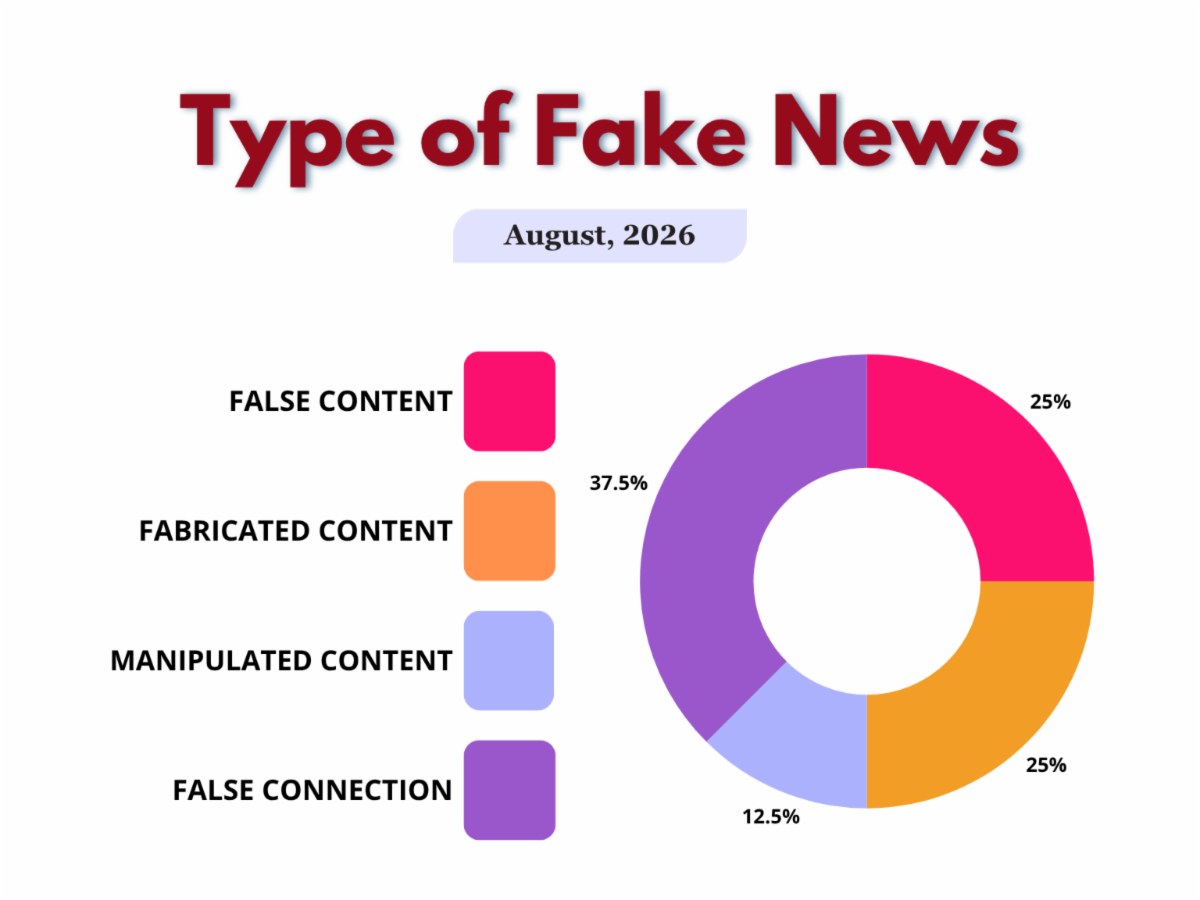
This report presents findings from the monitoring of social media platforms conducted during August 2026, documenting and analysing instances of hate speech, fabricated content, and misinformation identified during the reporting period. The primary platforms monitored were Facebook and Telegram. A total of 103 cases were documented, including 95 cases of hate speech and eight cases involving fabricated content and misinformation.
The majority of the cases documented during the reporting period involved hate speech targeting individuals and groups on the basis of religion, ethnicity, gender, sexual orientation and gender identity, and political views. The monitoring identified recurring narratives that sought to stigmatise, marginalise, or portray targeted individuals and groups in negative terms.
The documented hate speech extended beyond direct attacks against individuals. In a number of cases, groups or entire communities were portrayed as dangerous, as terrorists, or as posing a threat to society, with some content suggesting that such groups should be excluded from society. These narratives contributed to the portrayal of targeted groups as inherently threatening or incompatible with the wider community.
Rather than reproducing or detailing the hate speech contained in each individual post, this report examines the recurring narratives and patterns identified across the monitored content. It focuses in particular on the principal targets of hate speech and the ways in which individuals and groups were portrayed through these narratives. This approach is intended to identify broader patterns and trends in the production and dissemination of hate speech during the reporting period.
2Research Methodology
As hate speech is generally understood as language or expression arising from hostility or hatred, there is no single universally agreed or comprehensive definition of the term. For the purposes of this report, BHRN applies the following working definition of hate speech:
Hate speech refers to any expression, whether verbal, written, behavioural, or artistic, that targets an individual or group on the basis of protected characteristics and involves severe criticism, condemnation, hostility, hatred, or discriminatory or degrading treatment directed at those characteristics.
For the purposes of this study, protected characteristics include an individual's religion, language, sex, sexual orientation, national origin, ethnicity, skin colour, race, beliefs, citizenship, and physical characteristics, among others.
The hate speech identified during the study was further categorised according to the nature and form of the content. The categories include:
- hate speech portraying targeted individuals or groups as perpetrators or wrongdoers;
- hate speech asserting superiority or dominance over targeted individuals or groups;
- dehumanising or degrading hate speech;
- hate speech that encourages or promotes violence or social unrest;
- hate speech expressed in the form of threats or threatening narratives; and
- hate speech that celebrates or glorifies acts of violence or other actions committed as a result of hatred.
Other forms of hate speech identified during the monitoring period were also categorised according to their characteristics and content.
The information recorded for each documented case included the date on which the content was posted on the social media platform, the name of the content creator or account, the social media platform on which it was published, estimated reach, the target of the hate speech, the category of hate speech, and key terms or expressions used in the content.
In documenting hate speech, BHRN records only content targeting groups or individuals on the basis of protected characteristics. This includes content that intentionally promotes or incites hatred against individuals or groups on the basis of characteristics such as religion, ethnic or national identity, gender, sexual orientation, skin colour, or citizenship. Statements or expressions targeting groups that do not fall within the scope of protected characteristics under this methodology are not classified as hate speech.
For example, statements targeting armed groups, political organisations or leadership groups such as the National Unity Government (NUG), Karen National Union (KNU), or Kachin Independence Organisation (KIO), as well as military-affiliated officials, are not classified as hate speech under this methodology solely on the basis of their political, organisational, or institutional affiliation.
Given the ongoing political and military tensions in Myanmar, BHRN conducts daily monitoring and documentation of content disseminated through military-affiliated and military propaganda channels, with particular attention to hate speech and related expressions contained within such content. The monitoring aims to identify recurring patterns, narratives, and targeting of protected groups within the broader information environment.
3Data Collection
For this report, BHRN conducted qualitative monitoring of 3 Facebook groups, 2 Facebook pages, 13 Facebook accounts, 24 Telegram channels, and 24 TikTok accounts during August 2026.
The monitoring documented and analysed identified cases of hate speech, fabricated content, and misinformation. For each case, relevant information was recorded and analysed, including the date of publication, social media platform, name of the content creator or account, category of hate speech, fabricated content, or misinformation, keywords or key expressions used, and the individuals or groups targeted.
As analysing each post solely as an isolated incident would not be sufficient to identify broader patterns, this report groups recurring terminology, targeted individuals or groups, and similar forms of representation identified across the monitored content. It therefore focuses on analysing the principal narratives and recurring patterns emerging from the collected data.
4Findings
Portrayal of Muslims as Dangerous, Intruders, Threats to Society, and Threats to National Security
Muslims were among the principal targets identified in the content documented during the reporting period. The hate speech targeting Muslims was not limited to attacks against individual Muslims; it also included narratives portraying the Muslim population as a collective threat capable of posing a danger to the country at any time.
The monitored content included narratives portraying Muslims as experiencing an allegedly disproportionate increase in population, entering the country unlawfully, and seeking to “overrun” or undermine wider society. Such narratives contributed to portraying Muslims as untrustworthy, disloyal, or as a source of fear and insecurity.
The monitoring also identified content portraying Muslims as engaging in, or preparing to engage in, acts of violence and as posing a threat to national security. These narratives collectively framed Muslims as outsiders or foreigners within Myanmar society and portrayed them as a potential threat to the country and the wider population.
Such recurring portrayals contribute to the stigmatisation and marginalisation of Muslims by associating the community as a whole with illegality, violence, insecurity, and threats to national and social order, rather than addressing individuals or specific conduct on an individual basis.
Portrayal of Muslims and Rohingya as Terrorists
The monitoring also identified content portraying Muslims and Rohingya as terrorists, armed actors seeking to destroy the country, criminals, and individuals allegedly attempting to undermine or destroy other communities.
Among the hate speech documented on 3 August, Rohingya were subjected to dehumanising language and were portrayed as individuals engaged in, or preparing to engage in, acts of violence. The monitored content also portrayed Rohingya as people who should reside only in Muslim-majority countries and alleged that they were entering and settling in Buddhist- and Christian-majority countries through various means with the purported intention of destroying those societies.
These narratives collectively associated Muslims and Rohingya with terrorism, criminality, violence, and the destruction of other communities, thereby portraying the groups as inherently threatening and incompatible with other religious and social communities.
On 16 and 23 August, posts published by AK-Media Live alleged that “Bengali” (the term used in the original content)/Rohingya people living in refugee camps had formed and were operating an Islamic extremist armed group for the purpose of carrying out acts of terrorism.
(See the translation of the attached link below the conclusion (1))
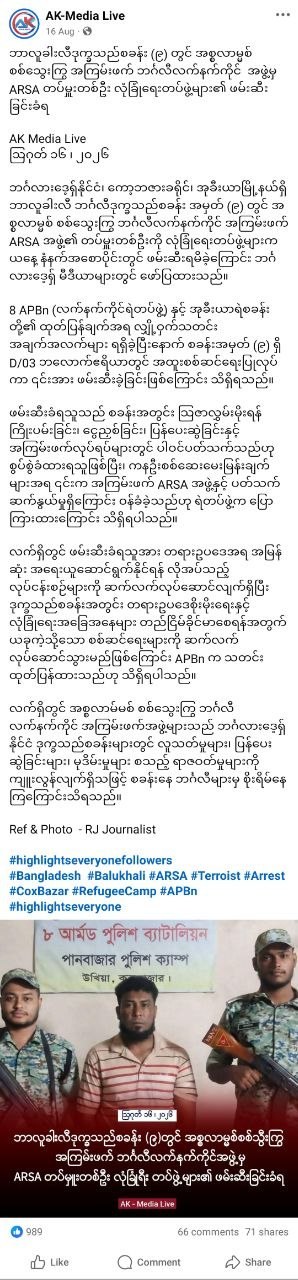
AK-Media (2)
(See the translation of the attached link below the conclusion (2))
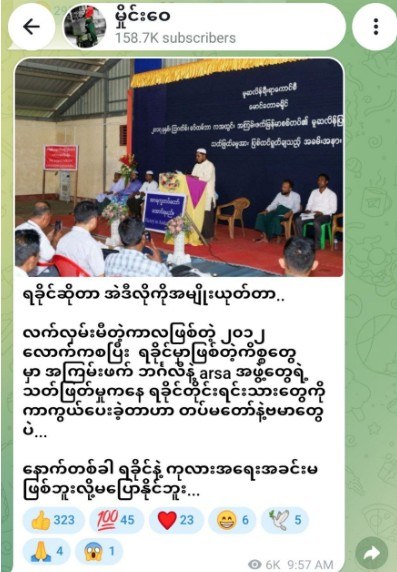
On 27 August, content posted on the Myaing Wai Telegram channel portrayed Rohingya people collectively as being affiliated with the Arakan Rohingya Salvation Army (ARSA) and as posing a threat to security in Rakhine State.
(See the translation of the attached link below the conclusion (3))
In addition, the Araksha Soe Rakkaing Facebook page used hate speech to portray Rohingya people as “illegal entrants” and armed terrorists.
These examples illustrate a recurring pattern in which Rohingya people are collectively associated with armed groups, terrorism, and threats to security, without distinguishing between individuals or substantiating such allegations on an individual basis.
(See the translation of the attached link below the conclusion (4))
The monitored content also included narratives that attributed the actions of individuals to an entire community and collectively blamed the broader community for the conduct of particular individuals. Such portrayals can contribute to increased distrust and hostility towards the community as a whole.
Much of the documented hate speech referred to Rohingya as “illegal Bengalis” or “illegal entrants” and alleged that they had crossed the border from Bangladesh into Rakhine State. A large proportion of the posts identified on 3 August questioned the identity and existence of the Rohingya people and circulated allegations that Rohingya were deliberately entering Myanmar and other countries with the intention of expanding their territory.
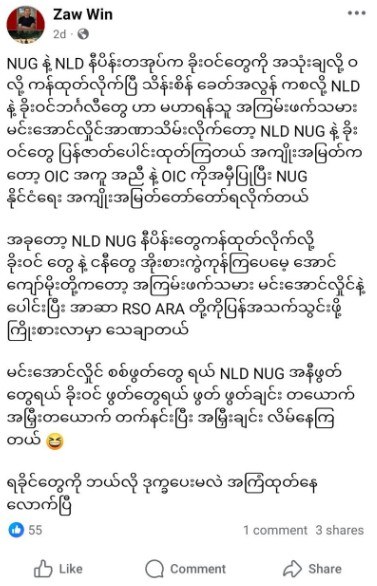
In addition, Zaw Win's Facebook account used hate speech on 5 August, referred to Rohingya as “illegal Bengalis,” and included allegations that the National League for Democracy (NLD) and the National Unity Government (NUG) were cooperating with Rohingya with the purported aim of causing harm to the country.
(See the translation of the attached link below the conclusion (5))
The monitored content also included narratives that linked displaced Rohingya communities with organisations currently engaged in armed resistance against the Myanmar military. These narratives framed such connections as a security threat to the country, portraying Rohingya as a potential danger to national security and using security-related claims to construct broader narratives of threat.
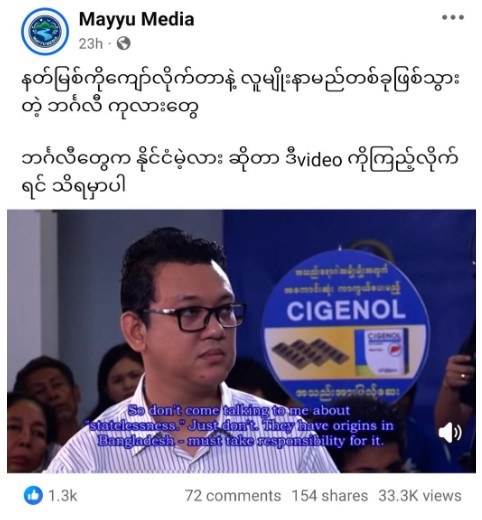
On 30 August, May Yu Media published a post using the question, “How did the Bengali Muslims become an ethnic name 'Rohingya' simply by crossing the Naf River?” The post questioned the identity of the Rohingya people and their claims to citizenship, contributing to a narrative that challenges their ethnic identity and legal status.
The narratives concerning Rohingya therefore extended beyond portraying them as displaced populations or refugees. The monitored content also repeatedly portrayed Rohingya as “illegal residents,” reinforcing narratives that questioned their legitimacy, identity, and right to reside in Myanmar. Mayyu Media
(See the translation of the attached link below the conclusion (6))
Restrictions on Religious Freedom and the Portrayal of Muslims as Lawless
Although Myanmar’s military leader has presented to the international community that full religious freedom is protected in the country, minority religious communities continue to face restrictions on the repair, renovation, and construction of places of worship.
In Thanlyin Township, Yangon Region, the expansion of the Sein Kone Sunni Jamae Mosque was reportedly ordered to be demolished on the grounds that it did not have the required permission. The action was led by Ashin U Thuzitta of the Patriotic Myanmar Monks Union.
The U Wai Aung TikTok account also reposted a video of remarks by Buddhist monk Ashin U Thuzitta concerning the incident. In the video, he stated that Muslims should not be considered a minority because Muslim men may have up to four wives and therefore have a high rate of population growth. He further stated that Muslims living in Myanmar should respect and comply with the laws of the country. The remarks portrayed Muslims as a demographic threat and framed their presence in Myanmar in terms of population growth and legal compliance.
In the context of the reported restrictions on the construction and expansion of Muslim places of worship, these statements contributed to a broader narrative portraying Muslims as unlawful or non-compliant members of Myanmar society.
(See the translation of the attached link below the conclusion (7))

The Bamar Tha TikTok account also reshared content concerning donations to the Sule Kone Mosque in Pyin Oo Lwin and posted statements calling for restrictions on mosques, the closure of some mosques, and government measures to control Muslim population growth.
In the post, the account stated that mosques should be closed and that this could be achieved through the mobilisation of “patriots.” More than 50 comments containing hate speech were observed beneath the post, while more than 800 users had indicated support for the post.
The content promoted restrictions on Muslim places of worship and called for measures targeting Muslim population growth. The accompanying comments and level of engagement further demonstrated the circulation and public amplification of anti-Muslim narratives on the platform. Bamar Tha
(See the translation of the attached link below the conclusion (8))

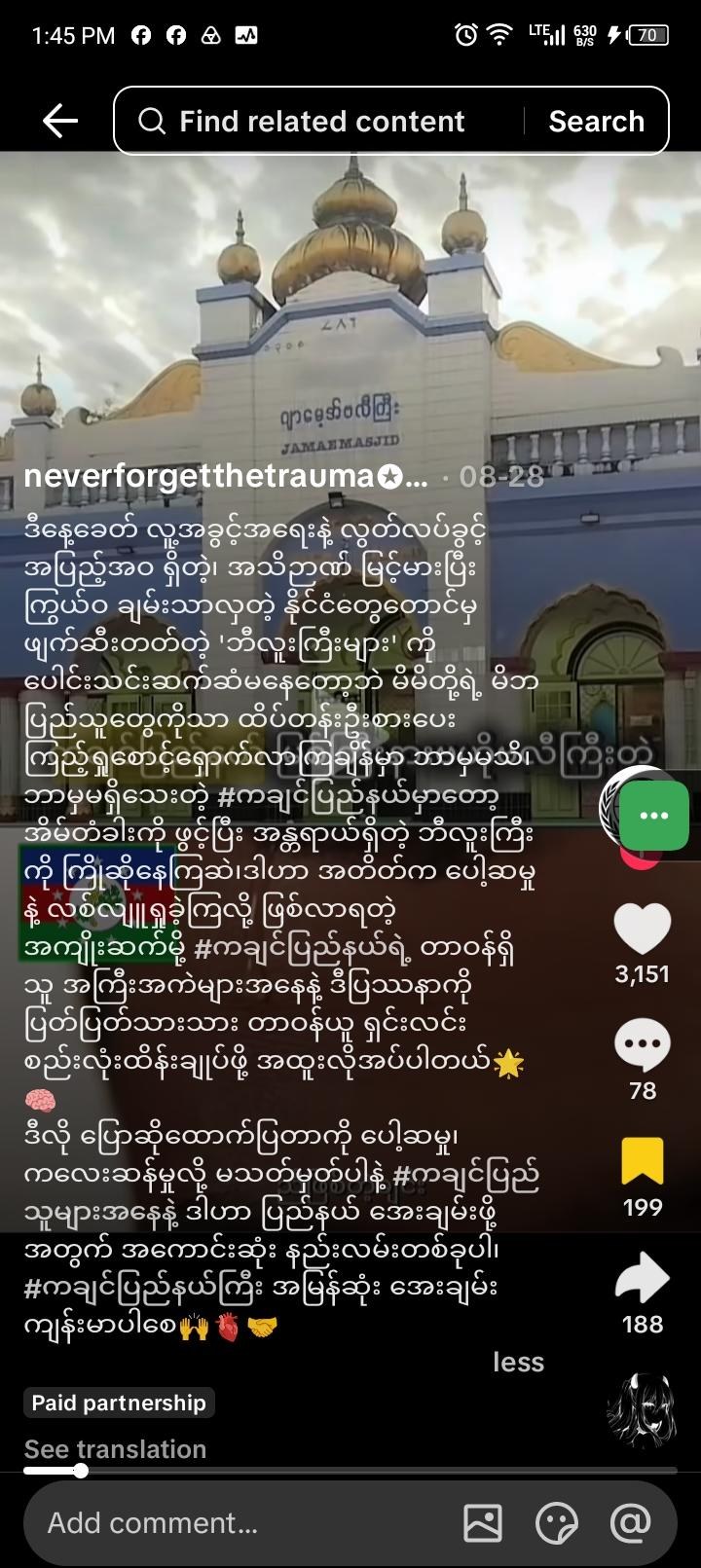
The Never Forget The Trauma TikTok account also reposted a video of the Myitkyina Jamae Mosque in Kachin State that had originally been shared by a Muslim user. The account accused the mosque of being “illegal” and used hate speech targeting Muslims.
The post also described Islam as a “demon” capable of destroying others and called on authorities in Kachin State to take responsibility and address the matter. The content thereby portrayed Islam and Muslims as inherently dangerous and framed the presence of the mosque as a threat requiring intervention by local authorities.
(See the translation of the attached link below the conclusion (9))
The Metta Shin TikTok account also disseminated hate speech alleging that Muslims living in Myanmar were seeking the country’s abundant natural resources and were conspiring with Western Islamic countries to gain control over them.
The account further portrayed Muslims as expansionist actors who, with assistance from Western countries, were constructing religious schools as part of an alleged effort to expand their influence in Myanmar. These narratives framed Muslims as acting in coordination with foreign actors and pursuing interests that were portrayed as contrary to those of the country. Metta Shin
(See the translation of the attached link below the conclusion (10))
Portrayal of Christians as Foreign-Influenced Actors and Political Enemies
Hate speech targeting Christians was also identified during August. The monitored content included narratives portraying Christians as being influenced by Western countries and as agents allegedly acting on behalf of foreign actors to interfere in Myanmar’s domestic politics.
On 15 August, View of Sue published content portraying Christians as dependent on Western countries and calling for measures to suppress or restrict Christians.
On 16 August, a Buddhist monk and writer, Chit Luu (University), published content portraying Christians as being subject to Western influence and characterising them as disloyal.
(See the translation of the attached link below the conclusion (11))

He further alleged that the emergence of Christian Pa-O communities in Pa-O areas had contributed to political and religious divisions among members of the ethnic community. Chit Luu (University)
(See the translation of the attached link below the conclusion (12))
In addition, the monk repeatedly portrayed Christianity as a religion subject to foreign influence and portrayed Christians as politically disloyal to the country or as being controlled by foreign actors. Chit Luu (University)
(See the translation of the attached link below the conclusion (13))
Portrayal of Women as Sexualised and Degraded Targets
The monitoring also identified hate speech targeting women. In particular, content targeting Muslim and Rohingya women included sexualised and degrading portrayals, including narratives linked to questions surrounding their recognition as citizens.
On 6 August, the Naing Soe and Family Telegram channel used hate speech to portray Daw Aung San Suu Kyi as a woman with excessive sexual desire. Naing Soe and Family
(See the translation of the attached link below the conclusion (14))

On 7 August, the Hmai Wai Telegram channel targeted a woman involved in the resistance movement, portraying her as someone who would be subjected to sexual violence as a consequence of her participation in the resistance.
These examples demonstrate the use of gender-based and sexualised hate speech to demean women, attack their dignity, and stigmatise women based on their gender, political activities, or identity. Hmai Wai
(See the translation of the attached link below the conclusion (15))
On 8 August, the View of Sue Telegram channel accused a woman who was speaking to students as part of the 8 August 1988 anniversary commemoration of using children for political gain.
On 13 August, the View of Sue Telegram channel was identified that compared images of women used for fundraising for the resistance movement to prostitution and sexually exploitative conduct. View of Sue
(See the translation of the attached link below the conclusion (16))

Hate Speech Disseminated Through Fabricated Content and Misinformation
In Myanmar, fabricated content and misinformation are frequently disseminated in ways that intersect with political and religious issues. Such content may be presented in misleading ways, combine inaccurate information with unrelated or distorted facts, or be entirely fabricated. These forms of content have also been used to promote narratives that can contribute to increased hostility and division between different communities.
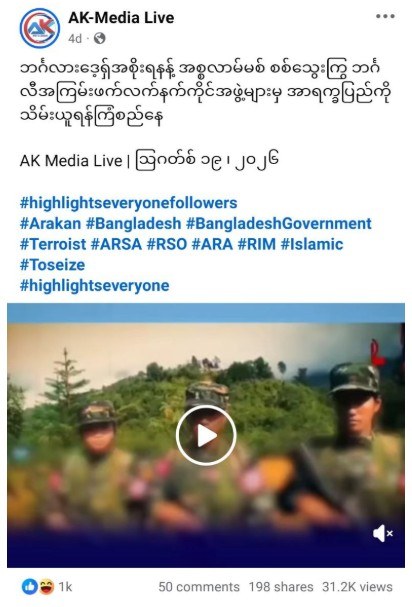
On 19 August, the AK Media Live Facebook page claimed that Bangladesh and the Arakan Rohingya Salvation Army (ARSA) were planning to seize control of Rakhine State. The post targeted Rohingya people and included a video depicting military operations. The content was found to be fabricated in its entirety, including both the information presented and the accompanying narrative.
(See the translation of the attached link below the conclusion (17))
On 9 August, the View of Sue Telegram channel shared a photograph showing buildings on fire alongside a foreign news report and claimed that Muslims were setting fire to and destroying Christian places of worship in Canada.
The channel used inaccurate associations between the photograph and the accompanying news report to portray Muslims as violent actors. By presenting unrelated or incorrectly connected information as evidence of the alleged attacks, the content contributed to a misleading narrative targeting Muslims. View of Sue (See the translation of the attached link below the conclusion (18))
The Ma Ma Su Su Facebook account disseminated religiously based hate speech warning Bamar people to be cautious of members of People’s Defence Forces (PDFs), portraying them as Christians and implying that their religious identity constituted a reason for concern.
The account also reshared a video report published by the pro-military Eleven Media concerning a killing incident in Khin-U Township, Sagaing Region. By linking the incident to the religious identity of PDF members, the content sought to portray the resistance movement negatively and associate it with religiously framed narratives of violence.
(See the translation of the attached link below the conclusion (19))
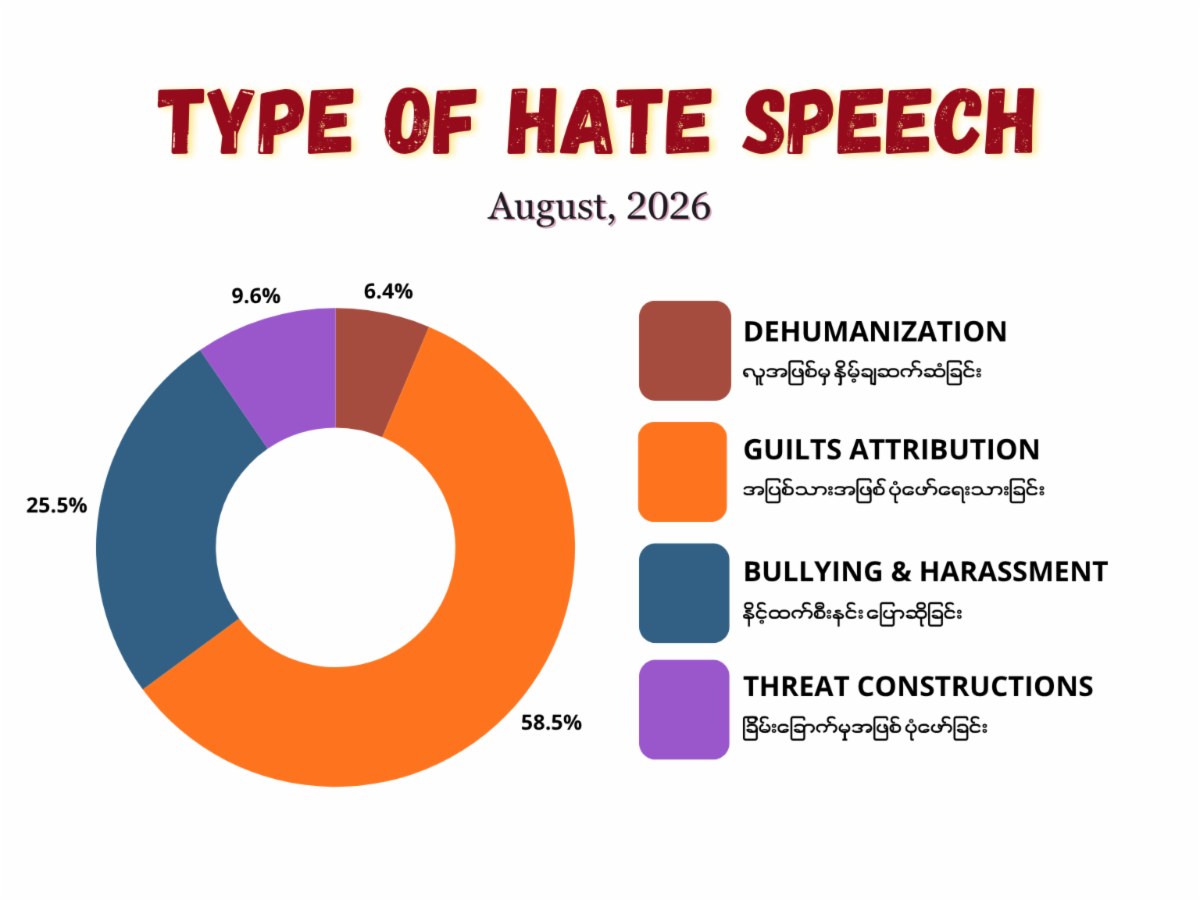
5The figure illustrating types of hate speech
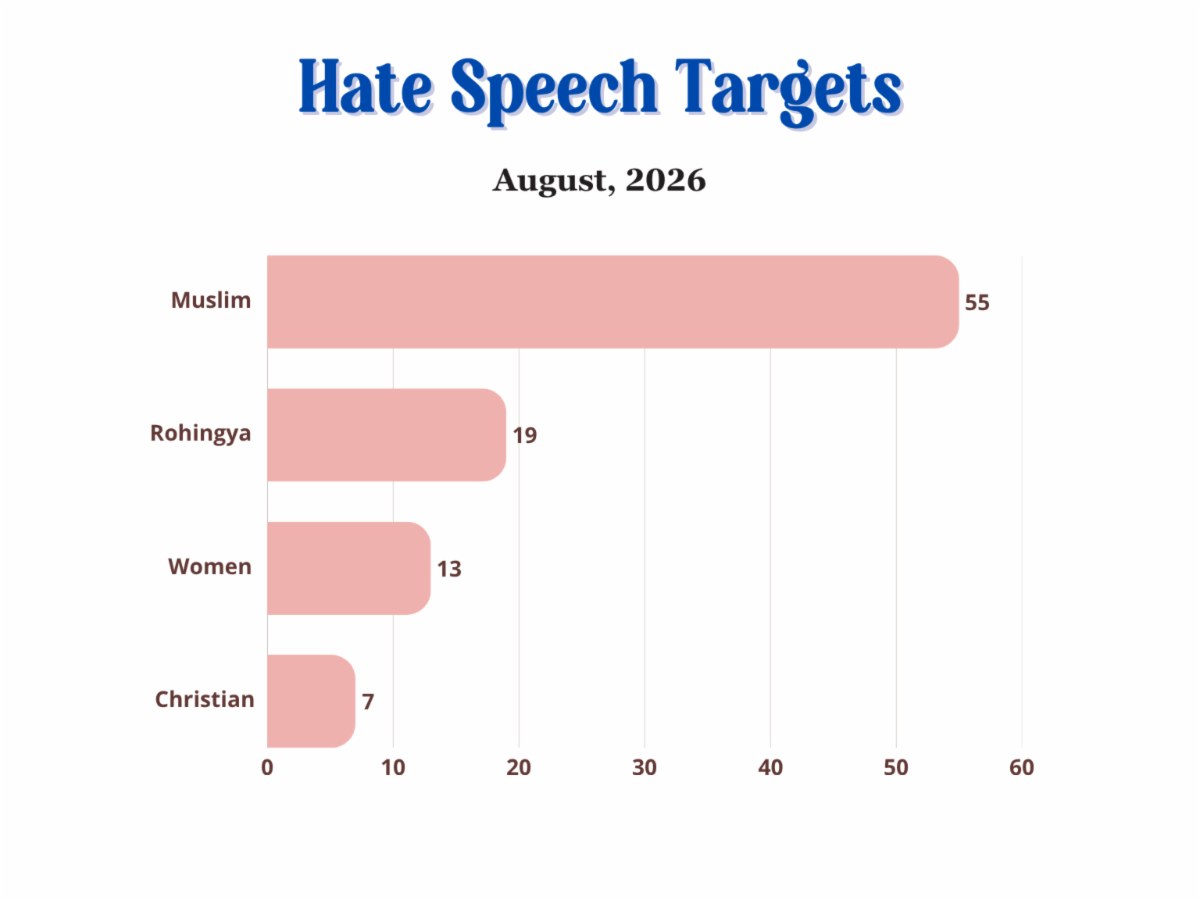
6The figure illustrating the number of hate speech targets
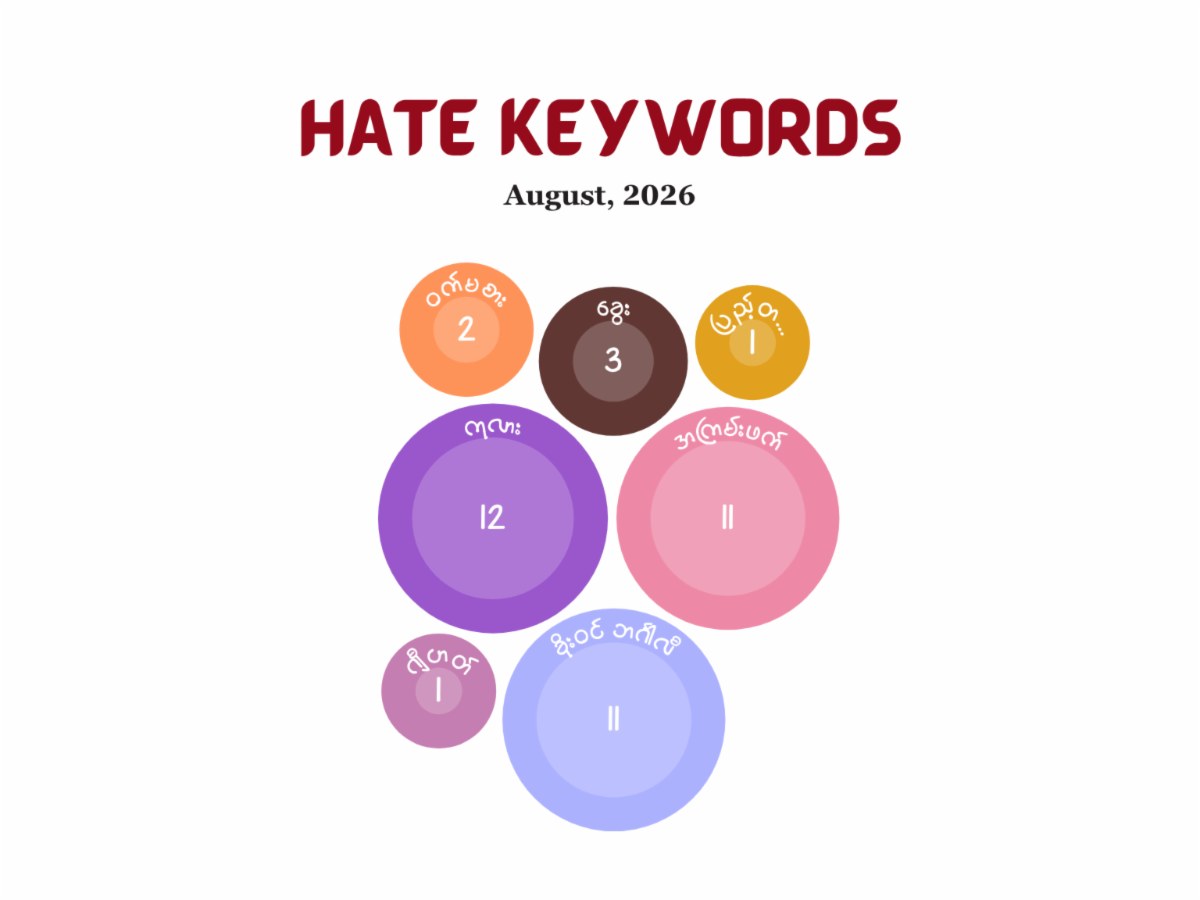
7Keywords used by hate speech writers
8The figure illustrating types of fake news
9Distribution by Platform

10Conclusion
The monitoring findings for August indicate a resurgence of religiously framed hate speech amid Myanmar’s ongoing political instability. The documented content frequently intertwined political and religious issues to promote narratives that could increase suspicion and hostility between Buddhist, Muslim, and Christian communities. In a number of cases, political developments and religious identities were deliberately presented together in ways that contributed to intercommunal tensions.
In particular, hate speech targeting Muslim places of worship and religious schools increased during August. Organisations that identify themselves as protectors of race, religion, and Buddhism were also observed disseminating and promoting a substantial amount of content framed around religious identity that could contribute to increased hostility between different ethnic and religious communities.
The monitoring also identified the circulation of misinformation and hate speech concerning the involvement of Rohingya people in the ongoing conflict between the Myanmar military and the Arakan Army (AA) in Rakhine State. Different actors disseminated inaccurate information and narratives concerning Rohingya involvement in the conflict, contributing to the spread of hostility towards the community. Historically used anti-Rohingya hate speech, ethnically derogatory terms, and narratives portraying Rohingya as a religious extremist or security threat were also repeatedly reproduced during the reporting period.
Overall, the August monitoring findings indicate that hate speech targeting Muslims and Rohingya increased, particularly through narratives framed around religious identity. The content documented during the month demonstrates the continued intersection of religious and political narratives in the production and dissemination of hate speech.
Translations of the documented posts
The posts below are hate speech documented by BHRN. They are translated here only as evidence for this report.
Translation (1)
AK Media Live| 16 August 2026
An ARSA Commander from an “Islamic Extremist Bengali Armed Terrorist Group” Arrested by Security Forces at Balukhali Refugee Camp (9)
According to reports in Bangladeshi media, security forces arrested a commander of the ARSA, described as an “Islamic extremist Bengali armed terrorist group,” in the early hours of today at Balukhali Bengali Refugee Camp No. (9), in Ukhiya Township, Cox’s Bazar District, Bangladesh.
According to statements issued by the 8th Armed Police Battalion (8 APBn) and Ukhiya Police Station, the arrest was made during a special operation in Block D/03 of Camp No. (9), following the receipt of intelligence information.
The arrested individual was reportedly accused of attempting to exert influence within the camp, extortion, kidnapping, and involvement in acts of terrorism. Police reportedly stated that, during an initial interrogation, he admitted to having links with the ARSA, described as a terrorist organisation.
The necessary procedures are reportedly being carried out to take legal action against the arrested individual as soon as possible. The APBn also reportedly stated that operations of this kind would continue in order to strengthen law enforcement and maintain security and stability within the refugee camp.
It is further reported that “Islamic extremist Bengali armed terrorist groups” are currently committing crimes, including killings, kidnappings, and rape, in refugee camps in Bangladesh, causing concern among the Bengali residents of the camps.
Translation (2)
AK Media Live | 23 August 2026
Warning Issued over an Emergency Security Situation and Possible Conflict at Camp 1E, a Bengali Refugee Camp in Cox’s Bazar
Bangladeshi media reported that an emergency security warning had been issued after information was received that “Islamic extremist Bengali armed terrorist groups” were planning to create conflict at Camp 1E, a Bengali refugee camp in Cox’s Bazar, Bangladesh.
It was reported that armed members affiliated with the “Bengali armed terrorist group” RSO (Rohingya Solidarity Organisation) were planning to create instability within the camp.
In addition, information was reportedly received that a group led by Shofiq, consisting of approximately 18 members from Camps 18, 9, and 11, might also be involved in the plan. Ton Khang was described as a senior commander affiliated with the group. The report stated that they were currently in an area under the supervision of their leader, Magyi Jahangir.
To protect the lives and safety of refugees at Camp 1E, Bengali residents of the refugee camp called on the camp authorities, security forces, and other relevant authorities to urgently verify the information and take appropriate preventive measures.
The influence of armed groups and violence in refugee camps has reportedly remained a longstanding concern. It was further reported that “Bengali armed terrorist groups” have been recruiting Bengali refugees by taking advantage of their vulnerabilities and desperation.
In May 2026, an attack by the “Bengali armed terrorist group” ARSA against members of RSO, which was likewise described as a terrorist group, reportedly resulted in four deaths and three injuries. The report further stated that 37 people were killed in 2025 and 42 in 2024. It said that humanitarian vulnerabilities in the world’s largest refugee camps in Cox’s Bazar overlap with violence committed by “Bengali armed terrorist groups.”
The statement said that the information was being shared in good faith with the aim of preventing potential violence and loss of life.
The relevant authorities were urged to treat the matter as a serious issue and conduct an immediate investigation.
Translation (3)
Hmai Wai wrote:
“Rakhine people are inherently like that; it is simply in their nature.
Since around 2012, as far as I can recall, whenever incidents occurred in Rakhine, it was the Myanmar military and the Bamar who protected Rakhine ethnic people from killings by ‘terrorist Bengalis’ and the ARSA group.
It cannot be said that there will never be another conflict between the Rakhine and the ‘Kalar’.”
Translation (4)
Araksha Soe Rakhaing posted:
“Six ‘illegal Bengali entrants,’ ‘liars’ (Rohingya), and members of the ARSA and ARO terrorist groups who had allegedly entered the Maungdaw area of Rakhine State from Bangladesh were arrested by the AA along with weapons.”
Translation (5)
Zaw Win wrote:
“The NUG and NLD ‘red idiots’ have already expelled the illegal entrants after using them for their own purposes. Since the end of the Thein Sein era, the NLD and the illegal Bengali entrants have been sworn enemies. When Min Aung Hlaing seized power, the NLD, NUG, and the illegal entrants once again joined forces. As a result, they gained considerable political benefits through assistance from and reliance on the OIC.
Now that the NLD and NUG ‘red idiots’ have expelled them, the illegal entrants and the ‘red’ groups have gone their separate ways. However, people like Aung Kyaw Moe will certainly try to revive ARSA, RSO, and ARA by working with the terrorist Min Aung Hlaing.
Min Aung Hlaing’s military supporters, the NLD and NUG ‘red’ supporters, and the illegal entrants are all deceiving one another, with each trying to outmanoeuvre the other.
They are probably already planning how to cause suffering to the Rakhine people.”
Translation (6)
Mayyu Media wrote:
“Bengali Muslims who became an ethnic group simply by crossing the Naf River.
Watch this video to find out whether the Bengalis are stateless.”
Translation (7)
Statement attributed to Ashin U Thuzitta:
“Although Muslims in Myanmar are said to be a minority, they should not be considered a minority because they may take up to four wives and have a high rate of population growth.”
Translation (8)
Bamar Thar wrote:
“Just imagine how much they will have grown in another ten years.
Mosques should be restricted, and some should be demolished.
I am deeply concerned about Myanmar. The government should no longer grant permission to build mosques.
Even in powerful countries such as the United States and England, they have already been ‘taking over.’
Myanmar will be even worse, so permission to build mosques should be prohibited.”
Translation (9)
Never Forget The Trauma TikTok account wrote:
“Even countries that today have full human rights and freedoms, and are highly educated and wealthy, have begun to stop associating with the ‘giants’ that destroy them and have instead prioritised caring for and protecting their own people.
Yet in Kachin State, which knows nothing and has little, they are still opening their doors and welcoming a dangerous ‘giant.’ This is the consequence of past negligence and disregard. It is therefore especially necessary for the responsible authorities and leaders of Kachin State to take decisive responsibility for this problem, resolve it, and maintain unity and control.
Please do not regard these statements and criticisms as negligence or childishness. For the people of Kachin State, this is one of the best ways to ensure peace in the state. May Kachin State become peaceful and healthy as soon as possible.”
Translation (10)
Mitta Shin wrote:
“I think everyone knows that, because Myanmar is rich in natural resources both above and below the ground, people from other religious and ethnic groups living in the country want to take advantage of them.
They are building religious schools throughout the country with financial support from countries that share their religion.”
Translation (11)
Chit Luu (University) wrote:
“Most Christians are under Western influence and are spies for the West. They are loyal only to their former colonial rulers and do not love the countries where they were born. This is why Christian schools have had to be closed, as the situation requires vigilance against Western spies.”
Translation (12)
Chit Luu (University) wrote:
“I will write, when I have time, about Christianity in Pa-O areas and how ethnic communities have become divided along ethnic and religious lines because of Christianity.
Photo caption: “Pa-O Christians with differing views have now emerged.”
Translation (13)
Chit Luu (University) wrote:
“They say that the CIA is entering different parts of the country by posing as Christian religious teachers.
This is the most likely explanation.
The fact that Christian religious teachers are involved behind most ethnic armed organisations is evidence of this.
Everyone who loves national security, the country and its people, and religion and Buddhism should be vigilant about the involvement of certain Christian religious teachers who are allegedly under Western influence and controlled by the CIA.”
Translation (14)
Andrew Soe wrote:
“She is like this:
Even though she is close to death,
she still cannot live happily
unless she has her fake buttocks attached,
no matter whom she meets.
🤸♂️ Even though she is going through menopause,
she is the real one who never dislikes testicles.
Well, that is because she has
her mother’s ‘Kalar’ blood.”
(Andrew Soe)
6 August 2026
Translation (15)
Hmai Wai wrote:
“What does this PDF woman want?
If she meets Lwin Ko Latt,
she will be made to s*x,
even if he does not win the lottery.”
😁😁😁
Moing Wai
Translation (16)
View of Sue wrote:
“This ‘red’ woman is indoctrinating children with politics.”
Translation (17)
AK Media Live Facebook page wrote:
“The Bangladesh government and Islamic extremist Bengali armed terrorist groups are plotting to seize control of Arakan.”
Translation (18)
View of Sue wrote:
“Illegal-entry Muslims are setting fire to churches in Canada.”
Translation (19)
MaMa SuSu wrote:
“Most PDFs are Christians.
Bamar people need to be extremely cautious.”
Reposted from Eleven Broadcasting: A post concerning a video that circulated on social media reported that a woman from Khin-U Township, Sagaing Region, was hacked to death with knives by several men and that the killing was allegedly carried out by PDFs on accusations that she was an informant (“dalan”).
About BHRN
Burma Human Rights Network (BHRN) is based in London, operates across Burma/Myanmar and works for human rights, minority rights and religious freedom in Burma. BHRN has played a crucial role in advocating for human rights and religious freedom with politicians and world leaders.
Media enquiries
၁နိဒါန်း
ယခုအစီရင်ခံစာသည် ၂၀၂၆ ခုနှစ် ဩဂုတ်လ အတွင်း လူမှုကွန်ယက် များကို လေ့လာစောင့်ကြည့်ပြီး တွေ့ရှိသည့် အမုန်းစကားများ၊ သတင်းတု သတင်းမှားများနှင့်ပတ်သက်သည့် တွေ့ရှိချက်များကို ရေးသားထားခြင်းဖြစ်သည်။ အဓိကစောင့်ကြည့်သည့် လူမှုကွန်ယက် ချန်နယ်များမှာ ဖေ့ဘုတ်၊ တယ်လီဂရမ် တို့ဖြစ်သည်။ လေ့လာစောင့်ကြည့်မှုများထဲမှာ အမုန်းစကားများ၊ သတင်းတုသတင်းမှားများ စုစုပေါင်း ၁၀၃ ခုကို မှတ်တမ်းတင်ခဲ့ပြီး အမုန်းစကား ၉၅ ခုနှင့် သတင်းတုသတင်းမှား ၈ ခုကို ခွဲခြမ်းမှတ်တမ်းတင်ခဲ့သည်။ မှတ်တမ်းတင်ရာတွင် အများစုမှာ အမုန်းစကားများဖြစ်ပြီး ဘာသာရေး၊ လူမျိုးရေး၊ အမျိုးသမီးများ၊ LGBT များ၊ နိုင်ငံရေးခံယူချက်မတူသူများကို အဓိကဦးတည်သည့် အမုန်းစကားအခြေခံသည့် ဇာတ်ကြောင်းများကို ရေးသားကြသည်ကို တွေ့ရှိရသည်။
ယခုလတွင် တွေ့ရှိရသည့် အမုန်းစကားများသည် လူပုဂ္ဂိုလ် တဦးစီကို ဦးတည်ပြီး အမုန်းစကားပြောခြင်းသာမက အုပ်စုတစု၊ လူ့အဖွဲ့အစည်းတခုလုံးကို အန္တရာယ်ရှိသူ၊ အကြမ်းဖက်သမားများ၊ လူ့အဖွဲ့အစည်းအား အန္တရာယ်ပေးနိုင်သည့်အတွက် လူ့အဖွဲ့ အစည်းမှ ဖယ်ကြဉ်ရန်လိုအပ်သူများအဖြစ် ပုံဖော်ရေးသားထားသည့် အမုန်းစကားများလည်း ပါဝင်သည်။ ထို့ကြောင့် ယခုအစီရင်ခံစာသည် ပို့စ်တခုစီ၏ အမုန်းစကားများကို ဖော်ပြခြင်းမဟုတ်ဘဲ ထိုပို့စ်များမှ အကြောင်းအရာများမှ ထပ်တလဲလဲ ဖြစ်ပေါ်လာသည့် ဇာတ်ကြောင်းများနှင့် ဦးတည်ပစ်မှတ်များအပေါ် ပုံဖော်ရေးသားမှုများကို အဓိကထား၍ ဆန်းစစ်လေ့လာထားပါသည်။
၂သုတေသနနည်းနာ
အမုန်းစကားသည် စိတ်ခံစားမှု အမုန်းတရားပေါ်မူတည်ပြီး ပေါ်ပေါက်လာသော စကားရပ်ဖြစ်သည့် အလျောက် အဓိပ္ပါယ်ဖွင့်ဆိုရန် ကျယ်ပြန့်ပြီး တိကျသော ဖွင့်ဆိုချက်ဟူ၍ မရှိပေ။ သို့ဖြစ်ရာ ယခုအစီရင်ခံစာ၏ရည်ရွယ်ချက်အတွက် အမုန်းစကားဖွင့်ဆိုချက်ကို BHRN မှ အောက်ပါအတိုင်း သတ်မှတ်ထားသည်။
တစ်စုံတစ်ဦး သို့မဟုတ် အုပ်စုတစ်စုကို ရည်ရွယ်၍ လူတစ်ဦးကို အကာအကွယ်ပြုရမည့် ဝိသေသလက္ခဏာများကို ပြင်းထန်စွာ ဝေဖန်ခြင်း၊ ပြစ်တင်ခြင်း၊ မုန်းတီးခြင်း၊ ရန်လိုခြင်းတို့ကို ခွဲခြားနှိမ့်ချဆက်ဆံမှုများကို ထုတ်ဖော်ပြောဆိုခြင်း၊ စာဖြင့်ရေးသားခြင်း၊ အမူအယာဖြင့် ဖော်ပြခြင်း၊ အနုပညာဖြင့် ဖော်ပြခြင်းတို့ကို ဆိုလိုသည်။
လူသားတစ်ဦး၏ ကိုးကွယ်မှု၊ ဘာသာစကား၊ လိင်၊ လိင်စိတ်ခံယူမှု၊ နိုင်ငံသားဇစ်မြစ်၊ တိုင်းရင်းသားဖြစ်မှု၊ အသားအရောင်၊ လူမျိုး၊ ယုံကြည်မှု၊ နိုင်ငံသားဖြစ်မှု၊ ရုပ်ပိုင်းဆိုင်ရာ အသွင်အပြင်များ စသည့် မွေးရာပါအခွင့်အရေးများကို ထိခိုက်ပြောဆိုခြင်းတို့ကိုဆိုလိုပါသည်။ လေ့လာမှုတွင် တွေ့ရှိသည့် အမုန်းစကားများကို အောက်ပါအတိုင်းပြန်လည်ခွဲခြားပါသည်။
- အပြစ်သားများအဖြစ်ပုံဖော်ရေးသားသည့် အမုန်းစကားများ၊
- နိုင့်ထက်စီးနင်းပြောဆို သည့်အမုန်းစကားများ၊
- လူအဖြစ်မှ နှိမ့်ချဆက်ဆံသည့်အမုန်းစကားများ၊
- ဆူပူအကြမ်းဖက်မှုကိုအားပေးသည့်အမုန်းစကားများ၊
- ခြိမ်းခြောက်မှုအဖြစ်ပုံဖော်ရေး သားသည့်အမုန်းစကားများ၊
- အကြမ်းဖက်မှုနှင့်အ မုန်းစကားကြောင့် ကျူးလွန်သည့် လုပ်ရပ်များကို ဂုဏ်ယူစရာအဖြစ်ရေးသားသည့်အ မုန်းစကားများ
စသည်တို့ဖြင့် အမျိူးအစားခွဲခြားထားပါသည်။
မှတ်တမ်းတင်ထားသော အချက်အလက်များတွင် အမုန်းစကားကို လူမှု့ကွန်ယက်စာမျက်နှာတွင် ရေးသားသည့် ရက်စွဲ၊ ရေးသားသူအမည်၊ အသုံးပြုသည့် လူမှု့ကွန်ယက်စာမျက်နှာ ပလက်ဖောင်း၊ reach၊ အမုန်းစကား ဦးတည်ပစ်မှတ်များ၊ အမုန်းစကားအမျိုးအစားများ၊ အမုန်းစကား အသုံးပြုထားသော အဓိက အသုံးအနှုန်းတို့ ပါဝင်သည်။
အမုန်းစကားများကို မှတ်တမ်းတင်ရာတွင် အကာကွယ်ပေးရမည့် ဝိသေသ လက္ခဏာရှိသော အုပ်စုများကို ပြောဆိုသည့် အမုန်းစကားများကိုသာ အမုန်းစကားအဖြစ် သတ်မှတ်ကာ မှတ်တမ်းတင်သည်။ ဥပမာ ဘာသာရေးအရ၊ လူမျိုးစု၊ တိုင်းရင်းသားများအရ၊ ကျားမ ဖြစ်တည်မှုအရ၊ လိင်စိတ်ခံယူမှုအရ၊ အသားအရောင်အရ၊ နိုင်ငံသားဖြစ်မှုအရ စသည့် ဖြစ်တည်မှုများကို ရည်ရွယ်ချက်ရှိစွာ မုန်းတီးစေရန် လှုံ့ဆော်သည့် အမုန်းစကားများကို အမုန်းစကားအဖြစ် သတ်မှတ်သည်။ အကာကွယ်ပေးရန် မလိုသည့် အုပ်စုများကို ပြောဆိုမှုအား အမုန်းစကားအဖြစ်မသတ်မှတ်ပေ။ ဥပမာ လက်နက်ကိုင်အစုအဖွဲ့များ၊ နိုင်ငံရေး ဦးဆောင်အဖွဲ့အစည်းများ (NUG, KNU, KIO, etc)၊ စစ်တပ်နှင့်ပတ်သက်သည့်အရာရှိများ စသည့် အစုအဖွဲ့များကို ပြောဆိုမှုအား အမုန်းစကားအဖြစ် မသတ်မှတ်ပေ။
BHRN သည် လက်ရှိမြန်မာနိုင်ငံတွင် ဖြစ်ပေါ်နေသည့် နိုင်ငံရေးစစ်ရေးတင်းမာမှုများဖြစ်ပေါ်နေချိန်တွင် စစ်တပ်နှင့် ၎င်း၏ ဝါဒဖြန့်ချန်နယ်များမှ ဖြန့်ဝေနေသည့် သတင်းအကြောင်းအရာများတွင် ပါဝင်သည့် အမုန်းစကားအသုံးအနှုန်းများကို နေ့စဥ်လေ့လာစောင့်ကြည့်မှတ်တမ်းတင်ထားပါသည်။
၃ဒေတာစုဆောင်းခြင်း
ယခုအစီရင်ခံစာသည် ၂၀၂၆ ခုနှစ် ဩဂုတ်လတွင် Facebook gp ၃ ခု Page ၂ ခု နှင့် Facebook အကောင့် ၁၃ ခု ၊ တယ်လီဂရမ် ချန်နယ်(၂၄) ခုနှင့် TikTok Acc ၂၄ ခု တို့ကို Qualitative method အသုံးပြုပြီး စောင့်ကြည့်လေ့လာခဲ့ပါသည်။ တွေ့ရှိသည့် အမုန်းစကားများ၊ သတင်းတု သတင်းမှားများကို ရေးသားသည့် ရက်စွဲ၊ ဆိုရှယ်မီဒီယာ ပလက်ဖောင်းအမည်၊ ရေးသားသူအမည်၊ အမုန်းစကား/သတင်းတုသတင်းမှားအမျိုးအစားများ၊ Keyword များနှင့် ဦးတည်ပစ်မှတ်များစသည် တို့ကို ခွဲခြမ်း မှတ်တမ်းတင်ပါသည်။
ပို့စ်တခုချင်းစီအား သီးခြားဖြစ်ရပ်များအဖြစ်သာကြည့်ရန် မလုံလောက်သည့်အတွက် ယခုအစီရင်ခံစာတွင် ထပ်ခါထပ်ခါ တွေ့ရှိရသည့် စကားလုံးအသုံးအနှုန်းများ၊ ဦးတည်ပစ်မှတ်များကို တူညီသော ပုံဖော်ရေးသားမှုများကို စုစည်း၍ အဓိက ဇာတ်ကြောင်းများကို ခွဲခြမ်းလေ့လာထားပါသည်။
၄တွေ့ရှိချက်များ
မွတ်စလင်များကို အန္တရာယ်၊ ကျူးကျော်သူများ၊ လူ့အဖွဲ့အစည်းကို အန္တရာယ်ပေးသူများ၊ တိုင်းပြည်လုံခြုံရေး ခြိမ်းခြောက်သူများအဖြစ် ပုံဖော်ခြင်း
ယခုလအတွင်း မှတ်တမ်းတင်ထားသည့် အကြောင်းအရာများတွင် မွတ်စလင်များသည် အဓိက ဦးတည်သည့် ပစ်မှတ်များထဲမှ တခုဖြစ်သည်။ မွတ်စလင်များကို ဦးတည်သည့် အမုန်းစကားများသည် မွတ်စလင်တဦးစီကို ဦးတည်သည့် အမုန်းစကားများသာမကဘဲ မွတ်စလင်လူ့အဖွဲ့အစည်းအနေနဲ့ တိုင်းပြည်အတွက် အချိန်မရွေးအန္တရာယ်ပေးနိုင်သူများအဖြစ် ပုံဖော်ထားမှုများကိုတွေ့ရှိရသည်။ ထို့ပြင် မွတ်စလင်များအား လူဦးရေ အဆမတန် တိုးပွားလာခြင်း၊ နိုင်ငံအတွင်းသို့ တရားမဝင် ဝင်ရောက်လာခြင်း၊ လူ့အဖွဲ့အစည်းကို ဝါးမျိုရန် ပြင်ဆင်နေခြင်း စသည်တို့ကို လုပ်ဆောင်နေသူများအဖြစ် ပုံဖော်ထားပါသည်။ ထိုသို့သော ပုံဖော်မှုများသည် မွတ်စလင်များအား ယုံကြည်မှု ပျက်ပြားစေခြင်း၊ ကြောက်ရွံခြင်း၊ သစ္စာမရှိသူများအဖြစ် ပုံပေါ်စေပါသည်။ ထို့ပြင် မွတ်စလင်များကို အကြမ်းဖက်လုပ်ရပ်များကို လုပ်ဆောင်ခြင်း၊ အကြမ်းလုပ်ရပ်များလုပ်ဆောင်ရန် ပြင်ဆင်နေခြင်း၊ နိုင်ငံတော်လုံခြုံရေးများ အန္တရာယ်ပေးသူများအဖြစ် ပုံဖော်ရေးသားမှုများကို တွေ့ရှိရသည်။ ထိုသို့ ရေးသားမှုများသည် မွတ်စလင်များအား မြန်မာ့လူ့အဖွဲ့အစည်းအတွင်းမှ ဖယ်ကြဉ်ကာ နိုင်ငံခြားမှလာသူများအဖြစ်လည်းကောင်း၊ တိုင်းပြည်နှင့် လူမျိုးအတွက် အန္တရာယ်ရှိသူများအဖြစ်လည်းကောင်း ပုံဖော်ခြင်းဖြစ်သည်။
မွတ်စလင်များနှင့် ရိုဟင်ဂျာများကို အကြမ်းဖက်သမားများအဖြစ် ပုံဖော်ခြင်း
မွတ်စလင်များနှင့် ရိုဟင်ဂျာများအား အကြမ်းဖက်သူများ၊ လက်နက်ကိုင်ကာ တိုင်းပြည်အား ဖျက်စီးနေသူများနှင့် ရာဇဝတ်အပြစ်သားများ၊ မတူညီသည့် လူ့အဖွဲ့အစည်းကို ပျက်စီးရန် လုပ်ဆောင်နေသူများအဖြစ် ပုံဖော်ရေးသားမှုများကိုလည်း တွေ့ရှိရသည်။ ဩဂုတ်လ ၃ ရက်နေ့တွင် တွေ့ရှိရသည့် အမုန်းစကားများတွင် ရိုဟင်ဂျာများအား လူအဖြစ်မှ နှိမ့်ချသည့် စကားများ၊ အကြမ်းဖက်ရန် လုပ်ဆောင်နေသူများအဖြစ် ပုံဖော်ရေးသားခဲ့သည်။ ထို့ပြင် ရိုဟင်ဂျာများသည် မွတ်စလင်နိုင်ငံများတွင်သာ နေထိုင်သင့်ကြောင်းနှင့် ဗုဒ္ဓဘာသာနိုင်ငံများနှင့် ခရစ်ယာန်ဘာသာ နိုင်ငံများကို ဖျက်စီးရန် ရည်ရွယ်ချက်ဖြင့် နည်းလမ်းပေါင်းစုံဖြင့် ဝင်ရောက်နေထိုင်သူများအဖြစ် ပုံဖော်ရေးသားခဲ့ကြသည်။
ဩဂုတ်လ ၁၆ နှင့် ၂၃ ရက်နေ့တွင် AK-Media Live မှ ရေးသားမှုတွင် ဒုက္ခ သည်စခန်းများတွင်ရှိသော ဘင်္ဂါလီ (မူရင်းအသုံးအနှုန်း)/ ရိုဟင်ဂျာများသည် အကြမ်းဖက်မှုလုပ်ငန်းများလုပ်ဆောင်ရန် အစ္စလာမ်မစ်အစွန်းရောက် အကြမ်း ဖက် လက်နက်ကိုင်အဖွဲ့ကိုဖွဲ့စည်းပြီး ဆောင်ရွက်နေသည်ဟု ဖော်ပြခဲ့သည်။ AK-Media ,
ထို့ပြင် ဩဂုတ်လ ၂၇ ရက်တွင် မှိုင်းဝေ တယ်လီဂရမ် ချန်နယ်မှ ရိုဟင်ဂျာအားလုံးသည် အာဆာအဖွဲ့နှင့် ဆက်စပ်ကာ ရခိုင်ပြည်နယ်လုံခြုံရေးကို ခြိမ်းခြောက်နေသူများအဖြစ် ပုံဖော်ရေးသားမှုများကို တွေ့ရှိရသည်။ မှိုင်းဝေ
ထို့ပြင် Araksha Soe Rakkaing Facebook pageမှလည်း ရိုဟင်ဂျာများအား ခိုးဝင် လက်နက်ကိုင် အကြမ်းဖက်များအဖြစ် ပုံဖော် အမုန်းစကားဆိုထားသည်။
ထိုသို့ရေးသားမှုများတွင် လူတဦးချင်းစီ၏ လုပ်ရပ်များကို လူ့အဖွဲ့အစည်းတခုလုံးကို တာဝန်ခံခိုင်းကာ အပြစ်ဖို့သည့် ပုံဖော်မှုများကို တွေ့ရှိရသည်။ ထိုသို့သော ပုံဖော်မှုသည် သက်ဆိုင်ရာလူ့အဖွဲ့အစည်းတခုလုံးအပေါ် ယုံကြည်မှုပျက်ပြားခြင်း၊ မုန်းတီးခြင်းတို့ကို ပိုမိုဖြစ်ပေါ်စေသည်။
အမုန်းစကားအများစုသည် ရိုဟင်ဂျာများကို တရားမဝင် ဘင်္ဂါလီ သို့မဟုတ် တရားမဝင် ဝင်ရောက်လာသူများအဖြစ် သုံးနှုန်းကြပြီး ဘင်္ဂလားဒေ့ရှ်နိုင်ငံမှ ရခိုင်ပြည်နယ်သို့ နယ်စပ်ဖြတ်ကျော်ဝင်ရောက်လာသူများဟု စွပ်စွဲရေးသားမှုများကို တွေ့ရှိရသည်။ ဩဂုတ်လ ၃ ရက်နေ့တွင် တွေ့ရှိရသည့် ပို့စ်အများစုသည် ရိုဟင်ဂျာများ၏ ဖြစ်တည် တည်ရှိမှုကို မေးခွန်းထုတ်ကြပြီး ရိုဟင်ဂျာများသည် နယ်မြေချဲ့ထွင်ရန် မြန်မာနိုင်ငံနှင့် အခြားနိုင်ငံများသို့ ရည်ရွယ်ချက်ရှိရှိ ဝင်ရောက်နေကြသည်ဟူသည့် စွပ်စွဲချက်များကို ရေးသားဖြန့်ဝေထားသည်။
ထို့ပြင် ဩဂုတ်လ ၅ ရက်နေ့တွင်လည်း Zaw Win accountက ရိုဟင်ဂျာများကို တရားမဝင်ဘင်္ဂါလီများဟု ဖော်ပြကာ NLD နှင့် NUG အဖွဲ့တို့သည် တိုင်းပြည်ကို ဒုက္ခရောက်ရန် ရိုဟင်ဂျာများနှင့် ပူးပေါင်းဆောင်ရွက်နေသည်ဟူသည့် စွပ်စွဲချက်မျာကို ရေးသားသည့် အမုန်းစကားများကို တွေ့ရှိရသည်။ Zaw Win
ထိုသို့ရေးသားမှုများသည် နယ်မြေရွှေ့ပြောင်းနေထိုင်နေရသည့် ရိုဟင်ဂျာများနှင့် လက်ရှိ စစ်တပ်ကို တော်လှန်နေသည့် အဖွဲ့အစည်းများနှင့် အပြန်အလှန်ချိတ်ဆက်ကာ တိုင်းပြည်လုံခြုံရေး အကြောင်းပြချက်ဖြင့် တိုင်းပြည်အတွက် ခြိမ်းခြောက်နေသည့် အန္တရာယ်အဖြစ် ဇာတ်ကြောင်းဖန်တီးကာ ရေးသားမှုများကို တွေ့ရှိရသည်။
ဩဂုတ်လ ၃၀ ရက်နေ့တွင် မေယုမီဒီယာမှ နတ်မြစ်ကို ကျော်လိုက်တာနဲ့ လူမျိုးနာမည်တစ်ခု ဖြစ်သွားတဲ့ ဘင်္ဂလီ ကုလားတွေဟူသည့် မေးခွန်းတခုကို အသုံးပြုခဲ့ပြီး ရိုဟင်ဂျာလူမျိုးများ၏ ဖြစ်တည်မှုနှင့် နိုင်ငံသားဖြစ်ခွင့်ကို မေးခွန်းထုတ်သည့် ဇာတ်ကြောင်းတခုကို ရေးသားခဲ့သည်။ ရိုဟင်ဂျာများနှင့်ပတ်သက်သည့် ဇာတ်ကြောင်းများသည် ရိုဟင်ဂျာများကို ရွှေ့ပြောင်းနေထိုင်နေ သည့် ဒုက္ခသည်များအဖြစ် ပုံဖော်ရုံသာမက တရားမဝင်နေထိုင်သူများအဖြစ် ပုံဖော်ရေးသားခဲ့ခြင်းဖြစ်သည်။ မေယုမီဒီယာ
မြန်မာနိုင်ငံတွင် ဘာသာရေးလွတ်လပ်ခွင့် အပြည့်အဝပေးထားသည်ဟု စစ်ခေါင်းဆောင်က နိုင်ငံတကာအား တင်ပြနေသော်လည်း ပြည်တွင်းရှိ လူနည်းစု ဘာသာဝင်များ၏ ဝတ်ပြုဆောင်များအား ပြုပင်ခွင့်နှင့် အသစ်ဆောက်လုပ်ခွင့်များအား ပိတ်ပင်ထားဆဲပင် ဖြစ်သည်။ ရန်ကုန်တိုင်း သန်လျင်မြို့နယ်ရှိ စိန်ကုန်းစွန္နိဂျာမေဗလီ အဆောင်အဦးတိုးချဲ့ဆောက်လုပ်မှုအပေါ် မျိုးချစ်မြန်မာရဟန်းတော်များသမ္ဂမှ ဆရာတော် ဦးသုစိတ္တ ဦးဆောင်ပြီး ခွင့်ပြုမိန့်မရှိဟုဆိုကာ ဖြိုဖျက်ခိုင်းခဲ့သည်။
ယင်းဖြစ်ရပ်ကို ဦးဝေအောင်၏ TikTok Acc က ဆရာတော် ဦးသုစိတ္တ၏ ပြော ဆိုချက်ရုပ်သံကို ပြန်လည်ဖော်ပြရာ တွင် လူနည်းစုဟု ဆိုသော်လည်း အမျိုးသမီးလေးယောက်ယူကာ မျိုးပွားနုန်းမြန်သည့်အတွက် လူနည်းစုဟုမဆိုသာကြောင်းနှင့် မြန်မာနိုင်ငံတွင် နေထိုင်မည်ဆိုပါက မြန်မာနိုင်ငံ၏ ဥပဒေကို လေးစားလိုက်နာရန်လိုအပ်သည်ဟု ဆိုထားသည်။ ၎င်း၏ ပြောကြားချက်များသည် အစ္စလာမ်ဘာသာဝင်များအား ဥပဒေမဲ့နေထိုင်သူများအဖြစ် ပုံဖော်ကာ အမုန်းစကားဆိုထားသည်ကို တွေ့မြင်ရသည်။ ဥူးဝေအောင်
ဗမာ့သား Tiktok Acc မှလည်း ပြင်ဦးလွင် ဆူးလေကုန်းဗလီအား လှုဒါန်းမှုကို ပြန်လည်မျှဝေကာ ဗလီများအား ကန့်သတ်ကာ တချို့အား ပိတ်သိမ်းရန်နှင့် လူဦးရေးကြီးထွားမှုနုန်းကို အစိုးရအနေဖြင့် ထိန်းချုပ်သင့်ကြောင်း အမုန်းစကားဆိုထားသည်။ ၎င်း၏ ပို့စ်တွင် ဗလီတွေ ပိတ်သိမ်းသင့်ပြီး မျိုးချစ်များ စည်းရုံမှဖြစ်မည်ဟု မှတ်ချက်ရေးထိုးထားပြီး အောက်တွင် အမုန်းစကားမှတ်ချက်ပြုသူ ၅၀ ကျော်ရှိနေပြီး အဆိုကို ထောက်ခံသူ ရှစ်ရာကျော်ရှိသည်ကို တွေ့မြင်ရသည်။ ဗမာ့သား
အစ္စလာမ်ဘာသာဝင်တစ်ဦးက မျှဝေထားသည့် ကချင်ပြည်နယ် မြစ်ကြီးနားဂျာမေ့အ်ဗလီ ဗီဒီယိုဖိုင်အား ပြန်လည်တင်ပြကာ Never Forget The Trauma Tiktok Acc မှ တရားမဝင်ဗလီဟု စွပ်စွဲကာ အမုန်းစကားဆိုထား သည်။ ၎င်းက အစ္စလာမ်ဘာသာအား ဖျက်စီးတတ်သည့် ဘီလူးကြီးအဖြစ် ဆိုထားကာ ကချင်ပြည်နယ်တာဝန်ရှိသူ များအနေဖြင့် တာဝန်ယူဖြေရှင်းရန် ပြစ်တင်အမုန်းစကားဆိုထားသည်၊ အစ္စလာမ်ဘာသာဝင်များအား အန္တရာယ်ရှိသူများအဖြစ် ပုံဖော်ထားသည်။
မြန်မာနိုင်ငံတွင် သံယံဇာတပေါကြွယ်ဝသည့်အတွက် ပြည်တွင်းနေ အစ္စလာမ်ဘာသာဝင်များက လိုချင်နေသည့်အတွက် အနောက်အစ္စလာမ္မစ်နိုင်ငံများဖြင့်ပေါင်းကာ ကြံစည်နေသည်ဟု မေတ္တာရှင် Tiktok Acc က အမုန်းစကားဆိုထားသည်။ ၎င်းက အနောက်နိုင်ငံများ အကူအညီဖြင့် ဘာသာရေးစာသင်ကျောင်းများ ဆောက်လုပ် နယ်ချဲ့သူများအဖြစ်ပုံဖော် အမုန်းစကားဆိုထားသည်။ မေတ္တာရှင်
ခရစ်ယာန်များကို နိုင်ငံခြားသြဇာခံသူနှင့် နိုင်ငံရေးရန်သူများအဖြစ် ပုံဖော်ခြင်း
ဩဂုတ်လတွင် ခရစ်ယာန်များကို ဦးတည်သည့် အမုန်းစကားများကိုလည်းတွေ့ရှိရသည်။ ခရစ်ယာန်များသည် အနောက်တိုင်းနိုင်ငံများ၏ လွှမ်းမိုးမှုများကို ခံနေရသူများ၊ နိုင်ငံခြားမှ မြန်မာနိုင်ငံရေးကို ထောက်လှမ်းရန် အေးဂျင့်များအဖြစ် ပုံဖော်မှုများကို တွေ့ရှိရသည်။ ဩဂုတ်လ ၁၅ ရက်နေ့တွင် View of Sue မှ ခရစ်ယာန်များသည် အနောက်တိုင်းနိုင်ငံများကို မှီခိုနေထိုင်သူများအဖြစ် ပုံဖော်ရေးသားပြီး ခရစ်ယာန်များကို နှိမ်နှင်းရန် ရေးသားလှုံ့ဆော်မှုများကို ရေးသားခဲ့သည်။
ဩဂုတ်လ ၁၆ ရက်နေ့တွင် စာရေး ဆရာ ချစ်လူတက္ကသိုလ် သံဃာတပါးသည် ခရစ်ယာန်များသည် အနောက် တိုင်း လွှမ်းမိုးခြင်းကိုခံရပြီး ခရစ်ယာန်များကို သစ္စာမရှိသူများအဖြစ် ပုံဖော်ရေးသားမှုများကို တွေ့ရှိရသည်။ စာရေးဆရာ ချစ်လူတက္ကသိုလ်
ထို့ပြင် ပအိုဝ်းဒေသများတွင် ပအိုဝ်းများအကြား ခရစ်ယာန် ပအိုဝ်းများ ပေါ်ပေါက်လာသည့်အတွက် တိုင်းရင်းသားများအကြား နိုင်ငံရေး၊ ဘာသာရေးကွဲပြားမှုများရှိခဲ့သည်ဟု ထိုဗုဒ္ဓဘာသာ ဘုန်းကြီးမှ ရေးသားခဲ့သည်။ စာရေးဆရာချစ်လူ တက္ကသိုလ်
ထို့ပြင် ခရစ်ယာန်ဘာသာအား နိုင်ငံခြားလွှမ်းမိုးမှုခံရသည့် ဘာသာတခုအဖြစ် ထပ်ခါ ပုံဖော်နေပြီး ခရစ်ယာန်များအား နိုင်ငံရေးအရ တိုင်းပြည်အပေါ် သစ္စာမဲ့သူများ၊ တိုင်းတပါးမှ ချုပ်ကိုင်ခံနေရသူများအဖြစ် ပုံဖော်မှုများကို အဆိုပါ ဘုန်းကြီးက ရေးသားခဲ့ကြသည်။ စာရေးဆရာ ချစ်လူ တက္ကသိုလ်
အမျိုးသမီးများအားကိုယ်ကျင့်တရားမရှိသူများ၊ လိင်ပိုင်ဆိုင်ရာနှင့်ပတ်သက်ပြီး နိုင့်ထက်စီးနင်းရေးသားပုံဖော်မှုများ
အမျိုးသမီးများအား အမုန်းစကားတိုက်ခိုက်မှုများကို တွေ့ရှိရပြီး မွတ်စလင်များနှင့် ရိုဟင်ဂျာအမျိုးသမီးများကို နိုင်ငံသားအဖြစ်အသိအမှတ်ပြုခြင်းနှင့် သက်ဆိုင်သည့် အကြောင်း ရင်းများကို အခြေခံပြီး ရေးသားမှုများတွင် လိင်ပိုင်ဆိုင်ရာ နိုင့်ထက်စီးနင်းရေးသားမှုများ၊ လူ့ဂုဏ်သိက္ခာကျဆင်းရန် ရေးသားမှုများကို တွေ့ရှိရသည်။
ဩဂုတ်လ ၆ ရက်နေ့တွင် ဒေါ်အောင်ဆန်းစုကြည်အား လိင်စိတ်ကြီးသူအဖြစ်ပုံဖော်ကာ နိုင်စိုးနှင့်အမျိုးများ တယ်လီဂရမ်ချန်နယ်တွင် အမုန်းစကား ရေးသားထားသည်။
ထို့ပြင် ဩဂုတ်လ ၇ ရက်နေ့တွင် တော်လှန်ရေးတွင် ပါဝင်နေသည့် အမျိုးသမီးတဦးအား တော် လှန်ရေးတွင် လိင်ကျူးလွန်မှုကို ခံရမည့်သူဟု မှိုင်းဝေ တယ်လီဂရမ်ချန်နယ်တွင် ရေးသားခဲ့သည်။ မှိုင်းဝေ
ဩဂုတ်လ ၈ ရက်နေ့တွင် ၈၈၈၈ အထိမ်းအမှတ်အဖြစ် ကျောင်းသားများအား ဟောပြောနေသည့် အမျိုးသမီးအား နိုင်ငံရေးအကျိုးအမြတ်အတွက် ကလေးများကို အသုံးချနေသည်ဟု View of Sue တယ်လီဂရမ်ချန်နယ်မှ ရေးသားခဲ့သည်။
ဩဂုတ်လ ၁၃ ရက်နေ့တွင်လည်းတော်လှန်ရေး ရန်ပုံငွေရှာရေးတွင် အသုံးပြုသည့် အမျိုးသမီးများပုံအား လိင်ပိုင်ဆိုင်ရာ ကျူးလွန်သည့် ပြည့်တန်ဆာလုပ်ငန်းနှင့် နှိုင်းယှဉ်ကာရေးသားမှုကိုတွေ့ရှိရသည်။
သတင်းတု သတင်းမှားများဖြင့် ဝါဒဖြန့် အမုန်းစကားဆိုမှုများ
မြန်မာနိုင်ငံတွင် သတင်းတု၊ သတင်းမှားများကို နိုင်ငံရေးနှင့် ဘာသာရေးကို ရောယှက်ကာ ဖြန့်ဝေလေ့ရှိသည်၊။ ဖြန့်ဝေရာတွင်လည်း ထင်ယောင်ထင်မှားဖြစ်အောင် လုပ်ဆောင်ခြင်း၊ မမှန်ကန်သော အချက်အလက်များကို ချိတ်ဆက်ခြင်း၊ သတင်းအချက်အလက်အားလုံးအား လုပ်ကြံဖန်တီးထားခြင်းများဖြင့် လူ့အဖွဲ့အစည်း တခုနှင့်တခုအကြား အမုန်းတရားတိုးပွားလာအောင် သွေးထိုးလှုံ့ဆော်မှုများကို တွေ့မြင်ရသည်။
ဘင်္ဂလားဒေ့ရှ်နိုင်ငံနှင့် ARSA အဖွဲ့က ရခိုင်ပြည်နယ်အား သိမ်းယူရန် ကြံစည်နေသည်ဟု AK Media Live Facebook page တွင် ဩဂုတ် ၁၉ ရက်က ရေးသားဖော်ပြထားသည်။ ၎င်းက ရိုဟင်ဂျာလူမျိုးများအား ပစ်မှတ်ထားပြီး စစ်ဆင်ရေး ဗီဒီယိုတခုအားဖော်ပြကာ သတင်းအစမှအဆုံးထိ လုပ်ကြံဖန်တီးထားသည်ကို တွေ့မြင်ရသည်။ AK-Media
View of Sue တယ်လီဂရမ်ချန်နယ်၌ အဆောက်အဦများ မီးလောင်နေသည့် ဓာတ်ပုံနှင့် ပြည်ပသတင်းတခုအား ဖော်ပြကာ ကနေဒါနိုင်ငံရှိ ခရစ်ယာန်ဝတ်ပြုကျောင်းများအား အစ္စလာမ်ဘာသာဝင်များ မီးရှို့ဖျက်ဆီးနေသည်ဟု ဩဂုတ် ၉ ရက်က အမုန်းစကားဖြန့်ထားသည်။ ယင်းချန်နယ်က မမှန်ကန်သော ချိတ်ဆက်မှုများဖြင့် အစ္စလာမ်ဘာသာဝင်များအား အကြမ်းဖက်အဖြစ် ပုံဖော် တိုက်ခိုက်ထားသည်။ View of Sue
စစ်အာဏာသိမ်းယူခြင်းကြောင့် ထွက်ပေါ်လာသည့် ပြည်သူ့ကာကွယ်ရေးတပ်ဖွဲ့မှ အဖွဲ့ဝင်များသည် ခရစ်ယာန်ဘာသာဝင်များဖြစ်သဖြင့် ဗမာလူမျိုးများအား သတိထားကြရန် ဘာသာရေးအခြေပြု အမုန်းစကားဆိုမှုကို မမ စုစု Facebook Acc မှ ပြုလုပ်ထားသည်။ ၎င်းက စစ်ကောင်စီထောက်ခံသည့် Eleven Media ကဖော်ပြသည့် စစ်ကိုင်းတိုင်း ခင်ဦးမြို့နယ်တွင် ဖြစ်ပွားခဲ့သော လူသတ်မှုဖြစ်စဉ် ဗီဒီဖိုင် သတင်းဖော်ပြမှုကို ပြန်လည်မျှဝေကာ ရည်ရွယ်ချက်ရှိရှိ တော်လှန်ရေးအား ပုံဖျက်တိုက်ခိုက်ထားသည်ကို တွေ့မြင်ရသည်။ မမ စုစု
၅အမုန်းစကားအမျိုးအစား အရေအတွက်ပြပုံ
၆အမုန်းစကား ဦးတည်ပစ်မှတ်များ အရေအတွက်ပြပုံ
၇အမုန်းစကားရေးသားသူများ သုံးစွဲသည့် keywords များ
၈သတင်းတုသတင်းမှား အရေအတွက်ပြပုံ
၉ပလက်ဖောင်းအလိုက် ဖြန့်ဝေမှု
၁၀နိဂုံး
ခြုံငုံသုံးသပ်ချက်
မြန်မာနိုင်ငံ၏ ဩဂုတ်လအတွင်း အမုန်းစကား ဖြန့်ဝေမှု အခြေအနေသည် နိုင်ငံရေး မတည်ငြိမ်မှုကို အခွင့်ကောင်းယူ၍ ဘာသာရေးဆိုင်ရာ အစွန်းရောက် ရေးသားချက်များ ပြန်လည်မြင့်တက်လာခဲ့သည်။ ဗုဒ္ဓဘာသာ၊ အစ္စလာမ်ဘာသာနှင့် ခရစ်ယာန်ဘာသာဝင်များအကြား သံသယနှင့် မုန်းတီးမှု တိုးပွားစေရန် ဘာသာရေးနှင့် နိုင်ငံရေးဆိုင်ရာ ပဋိပက္ခများကို ရောထွေးကာ စနစ်တကျ ရေးသားလှုံ့ဆော်မှုများ ပြုလုပ်ခဲ့ကြသည်ကို တွေ့ရှိရသည်။
အထူးသဖြင့် အစ္စလာမ်ဘာဝင်များ၏ ဝတ်ပြုဆုတောင်းသည့် အဆောက်အဦများ၊ ဘာသာရေးစာသင်ကျောင်းများနှင့် ပတ်သက်သည့် အမုန်းစကားများသည် ဩဂုတ်လအတွင်းပိုမိုများပြားခဲ့သည်။ အမျိုးဘာသာသာသနာ စောင့်ရှောက်သူများအဖြစ် အမည်ခံအဖွဲ့အစည်းများက ဘာသာရေးကိုအခြေခံကာ လူမျိုးတခုနှင့်တခုအကြား ဘာသာတခုနှင့်တခုအကြား အမုန်းတရားတိုးပွားစေသည့် လုပ်ဆောင်ချက်များ ရေးသားချက်များကို ဩဂုတ်လအတွင်း အများအပြား လုပ်ဆောင်ခဲ့သည်။
ထို့ပြင် ရခိုင်ပြည်နယ်အတွင်း ဖြစ်ပွားနေသည့် စစ်ကောင်စီနှင့် အာရက္ခတပ်တော် (AA) တို့ကြား တိုက်ပွဲများတွင် ရိုဟင်ဂျာများ ပါဝင်ပတ်သက်နေမှုနှင့် ပတ်သက်၍ ဘက်အသီးသီးမှ သတင်းအချက်အလက် မှားယွင်းများ ဖြန့်ဝေကာ အမုန်းတရား ပွားများစေရန် ရေးသားခဲ့ကြသည်။ ရိုဟင်ဂျာများအပေါ် သမိုင်းကြောင်းအရ အသုံးပြုလေ့ရှိသည့် အမုန်းစကားများ၊ လူမျိုးရေးအရ နှိမ့်ချခေါ်ဆိုသည့် စကားလုံးများနှင့် ဘာသာရေး အစွန်းရောက် ခြိမ်းခြောက်မှုအဖြစ် ပုံဖော်သည့် စကားလုံးများကို စနစ်တကျ ပြန်လည်အသုံးပြုလာကြသည်။ ခြုံငုံသုံးသပ်ချက်အရ ဩဂုတ်လအတွင်း ယုံကြည်ကိုးကွယ်မှုကို အခြေခံပြီး အစ္စလာမ်ဘာသာဝင်များနှင့် ရိုဟင်ဂျာများအပေါ် အမုန်းစကားဖြန့်ဝေမှု ပိုမိုများပြားသည်ကိုတွေ့မြင်ရသည်။


