
- Hits: 1063

In recent weeks, the key highlights of events in Myanmar’s political conflict have been characterized by China’s ambivalent position. By not having a firm position either to push out the junta or to support it China exposed its weakness when it comes to its reliance on Myanmar for its strategic and economic reasons.
Some ethnic groups, especially the Kachin Independence Army (KIA) and Arakan Army (AA) openly ignored China’s call to end their attacks against the junta. Also, ignorance of a call by Beijing to these groups to put an end to the conflict exposed the weakening of the influence of China on Myanmar’s internal dynamics.
The junta has lost a major portion of its territory in Northern Shan State and Rakhine State, more recently in Kachin and Kayin states as well as in central Dry Zone areas, where a resistance group using their credential as Bama ethnic group is fighting the junta. It is a rare occurrence in the country, which was ruled by a junta with a mandate of enforcing Bama supremacy.
It is of course not a rare occurrence in Myanmar that Muslims fight the regime for their religious identity. Several pro-Muslim groups fought the junta in Northern Rakhine State and a small number in Kayin State during the 1980s.
In the current political climate, Muslims joined in a fight for democracy, federalism, and human rights along with Bama and other ethnic armies. They are fighting in unity under a broad umbrella of the People's Defence Force which operates under the command of the government in exile the National Unity Government (NUG).
It is a rapid development in Myanmar in which Muslims joined the NUG politicians, who denied the Rohingya genocide only less than a decade ago. At one stage the NUG politicians, who were formerly with the government led by the National League for Democracy (NLD) even refused to accept the existence of Rohingya Muslims.
These NUG politicians failed to support the persecuted Rohingya Muslim minority and condemn calls by ultra-nationalist Buddhists to exterminate Muslims from Myanmar. These incidents occurred from 2012 to 2021.
- Hits: 691

A total of 114 hate speech cases were found during BHRN’s monitoring process this month. When Facebook accounts of hate speech spreaders were disabled, some moved to Telegram channels. The military mainly used Telegram channels and TikTok accounts to spread hate speeches and the hate speeches were done through the cartoons as well.
In this month’s (the month of September) monitoring, hate speech targeted the most was PDF and the second most was Arakan Army (AA) and the third was TNLA/MNDAA. Moreover, hate speeches targeting women, Rohingya ethnicity and the Muslim community were found as well.
In addition, the most used terms of hate speeches for this month are "dog, terrorists, Kalar (a derogatory term referring to Muslim), prostitutes, non-pork eater (a derogatory term referring to Muslim), evil, illegal Bengali, Roleinnyar (a derogatory term referring to Rohingya).
- Hits: 1103
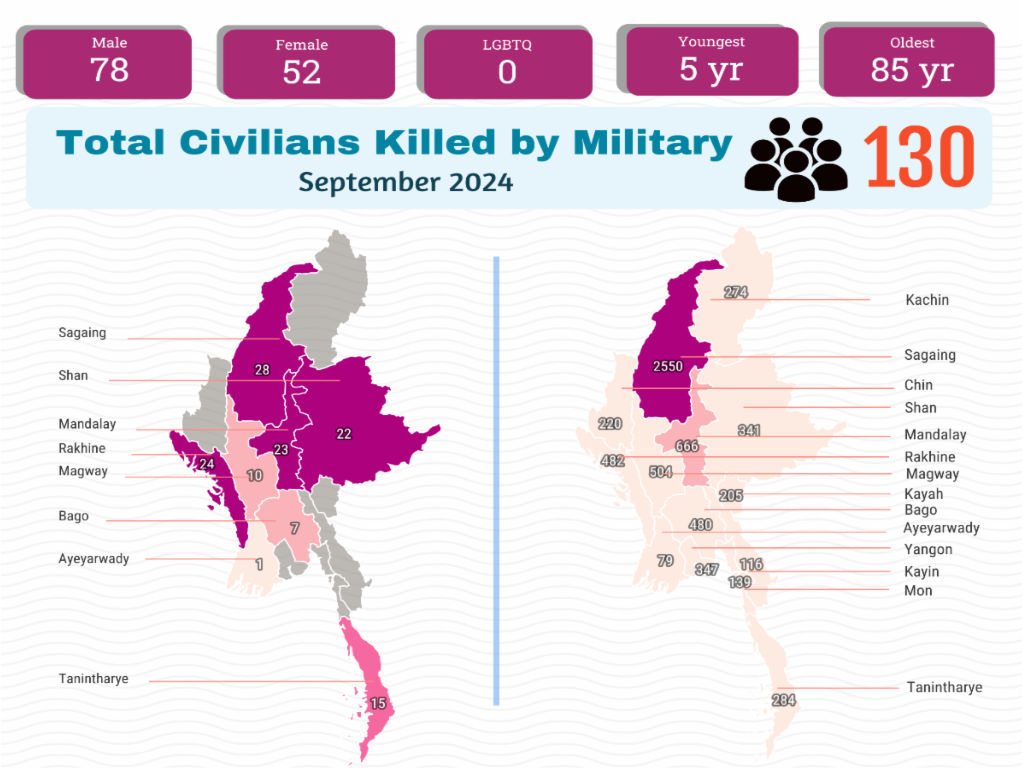
The month of September this year perhaps would be remembered as one of the most devasting months for vulnerable civilians in Myanmar. The month saw the junta troops launch nearly 50 airstrikes in which nearly 100 civilians were killed[1].
They include 10 airstrikes on Lashio, the capital of Northern Shan State which is currently under the control of the Myanmar National Defense Army (MNDAA) or Kokang group since August. Also, the junta forces launched at least 5 airstrikes on Thandwe Town in Southern Rakhine State, which is under the control of the Arakan Army.
Similarly, a more intense conflict seems to be brewing in the country’s far north Kachin State, which borders China. The Kachin rebel group KIA now seized 10 towns mostly in Kachin State and in Northern Shan State. Military analysts are predicting that KIA may push its offensive to take control of the state capital Myitkyina.
These conflicts are taking place mostly on the Sino-Myanmar border and the position of Beijing on these events is as perplexing as ever. After the peace offer was issued by the junta this month China seems to be siding with the junta in Nay Pyi Taw and trying to control rebel groups in Northern Shan State to stop their offensives.
China also put pressure on its proxy rebel groups to sever their ties with the exiled Myanmar government, the National Unity Government (NUG).
The situation in the West where the Arakan Army (AA) is fighting the junta troops is somewhat different from the rest of the country. AA is now marching to the junta’s military base in Ann township. Since AA's motive for fighting the junta is purely based on nationalism, they are less concerned about China’s position as their key motive is to restore the pride of the Rakhine people and claim autonomous rights for the Rakhine people.
- Hits: 961
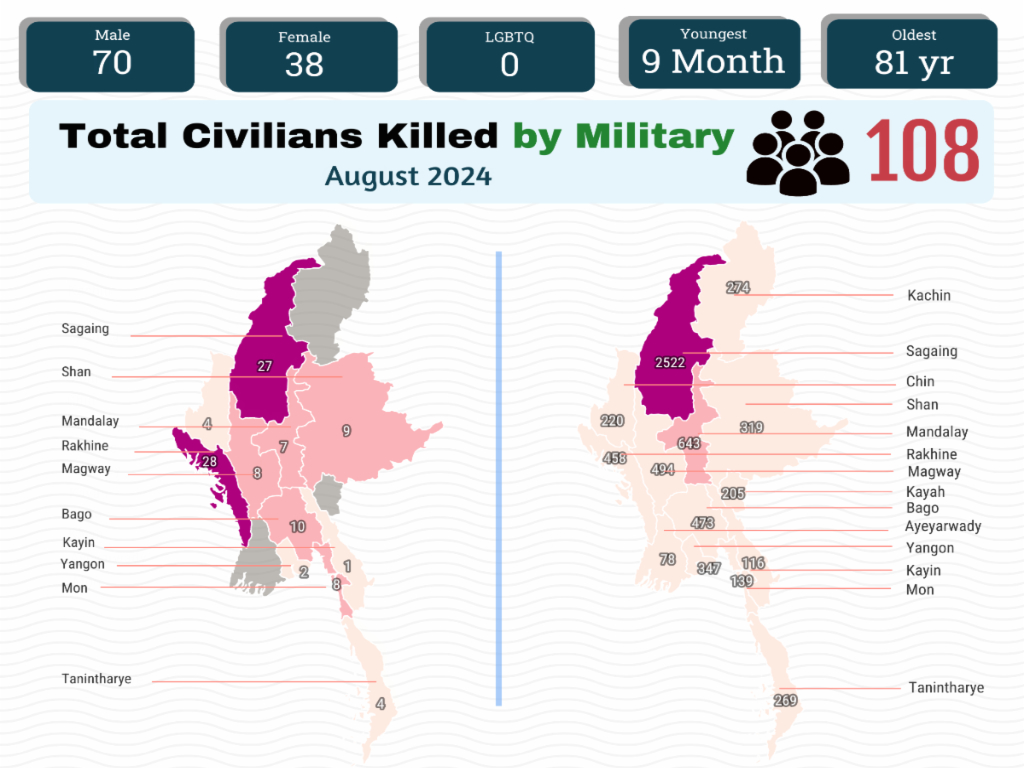
In early August the junta’s key base which has existed for more than 50 years to control the Northern Shan hill area had fallen to the hands of the MNDAA troops. Tens of thousands of the junta troops in Northeastern Command based in Lashio had surrendered to the MNDAA. Never in the history of the Myanmar military history its regional headquarters fallen into the hands of the rebel group. Such a case did not happen even during the height of the Communist insurgency in the Northern Shan State during the 1960s and 1970s.
Since the taking control of the Northeastern Command and Lashio town[1], the comments made by the local residents to independent media tend to indicate that, even though MNDAA is not ideal in terms of civilian protection and providing an effective administration, however, they said current conditions under MNDAA are far better than at the time when the town was under the junta’s control.
Some major battles were fought in Rakhine State as well during the month of August and the rebel group there AA has made significant gains of territory including taking over a key tourist town of Thandwe. After AA took control of the town one of the first moves was to release the political prisoners the junta held in the prison in the town in very inhumane conditions[2].
The month of August also saw AA making an advance to the Northern Rakhine State close to the border with Bangladesh, where AA faced criticisms over possible atrocities committed by the Rohingya communities in the area. The situation seems to be still very complicated to verify the actual situation. However, the International Crisis Group said in its report Breaking Away: The Battle for Myanmar’s Rakhine State published on 27 August, advised AA that “to foster stability, the Arakan Army should mend relations with the Rohingya, support an independent investigation of alleged abuses, and reach out to Dhaka and donors, which should find ways to work with the group on shared humanitarian and security objectives”.
- Hits: 657

BHRN has daily documented hate speech terms and usages found in the contents –based on the current political crisis - disseminated by the military.
This report was written after monitoring both online and printed media which Junta and its supporters used to spread their hate speeches. BHRN has monitored 3 Facebook groups, 1 Facebook page, 12 Facebook accounts, 24 Telegram channels, 21 TikTok accounts, and 4 Printed Media during July 2024.
In this report, BHRN has analysed hate speech in the context of the ongoing political tensions in Myanmar. Sometimes, when measured by international standards, what might look like misinformation takes on a different significance in the aftermath of the 2021 coup. This is because misinformation, particularly when aimed at individuals, groups with opposing political beliefs, or minority religious communities, can have severe consequences, even leading to loss of life and the intensification of religious and community conflicts.