BLOCKED FROM REBUILDING
Myanmar Junta Restrictions on Mosque Repair and Reconstruction
Table of Contents

Cover image: BHRN, 2026.
Summary
On March 28, 2025, a magnitude 7.7 earthquake struck central Myanmar as Muslims gathered for Friday prayers, killing large numbers of worshippers and damaging or destroying mosques. BHRN documented at least 180 earthquake-affected mosques and other Islamic religious buildings in 29 townships across Mandalay Region, Sagaing Region, Naypyidaw Union Territory, Bago Region, and southern Shan State, and at least 670 deaths among Muslims when mosques and other Islamic religious buildings collapsed. This report documents how decades of restrictions on mosque construction, repair, and renovation prevented or deterred some Muslim communities from addressing known structural risks before the disaster and continued to obstruct demolition, repair, and reconstruction afterward.
Before the earthquake, Muslim communities faced years-long delays and unclear approval procedures for major repairs and structural work. Some communities repeatedly sought permission without receiving a formal permit. At one Mandalay mosque, an engineer identified cracks in supporting pillars beneath an excessively heavy roof, but the trustee feared that a formal application would create further problems over the mosque's land and ownership. The community carried out the urgent work discreetly while watching for police and municipal officials. Other interviewees described leaking roofs, weakened pillars, deteriorating brickwork, and other repairs that could not be completed through a clear and predictable process.
After the earthquake, the Myanmar military junta continued to restrict the demolition, repair, and reconstruction of damaged mosques. BHRN documented communities waiting for permission to demolish unsafe structures, clear damaged sites, repair buildings, or rebuild destroyed mosques. In Bone Oh Village, none of the damaged mosques had received demolition permission three months after the earthquake. By September 2026, some applications had advanced, but many remained unresolved. One Mandalay trustee said that more than 70 mosques had submitted applications, while only four had received repair permission and Panthay Mosque was the only mosque he knew to have received permission to rebuild from scratch. In Bago Region, a mosque received a demolition order two months after the earthquake but later obtained a construction permit. Some communities were still using temporary prayer spaces more than a year after the earthquake.
BHRN found no clear, uniform legal framework governing mosque repair and reconstruction. Instead, communities described a system shaped by differing local requirements, official discretion, and informal practices. Lawyers, mosque trustees, and construction professionals said applications could pass through religious-affairs offices, municipal departments, land offices, the General Administration Department, and other junta-controlled offices, with requirements varying by location. One trustee who obtained approval said personal relationships and local influence were important and that mosques without such connections faced considerable difficulties. BHRN also documented allegations of payments connected to mosque repair and construction, although the available evidence did not establish whether every payment was an official fee or an unofficial payment.
Land and documentation requirements created further barriers. Some longstanding mosque compounds lack the ownership or land-registration documents demanded during permit processes because they pre-date current registration systems. BHRN found that recognised religious-land status did not guarantee reconstruction permission, while communities without that status could be required to obtain land documents before a building application would be considered. The requirements varied between locations, leaving Muslim communities without a consistent route to repair or rebuild their places of worship.
The restrictions documented in this report interfere with the right to freedom of religion or belief, including the ability of Muslim communities to establish, maintain, and use places of worship. Restrictions imposed because a site is Muslim, or applied more restrictively to Muslim places of worship than to comparable religious sites without objective and reasonable justification, constitute religious discrimination. The earthquake triggered the collapses, but BHRN documented how discriminatory restrictions prevented or deterred some Muslim communities from addressing known structural risks before the disaster and delayed work needed to make damaged sites safe afterward.
Governments, ASEAN, the European Union, the Organisation of Islamic Cooperation, donors, and United Nations agencies should support affected Muslim communities through independent and locally led channels, strengthen targeted measures against those responsible for serious human rights violations, and support international and domestic accountability efforts. Assistance should not strengthen junta-controlled institutions or force affected communities to rely on discriminatory administrative systems where alternative channels are available.

The Shwe Bone Shein Mosque in Mandalay, after sustaining damage in the 2025 earthquake. © BHRN, 2025.
Methodology
This report is based on research conducted by the Burma Human Rights Network (BHRN) from March 29, 2025, through September 2026 following the magnitude 7.7 earthquake that struck central Myanmar on March 28, 2025. BHRN conducted 18 interviews with mosque trustees and administrators, community representatives, lawyers, construction professionals, and representatives of Muslim religious and community organisations. Four interviews in September 2026 with community members in Mandalay and Bago Regions provided updated information on demolition, repair, reconstruction, administrative procedures, and assistance. Unless otherwise indicated, information concerning post-earthquake permits and reconstruction is current as of September 15, 2026.
BHRN conducted interviews in person and via Signal and carried out field visits to earthquake-affected mosques and other Islamic religious buildings, directly observing damage at accessible sites. Researchers also reviewed photographs, videos, engineering information, administrative and legal documents, Myanmar laws and administrative rules, United Nations materials, media reporting, and public statements and publications by the Myanmar military junta and junta-run institutions. BHRN sought to corroborate interview testimony through field observations, other interviews, visual material, documents, and publicly available sources where possible. Information that could not be adequately corroborated is attributed to the source.
BHRN documented 180 earthquake-affected mosques and other Islamic religious buildings across Mandalay Region, Sagaing Region, Naypyidaw Union Territory, Bago Region, and southern Shan State. This figure is not exhaustive. BHRN could not visit every affected location or independently inspect every building. Researchers separately reviewed available engineering information concerning buildings assessed as beyond repair and interviewed community representatives involved in compiling casualty information in Sagaing. Witnesses there said some families removed bodies before identifying information could be recorded, which may have limited casualty documentation.
BHRN withheld names and other identifying information where disclosure could expose interviewees, mosque trustees, or affected communities to surveillance, arrest, harassment, or retaliation by the Myanmar military junta. BHRN also withheld or generalised information concerning particular sites where linking a location to testimony could identify a source.
BHRN carried out the research amid armed conflict, disrupted communications, restricted access, and risks of junta surveillance and retaliation. Information from junta-run institutions concerning permits, administrative decisions, and assistance was incomplete or unavailable. These constraints prevented BHRN from independently verifying conditions at every affected site, and the figures in this report may understate the scale of damage, casualties, and restrictions affecting Muslim communities.
Background
The March 2025 Earthquake
On March 28, 2025, at about 12.50 p.m., a magnitude 7.7 earthquake struck central Myanmar along the Sagaing Fault, causing widespread destruction in Mandalay and Sagaing Regions, Naypyidaw Union Territory, southern Shan State, and Bago Region.1
The earthquake struck on a Friday during Ramadan, when many mosques were crowded with worshippers. BHRN documented 180 earthquake-affected mosques and other Islamic religious buildings across the five affected administrative areas, including 149 in Mandalay Region, 16 in Naypyidaw, seven in Bago Region, six in Sagaing Region, and two in southern Shan State. The junta-run Ministry of Religious Affairs and Culture reported 136 affected mosques.2
Longstanding Restrictions on Mosques
Muslim communities have lived in Myanmar for centuries, including in royal capitals and trading towns. Historical sources reviewed by BHRN describe Muslim service in royal courts and royal grants of land for religious use, including support for mosque construction in Mandalay under King Mindon. Several mosques damaged in the 2025 earthquake date to the nineteenth century or earlier.3
Many historic mosque compounds were established under land and religious arrangements that predate Myanmar's present registration system. A lawyer interviewed by BHRN said some longstanding mosque properties in Mandalay lack formal ownership documents and instead rely on records of waqf donations, utility accounts, or older royal and ancestral arrangements. Present-day permit processes can require land documents that these longstanding religious sites do not possess.4
Restrictions on mosque construction were already evident before the 1962 coup. On October 29, 1961, more than 200 Buddhist monks protested outside Prime Minister U Nu's residence against government permission for mosque construction in North Okkalapa. About 50 monks then occupied a mosque under construction in North Okkalapa and demanded that construction be suspended.5
General Ne Win's 1962 coup began decades of military rule. Restrictions on Muslim religious institutions expanded under successive military governments, including limits on new mosque construction and major renovation. Human Rights Watch has separately documented that restrictions on mosque construction and repairs have existed since at least the early 1960s and have contributed to severe disrepair at some mosques.6
BHRN interviewees described restrictions on mosque construction and repair as longstanding and continuing across successive governments and military regimes. While some renovation was permitted, rebuilding, structural additions, and major repairs faced tighter restrictions and approval processes that were neither clear nor predictable.7
Myanmar has no single national law establishing a uniform process for mosque construction or renovation. Lawyers and construction professionals interviewed by BHRN described overlapping municipal, land, General Administration Department, and religious-affairs procedures that differed by location. Historic mosques could face particular obstacles when officials demanded land status or documents that older religious properties did not possess.8
BHRN documented communities that pursued formal recognition of mosque land for years without obtaining it, leaving them unable to satisfy documentation requirements later used in repair or reconstruction applications.9
Restrictions on mosque construction and repair have also occurred amid recurrent anti-Muslim violence and Buddhist nationalist mobilisation. Human rights reporting has documented mosques destroyed, closed, sealed, or confiscated during successive periods of violence and repression.10 Successive governments and military regimes also prevented some damaged or closed mosques from reopening or rebuilding, depriving Muslim communities of access to longstanding places of worship.11
On February 1, 2021, the Myanmar military seized power, detained members of the elected civilian government, and established a military junta. The coup intensified repression nationwide and returned administrative control over mosque permits and other local approvals to institutions operating under military rule.12
A construction professional interviewed by BHRN said restrictions on rebuilding or substantially altering mosques became more severe after the coup. Rebuilding was not permitted, renovations were required to preserve the original design, and extensions or structural additions were prohibited.13
When the March 2025 earthquake struck, some Muslim communities were worshipping in ageing mosques after years of restrictions had obstructed necessary repair and structural work. Recurrent anti-Muslim violence and unresolved land-registration barriers further constrained communities' ability to maintain, strengthen, or rebuild religious sites.14

The Yatkantaw South (Yat Kan Taw Taung) Mosque in Bone Oh Village, Amarapura Township, after collapsing in the 2025 earthquake. © BHRN, 2025.
I. Restrictions on Mosque Construction and Repair Before the Earthquake
For decades before the March 2025 earthquake, Myanmar governments and military regimes restricted mosque construction, expansion, and major repair. A lawyer interviewed by BHRN said Myanmar has no specific law establishing a uniform process for constructing or rebuilding religious buildings and no clear statutory allocation of authority among municipal, General Administration Department, and Religious Affairs offices. A construction professional described different permit arrangements in Yangon, Mandalay, Naypyidaw, and other states and regions. In Yangon, he said junta officials after the 2021 coup did not permit mosque rebuilding and required approved renovations to retain the original design, without extensions or structural additions. Work outside the approved scope could lead to orders to remove newly constructed portions.17
In Yangon, one mosque that received renovation permission added a concrete slab and another floor. The engineer was reported to the Engineering Council and the additional construction was to be demolished. At a mosque in central Yangon, an application to rebuild resulted only in permission for internal renovation, with extensions and additions prohibited and the work subject to three- or six-month deadlines.18
Blocked and Delayed Mosque Repairs
BHRN documented Muslim communities that spent years seeking permission for necessary repairs while mosques continued to deteriorate. At a mosque in Amarapura Township, repeated applications to repair the approximately century-old building passed between government offices without producing a permit. The community instead made small repairs and continued worshipping there. A mosque representative told BHRN, "We tried repeatedly to obtain permission to repair the mosque. When we ultimately could not get it, we simply added or replaced small things here and there and continued using the mosque for worship as best we could."19 At a village mosque in Sintgating Township, the community pursued permission through Religious Affairs, the General Administration Department, Immigration, ward or village-tract offices, township offices, and the district level for years without receiving a formal permit. Residents patched the building as it deteriorated and later carried out work on verbal instructions from local junta officials. Communities described trying to fix leaking roofs and toilets, reinforce weakened pillars, and repair deteriorating brickwork.21
Restrictions also affected efforts to address known structural dangers. At a Mandalay mosque, objections had previously halted repairs and the roof later leaked during the rainy season. An engineer subsequently found cracks in central pillars beneath a concrete roof covering an area of about 40 by 40 feet and estimated that the added structure weighed at least 10 to 15 tonnes, with greater danger when wet. He recommended replacing the heavy structure with lighter roofing.
The trustee explained that the building had deteriorated with age and required urgent repairs to address safety concerns. However, he feared that submitting a formal application for permission to carry out the work could create further disputes over ownership of the building and the surrounding land. As obtaining permission was difficult, the community therefore arranged the necessary repairs and maintenance locally. Community members watched for police and municipal officials, and workers temporarily stopped whenever a warning whistle signalled that officials were approaching.22
The community completed the work in about a week. The main prayer hall remained standing during the March 2025 earthquake. The trustee believed that removing the heavy roof had helped prevent a collapse and said about 150 people would have been inside had the building fallen. BHRN could not independently verify that causal link.
Personal Connections and Payments
Personal connections could determine whether a mosque obtained construction or repair approval. One trustee who secured formal construction permission described applications moving through ward, township, district, and regional offices, but said relationships with officials were central to getting approval. He said the person leading an application needed to be respected and influential at ward level and that mosques without such connections faced 'considerable difficulties.' He also described disputes in which officials objected to changes in the height of a rebuilt mosque and to newly installed tiles, and said a separate two-storey school building was ordered demolished to its foundations after a complaint.23
BHRN also documented payments linked to mosque construction and repair. A witness at a village mosque in Sintgaing Township said officials repeatedly requested money while repairs were underway, payments connected to repair or construction processes.24 A Mandalay trustee interviewed in September 2026 alleged that payments were required at ward, township, and regional levels. "It is all under the table. You have to pay at the ward, township, and regional levels... If you do not pay, you cannot get it." He said mosque trustees arranged the payments personally rather than through mosque organisations.25 BHRN could not determine in every case whether the payments described by other witnesses were official fees, unofficial payments, or a combination of both.
Land and Documentation Barriers
Land status and documentation requirements created another barrier to mosque repair. A lawyer interviewed by BHRN said some longstanding mosque properties in Mandalay lack formal proof of ownership because they were established under royal, ancestral, wqaf, or other arrangements that pre-date present registration systems. Some possess only wqaf records, utility documents, or other evidence of longstanding religious use. Permit processes that require formal land maps and recognised religious-land status can therefore exclude historic mosque properties from repair or reconstruction.26
A construction professional described a Yangon mosque on land recorded as residential property that could not obtain renovation permission because the site lacked religious-land status. The community instead carried out painting and minor repairs on its own.27
Myanmar's historical land rules include procedures for granting land for religious purposes. Rule 50 of the Lower Myanmar Town and Village Land Rules provides for revenue-free grants of unoccupied government land for a religious edifice, while the Upper Burma Land Revenue Manual contains procedures for grants of state waste land for religious purposes.28
Following anti-Muslim violence in Htan Gone Village in 2013, a committee applied for religiousland status for 37 mosques in Sagaing Region. The applications obtained approval through the regional level but were rejected at Union level in Naypyidaw. More than five years of efforts resulted in none of the 37 mosques obtaining religious-land status.
Obtaining required land documents could involve multiple approvals without guaranteeing permission to proceed. A lawyer said an applicant seeking a Form 105 land map might need recommendations from neighbouring households, an Islamic religious organisation, the Township Administrator, and an engineer. "Even after all these recommendations have been obtained, however, it does not necessarily mean that permission to proceed will be granted," he told BHRN. He also described a 2022 case in which Minhla Sunni Jamae Mosque sought a land map for renovation after the Land Records Department refused to issue it. The mosque unsuccessfully sought an order from the Supreme Court requiring the department to provide the map. BHRN did not obtain the judgment or case file and could not independently verify the case.29
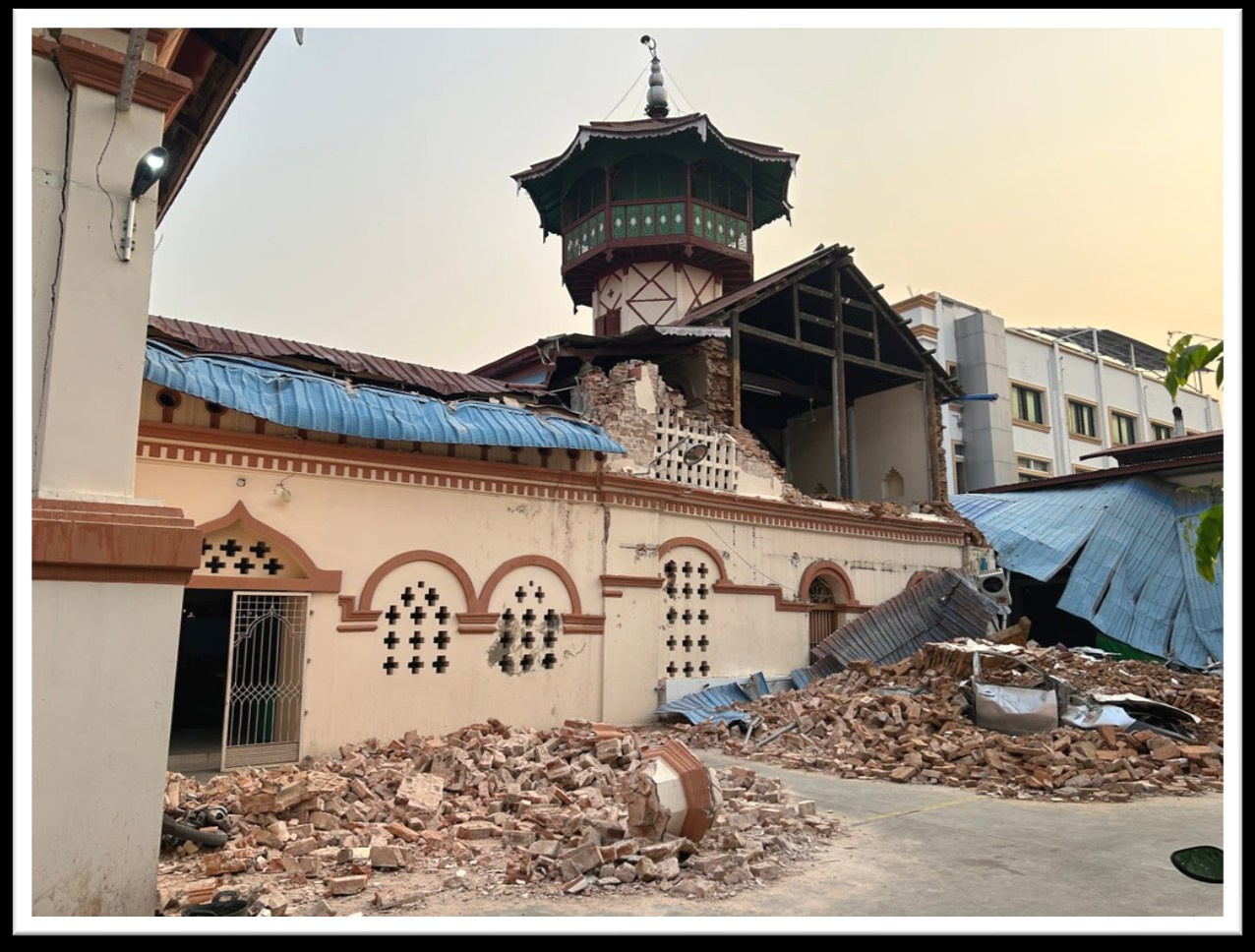
The Panthay Mosque in Maha Aung Myay Township, Mandalay Region, originally built in 1868, after sustaining damage in the 2025 earthquake. © BHRN, 2025.
II. Restrictions on Mosque Recovery After the Earthquake
Deaths and Destruction at Mosques
The earthquake struck during Friday prayers, when mosques across the affected areas were crowded with worshippers. BHRN documented at least 670 deaths among Muslims when mosques and other Islamic religious buildings collapsed, with many others injured.30 Researchers cross-checked casualty information through interviews with survivors, relatives, witnesses, and mosque trustees, as well as available hospital records, burial records, and community casualty lists. Communications failures, restricted access, and incomplete records prevented BHRN from establishing a definitive death and injury toll.
BHRN documented 180 earthquake-affected Islamic religious buildings, including 149 in Mandalay Region, 16 in Naypyidaw Union Territory, seven in Bago Region, six in Sagaing Region, and two in southern Shan State. Historical and building records show that a number of the damaged mosques were more than a century old, including brick-masonry structures. Casualty records document collapses in areas where worshippers had gathered to pray.
Early interviews conducted in Yamethin and Sagaing documented substantial loss of life at mosques. A lawyer interviewed in Yamethin two days after the earthquake said four mosques there had completely collapsed and approximately nine mosques had been affected in total, although damage assessments were still underway. He said more than 40 people had been killed at a Jamae Mosque in Pyawbwe, where Friday prayers drew worshippers from surrounding areas, and described old buildings collapsing so quickly that people had little or no time to escape. Describing the immediate aftermath, he told BHRN, "People thought it was the Day of Judgment. Everyone was shouting. It felt like a small-scale Qayamat."31
In Sagaing, a community member told BHRN that more than 100 people had been killed at three mosques. Another community representative described mosque-level records documenting 60 deaths at one mosque, 58 at another, and 37 at a third. He said most of the recorded deaths occurred at mosques rather than in homes. Mosque communities recorded names, photographs of people who had died, and contact information for relatives, but some names were missing because families removed bodies directly to their villages before information could be recorded. At Myothit, the same representative said 32 people were included in the records, while another 28 people were seen being taken away without their names being provided.32
A community source in Bone Oh Village, Amarapura Township, told BHRN that the women's prayer hall of one mosque collapsed while the men's prayer hall remained standing, and reported that 42 people were killed in the collapsed section. The source said the men's hall had previously undergone renovation and reconstruction, while the women's hall retained its older structure.
At Shwe Bone Shein Mosque in Mandalay, the main prayer hall, which had undergone earlier roof modifications, remained standing while an unrenovated ablution area collapsed.
BHRN documented additional deaths and injuries at individual mosques. A witness at Ko Yan Taw Mosque in Amarapura Township reported three people killed and six injured.33 A witness at Kala Pyo Mosque in Amarapura reported eight people killed and one seriously injured when the more than 200-year-old mosque was destroyed.34 At Hpalambo Village Mosque in Sintgaing Township, a witness said records showed 16 people killed and eight injured, including 14 people who died at the mosque.35 At a mosque in Hin Ngu Village, the older women's section collapsed while the sections added during renovation were not damaged.36 BHRN did not conduct building-specific engineering assessments and cannot determine why these sections performed differently.
BHRN identified 180 earthquake-affected Islamic religious buildings across 29 townships. It classified 102 as severely damaged, 59 as moderately damaged, and 19 as sustaining minor damage. Separate engineering information identified 47 buildings as damaged beyond repair and requiring demolition and reconstruction. Those 47 buildings are not the same category as the 103 buildings BHRN classified as severely damaged.
A BHRN interviewee said that the khutbah was being delivered at Let Pan Mosque when the earthquake struck, and the worshippers tried to flee, but exits were blocked, forcing people to climb through glass windows and over barriers to get outside. The same interviewee later saw the historic Kan Oo Mosque in Kyaukse Township almost reduced to a pile of bricks.37

The Kan Oo Mosque in Kyaukse Township, Mandalay Region, after collapsing in the March 2025 earthquake. © BHRN, 2025.
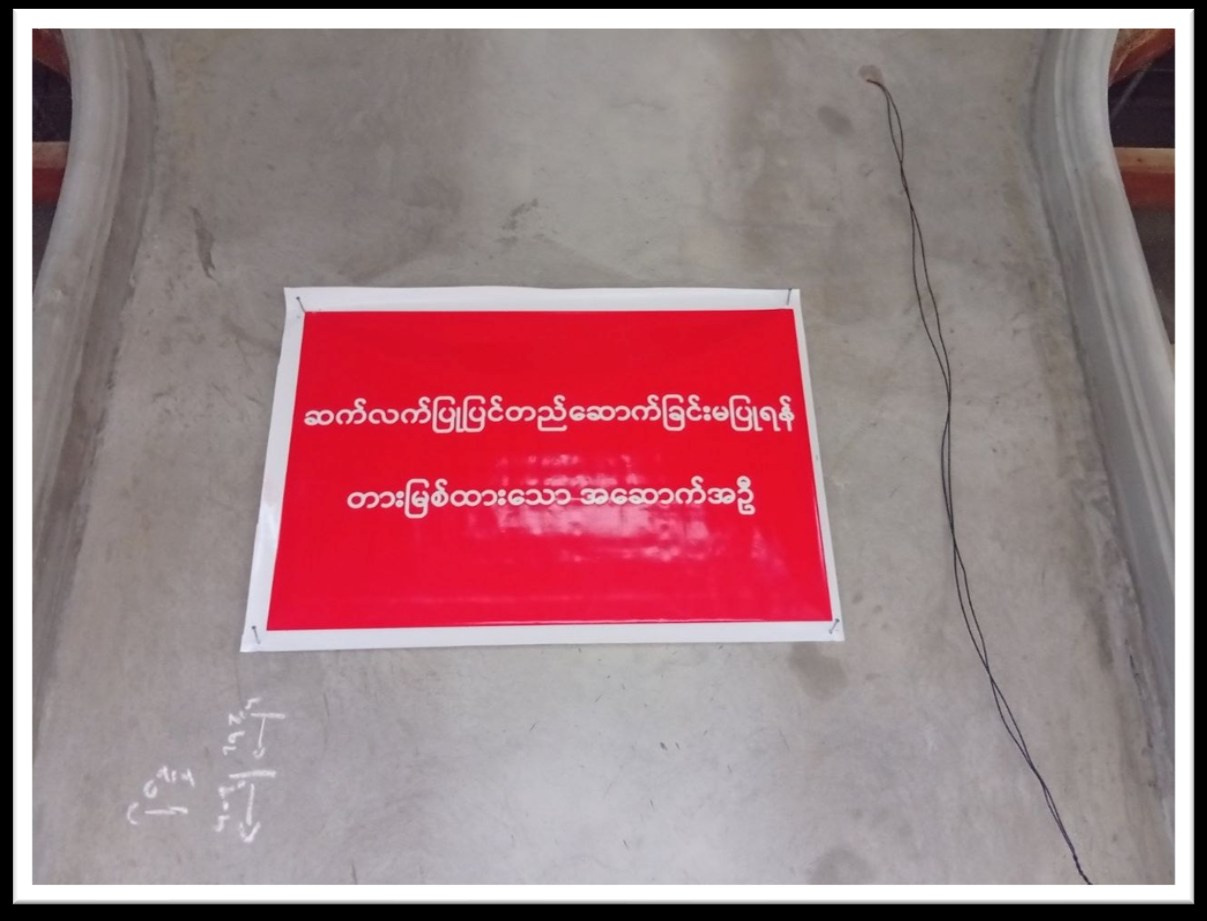
In Mid-September 2026, the township authority blocked the reconstruction of Sit Tat (Military) Mosque, Taungoo Township, Bago Region, after it collapsed in the March 2025 earthquake. © BHRN, 2026.
Temporary Prayer Spaces
After the earthquake, Muslim communities erected temporary prayer spaces while damaged mosques remained unusable or their future was unresolved. More than a month after the disaster, a construction professional told BHRN that debris remained uncleared at many mosque sites and that communities were building small temporary prayer spaces themselves.38 In Nauk Taw Par Village, the village chairperson said local officials allowed the community to build a temporary prayer space, but the community still had no information about whether its more than 200-year-old mosque could be rebuilt. He said nearby Muslim villages had not been allowed even to construct temporary prayer spaces.39
Temporary prayer spaces remained in use in September 2026. Three Mandalay interviewees said the temporary spaces known to them were being used without identified interference from junta officials, and one trustee said ward administrators had supported their use.40 At a mosque in Bago Region, a community member said worshippers were still using temporary facilities while reconstruction continued and that safety was the principal concern.41
Land Requirements Blocking Reconstruction
Land-status requirements blocked or delayed some Muslim communities from obtaining permission to repair or rebuild mosques. A construction professional told BHRN that in Yangon only mosques on land officially classified as religious land could obtain renovation permission, and said land approval preceded building approval in both Yangon and Mandalay.42 In Mandalay, a lawyer said some longstanding mosque properties lack formal proof of ownership and in some cases possess only records of waqf donations or utility-meter documents.43
A mosque trustee in Mandalay described a lengthy, multi-stage post-earthquake application process. Applicants first had to obtain a Form 105 land map, secure religious-land classification where necessary, and obtain endorsements from ward-, township-, and district-level junta-controlled offices and the Township Development Committee. They then had to conduct soil tests, prepare architectural and structural plans, obtain a second round of endorsements, and submit the completed file to municipal offices. The file passed through the Mandalay Region Government, while structural plans required inspection by the Construction Department in Naypyidaw before returning to Mandalay. All four September interviewees said they were not aware of new documentary or procedural requirements introduced after the earthquake in the cases known to them. Communities were instead forced to navigate longstanding requirements through a lengthy, multi-level process.44
Even official recognition of mosque land did not guarantee permission to rebuild. A former trustee told BHRN that Panthay, Taung Balu, Saing Tann, and Shwe Bone Shein Mosques were all on land officially registered for religious use and, as far as he understood, had submitted the required documents. By September 13, 2026, only Panthay Mosque had received reconstruction permission. The former trustee said Taung Balu had secure religious-land status but still had not received permission.45
Junta-controlled offices did not apply land-status requirements uniformly. In Bago Region, a mosque was not formally registered as religious land, but it nevertheless obtained both demolition and reconstruction permission.46
The community member described a different administrative sequence in Bago Region. The community obtained recommendations from ward and village-tract administrators, a municipal no-objection letter, and an Immigration Department no-objection letter before the application passed through township and district junta-controlled offices to the regional level. Regional junta officials then required reconstruction under the supervision of a five-member team.47
The earthquake exposed the immediate consequences of longstanding land and permit restrictions. BHRN documented Muslim communities seeking to repair or rebuild damaged mosques being required to produce formal land documents or recognised land status that some historic mosque properties do not possess. In other cases, communities had to obtain those records from the same junta-controlled system that decides whether reconstruction may proceed. BHRN documented cases in which the absence of recognised land status or required documents prevented repair or reconstruction applications from advancing even though mosques had stood on the sites for generations.48
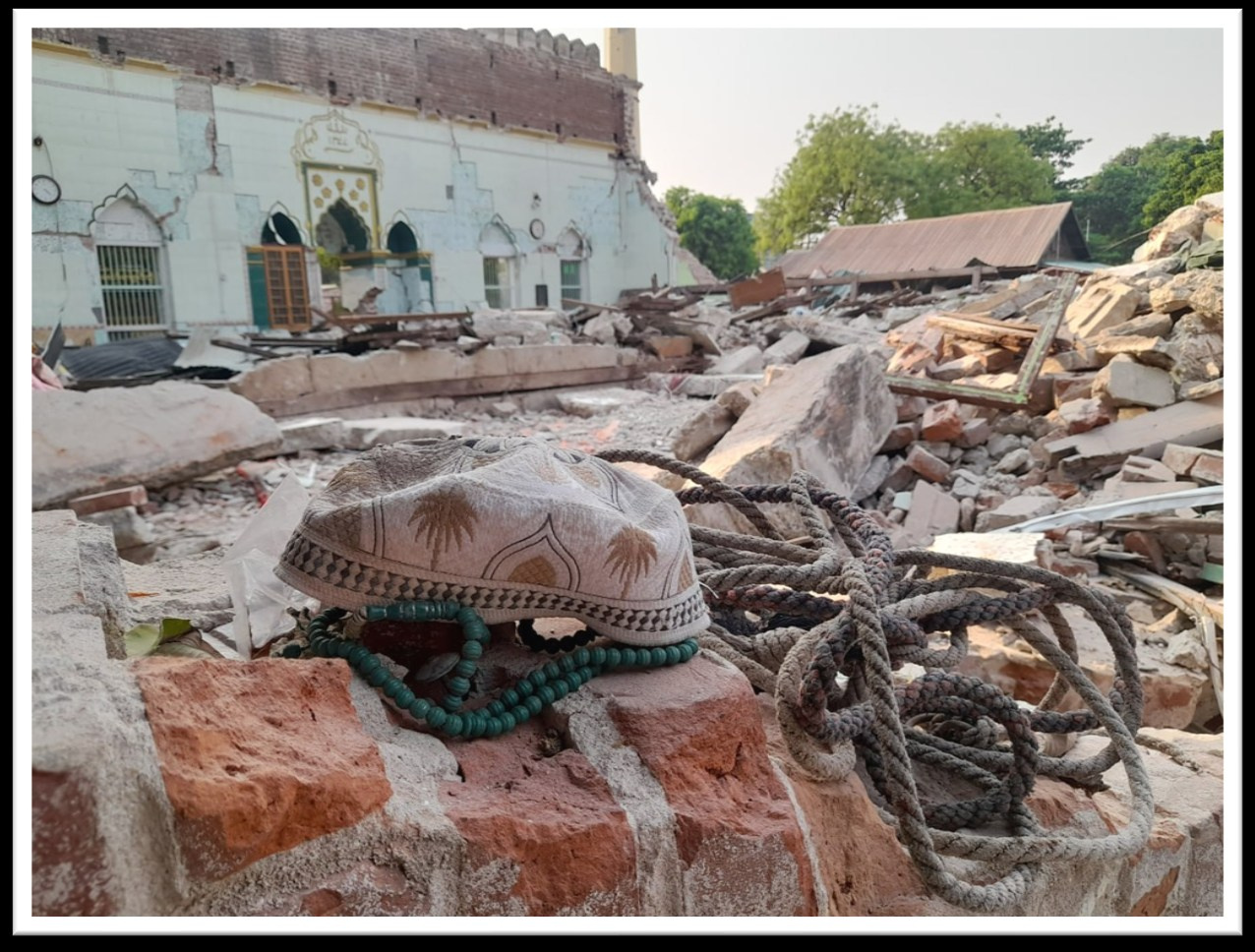
The Myoma Mosque in Sagaing Township after the 2025 earthquake. © BHRN, 2025.
Delays in Demolishing Unsafe Structures
On May 27, 2025, junta officials sealed Gattan Mosque in Sagaing after it was damaged in the earthquake, amid a dispute with local police over ownership of the site. BHRN classified the mosque as moderately damaged.49
In Bone Oh Village, Amarapura Township, a community representative said three of eight mosques had completely collapsed or been reduced to the ground, while the remaining five had sustained major damage requiring repair or reconstruction. Asked whether any had received demolition permission, he replied, "Not a single one." He said community representatives, local groups, and villagers had repeatedly approached officials without obtaining permission. At one mosque, after the women's section collapsed, the community demolished the men's section without permission. He said another mosque was similarly demolished, creating complications for other mosque applications.50
The same representative said the Arabic Science School in Bone Oh had also collapsed. The community applied for permission to remove the remaining walls and damaged structures. Officials said permission would be issued within a few days, but by June 15, 2025, the community had still not received it.51 He said most prayer facilities in the village remained temporary, with worshippers using only two or three mosque buildings.52
Community representatives repeatedly sought permission through township, district, and regional junta-controlled offices. A representative said a newspaper report after the earthquake stated that affected religious buildings could be rebuilt according to their original designs, but the announcement had not translated into permission locally. "That is the only announcement I have seen saying that permission would be granted," he told BHRN. "In practice, however, the announcement has not reached us on the ground."53
A Mandalay trustee told BHRN that junta officials initially issued demolition orders for 33 mosques after the earthquake. When other mosques were submitted, officials did not issue demolition orders and instead instructed applicants to obtain religious-land designation and apply for construction permits. By September 13, 2026, the trustee said only about four to six of the original 33 cases had made meaningful progress through the approval process.54
Another Mandalay trustee said more than 70 mosques across the city had submitted applications by September 13, 2026. He said only four mosques had received repair permission, while Panthay Mosque was the only mosque he identified as having received permission to rebuild from scratch. "There are more than 70 mosques. Only four have received permission, so there are still many left," he told BHRN, referring to repair permissions.55
BHRN also documented other factors contributing to delays, including incomplete applications, expired endorsements, lack of funds or technical expertise, and limited follow-up by some mosque committees. A former trustee said some mosques with relatively minor damage eventually stopped waiting for approval and carried out repairs themselves.56
The trustee said the repair permissions issued in Mandalay required work to conform to the buildings' original condition.57
The experience documented at a mosque in Bago Region, was different. The community member told BHRN that the mosque received an official demolition order two months after the earthquake but later obtained a construction permit. The community member added that, as far as he knew, Township Administrators in Yedashe and Phyu had also issued official written permission orders, although he did not know the status of the other earthquake-damaged mosques in Bago Region.58
The community member said the written permit required reconstruction without changing the mosque's original dimensions. The community obtained recommendations from ward and village-tract administrators, municipal and Immigration Department no-objection letters, and approvals through township, district, and regional offices. Regional officials required the work to proceed under a five-member supervisory team headed by the Township Administrator, although the vicechairperson said the team had not actually visited the site during reconstruction.59
The community member said that, in his understanding, the phrase "without changing the original dimensions" appeared in "the orders for all the mosques." BHRN did not independently verify the scope of that broader statement.60
Lack of Engineering and Reconstruction Support
More than a month after the earthquake, a construction professional who visited affected mosques said debris remained uncleared at many sites while Muslim communities built temporary prayer spaces themselves. At Bone Oh, he said the central mosque had still not undergone debris clearance. "I have not seen any systematic effort to design and reconstruct them in a way that would make them resistant to earthquakes, strong winds, and other natural hazards," he told BHRN.61
At sites where repairs had begun, the construction professional said work was proceeding without adequate structural engineering. At a mosque in Amarapura Township, he said masons and metalworkers were inserting steel bars and pouring concrete without proper structural calculations. "The resulting structures are also irregular and poorly executed, which may compromise their structural integrity," he told BHRN.62
Unequal Access to Disaster Recovery
After the earthquake, junta-run media reported officials and technical personnel working at Buddhist religious and heritage sites. The junta-run Ministry of Information also announced National Disaster Management Fund allocations for cleaning and rehabilitation in earthquake-affected areas, including renovation of pagodas, stupas and temples, historic buildings, religious buildings, and other seriously damaged buildings. During the same period, BHRN documented uncleared debris at mosque sites while Muslim communities were still seeking permission from junta-controlled offices to demolish damaged structures and rebuild mosques.64
On July 5, 2025, junta-run media reported Lieutenant General Thet Pone inspecting reconstruction and renovation at Shinpin Nann Oo Pagoda in Sagaing and Lieutenant General Soe Tint Naing inspecting Maha Muni Pagoda in Mandalay, where officials coordinated measures for restoration.65
BHRN also documented emergency assistance from junta-run institutions reaching some Muslim earthquake survivors. A community member in Sagaing told BHRN that assistance provided 300,000 kyats for each person killed and 50,000 kyats for each injured person. A community member of another mosque said many displaced families were sleeping outside in the heat and lacked basic items such as adequate mats, mosquito nets, and pillows. He said relief distributions focused largely on food, drinking water, and similar supplies, while injured people and others unable to reach ward distribution points could miss assistance before supplies ran out.66
Other mosque communities described receiving no assistance from junta-run institutions for mosque recovery. A witness at Ko Yan Taw Mosque said on 13 April 2025 that the community had received no such assistance or donations and was relying on its own efforts.67 At Kala Pyo Mosque, a small congregation was carrying out demolition and debris clearance through volunteer labour and preparing a temporary prayer space after the mosque was destroyed.68 The community member in Nauk Taw Par similarly said no assistance from junta-run institutions had been provided there by the date of interview.69
September 2026 interviews showed that permission to rebuild did not bring reconstruction assistance. Trustees in Mandalay said they had received no financial support from junta-run institutions for mosque reconstruction and were relying on mosque communities, private donors, or other non-governmental assistance.70 At a mosque in Bago Region, a community member said, "We haven't received anything from the government. We have had to handle everything ourselves from beginning to end."71 Some Muslim earthquake survivors did receive emergency cash or relief assistance, and junta-run departments used at least one mosque compound as a relief-distribution site.72 BHRN did not obtain sufficient information to make a nationwide quantitative comparison between assistance provided to Buddhist and Muslim religious sites.

The Zay Tan Mosque in Yindaw Ywama village, Pyawbwe Township, Mandalay Region, after collapsing in the March 2025 earthquake. © BHRN, 2025.
III. Human Rights Standards and Legal Analysis
International human rights standards protect the right to establish, maintain, and use places of worship without discrimination. Article 18 of the Universal Declaration of Human Rights protects freedom to manifest religion in worship and observance. Article 6(a) of the 1981 U.N. Declaration on the Elimination of All Forms of Intolerance and of Discrimination Based on Religion or Belief specifically protects worship and assembly and the establishment and maintenance of places for those purposes.73 The UDHR and the 1981 Declaration prohibit discrimination based on religion or belief.74 Myanmar is not a party to the International Covenant on Civil and Political Rights. The U.N. Human Rights Committee's interpretation of article 18(3) nevertheless provides relevant guidance that restrictions on the manifestation of religion should be prescribed by law, pursue a recognised protective purpose, and be necessary and proportionate.75
Myanmar's 2008 Constitution protects freedom of conscience and the right to profess and practise religion under section 34. Sections 347 and 348 guarantee equality before the law and equal legal protection and prohibit discrimination against citizens on grounds including religion. Section 360 permits regulation of secular activities associated with religious practice and laws for public welfare and reform.76 Restrictions that prevent Muslim communities from repairing, demolishing, or rebuilding mosques without a clear legal basis, or that treat Muslim places of worship less favourably than comparable religious sites without objective and reasonable justification, interfere with freedom of religion or belief and constitute religious discrimination.77 BHRN's findings show that the permit system lacked clear and predictable rules. A November 2025 article on the junta-run Ministry of Information website referred to an order requiring collapsed Christian churches and mosques to be rebuilt only in their original form, but did not identify a statutory basis. A lawyer interviewed by BHRN described the original-design requirement as a local administrative order rather than a law.78
Article 3 of the UDHR recognises the rights to life, liberty, and security of person. The earthquake triggered the collapses. BHRN documented that restrictions prevented some Muslim communities from carrying out repairs sought before the disaster, left known structural risks unresolved, and delayed demolition, stabilisation, repair, and reconstruction afterward. Arbitrary restrictions that block work needed to address known structural hazards can increase foreseeable risks to worshippers and surrounding communities.79
Myanmar's Natural Disaster Management Law defines disaster management to include rehabilitation and reconstruction. Its stated objectives include expeditious disaster-management programmes, coordination with relevant organisations, and measures to improve the living conditions of disaster victims.80 Section 13 requires departments, organisations, and persons assigned responsibilities under the law to carry out rehabilitation and reconstruction activities. Section 18 provides for confirming damage, continuing relief and rehabilitation assistance, preparing rehabilitation and reconstruction plans, and rebuilding damaged structures to withstand future disasters. These duties should be carried out consistently with constitutional protections for religious freedom, equality before the law, and non-discrimination on grounds including religion. The Disaster Management Law provides no basis for discriminatory barriers to making damaged Muslim religious sites safe or repairing or rebuilding them.81

The Ywamonthar Mosque in Ywamonthar village, Tharzi Township, Mandalay Region, after collapsing in the March 2025 earthquake. © BHRN, 2025.
Recommendations
To U.N. Member States, the European Union, ASEAN Member States, and OIC Member States
- Impose and strengthen targeted sanctions against Myanmar military officials and entities responsible for serious human rights violations, including restrictions and discriminatory practices affecting Muslim communities and places of worship, while ensuring sanctions are designed to minimise harm to civilians.
- Coordinate measures to restrict the Myanmar military's access to revenue, arms, aviation fuel, equipment, and other resources that enable serious human rights abuses.
- Support international and domestic accountability efforts for serious crimes committed by the Myanmar military, including the work of the International Criminal Court, the Independent Investigative Mechanism for Myanmar, and appropriate universal jurisdiction proceedings.
- Support independent documentation and preservation of evidence relating to discrimination, arbitrary restrictions, confiscation, closure, retaliation, unofficial-payment demands, and other abuses affecting Muslim places of worship.
- Provide financial, legal, engineering, and technical assistance directly to affected Muslim communities through independent civil society organisations and trusted locally led actors, including support for structural assessments, safe demolition, repair, and earthquake-resistant reconstruction.
- Channel humanitarian and recovery assistance through independent organisations, cross-border mechanisms, and locally led networks wherever possible, rather than through junta-controlled institutions.
- Ensure that assistance reaches Muslim communities without discrimination and that funding arrangements do not strengthen junta-controlled institutions or contribute to the military's efforts to claim political legitimacy.
- Support independent Burmese and ethnic civil society organisations working on freedom of religion or belief, minority rights, disaster recovery, documentation, and accountability.
To the United Nations Security Council and U.N. Member States
- Support referral of the situation in Myanmar to the International Criminal Court and other appropriate international justice mechanisms.
- Support a global arms embargo on the Myanmar military and coordinated targeted financial sanctions against military leaders and military-controlled entities implicated in serious human rights violations.
- Support the collection, preservation, and analysis of evidence concerning abuses against Muslim communities and other religious and ethnic minorities for use in future criminal proceedings and other accountability processes.
- Ensure that international responses to the Myanmar crisis do not confer legitimacy on the military junta or its institutions.
To the U.N. Special Rapporteur on the Situation of Human Rights in Myanmar, the U.N. Special Rapporteur on Freedom of Religion or Belief, OHCHR, and the Independent Investigative Mechanism for Myanmar
- Investigate and publicly report on discriminatory restrictions affecting Muslim places of worship, including restrictions on construction, repair, demolition, reconstruction, land registration, and access to earthquake recovery assistance.
- Document cases in which administrative restrictions prevented or delayed work needed to address known structural hazards or make earthquake-damaged religious sites safe.
- Investigate allegations of confiscation, sealing or closure of mosques, unofficial-payment demands, retaliation, discriminatory land requirements, and other abuses connected to Muslim places of worship.
- Preserve relevant evidence and, where within mandate, share information with appropriate international and domestic accountability mechanisms.
- Engage directly with affected Muslim communities, lawyers, engineers, human rights defenders, and independent civil society organisations rather than relying on information supplied by junta-controlled institutions.
To U.N. Agencies, Humanitarian Organisations, and Donors
- Provide recovery assistance directly to affected Muslim communities through independent humanitarian organisations, local civil society groups, and other trusted non-junta channels.
- Ensure that Muslim communities have equal access to structural assessments, engineering expertise, reconstruction materials, temporary places of worship, and other forms of disaster-recovery assistance.
- Fund safe demolition, repair, and earthquake-resistant reconstruction of damaged mosques through qualified independent engineers and architects.
- Establish safeguards so that assistance does not reinforce discriminatory administrative systems, expose recipients to retaliation, or require affected communities to engage with junta-controlled institutions where alternative delivery mechanisms are available.
- Support confidential and secure documentation of discrimination, extortion, threats, retaliation, and other abuses affecting communities seeking to repair or rebuild places of worship.
Appendix. Earthquake-Affected Mosques and Other Islamic Religious Buildings
BHRN documented 180 earthquake-affected Islamic religious buildings in 29 townships across Mandalay Region, Sagaing Region, Bago Region, Naypyidaw Union Territory, and southern Shan State. The list consists primarily of mosques and also includes dargahs and other Islamic religious facilities recorded in BHRN's dataset. BHRN documented 149 affected buildings in Mandalay Region, 16 in Naypyidaw Union Territory, seven in Bago Region, six in Sagaing Region, and two in southern Shan State.
The 180 buildings should not be understood as an exhaustive list of all Islamic religious buildings damaged in the 28 March 2025 earthquake. Security restrictions, disrupted communications, and limited access prevented BHRN from independently visiting every affected location.
BHRN classified 102 buildings as severely damaged, 59 as moderately damaged, and 19 as sustaining minor damage. These classifications describe the extent of damage recorded in BHRN's research. They are not building-specific engineering certifications.
BHRN separately obtained engineering information identifying 47 buildings as damaged beyond repair and requiring demolition and reconstruction. The 47 buildings assessed as beyond repair are not synonymous with the 102 buildings classified by BHRN as severely damaged. A severe-damage classification does not necessarily mean that a building cannot be repaired.
The damage classifications used in the table are as follows:
- A - Severe damage. Substantial damage requiring major structural repair, partial reconstruction, or further professional assessment.
- B - Moderate damage. Significant damage that may be repairable.
- C - Minor damage. Limited damage requiring repair.
The names and locations below are drawn from BHRN's earthquake-damage dataset. Inclusion of a religious building in this appendix does not mean that BHRN personally inspected the site or that an engineer conducted a structural assessment. Nor should the identification of a building in this appendix be understood as identifying the source of testimony concerning that building elsewhere in this report. BHRN has not linked sensitive testimony to named sites where doing so could expose interviewees, trustees, or other community members to surveillance, harassment, arrest, or retaliation.
| No. | Name | Village | Township | Region | Damage |
|---|---|---|---|---|---|
| 1 | Gattan Mosque | Sagaing | Sagaing | B | |
| 2 | Moe Kya Mosque | Sagaing | Sagaing | A | |
| 3 | Myoma Mosque | Sagaing | Sagaing | A | |
| 4 | Myo Daw Mosque | Sagaing | Sagaing | A | |
| 5 | Ywa Htaung Mosque | Sagaing | Sagaing | B | |
| 6 | Sin Yone Mosque | Shwe Bo | Sagaing | B | |
| 7 | Sandi Jame Mosque | Shwe Nyaung | Southern Shan State | A | |
| 8 | Apaw Mosque | Aung Pan | Southern Shan State | B | |
| 9 | Jame Mosque | Leway | Naypyitaw | B | |
| 10 | Yan Aung Mosque | Leway | Naypyitaw | B | |
| 29 | Kandaw Mosque | Taungoo | Bago | B | |
| 30 | Zayat Gyi Mosque | Taungoo | Bago | B | |
| 31 | Sit Tat Mosque | Taungoo | Bago | B | |
| 32 | Kat Kye Tan Mosque | Chan Aye Thar Zan | Mandalay | A | |
| 33 | Sakkyar Taung Mosque | Chan Aye Thar Zan | Mandalay | A | |
| 34 | Sakkyar Myauk Mosque | Chan Aye Thar Zan | Mandalay | B | |
| 35 | Kala Pyo Taung Mosque | Chan Aye Thar Zan | Mandalay | C | |
| 36 | Saing Tan Mosque | Chan Aye Thar Zan | Mandalay | A | |
| 37 | Zarweya 30 Mosque | Chan Aye Thar Zan | Mandalay | B | |
| 38 | Taik Tan Mosque | Chan Aye Thar Zan | Mandalay | A | |
| 39 | South Sin Kyone Mosque | Chan Aye Thar Zan | Mandalay | B | |
| 40 | Taung Balu Mosque | Chan Aye Thar Zan | Mandalay | A | |
| 41 | Taung Ohbo Mosque | Chan Aye Thar Zan | Mandalay | B | |
| 42 | Day Wun Mosque | Chan Aye Thar Zan | Mandalay | B | |
| 43 | Daung Yoe Tan Mosque | Chan Aye Thar Zan | Mandalay | B | |
| 44 | Phalan Bo Mosque | Chan Aye Thar Zan | Mandalay | B | |
| 45 | North Sin Kyone Mosque | Chan Aye Thar Zan | Mandalay | A | |
| 46 | Miba Zay Mosque | Chan Aye Thar Zan | Mandalay | C | |
| 47 | Yadanabon Tailor Mosque | Chan Aye Thar Zan | Mandalay | B | |
| 48 | Yadanabon Ohbo Mosque | Chan Aye Thar Zan | Mandalay | B | |
| 49 | Shia Mosque | Chan Aye Thar Zan | Mandalay | A | |
| 50 | West Kone Yoe Mosque | Chan Aye Thar Zan | Mandalay | A | |
| 51 | West Tailor Mosque | Chan Aye Thar Zan | Mandalay | A | |
| 52 | East Kone Yoe Mosque | Chan Aye Thar Zan | Mandalay | B | |
| 53 | East Tailor (South) Mosque | Chan Aye Thar Zan | Mandalay | A | |
| 54 | East Tailor (North) Mosque | Chan Aye Thar Zan | Mandalay | B | |
| 55 | Amyauk Tan Mosque | Chan Aye Thar Zan | Mandalay | C | |
| 56 | O Taw Mosque | Chan Aye Thar Zan | Mandalay | B | |
| 57 | Junn Mosque | Chan Aye Thar Zan | Mandalay | C | |
| 58 | Mingalar Mosque | Aungmyay Thar Zan | Mandalay | B | |
| 59 | Kyauk Mosque | Aungmyay Thar Zan | Mandalay | A | |
| 60 | Seik Badi Su Mosque | Aungmyay Thar Zan | Mandalay | C | |
| 61 | Surati Mosque | Aungmyay Thar Zan | Mandalay | A | |
| 62 | Nan Shay Zay Mosque | Aungmyay Thar Zan | Mandalay | C | |
| 63 | Ywa Thar Mosque | Aungmyay Thar Zan | Mandalay | A | |
| 64 | Nwa Chan Gone Mosque | Aungmyay Thar Zan | Mandalay | C | |
| 65 | Hninse Chan Mosque | Aungmyay Thar Zan | Mandalay | A | |
| 66 | Thahtay Tan Mosque | Aungmyay Thar Zan | Mandalay | A | |
| 67 | Hindustani Mosque | Aungmyay Thar Zan | Mandalay | B | |
| 68 | Aye Yeik Nyein Mosque | Aungmyay Thar Zan | Mandalay | C | |
| 69 | Kun Chan Hlwa Taung Mosque | Mahar Aung Myay | Mandalay | A | |
| 70 | Sakkyar West Mosque | Mahar Aung Myay | Mandalay | A | |
| 71 | Sein Pan Mosque | Mahar Aung Myay | Mandalay | A | |
| 72 | Sule Mosque | Mahar Aung Myay | Mandalay | B | |
| 73 | Zagwe Mosque | Mahar Aung Myay | Mandalay | C | |
| 74 | Za Myinzwe Mosque | Mahar Aung Myay | Mandalay | A | |
| 75 | Pan Set Mosque | Mahar Aung Myay | Mandalay | B | |
| 76 | Panthay Mosque | Mahar Aung Myay | Mandalay | A | |
| 77 | Bengali Mosque | Mahar Aung Myay | Mandalay | A | |
| 78 | Bone Oh Sakkyar Mosque | Mahar Aung Myay | Mandalay | A | |
| 79 | Mingalar Mosque | Mahar Aung Myay | Mandalay | B | |
| 80 | Mingalar Middle Mosque | Mahar Aung Myay | Mandalay | B | |
| 81 | Mya Kone Paw Mosque | Mahar Aung Myay | Mandalay | B | |
| 82 | Than Lan Mosque | Mahar Aung Myay | Mandalay | A | |
| 83 | Shwe Bone Shein Mosque | Mahar Aung Myay | Mandalay | A | |
| 84 | Letpan Mosque | Mahar Aung Myay | Mandalay | B | |
| 85 | Kan Ywa Mosque | Chanmya Tharzi | Mandalay | A | |
| 86 | Zarweya Mosque | Chanmya Tharzi | Mandalay | B | |
| 87 | Dawna Chan Mosque | Chanmya Tharzi | Mandalay | C | |
| 88 | Panthay Baitulmar | Chanmya Tharzi | Mandalay | C | |
| 89 | Mingalar Mosque | Taung Myint | Pyigyidagun | Mandalay | A |
| 90 | West Mosque | Taung Myint | Pyigyidagun | Mandalay | A |
| 91 | East Mosque | Taung Myint | Pyigyidagun | Mandalay | A |
| 92 | Central Mosque | Taung Myint | Pyigyidagun | Mandalay | A |
| 93 | 555 Mosque | Pyigyidagun | Mandalay | A | |
| 94 | Shia Mosque | Amarapura | Mandalay | A | |
| 95 | Kyri Myin Taing Mosque | Kyri Myin Taing | Amarapura | Mandalay | A |
| 96 | Ko Yan Taw Mosque | Amarapura | Mandalay | A | |
| 97 | Sakyin Wa Mosque | Sakyin Wa | Amarapura | Mandalay | A |
| 98 | Myoma Kala Pyo Mosque | Amarapura | Mandalay | A | |
| 99 | Zay Htate Mosque | Amarapura | Mandalay | A | |
| 100 | Thanbaya Chan Mosque | Bone Oh | Amarapura | Mandalay | A |
| 101 | Tailor South Mosque | Tha Lay Swa | Amarapura | Mandalay | A |
| 102 | Fakir al-Rahman Shah Dargah | Kyri Myin Taing | Amarapura | Mandalay | B |
| 103 | Hnae Su Mosque | Bone Oh | Amarapura | Mandalay | A |
| 104 | Abesha Hussaini Dargah | Amarapura | Mandalay | B | |
| 105 | Oh Taw Mosque | Bone Oh | Amarapura | Mandalay | A |
| 106 | Ooyin Ywa Mosque | Ooyin Ywa | Amarapura | Mandalay | A |
| 107 | Bone Oh East Mosque | Bone Oh | Amarapura | Mandalay | A |
| 108 | Bone Oh Central Mosque | Bone Oh | Amarapura | Mandalay | A |
| 109 | Tailor Central Mosque | Bone Oh | Amarapura | Mandalay | A |
| 110 | Yatkantaw North Mosque | Bone Oh | Amarapura | Mandalay | A |
| 111 | Yatkantaw South Mosque | Bone Oh | Amarapura | Mandalay | A |
| 112 | Kan Oo Mosque | Kyaukse | Mandalay | A | |
| 113 | Pyilone Naing Mosque | Kyaukse | Mandalay | A | |
| 114 | Thit Gyi Tan Mosque | Kyaukse | Mandalay | A | |
| 115 | Sule Kone Ywa Oo Mosque | Sule Kone | Kyaukse | Mandalay | A |
| 116 | Sakkyar Nwe Zin Central Mosque | Sule Kone | Kyaukse | Mandalay | A |
| 117 | Jame North Mosque | Sule Kone | Kyaukse | Mandalay | B |
| 118 | Pvin Oo Lwin Mosque | Sule Kone | Kyaukse | Mandalay | A |
| 119 | Letpan School Mosque | Letpan | Kyaukse | Mandalay | A |
| 120 | Ywa Lal Mosque | Letpan | Kyaukse | Mandalay | A |
| 121 | North Mosque | Letpan | Kyaukse | Mandalay | B |
| 122 | South Mosque | Letpan | Kyaukse | Mandalay | B |
| 123 | Dai Kaung Kan Mosque | Myitthar | Mandalay | A | |
| 124 | Kume Mosque | Kume | Myitthar | Mandalay | A |
| 125 | Myitthar Jame Mosque | Myitthar | Mandalay | A | |
| 126 | Myit Thar Mosque | Tada-U | Mandalay | A | |
| 127 | Palate Mosque | Palate | Sintgaing | Mandalay | B |
| 128 | Khan Luu Mosque | Khan Luu | Sintgaing | Mandalay | B |
| 129 | Tabet Swe Jame Mosque | Tabet Swe | Sintgaing | Mandalay | B |
| 130 | West Mosque | Tabet Swe | Sintgaing | Mandalay | A |
| 131 | Dargah Dada Khalu Shah | Tabet Swe | Sintgaing | Mandalay | A |
| 132 | Nauk Taw Par Mosque | Nauk Taw Par | Sintgaing | Mandalay | A |
| 133 | Phalan Bo Mosque | Phalan Bo | Sintgaing | Mandalay | A |
| 134 | Myit Nge Mosque | Myit Nge | Sintgaing | Mandalay | C |
| 135 | Kyauk Mosque | Hingu | Sintgaing | Mandalay | B |
| 136 | Sein Mosque | Hingu | Sintgaing | Mandalay | A |
| 137 | Bengali Mosque | Meiktila | Mandalay | A | |
| 138 | Turkish Mosque | Meiktila | Mandalay | A | |
| 139 | Kan Kale Mosque | Yamethin | Mandalay | A | |
| 140 | Kuttawah Mosque | Yamethin | Mandalay | A | |
| 141 | Ghai Gyi Mosque | Yamethin | Mandalay | A | |
| 142 | San San Mosque | Yamethin | Mandalay | A | |
| 143 | Nay Pu Kone Mosque | Nay Pu Kone | Yamethin | Mandalay | A |
| 144 | Shwe Bon Thar Mosque | Yamethin | Mandalay | A | |
| 145 | Ywa Daw Mosque | Yamethin | Mandalay | A | |
| 146 | Ekariz Mosque | Yamethin | Mandalay | A | |
| 147 | Railway Mosque | Thazi | Mandalay | A | |
| 148 | Myoma Jame Mosque | Thazi | Mandalay | A | |
| 149 | Nyaung Yan Mosque | Nyaung Yan | Thazi | Mandalay | B |
| 150 | Ywamontha Mosque | Ywamontha | Thazi | Mandalay | A |
| 151 | Yinmarbin Mosque | Yinmarbin | Thazi | Mandalay | A |
| 152 | Kyat Twin East Mosque | Kyat Twin | Pyawbwe | Mandalay | B |
| 153 | Kyat Twin West Mosque | Kyat Twin | Pyawbwe | Mandalay | B |
| 154 | Myo Thit Mosque | Pyawbwe | Mandalay | A | |
| 155 | Ye Lei Kwayt Mosque | Ye Lei Kwayt | Pyawbwe | Mandalay | A |
| 156 | Markaz Myoma Mosque | Pyawbwe | Mandalay | A | |
| 157 | Downtown Mosque | Pyawbwe | Mandalay | A | |
| 158 | Shwe Pyi Yan Aung Mosque | Pyawbwe | Mandalay | A | |
| 159 | Shwe Pyi Yan Naing Mosque | Pyawbwe | Mandalay | A | |
| 160 | Hlwa Pauk Kone Mosque | Hlwa Pauk Kone | Pyawbwe | Mandalay | B |
| 161 | Batta Thahtay Kone Mosque | Batta Thahtay Kone | Pyawbwe | Mandalay | B |
| 162 | Kyaung Kone Mosque | Kyaung Kone | Pyawbwe | Mandalay | B |
| 163 | Makye Bin Mosque | Makye Bin | Pyawbwe | Mandalay | B |
| 164 | Swal Hman Mosque | Swal Hman | Pyawbwe | Mandalay | B |
| 165 | Ye Lei Kwayt Ywa Mosque | Ye Lei Kwayt | Pyawbwe | Mandalay | B |
| 166 | Thee Kone Mosque | Thee Kone | Pyawbwe | Mandalay | A |
| 167 | Yin Taw Zay Tan Mosque | Yin Taw | Pyawbwe | Mandalay | A |
| 168 | Tada Oo Mosque | Yin Taw | Pyawbwe | Mandalay | B |
| 169 | Daunt Taik Mosque | Yin Taw | Pyawbwe | Mandalay | A |
| 170 | Pyin Htaung Mosque | Yin Taw | Pyawbwe | Mandalay | B |
| 171 | Myoma Mosque | Yin Taw | Pyawbwe | Mandalay | A |
| 172 | Yun Set Mosque | Yin Taw | Pyawbwe | Mandalay | A |
| 173 | Madinatul Ulum Arabic University Mosque | Yindaw | Pyawbwe | Mandalay | B |
| 174 | Jamat Khana | Yin Taw | Pyawbwe | Mandalay | B |
| 175 | Ouk Taik Mosque | Yin Taw | Pyawbwe | Mandalay | B |
| 176 | Thaedaw Mosque | Thaedaw | Wundwin | Mandalay | B |
| 177 | Hamza Mosque | Thaedaw | Wundwin | Mandalay | A |
| 178 | Pintale Thae Su Mosque | Thaedaw | Wundwin | Mandalay | A |
| 179 | Myoma Mosque | Madaya | Mandalay | A | |
| 180 | South Mosque | Ngazun | Ngazun | Mandalay | B |
Voices from the Ground
"That is the only announcement I have seen saying that permission would be granted. In practice, however, the announcement has not reached us on the ground."
"Even after all these recommendations have been obtained, however, it does not necessarily mean that permission to proceed will be granted"
"We tried repeatedly to obtain permission to repair the mosque. When we ultimately could not get it, we simply added or replaced small things here and there and continued using the mosque for worship as best we could."