
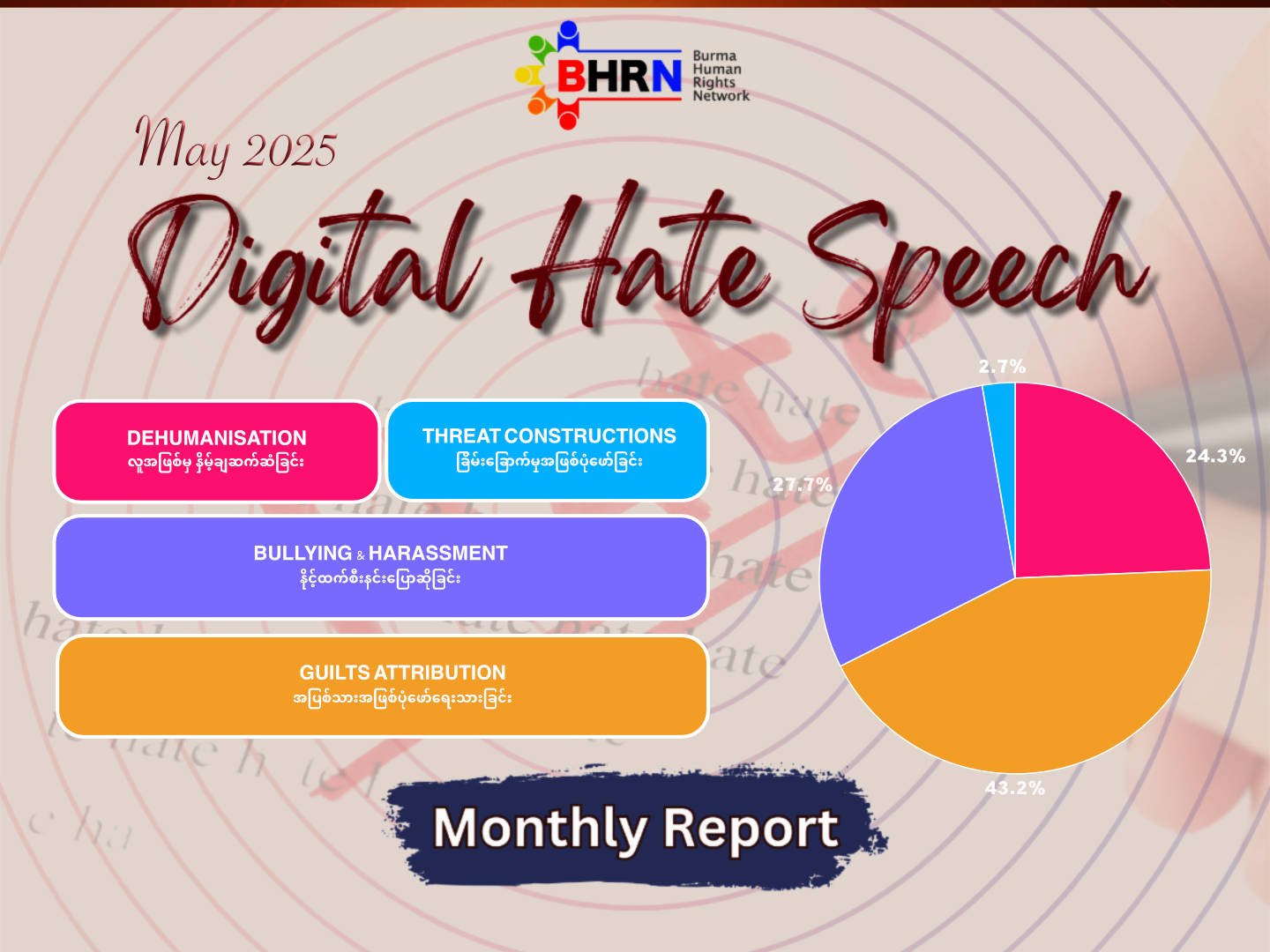
This report is based on an analysis of 77 posts shared on social media platforms in Myanmar during May 2025. It examines patterns of hate speech and fake news, focusing on the targeted ethnic and religious groups, the methods of propaganda dissemination, and the role of media platforms. The aim of this research is to uncover how such content contributes to social division, conflict, and the incitement of violence within the community.
The spread of hate speech and fake news through social media and other communication channels within Myanmar has the potential to exacerbate ethnic, religious, and political tensions, leading to a rise in social polarization and conflict across communities.
This report was compiled by monitoring online and print media used by the junta and its supporters to disseminate hate speech. Specifically, in May 2025, BHRN monitored 3 Facebook groups and 13 Facebook accounts, identifying 25 instances of hate speech. On Telegram, 40 instances of hate speech were found across 24 channels. Monitoring of 24 TikTok accounts revealed 12 instances of hate speech. In terms of print media, 2 newspapers and 1 journal were monitored.
During the month of May, a total of 77 instances of hate speech and fake news were documented. The results will be presented using charts, graphs, and clear explanations. The main causes of hate speech, its impacts, and recommendations for prevention will also be provided.
Due to limitations in conducting comprehensive monitoring across all social media platforms, some instances of hate speech may not have been recorded.
Context of misinformation as hate speech
In this report, BHRN has analysed hate speech in the context of the ongoing political tensions in Myanmar. Sometimes, when measured by international standards, what might look like misinformation takes on a different significance in the aftermath of the 2021 coup. This is because misinformation, particularly when aimed at individuals, groups with opposing political beliefs, or minority religious communities, can have severe consequences, even leading to loss of life and the intensification of religious and community conflicts.
Hate speech in Myanmar's current political climate is more than just false information; it can be a catalyst for very real and harmful outcomes, especially in the post-coup environment. Understanding this complex relationship between hate speech, misinformation, and their tangible impacts is crucial for grasping the region's broader social, political, and intergroup dynamics.