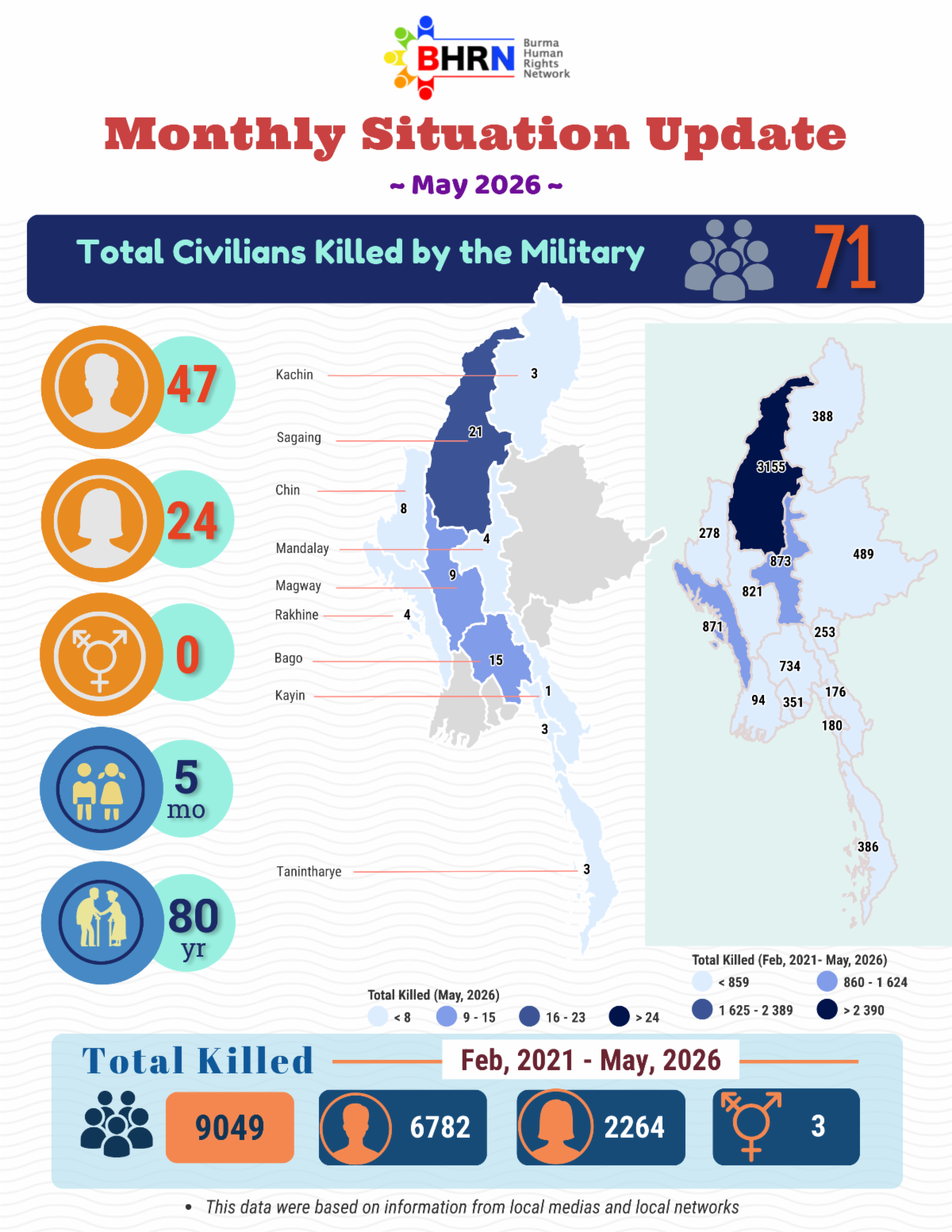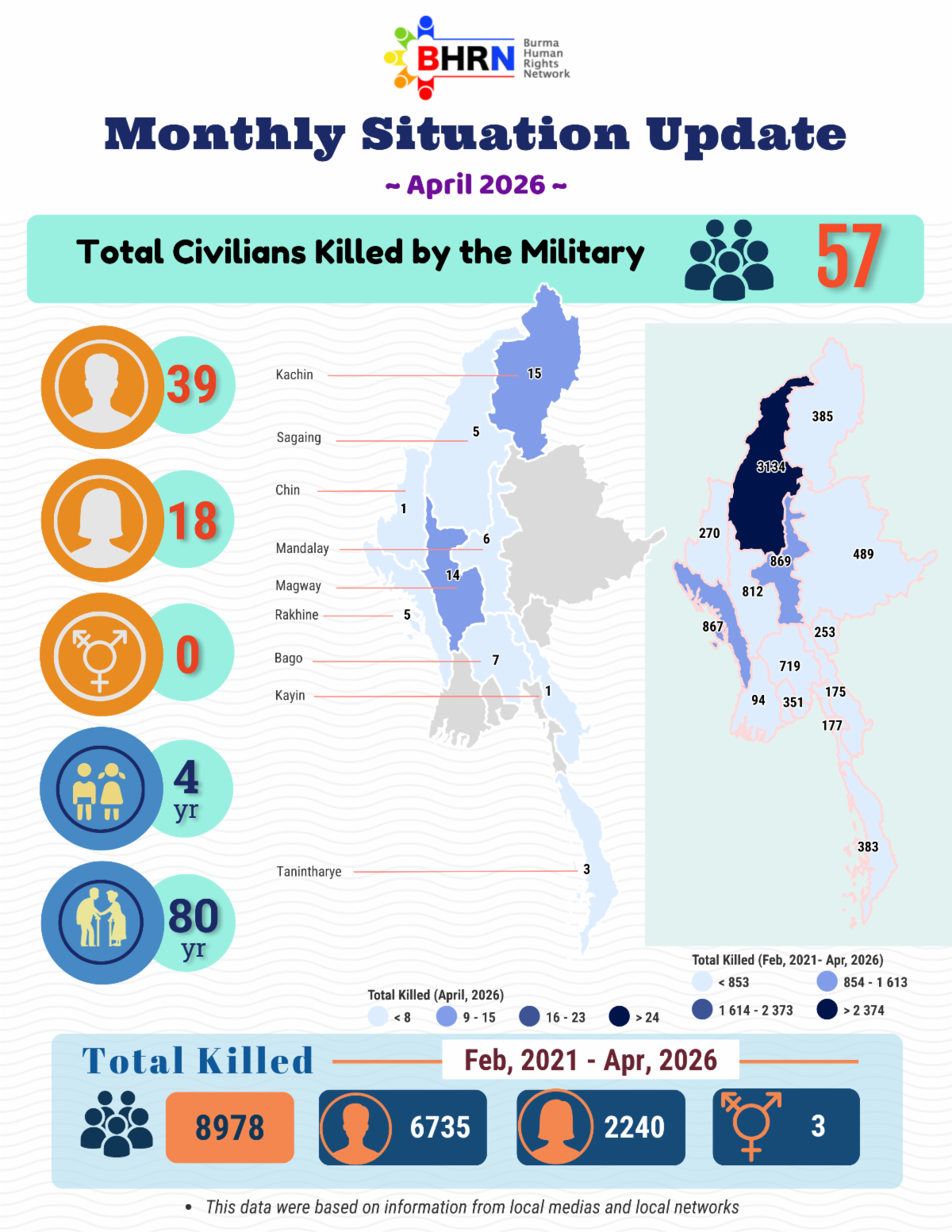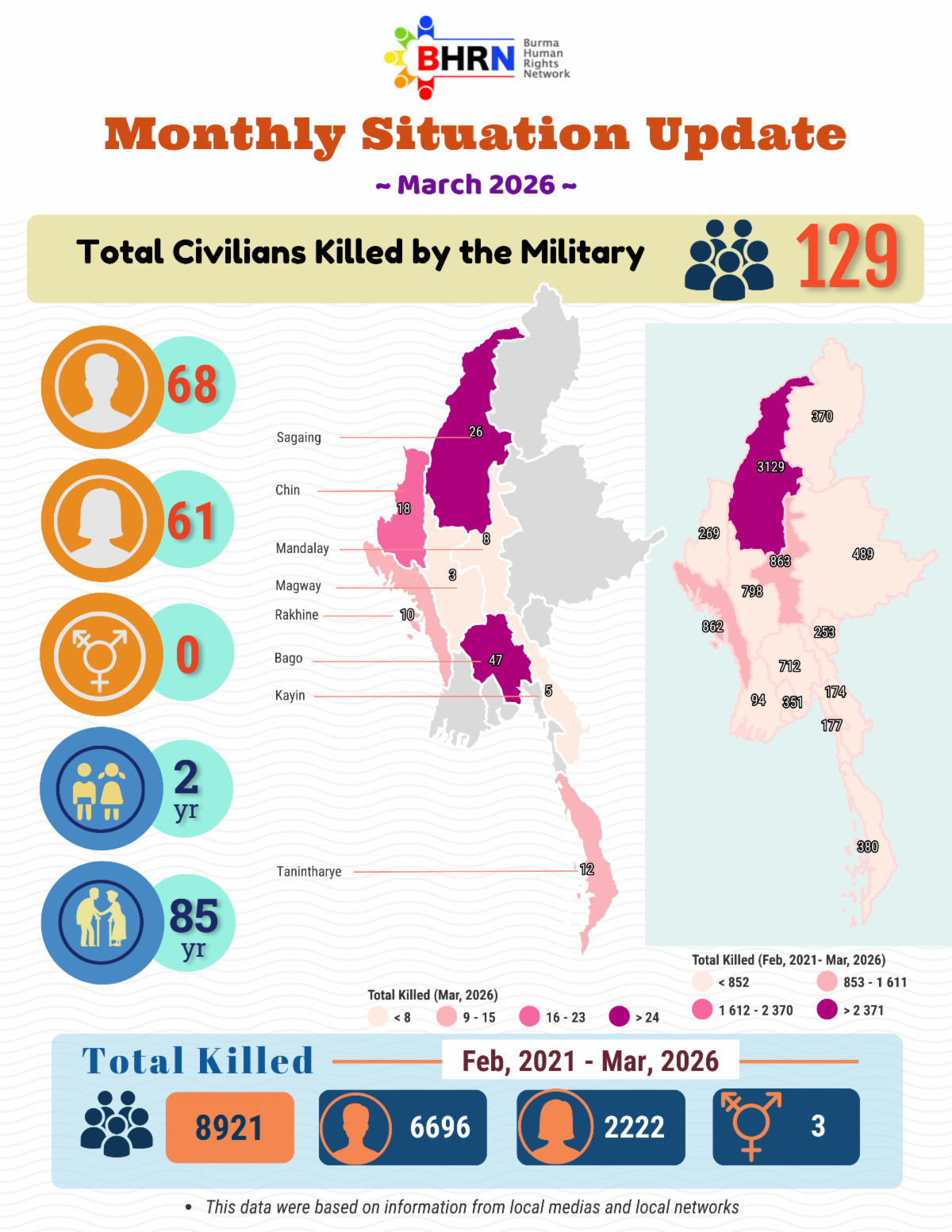
Methodology
Information in this document has been gathered by the BHRN team by primary and secondary research methods. We employed local researchers and local informers across Burma including in Rakhine State, Thai-Burma border and the Bangladesh border monitoring, investigating and documenting incidents of human rights violations. Any information we receive is carefully checked for credibility and authenticity by experienced senior research officers in the organisation. Once the information is approved the editorial team prepares the final document.
1Info-graphs of BHRN’s Report


Tap any image to see it full size.
2News Summary and Analysis
Background · The month of September this year perhaps would be remembered as one of the most devasting months for vulnerable civilians in Myanmar. The month saw the junta troops launch nearly 50 airstrikes in which nearly 100 civilians were killed[1].
- They include 10 airstrikes on Lashio, the capital of Northern Shan State which is currently under the control of the Myanmar National Defense Army (MNDAA) or Kokang group since August. Also, the junta forces launched at least 5 airstrikes on Thandwe Town in Southern Rakhine State, which is under the control of the Arakan Army.
- Similarly, a more intense conflict seems to be brewing in the country’s far north Kachin State, which borders China. The Kachin rebel group KIA now seized 10 towns mostly in Kachin State and in Northern Shan State. Military analysts are predicting that KIA may push its offensive to take control of the state capital Myitkyina.
- These conflicts are taking place mostly on the Sino-Myanmar border and the position of Beijing on these events is as perplexing as ever. After the peace offer was issued by the junta this month China seems to be siding with the junta in Nay Pyi Taw and trying to control rebel groups in Northern Shan State to stop their offensives.
- China also put pressure on its proxy rebel groups to sever their ties with the exiled Myanmar government, the National Unity Government (NUG).
- The situation in the West where the Arakan Army (AA) is fighting the junta troops is somewhat different from the rest of the country. AA is now marching to the junta’s military base in Ann township. Since AA's motive for fighting the junta is purely based on nationalism, they are less concerned about China’s position as their key motive is to restore the pride of the Rakhine people and claim autonomous rights for the Rakhine people.
- Similarly, Kayin and Eastern parts of Bago regions where one of the country’s oldest rebel groups the Kayin National Union (KNU) operates is also likely to see more intense conflict in the coming weeks, after the KNU continues to impose a blockade on a major highway that connects Myanmar with northern Thailand.
- While the political conflict continued to be tense, the month saw the worst flooding in Myanmar for several decades in which more than 1 million civilians have been impacted in the natural disaster whereas nearly 400 civilians were killed.
- Amid the flood crisis, the junta continued its airstrikes in several parts of the country on the other hand issued an offer for a political dialogue with the rebel groups. The offer, as expected, was roundly rejected by all of the junta’s antagonistic.
- Amid chaos and uncertainties, the junta launched a national census which it says will be used in preparing a voter list for the election which it said will be held next year. This offer for election fools no one but the Communist leaders in Beijing, who may be thinking that this will lessen the conflict in the country, which in turn will serve in its interest in terms of trade and investment opportunities for the Chinese companies in Myanmar.
- There was also a rather unusual development this month, with a new international actor trying to jump into the Myanmar crisis. After a visit to Indonesia in early September Pope Francis called for the end of the crisis in Myanmar. The Holy See reportedly has been working behind the scenes with the Indonesian Foreign Ministry to organize an international conference led by the Association of Southeast Asian Nations (ASEAN)[2].
- Pope Francis called for the release of Daw Aung San Suu Kyi during his visit to Indonesia and offered political asylum for Myanmar's pro-democracy leader in the Vatican, during his visit to Indonesia.
Context
The junta relentlessly launched brutal aerial bombings on civilian targets in at least 25 townships across the country in a desperate bid to retake the territories it lost to rebel groups. But so far apart from causing civilian casualties, and displacements these bombings are not helping its aim to regain control of territories.
But these attacks may be helping to boost morale within the military that will help them to rally around Min Aung Hlaing.
Apart from the airstrikes the junta also launched three major operations involving tens of thousands of ground forces to retake the territories it lost to the rebel groups.
They are Operation Aung Zeya, which was launched in April this year under the command of the deputy junta chief Soe Win. The key aim of the operation was to organize a counter-offensive to regain control of a key Myanmar-Thai border town, Myawaddy. The operation involving more than 3000 troops initially made significant gains against the Kayin National Union (KNU) troops with the junta managing to retake control of some parts of the town, which was taken over by KNU earlier. However, since then its control of the area has weakened since the junta failed to take control of a major highway linking the town with other parts of the country.
The second one is Operation Sin Phyu Shin, which was launched in August this year under the command of Min Aung Hlaing to retake northern Shan State. The junta is known to be assembling troops to launch a ground operation to retake Lashio and other towns in the region. The latest intense bombing in the region tends to indicate that the junta is expected to launch the ground offensive in the coming weeks.
During the month of September, the junta launched a new Operation Yan Naing Min, the aim of the operation was to retake the towns lost in Kayah and Southern Shan State to various rebel groups.
There is no significant military gain for the junta so far despite these new operations. However, Min Aung Hlaing's regime has been buoyed by a slight shift in the policy of China, the new policy seems to be in favour now of the junta’s approach to open political dialogue and bring the country on the path of elections.
It is very naive to believe the current regime will be able to conduct a free election, as it does not control the entire country and also its record on respect for democracy is worse even if compared to other military regimes that were in power in the past.
The junta’s proposal to all rebel groups in late September to join a political process and election obviously faces rejection from the groups fighting the regime.
Rakhine and Rohingya
In Rakhine the junta is mostly using airpower to contain AA’s operations, the junta is aware that it is difficult to find support among the people of Rakhine State so it may not commit strong ground forces as it plans in other parts of the country. As the war situation intensified in the state the Rohingya Muslim population are facing exploitation by both sides.
On the other side of the border in Bangladesh, the recent change of the government in Dhaka after an uprising against the Government of Sheik Hasina could lead to new policy on dealing with the Rohingya refugees. The new leader of Bangladesh Mohamad Yonus said he was in favour of a speedy repatriation of the Rohingya refugees.
For a developing country like Bangladesh to cope with more than 1 million refugees is an economic burden out of proportion. However, it is also a reality that the current situation in Northern Rakhine State is far from conducive to the return of the refugees.
Severe flooding
While the country continues to face conflict, the month of September saw severe flooding and landslides in many parts of the country including the country's central dry zone, which normally receives less rain than other parts of the country.
Since 9 September 2024, severe flooding and mudslides triggered by torrential monsoon rains and remnants of Typhoon Yagi have devastated 70 townships across 11 states and regions in Myanmar. The United Nations says an estimated 1 million people have been impacted, with more than 360 fatalities and 100 people reported missing.
It said the flooding has affected already marginalized groups, including internally displaced persons, pregnant and breastfeeding women, children, and the elderly, for whom the disaster has exacerbated existing vulnerabilities. Early assessments suggest women and girls account for approximately 60% of people affected.
The most severely affected areas include the capital Nay Pyi Taw; the regions of Mandalay, Magway, Bago, Sagaing and Tanintharyi; and the states of southern and eastern Shan, Mon, Kayah, Kayin, and Rakhine, the UN said.
Census
Amid the displacement and chaos across the country Min Aung Hlaing regime launched a nationwide census, which is said to cover the entire country.
The Ministry of Immigration and Population says more than 42,000 census workers will be involved in the exercise and they will gather information from more than 13 million households across the country.
The ministry said the survey contains 68 questions on matters such as the number of people living in each home, their education, disabilities, types of houses and access to water, electricity and toilets. It also includes questions about the occupants’ backgrounds, family members who have been away from home and the cause of death of family members, all highly sensitive matters for those who joined the armed resistance or the civil disobedience movement.
A regional conference on Myanmar and Vatican intervention
A regional initiative led by Indonesia seems to have started to find a negotiated solution for Myanmar. There have been unconfirmed reports that a regional conference on Myanmar will be organized by ASEAN. The news was first featured by the Vatican’s news agency Agenzia Fides.
This development comes after a visit by Pope Francis to Indonesia in early September, during which he called for the end of conflict and bloodshed in Myanmar. Pope Francis conducted a visit to Myanmar in 2017 during Rohingya genocide which he met Daw Aung San Suu Kyi and other Myanmar leaders. It was reported at that time that Min Aung Hlaing insisted on meeting the pope even though the pontiff was not in favour of such a talk. A source close to the meeting said Min Aung Hlaing mentioned to the Pope that he wanted to meet him as he had a strong respect for the pontiff.
[1] Myanmar Now 3 October 2024
Observation and Analysis
- The conflict in Myanmar is expected to exacerbate in the coming months as the junta plans a series of counter-offensives and increases the use of air power against the anti-regime groups, which not only kills innocent civilians but also has a severe impact on the livelihood and the overall economy of the country. However, the groups fighting the regime may not have other viable alternatives apart from removing the junta from power.
- Since the launch of Operation 1027, at one stage it was seen that China will put all its support to its proxy groups, who are fighting the regime, which will eventually lead to the collapse of the military junta. However, once again it was proved that China is not a reliable partner, as it can switch sides depending on its geopolitical and strategic interests.
- Now the junta is regaining some level of support from China on its bogus peace plan. It was right for the anti-regime groups to reject the offer for a talk from Min Aung Hlaing, however, with the lack of a counterproposal from their side they could be seen as those opposing a move to find a peaceful solution.
- They should have made a counterproposal to the junta such as installing a creditable interim government before starting a peace dialogue, releasing all political prisoners and asking the junta to stop the conscription of youths in the country.
- It is surprising that Min Aung Hlaing still holds on to power, despite heavy military losses. However, China is backing its regime with a belief that the disintegration of Myanmar will be far more dangerous for China’s security and will be counter-productive for its strategic and economic interests.
- China tried to block its proxy rebel groups from forming an alliance with the NUG which controls the People's Defence Forces (PDF) the anti-regime forces will be weakened. With the Western powers continuing to engage with other global emergencies, the situation in Myanmar is expected to remain uncertain for the coming few years.
- The indication of Vatican involvement was a welcoming one, the representative of the Vatican in Myanmar Cardinal Charles Bo is known to be close to Min Aung Hlaing, he could deliver a message from the Pope to the junta head and persuade him to accept a mediation by the Catholic Church. The conference proposed by Indonesia is expected to be held in October.
- The governments in Bangladesh and India will have to accept the fact that the junta will not be the only entity that controls Rakhine State. There is a high chance that the entire state will be under the control of AA in the coming months. In such a case, it is important for the two countries that share a border with Rakhine State to start a working arrangement with AA.
- Such cooperation could include the safe return of more than one million Rohingya refugees from Bangladesh, for India to maintain its access to Myanmar through land border. However, AA's recent attacks on Rohingya contributed more influx of refugees to Bangladesh and if it is continue Bangladesh should seek protection of Rohingya that remain in Arakan State.
3Rohingya Issue
3.1Rohingya in Rakhine Updates
- 5 September
The military arrested seven Rohingya from Bu May village, who are IDPs from Buthidaung, on accusations of exporting food items to Buthidaung and Maung Daw townships. Five of them were released after a week, but it is unconfirmed what, if any, charges the authorities levied.
Source: BHRN - 9 September
More than 500 Rohingya refugees who fled from Maungtaw Township in Rakhine State to Bangladesh were forcibly repatriated to Myanmar by Bangladeshi authorities within two days after their arrival to the country, a local source said. He said Bangladeshi authorities left around 300 Rohingya refugees at the Fezi village beach in Maungtaw Township, where the junta troops were stationed. The incident took place on 7 September. In another incident a day later more than 200 Rohingya refugees were transported to the banks of the Pyin Phyu River in Maungtaw Township, the same source said. He said at least 300 Rohingya refugees who were returned to Fezi village on the night of September 7 are still missing.
Source: Arakan Express - 11 September
The Arakan Army (AA) reportedly killed many civilians, including nine Rohingya families from Maung Ni Ward, on 4 August, a civil society organisation the Mayu Region Human Rights Documentation Center (MHRDC) said. An MHRDC finding said AA troops entered Maung Ni Ward from Pantawpyin ward on the morning of 4th August and attacked the Maung Ni police station. The report said the AA troops also targeted and attacked residents. The AA troops surrounded and attacked some Rohingya homes in the southernmost part of Maung Ni Ward (closest to Pantawpyin village), killing children, the elderly, and women indiscriminately, the report said. It said they also attacked some houses with rocket-propelled grenades, killing most nine people trapped inside. In recent months, the military junta has cut off phone and internet lines in Rakhine State, and it is reported that the junta troops and AA rebels have killed tens of thousands of local Rohingya, the MHRDC report said.
Source: Arkan Express - 11 September
The exiled Rohingya activists have accused the Arakan Army (AA) of committing genocide similar to the military junta and they called for new ways to hold those who committed human rights abuses to account. A spokesperson of AA Khine Thukha told a local news agency Development Watch that the accusations against the rebel group were untrue and alleged that the exiled Rohingya group of not have genuine concern about the Rohingya but were instead pursuing their interests. Chris Lewa, a leader of an international humanitarian NGO, stated that both sides are spreading hate speech and called for necessary cooperation between AA and the exiled Rohingya groups.
Source: Arkan Express - 12 September
More than 40 Rohingya refugees, who fled from Maungtaw Township in Rakhine State to Bangladesh, were arrested and sent back to Myanmar by Bangladeshi authorities on 11 September, a local source said. He said the Rohingya refugees were trapped in areas controlled by the Arakan Army (AA) in Maungtaw Township and attempted to flee to Bangladesh due to difficulties such as lack of medical treatment and insufficient food and shelter, the source said.
Source: Arkan Express - 15 September
A 27-year-old Rohingya man from Bu May was kidnapped by ALP members. He was detained at ALP headquarters in Set Yone Su quarter (Nazi village) and released after one day when his family began searching for him. The family reportedly paid 2,500,000 kyats for his release, despite no formal charges.
Source: BHRN - 21 September
Three Rohingya from Bu May and Magyi Myaung villages were arrested downtown, accused of violating Article 144. However, it's reported they were arrested around 7:00 PM, whereas Article 144 restrictions are in effect from 9:00 PM to 5:00 AM.
Source: BHRN - 21 September
Three Rohingya children from the Sintat Maw Rohingya refugee camp in Pauk Taw Township, Rakhine State, died from diarrhoea, a local source told Burma Human Rights Network (BHRN). He said among the victims include two girls aged 5 and 3, and a boy aged 2. The source said that many Rohingya in the camp are suffering from diarrhoea due to drinking contaminated water. The Sintat Maw Rohingya refugee camp has a population of more than 1000 Rohingya Muslims.
Source: BHRN - 24 September
A boat carrying around 20 Rohingya refugees fleeing from Maungtaw, Rakhine State to Bangladesh sank on 23 September, a local newspaper Arakan Express News reported. It said 7 people survived the incident and the other are still missing.
Source: Arkan Express - 25 September
A rebel group the Arakan Army (AA) has denied the report of arrest and torture of almost all Rohingya residents from the northern Rohingya villages of Mi Kyaung Kaung, Kumi Khali, Maung Hla Ma, and Mi Swe villages in Buthitaung Township, Rakhine State. The AA reportedly took almost all villagers from these areas to a temporary camp in the Chinthamas village. Among those arrested include women, elderly people, and children. The three Rohingya villages have around 200 families, with a population of nearly 1000 people.
Source: Arkan Expres - 27 September
More than 200 Rohingya refugees, who fled from Maungtaw Township in Rakhine State to Bangladesh were arrested by Bangladeshi authorities and sent back to Myanmar on 24 September, a local source said. He said the refugees were arrested from the homes they rented in a Bangladeshi town. The Rohingya refugees in Maungtaw Township fled to Bangladesh to avoid difficulties due to lack of medical treatment and insufficient food and shelter, the source said. The first group of arrested refugees were sent back to Maung Ni village in Maungtaw Township on the evening of 24 September, while another group was sent to the northern part of Maungtaw near Mingalar village, the source said. He said the places where the returnees were sent were under the control of the Arakan Army (AA).
Source: Arkan Expres - 30 September
The Rohingya villages of Bu May, Magyi Myaing, Basara, and the associated IDP camp remain encircled and under restricted movement by SAC checkpoints since the resumption of fighting in Rakhine state. Rohingya from these villages must pass through five checkpoints to reach other Rohingya villages. Motorbike riders are charged 1,000 to 3,000 kyats per checkpoint, while tuk-tuks (taxis) are charged 3,000 to 5,000 kyats per checkpoint, round trip. INGO staff, students, and volunteer teachers are reportedly exempt from these fees. The number of checkpoints has increased since the BGF was assigned to Sittwe, with the total number of new checkpoints, military and police bases, and stations now exceeding 50.
Source: BHRN - 30 September
In Pauk Taw Rohingya IDP camps, where Rohingya and Kaman people live together, at least 15 people, including five children, have reportedly died from a diarrhea outbreak. The IDPs report that there are no doctors or medicine available for treatment, and the medical team from the ULA has not come to provide aid.
Source: BHRN - 30 September
Both ARSA and RSO claimed to have fought against the Arakan Army in northern Rakhine State and on the Bangladesh border throughout the month. However, these claims are difficult to verify. Rohingya are still fleeing from Northern Rakhine State to Bangladesh, but Bangladesh authorities are pushing them back to Burma. In some cases, refugees who’ve sought refuge in Teknaf and surrounding areas have also been sent back to Burma once they’ve been discovered by authorities.
Source: BHRN
3.2Rohingya in Bangladesh Camp
- September 1st, 2024
Nobi Hussein, a well-known drug dealer and commander in chief of the Arakan Rohingya Army (ARA), and one of his commanders were arrested by the police while they were traveling. He was allegedly released after paying a large sum of money.
Source: BHRN - September 3rd, 2024
RSO members, with support from the APBn police, entered Camp-15 to chase out ARSA members who controlled the territory. They were also accused of attacking innocent people in the process. Camp residents resisted, and RSO members fired bullets, resulting in two deaths and six injuries. Similar incidents occurred in Camps 15, 18, and 20 for several days.
Source: BHRN - September 5th, 2024
The APBn police and the RSO raided Camp-18, attempting to arrest militants, and they abducted innocent refugees in the process. Camp residents protested, chanting for the police and armed groups to leave. The police fired bullets at the crowd, injuring two children.
Source: BHRN - September 11th, 2024
Mohamed Hashem, an NGO volunteer from Camp 4, was arrested by APBn police on accusations of collaborating with ARSA. The community maintains his innocence. The police demanded 60,000 taka for his release, which he paid to avoid jail. The community believes RSO orchestrated the arrest due to Hashem's lack of support for them in a previous conflict. This is not confirmed but signals increasing distrust and unease in the camps.
Source: BHRN - September 11th, 2024
A major gang fight erupted between ARSA and RSO in Camps 20 and 20Ext. ARSA members were holding a meeting when RSO attacked, leading to a gunfight lasting over an hour. Two ARSA members were shot dead by RSO.
Source: BHRN - September 16th, 2024
RSO raided a refugee shelter in Camp 4. When the residents didn't open the door, RSO members fired bullets into the shelter, killing the head of the household and injuring two of his children. RSO accused him of being affiliated with ARSA, but locals said he was not involved with any armed groups.
Source: BHRN - September 18th, 2024
An innocent Rohingya man was shot dead by APBn police while traveling between camps. He ran from the police out of fear, as RSO gang members were often present during police patrols and would reportedly extort civilians. The police claimed the man was an ARSA member, but camp residents stated he was an ordinary refugee.
Source: BHRN - September 20th, 2024
A muezzin (person who calls for prayer) in Camp 4 was shot dead by an unknown gang. He had made an announcement to warn people about the gang's presence, and they tracked him down and killed him.
Source: BHRN - September 28th, 2024
A group of 10-12 armed individuals broke into the UNHCR Transit Centre, firing randomly and creating panic. Residents chased the gang away, and one member was caught and handed over to the police. The captured individual claimed he had been wrongly imprisoned for three years and was seeking revenge against the person who had accused him.
Source: BHRN - September 30th, 2024
Five young Rohingya were kidnapped from the Kutupalong area. Three victims were from Camp-5. They were taken hostage while traveling in a CNG (three-wheel taxi). The kidnappers demanded and received a ransom of 100,000 taka per victim for their release. The camp authorities were informed but did not intervene.
Source: BHRN
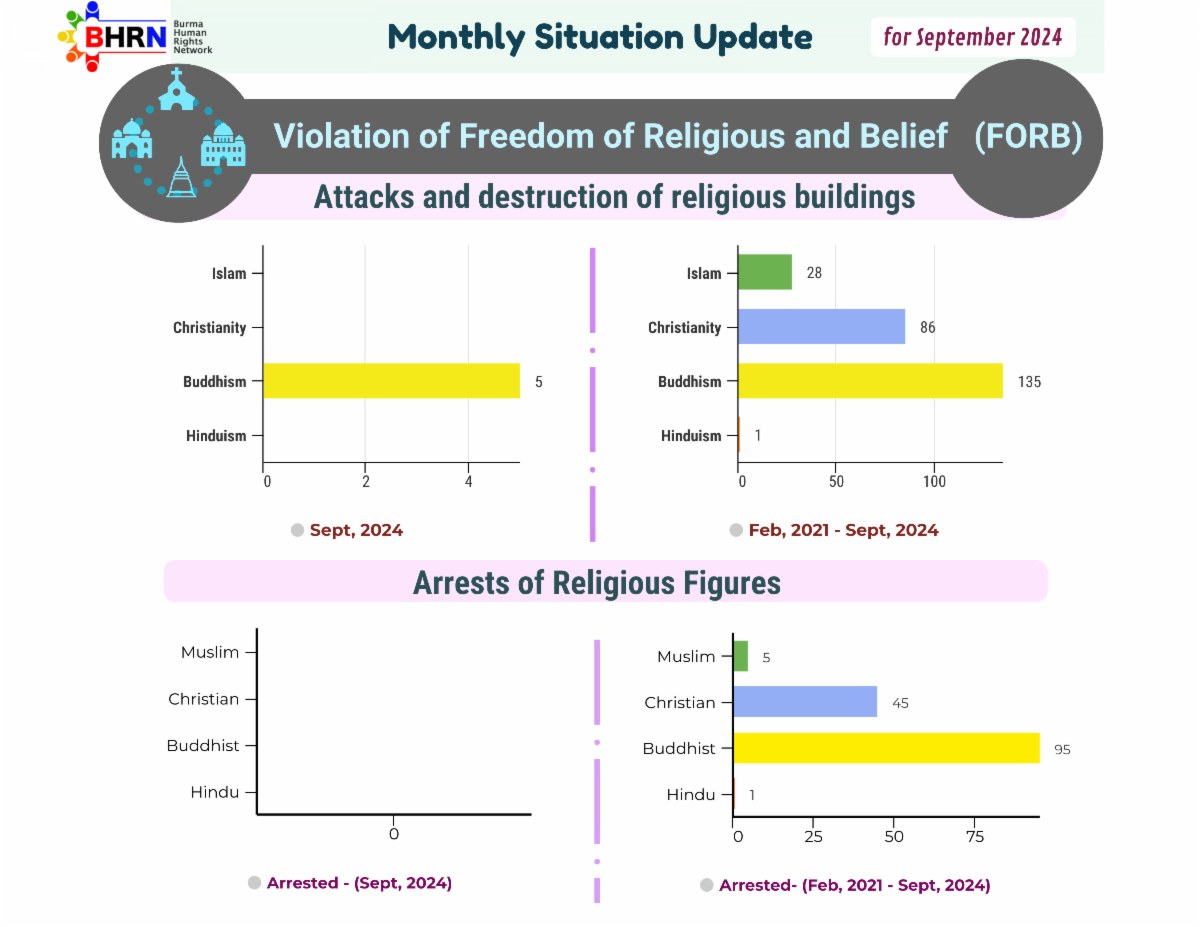
4Violations of Freedom of Religion and Belief
- 2 September
A civilian was killed, and four others injured in an air strike by the junta troops on a monastery in a village in Taungup Township, Rakhine State on 31 August, a local source told Burma Human Rights Network (BHRN). He said many buildings in the compound of the monastery in Kha Yine village were damaged in the attack, the source said.
Source: BHRN - 3 September
The junta troops are accused of stealing a precious relic from a pagoda in a village in Min Hla Township in Bago Region on 30 August, a local source told Yangon Khit Thit news agency. He said the junta troops arrived in U To Myanmar Su village to arrest youth in the village to conscript them. The news report said the disappearance of the relic was only discovered by the villagers on 2 September.
Source: Khit Thit Media - 16 September
Several pagodas in a village in Taungtha Township in Mandalay Region were destroyed in an airstrike by the junta troops, a spokesperson of the Public Movement Committee - Taungtha, said. It said the incident of attack on the pagoda in Hlai Ma Ku village took place on 16 September. In another incident, junta troops attacked Pyat Kyi village in Taungtha Township on 11 August, in which school buildings in the monastery were destroyed and a monk was injured in the attack.
Source: BHRN - 18 September
The junta troops fired heavy artillery indiscriminately into a civilian village in Madaya Township, Mandalay Region, a local source told Burma Human Rights Network (BHRN). It said three 81mm artillery shells fired by the junta troops exploded on the Thonse Pay village pagoda in Madaya Township, the source said, adding that the pagoda was completely destroyed.
Source: BHRN - 19 September
Several homes in Malai village in Kanbalu Township, Sagaing Region, were destroyed in an air strike by the junta troops, a local source told Burma Human Rights Network (BHRN). He said six fighter jets were involved in the attack, adding that 13 bombs were dropped on the village. He said the troops also attacked the village with three rounds of machine gunfire. The incident took place after two consecutive days of fighting between the junta troops and the People Defense Forces (PDF) in the region. The source said the fighter jets were used to protect the junta troops fighting on the ground.
Source: BHRN - 24 September
A monk was injured, and scores of schools and monasteries were destroyed in a series of air strikes by the junta troops on two villages in Myaing Township in Magwe Region on 22 and 23 September, a local source told Radio Free Asia.
Source: RFA - 24 September
The junta troops have been forcing some monks in Magway Region to disrobe and conscripting them into military service, a local source said. He said the junta troops accused the monks of wearing robes to avoid joining the military under mandatory military service law. The source said the incident took place in Yenangyaung Township, Magway Region, where the military has been inspecting some monasteries forcing monks to disrobe and conscripting them into the army. The source said monks are being asked to show their official monk registration cards, and those who cannot provide them are being forced to change into civilian clothes and taken away.
Source: Khit Thit Media - 27 September
A monk was killed in an airstrike by the junta troops in Pauk Township in Magwe Region, a local source said. He said the fighter jets of the junta attacked Bura Taung Monastery and Naga Pwat village in Pauk Township on 26 September. The source said three bombs were dropped on the Bura Taung Monastery area, and the aircraft also fired machine guns, leading to the destruction of the monastery and the death of one monk, the source said.
Source: Arkan Express
5Human Rights Violations
5.1Rape as War Crime (Committed by Junta Troops)
- 5 September
The junta troop committed sexual abuse of a woman working at a monastery in Minhla Township, Western Bago Region, a local source said. He said the incident took place on August 31 and three soldiers were involved in attacking a 30-year-old woman who was working at the Koe Htit Khaung Gawun Monastery, in Minhla Township. A member of the local People's Defense Force (PDF) said the soldiers beat and raped the woman before abandoning her in the monastery. The source said according to a family member of the victim severe internal and external injuries were caused to the victim due to the attack by soldiers.
Source: BHRN
5.2Extra Judicial Punishment
5.2.1Arbitrary arrests and imprisonment
- 4 September
The junta troops arrested about 20 civilians, including children in a village in Tanintharyi Township Tanintharyi Region on September 4, a local source told Burma Human Rights Network (BHRN). He said the victims will be used as human shields. The arrests follow intense clashes that occurred between the junta troops and the members of resistance forces in several villages in the area, including Banlamut Village where the 20 civilians were arrested, the source said. He said there were several casualties on the side of the junta in the fighting. Some of the arrested civilians, including children and women, were released, however, the men are still being detained.
Source: BHRN - 13 September
The junta troops arrested 23 civilians, including 13 women, in Salinngyi Township in Sagaing Region on 11 September, a spokesperson, of a local resistance group the Regional Friend Fighters said. The group said the victims were agriculture workers from Magyi Tathaung village who were arrested as they were returning home from their farm. The arrest followed an attack on junta troops near the village.
Source: BHRN - 14 September
The junta troops arrested 60 civilians in the Rakhine State capital Sittwe on 13 September, a local source told Burma Human Rights Network (BHRN). He said the troops had arrested the civilian pedestrians on the streets of Sittwe. The junta has tightened security in Sittwe, and landmines are laid in the city’s surrounding area as it faces an attack by a rebel group, the Arakan Army (AA), the source said. He said the junta is arresting civilians who are trapped in the city.
Source: BHRN - 16 September
The junta arrested nearly 1700 people across Myanmar for posting critical comments against its rule on social media, a report released by a civil society group Data for Myanmar on 16 September said. It said 1691 people were arrested since the military coup more than three years ago and it found an average of 54 people were arrested monthly. The report said the junta monitor social media posts and they also check the mobile phones of civilians in the checkpoints and arrest those who post comments critical to the junta. It said among those arrested the majority of them are users of popular social media sites such as Facebook, TikTok and Telegram. Among those arrested 36 per cent are women, the report said.
Source: BHRN - 18 September
The junta troops arrested 9 civilians in Maubin Township in Ayeyarwaddy Region on 18 September, a local source said. He said among those arrested included 2 women. Those arrested were mostly youths who were suspected of being conscripted into the military.
Source: DVB - 21 September
The junta arrested members of a charitable group in Thanbyuzayat Township in Mon State, a local source told Radio Free Asia. He said the victims are the members of Paing Shin Mat charitable group including its chair. The source said the arrest followed the junta troops conducted a raid on the office of the charity on 18 September in which the chair of the group and other five members were arrested and the other three members were arrested from their homes two days later. The families of the arrested people have had no communication with them since their arrest, the source said.
Source: RFA - 23 September
The junta murdered a member of the National League for Democracy (NLD) in Taungoo Township in Bago Region on 23 August, a local source told Burma Human Rights Network (BHRN). He said the troops sealed the house of U Min Swe who is the head of the party’s Taungoo unit after his arrest. The source said U Min Swe was taken to the headquarters of Southern Command based in Taungoo. His family was informed by the junta on 5 September that U Min Swe has died, the source said.
Source: BHRN - 25 September
The junta arrested 7 internally displaced people in Butalin Township in Sagaing Region on 24 September, a local resistance group said. He said the arrest followed the junta raided an IDP camp in Kudaw village in Butalin Township and they destroyed the camp and took away the food and other items from the camp. The camp was established after the residents from the region fled their homes as the junta took up positions in the area in July 2021.
Source: BHRN
5.2.2Issues of Political Prisoners
- 19 September
The prison authorities at Daik-U Prison in Bago Region, physically abused a political prisoner by stepping on his head and face with their shoes after they allegedly found cigarette paper from him, said U Thike Htun Oo, a member of the Political Prisoners Network Myanmar (PPNM), in an interview with the Yangon Khit Thit news agency. The news agency said the perpetrators of this unlawful beating were the head of dormitory No. 5, Ye Htut Win, and Deputy Sergeant Saw Aung Ko Lay. The victim is serving a three-year sentence under Section 505 of the penal code on criminal defamation. The prisoner was severely injured due to the attack, the PPNM official said.
Source: Khit Thit Media - 26 September
The prison authorities in Tharyarwaddy Prison in Bago Region, failed to take action against a prisoner who stabbed a female political prisoner with a sharpened iron rod, a source close to the prison told Yangon Khit Thit news agency. The incident occurred in the women’s dormitory 1 of Tharyarwaddy Prison, where a political prisoner was stabbed by another inmate with a sharpened iron rod. The source said this is the second time the perpetrator was involved in verbal altercations, fights, and physical assaults with other inmates, the source said.
Source: Khit Thit Media
5.3Extra Judicial Killings and Enforced Disappearances
- 4 September
A youth has died after he was conscripted and sent to a battlefield, a source in the victim’s native Mawlamyine Kyun Township in Ayeyarwaddy Region said. He said the 17-year-old youth was conscripted after he joined a factory in Hlaing Tharyar Township on the outskirts of Yangon in May this year. The source said he was conscripted and sent to a battlefield in Shan State. The family was informed about the death of the youth, and they were told that the junta would compensate financially for the loss of the youth.
Source: DVB - 21 September
More than 70 children were killed due to conflict in Chin State, the Chin Human Rights Organization (CHRO) said in a statement issued on 19 September. The statement said at least 73 children were killed in the airstrikes and shelling by the junta troops on the civilian targets in Chin State since the military coup in February 2021. The statement said the junta is accountable for war crimes for the killing of children.
Source: BHRN - 27 September
The junta troops killed three civilians in a village in Myingyan Township in Mandalay Region on 26 September, a local source told Burma Human Rights Network (BHRN). He said the victims were killed in a raid by the junta troops from No 15 Light Infantry Division on Phoneywa village. The source said Ko Aung Kyaw Zin, 53, Ko Ye Win, 52 and Ko Kyaw Swa Win, 45, were murdered during the raid. The source said two of the victims Ko Ye Win and Ko Kyaw Swa Win were brothers, and they served as village-level officials under the government led by the National League for Democracy (NLD). He said the homes of the two victims as well as another former NLD official Ko Myint Khaing were burned down during the raid.
Source: BHRN - 27 September
Four civilians including two novices were injured by a shelling on a village by junta troops in Kyaukkyi Township in Bago Region on 19 September, a spokesperson of a rebel group Karen National Union (KNU) said. KNU has its base in the area under its No 3 Battalion. The KNU spokesperson said the civilian casualties in Yaukthwa Kone village were caused by to use of a howitzer by the troops from the junta’s Light Infantry Division 264 based in the area.
Source: BHRN - 27 September
More than 167 people were sentenced to death during the three years since the military coup in February 2021, a civil society group the Association for Assistance for Political Prisoners (AAPP) said in its records published on the organisation’s website. It said 123 people are currently on death row and 44 people were sentenced to death in absentia. The AAPP record said that 123 people are on death row including 103 from the Yangon Region and among them include 13 women. The record also shows that 90 per cent of those sentenced to death are aged between 18 to 35. The junta has been using severe punishment against its opponent by using draconian laws such as counter-terrorism law and arms law as well as severe sections under the criminal procedure code including murder. Some of the junta’s opponents are sentenced to death more than once and some face lengthy prison sentences up to 225 years. These are more than the maximum punishment allowable under the country’s judicial system.
Source: Mizzima - 27 September
The junta troops killed three civilians in a village in Launglone Township in Tanintharyi Region on 27 September, a statement issued by a local branch of the National League for Democracy (NLD) said. It said the bodies of three unnamed victims were found in a garden in Maungmagan village where the victims had lived. They were among the 10 civilians the junta troops arrested on 12 September after its base near the village was attacked by local resistance groups, NLD said.
Source: RFA - 30 September
The junta troops killed three civilians in Sagaing Township in Sagaing Region on 28 September, a local source told Radio Free Asia. The victims were killed two days after they were arrested on suspicion of being members of the People's Defence Force. The source said they were from Yangon and arrested at a military checkpoint near Sagaing, where they wanted to go to seek employment.
Source: RFA
5.4Violence attacks by pro-junta thugs
- 6 September
The junta is forcing civilians in the villages in Nyaunglebin District in Bago Region to join the military as conscripts, a local source told Burma Human Rights Network (BHRN). He said they include asking civilians to join raffle draws to select conscripts and extortion for those who do not want to join the military. The source said the civilians from Pamo Nae, Kone In Su, Kywe Thay Myaung, Kyan Khin, and Mya Thar Nyo villages were forced to join a raffle draw on 27 August, to select youth to join the military. He said they were asked to pay Kyat 50,000 each family to support war veteran families. A local source said that those whose names were selected raffle draw include elderly and sick people.
Source: BHRN - 10 September
The junta is forcing the civilians in Kalay township in Sagaing Region to join the military as a conscript, a local news source told Burma Human Rights Network (BHRN). He said the junta used several tactics to force youth to join the military and to extort money from those who did not want to join. He said the junta abducted youth and forced them to serve in the military and extort money from the families of those who do not wish to join adding that some families have to pay more than Kyat 10 million as ransom money for the release of their loved ones. The source said the junta is also conducting regular checks on the civilians in the town, including in front of the Government Hospital in Kalay as well as in front of Sagarhla Monastery, in front of the District Police Headquarters and the highway bus depo. The troops seized the mobile phones, handbags and search toolbox of the motorbike with the intention to extort money, the source said.
Source: BHRN - 11 September
Members of a junta affiliate Pyu Saw Htee militant group have been involved in a series of arson attacks in at least 13 villages in Khin U region in Sagaing Region in recent days, a local source said. He said they are led by a militant monk Warthawa and mainly target the schools run by the exiled National Unity Government (NUG) as well as hospitals and monasteries.
Source: DVB
About BHRN
Burma Human Rights Network (BHRN) is based in London, operates across Burma/Myanmar and works for human rights, minority rights and religious freedom in Burma. BHRN has played a crucial role in advocating for human rights and religious freedom with politicians and world leaders.