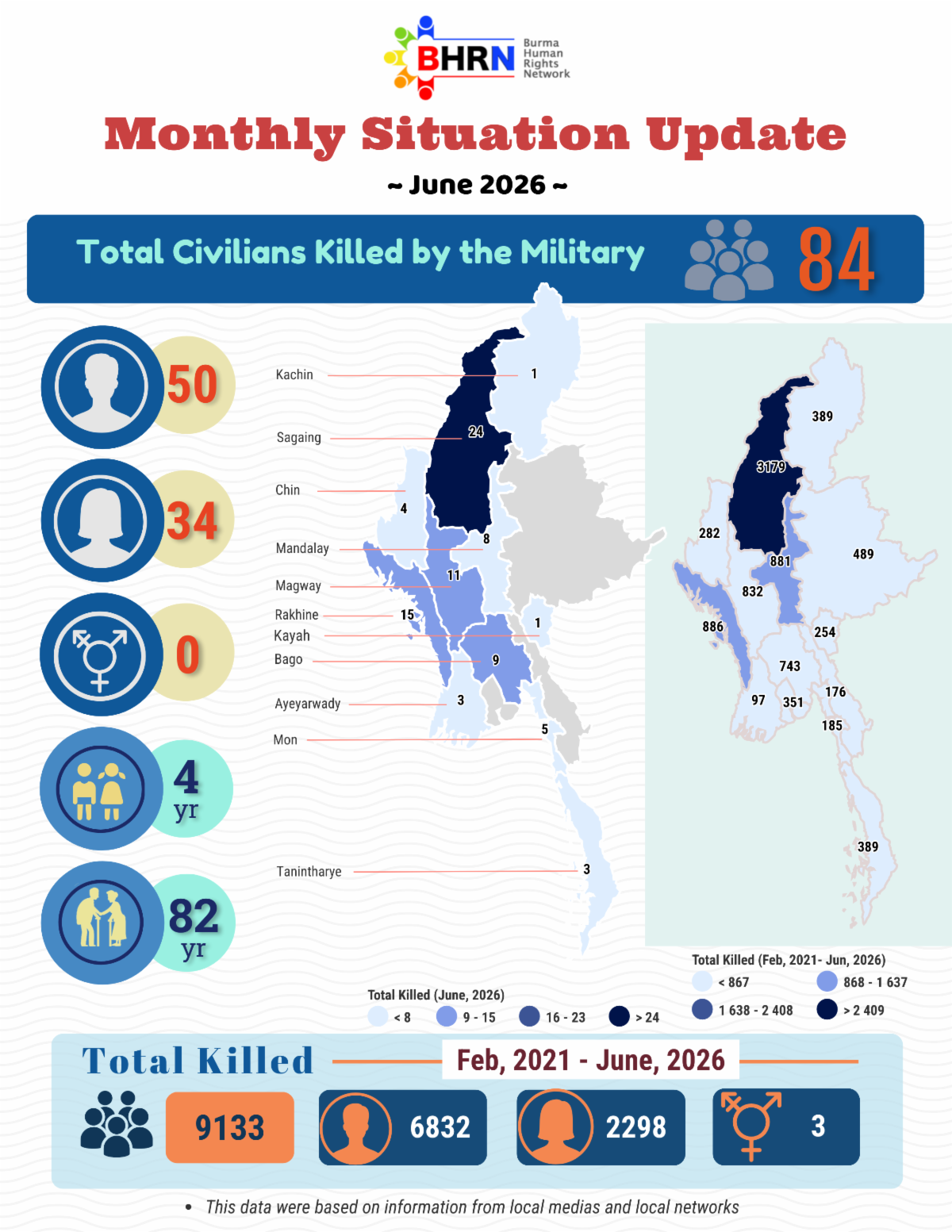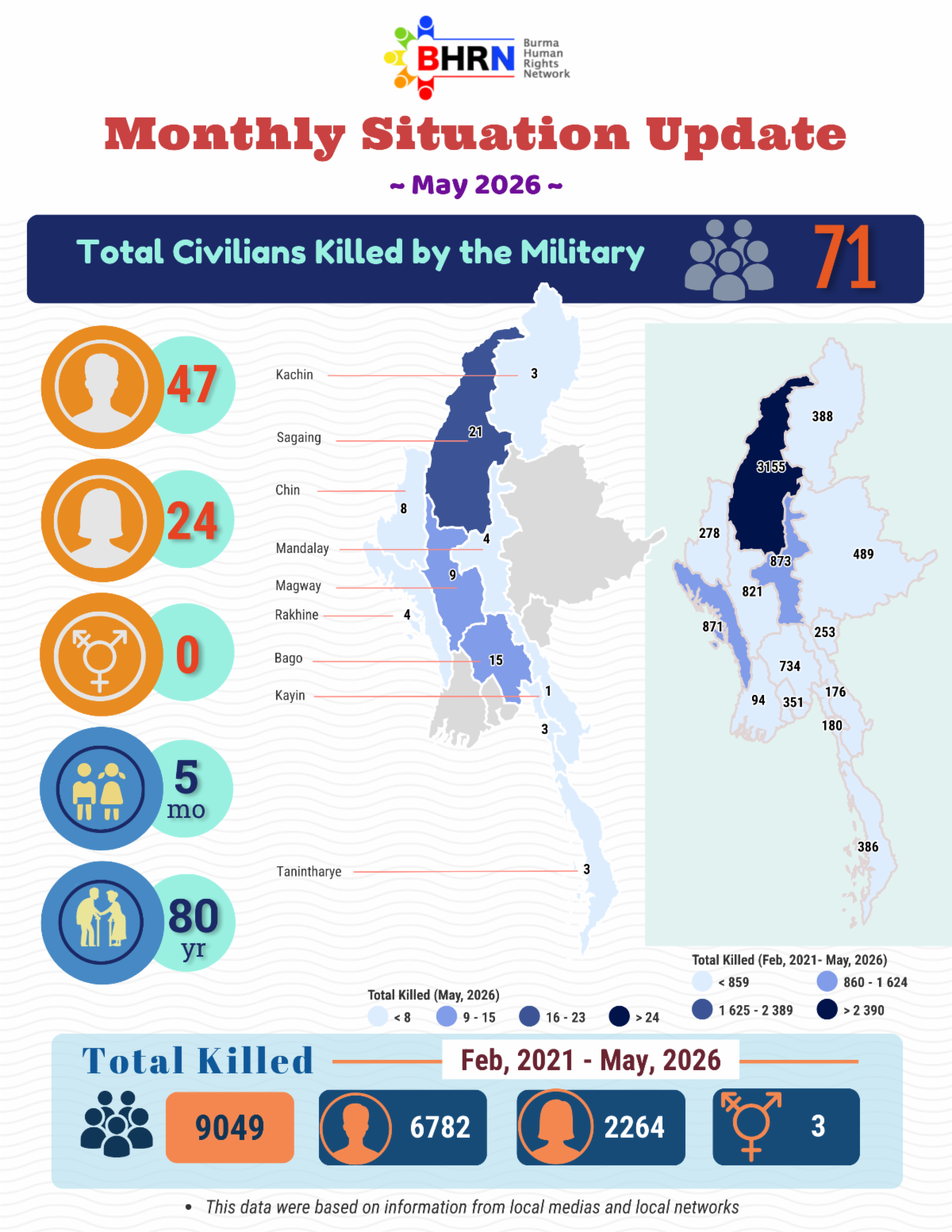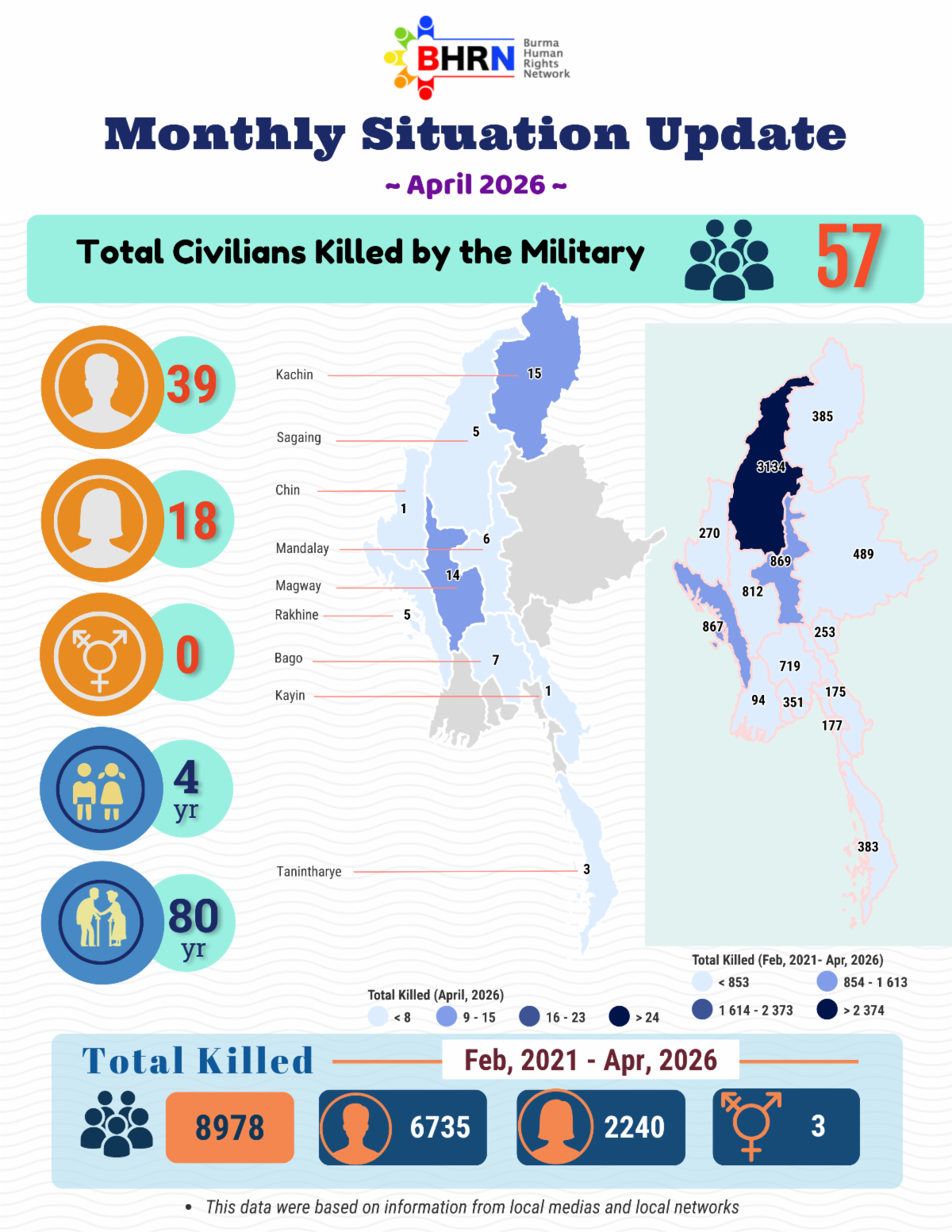

Methodology
Information in this document has been gathered by the BHRN team by primary and secondary research methods. We employed local researchers and local informers across Burma including in Rakhine State, Thai-Burma border and the Bangladesh border monitoring, investigating and documenting incidents of human rights violations. Any information we receive is carefully checked for credibility and authenticity by experienced senior research officers in the organisation. Once the information is approved the editorial team prepares the final document.
1Info-graphs of BHRN’s Report
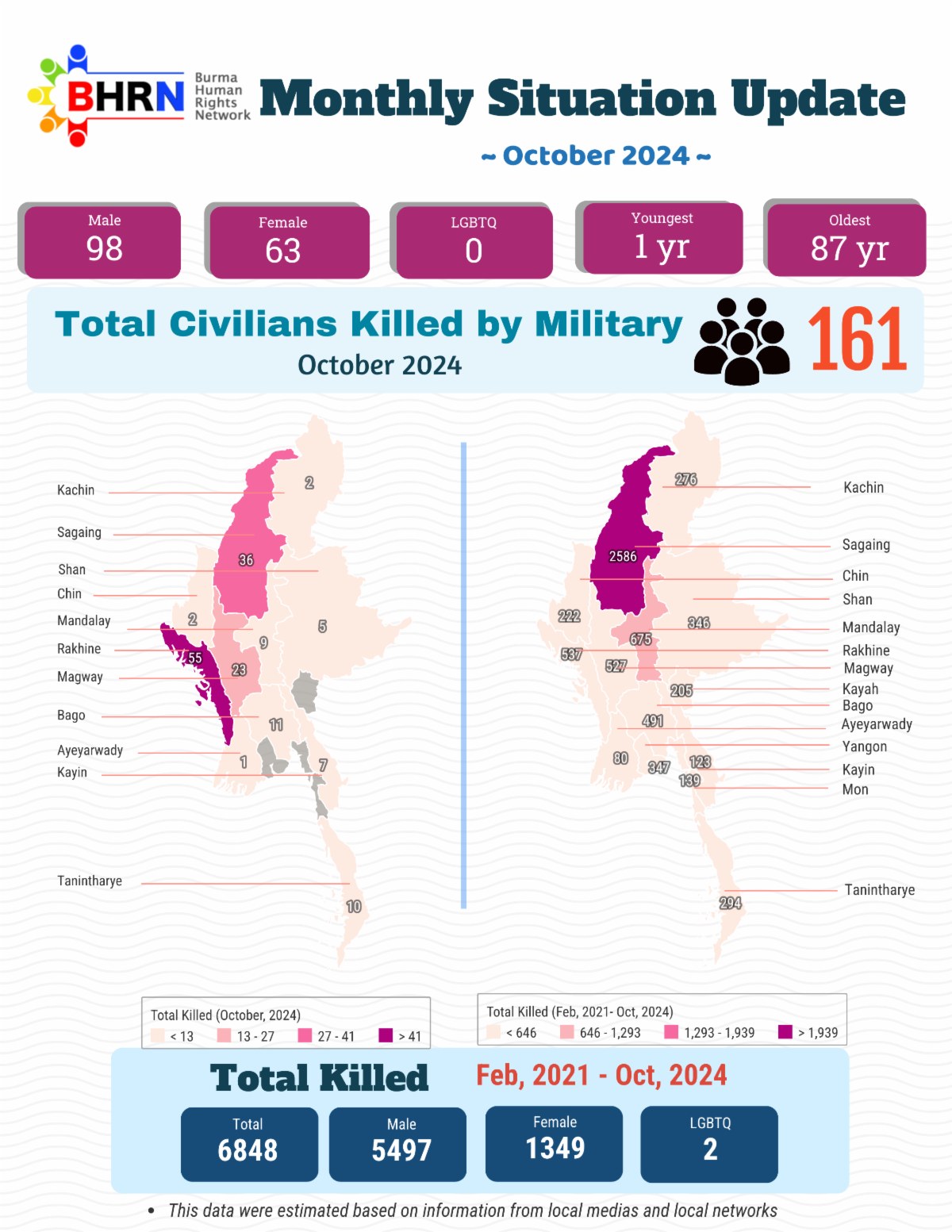

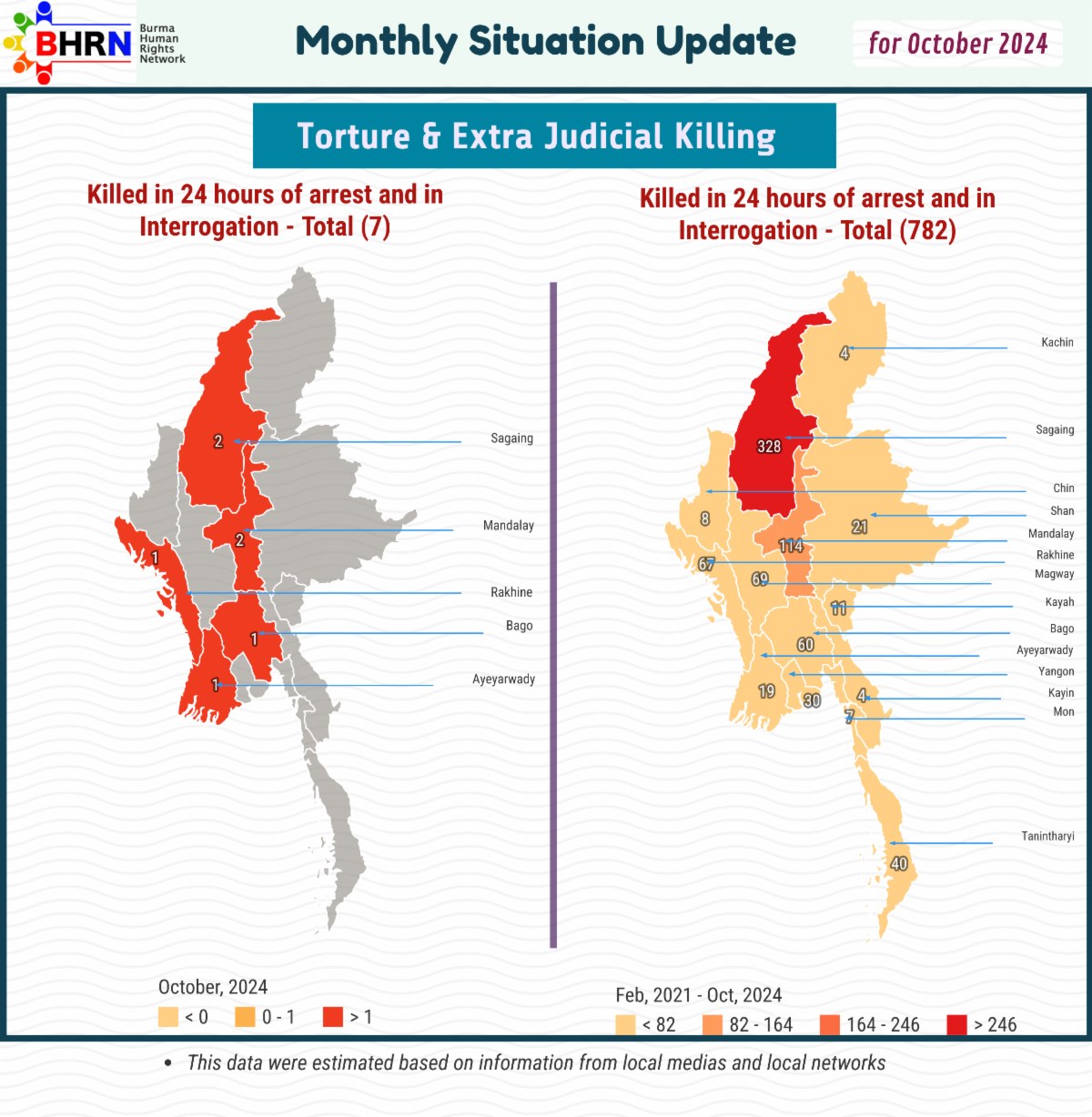

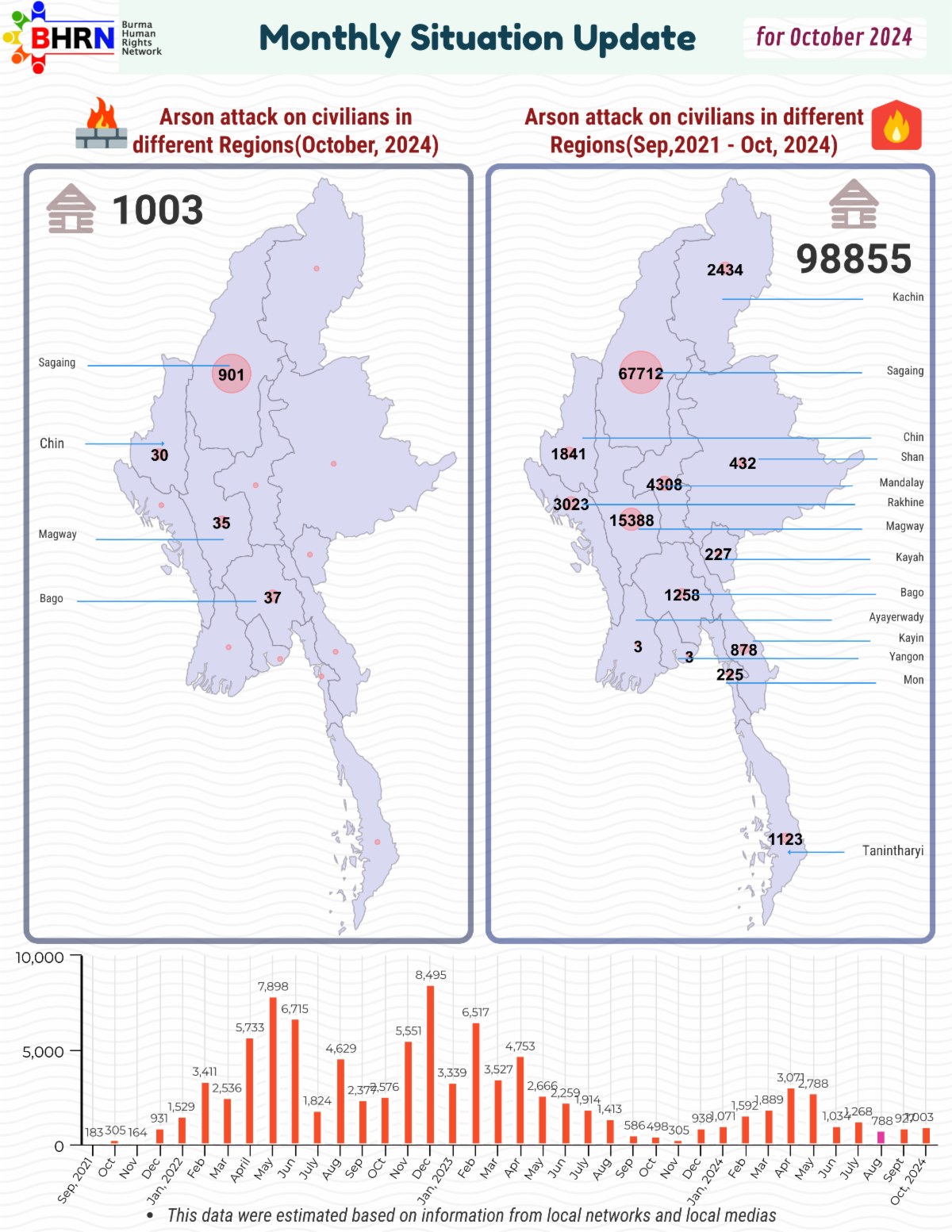
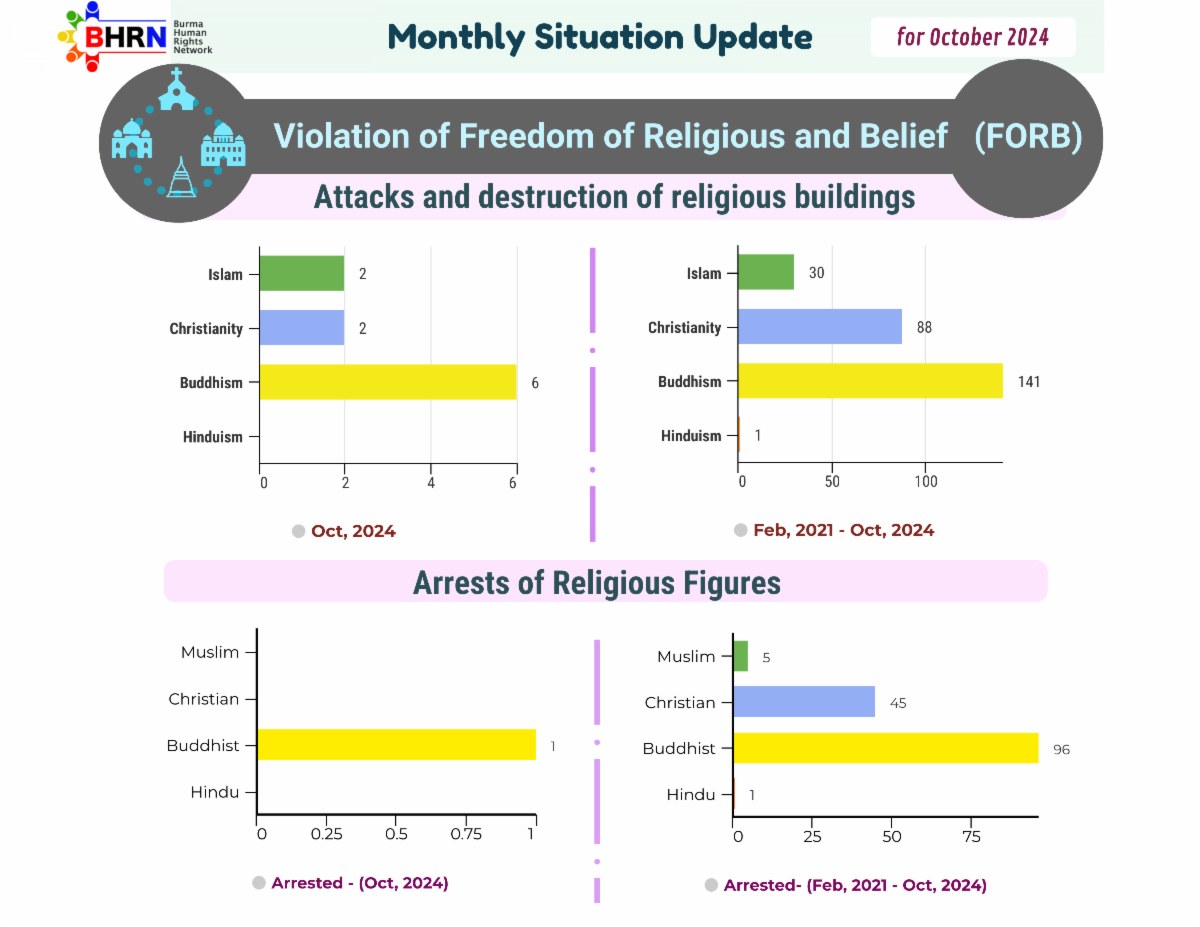
Tap any image to see it full size.
2News Summary and Analysis
o In recent weeks, the key highlights of events in Myanmar’s political conflict have been characterized by China’s ambivalent position. By not having a firm position either to push out the junta or to support it China exposed its weakness when it comes to its reliance on Myanmar for its strategic and economic reasons.
o Some ethnic groups, especially the Kachin Independence Army (KIA) and Arakan Army (AA) openly ignored China’s call to end their attacks against the junta. Also, ignorance of a call by Beijing to these groups to put an end to the conflict exposed the weakening of the influence of China on Myanmar’s internal dynamics.
o The junta has lost a major portion of its territory in Northern Shan State and Rakhine State, more recently in Kachin and Kayin states as well as in central Dry Zone areas, where a resistance group using their credential as Bama ethnic group is fighting the junta. It is a rare occurrence in the country, which was ruled by a junta with a mandate of enforcing Bama supremacy.
o It is of course not a rare occurrence in Myanmar that Muslims fight the regime for their religious identity. Several pro-Muslim groups fought the junta in Northern Rakhine State and a small number in Kayin State during the 1980s.
o In the current political climate, Muslims joined in a fight for democracy, federalism, and human rights along with Bama and other ethnic armies. They are fighting in unity under a broad umbrella of the People's Defence Force which operates under the command of the government in exile the National Unity Government (NUG).
o It is a rapid development in Myanmar in which Muslims joined the NUG politicians, who denied the Rohingya genocide only less than a decade ago. At one stage the NUG politicians, who were formerly with the government led by the National League for Democracy (NLD) even refused to accept the existence of Rohingya Muslims.
o These NUG politicians failed to support the persecuted Rohingya Muslim minority and condemn calls by ultra-nationalist Buddhists to exterminate Muslims from Myanmar. These incidents occurred from 2012 to 2021.
o Not only did the entire country fail to recognize the existence of Burma Muslims but it also refused to accept historical facts that Burma Muslims were part of the political evaluation of Myanmar and they were part of the country’s struggle for independence from the British in the 1930s and 1940s.
o Today, NUG proudly said it supports the Muslim company fighting alongside the Kayin National Union (KNU). The Muslim battalion is called the 3rd Company of Brigade 4 in the KNU operating in the southern Tanintharyi Region.
o It is not only the pro-Bama politicians but also the majority of the people in Burma including the ethnic minority, who are unwilling to grant equal rights to Muslims. So, the larger question now is whether Muslims will be part of a new political set-up in Myanmar in the future. Or will they be discarded again when they are no longer needed as was the case in the past?
o It is an obvious fact that no nation can achieve its political goals without granting equal rights to the country’s minority community. So far there have been no questions raised to the NUG and ethnic armies which control many parts of the country, first, whether they still believe in the idea of federalism, and if yes what will be their position on the minority rights issues?
NUG’s policies
The majority of members of NUG are members of the NLD which won the elections in 2020. So, their support among the people of Myanmar has been high until now, even though NUG failed to win international recognition. The leadership of NUG is also well-accepted among the resistance forces fighting the regime.
However, if the NUG would like to win support from the ethnic armies, that are fighting the regime and those controlling the territory, they must be able to take the lead and must position themselves in rebuilding the country. However, even though it has existed for three years the NUG still has not made clear its vision for the members of the minority ethnic and religious groups in post-junta Myanmar.
Clearly, the status quo would not work. The key issue the NUG should have spelled out now is what type of federal model it would like to build in Myanmar and what the role of the ethnic and religious minority groups would be.
The most challenging aspect would be how NUG and other stakeholders in Myanmar envisage the role of Muslims in the future. It will be very challenging for NUG to grant a formidable role in the new administration in the country’s new structure. This is because the policy of discrimination against Muslims is not embedded in the policies of the military regime, it is well spread among the country’s non-Muslim population.
Any idea granting constitutional rights to Muslims will be very challenging for the majority of people of Myanmar to accept. The advocacy groups calling for the rights of Muslims are focusing on asking for accepting their identity in Myanmar and the role of Myanmar Muslims in the country’s political struggles. And they are focused on how Muslims could be accepted as full citizens of Myanmar. If there is no political autonomy for Muslims, it is likely that the rights of Muslims will be again violated.
Up to now, the groups working on the rights of Muslims in Myanmar have focused only on individual rights for the community, and their citizenship rights. They still do not offer any vision or policy on how Muslims can be part of Myanmar as an equal partner and how constitutional protection should be provided to them.
So far, in order to influence the Muslim communities, the junta has recruited a bunch of Muslim cronies who serve their interests, but these cronies have only interested in protecting and growing their wealth while some of them have political ambitions. Muslim youth and politicians who emerged as forces against the junta see them as traitors to anyone who collaborates with the junta. However, these Muslim youth and politician groups are also not recognized by NUG or any opposition groups as a representative of the Muslim community despite several Muslim youths sacrificing their lives for the revolution and the community is paying a heavy price for supporting NUG. It’s now a very crucial time for the Muslim groups fighting against the junta to collaborate among themselves if they wish to secure a sustainable outcome to ensure equal rights and dignity that the community deserves.
Test case of tolerance of Muslims under rebel control regions in Myanmar
One positive example emerged from the Northern Shan State, where the rebel group Myanmar National Democratic Alliance Army (MNDAA) which controls the provincial capital Lashio issued a statement after its control of the town in early August that it would end all practice of discrimination against Muslims and other minority groups.
However, a different type of picture is emerging from another rebel control area in Myanmar. In Rakhine State where an ethnic army the Arakan Army (AA), even though it said it is not in favour of discrimination against Muslims, however, there are reports of rights abuse against Muslims emerging. There are reports of arson attacks on Rohingya towns and villages, travel bans imposed on Rohingya in northern Rakhine State.
The AA leadership earlier said they would work on racial and religious harmony in Rakhine State, but practically it is creating challenges because AA’s main motive for its rebellion is to restore the rule of Rakhine people in the state. The majority of Rakhine people are Buddhist, and they see Rohingya Muslims as illegal immigrants from Bangladesh despite having irrefutable historical evidences.
The plight of Rohingya communities is going to be aggravated when more than Seven Hundred Thousand Rohingya Muslims were forced to flee to Bangladesh in 2017 and are to be repatriated to Rakhine State.
International relations
Amid these internal dynamics which indicate that Min Aung Hlaing’s junta is to fall soon, there are attempts by the junta to reach out to the international community as a way to salvage the regime. Since the middle of this month, the junta has been known to be rebuilding its internal machinery that will help to sell its plans to the regional and international community.
In recent months there was the UN Special Envoy was allowed to visit the country and a think tank led by former military intelligence officers, who are experts in international relations, has visited China to lobby for support for the embattled regime. After a secret meeting with the junta, the UN Special Envoy called for the end of violence in the country.
In the coming months, the junta will likely continue to promote its idea of organizing elections to the region and the wider international community, with the concept that the election would put an end to conflicts in the country.
It remains to be seen who will follow the junta’s hoax. Only a few people are likely to believe that free and transparent elections are possible under the current circumstances in the country.
In the past, the junta organized an election under pressure from China and the UN. The election held in 2010 paved the way for substantive reforms in the country which led to the election of the first civilian government in 2015.
The next step of engagement with the international community would be to allow the UN envoy or other international actors to grant access to pro-democracy leader Daw Aung San Suu Kyi. The international community is still not ready to formally engage with NUG and the groups fighting the regimes.
Observation and analysis
- The regional powers including China have increasingly expressed that they do not want the conflicting parties in Myanmar to continue the current trends of achieving a zero-sum game, instead to find a negotiated settlement to the political problems. At the same time, they still want to wait for a homegrown solution.
- But the junta that came to power illegally must take the first step when it comes to making political concessions. After his visit to Kungming China in early November Min Aune Hlaing may take steps that would lead to finding a political solution through dialogue among all stakeholders which China has been advocating for. The previous junta of Myanmar started rapprochement with the international community in the early 2000s, the steps they took at that time were to showcase to the outside world that it was promoting a home-grown political dialogue and try to find a way for national reconciliation.
- However, this time more far-reaching measures from the junta would be needed given its shaky political position domestically. There is a need to show its intent to find a solution by releasing political prisoners. The opposition groups should call for the establishment of an interim government to oversee the process of rewriting a new constitution under which new elections can be conducted.
- The key reason why the previous attempt to restore Myanmar failed was because the ethnic and religious minority groups in Myanmar were sidelined in the process.
- Given Muslims are among the most persecuted minority groups in the country, restoring their rights would be very crucial. The pro-Myanmar Muslim groups are calling only for the citizen rights of the Muslim community, but it may not be sufficient given the previous policy of discrimination not only by the junta but also by the majority of people in Myanmar to persecute Muslims.
- For that, the entire community must reign in on the ultra-nationalist monk groups who advocate against Muslims because of their faith. And Muslims should be granted protection under the new constitution and representation in the national parliament.
3Rohingya Issue
3.1Rohingya in Rakhine Updates
- 1 October
Government staff, primarily school teachers, have collected census data. During the first two days of October, census workers visited each IDP household individually. However, after that, the responsibility for collection shifted to IDP camp management committees and village administrators.
Source: BHRN - 5 October
The navy and military intercepted a human trafficking boat en route to Malaysia. The boat was carrying 364 people, including women. According to the victims, they had been held in private rooms located in front of Sittwe Prison. They were released on October 16th after being charged 200,000 MMK per person.
Source: BHRN - 7 October
A rebel group, the Arakan Army (AA) imposed a ban on Rohingya Muslims from using Bangladeshi SIM cards in Northern Rakhine State, which shares a land border with Bangladesh, a local source told an online news site the Arakan Express News (AEN). The AEN said the rebel group allowed the members of the other communities in the region to use Bangladeshi SIM. The military junta has severed all the communication links to Rakhine State, which saw an upsurge in fighting between AA and junta troops since last November. The AEN report said the AA allowed Rohingya Muslims in Buthitaung and Maungtaw townships in Northern Rakhine State to use mobile phones they provide at the call charge of up to Kyat 500 per minute.
Source: Arakan Express News - 11 October
A rebel group Arkan Army (AA) evicted Rohingya Muslims from their village in Buthitaung Township near the border with Bangladesh, a local online news site Arakan Express News (AEN) reported quoting a local source. The source said a group of AA soldiers evicted Rohingya Muslims from Maunggyi Taung village on 9 October. AEN reported that the evicted villagers were forced to stay without shelter along the bank of the May Yu River situated on the eastern side of Maunggyi Taung village from 9 to 11 November. The source told AEN that AA troops asked some of the stranded villagers to move to two villages Maung Hnama and Maunghnama Pale villages and they were forced to live in fields. AA took some of them to the northern parts of Maunggyi Taung village and they are held, AEN reported.
Source: Arakan Express News - 12 October
A rebel group the Arakan Army (AA) reportedly imposed tight rules on the residents of Buthitaung Township after its control of the town from the junta, a local source told Arakan Express News (AEN). AEN report said most of the residents of Buthitaung are Muslims and they are facing severe violations of human rights, worse than the rights situation when the town was under the junta. The AEN said its report is based on testimonies from several dozen of Rohingya Muslims. It said the violation includes imposing a travel ban on Rohingya from traveling even to nearby villages. It said Rohingya Muslims are asked to apply for travel permits. One Rohingya Muslim said he was physically attacked recently by AA soldiers after they found him traveling without a travel permit.
Source: Arakan Express News - 12 October
A rebel group Arakan Army (AA) forced communities in Mrauk U, Kyauk Taw, and Myaypone Townships in Rakhine State including members of the Rohingya Muslim and Chin communities to join them in fighting against the military regime, a local source told Burma Human Rights Network (BHRN). He said at the same time AA imposed a severe travel restriction on Rohingya Muslims. The source said AA officials visited several places in the townships that are under their control and asked local communities to conscript forcibly. Under the mandatory conscription rule of AA 10 conscripts per 100 households must be provided. A source in Thantwe Township which is also under the control of AA said the rebel group is collecting underaged conscripts. The source said the quota for conscripts for Muslim villages is higher than that of non-Muslim villages.
Source: BHRN - 14 October
A rebel group the Arakan Army (AA) arrested more than 80 Rohingya Muslims who were repatriated by Bangladesh to Maungtaw Township in Northern Rakhine State, a local source said. The source said the repatriated Rohingya include children and elderly as well as sick people. A local source told an online news site, the Arakan Express News (AEN) that arrested Rohingya are not allowed to meet with their families. He said the repatriated Rohingya Muslims are held in Minglar Kinggyi and Paungzar camps near Myanmar Bangladesh border.
Source: Arakan Express News - 15 October
A rebel group Arakan Army (AA) is accused of committing torture of prisoners in Buthitaung prison in Northern Rakhine State, a former prisoner who was held in the prison told an online news site the Arakan Express News (AEN) that prisoners are dying in Buthitaung prison daily due to torture by AA troops. The source said he was held in prison and forced to work, and he added that prisoners are provided food only once in two days resulting in many prisoners being malnourished. Some local sources suggested that AA has at least 10 detention centres where the rebel group held Rohingya Muslims, he said. The source said among the detention centers run by AA the one in Buthitaung is the largest where about 10 000 prisoners are held in the prison.
Source: Arakan Express News - 19 October
At least six Rohingya Muslims were injured in an attack by the junta’s navy on a village in Southern parts of Maungtaw Township, which is situated on the border with Bangladesh, a local source said. He said two shells fired by the junta troops fell on Du Nayaung Bin Gyi village in which several houses were burned down in addition to human casualties. Among those injured was a civilian from Du Nayaung Bin Gyi village and five others from the nearby Kanyantan ward of Maungtaw. The source said among those injured in the attacks included internally displaced people.
Source: Narinjara - 21 October
Seven people from Bu May and Aung Mingla villages were arrested. They were accused of stealing chairs from Uddama Park and were taken into custody at the Sittwe police station.
Source: BHRN - 23 October
The Thai army arrested 13 Rohingya Muslims in Tak Province which border with Myanmar, a local source told Burma Human Rights Network (BHRN). The source said Rohingya Muslims who entered Thailand without permission were arrested during a patrol by Thai security forces in Phoe Pha township in Tak province. He said among the arrested Rohingya were six women. He said the Thai authorities are likely to take legal actions against 13 arrested Rohingya as well as the two drivers who were arrested together with them.
Source: BHRN - 26 October
The junta-appointed Immigration Minister Myint Kyine is forcing the Rohingya communities in Northern Rakhe State to take the Nationalities Verification Card (NVC). A source who joined a meeting organised by Myint Kyine on 22 October in Nay Pyi Taw said the immigration minister told his officials to force Rohingya Muslims to take up NVC cards. The NVC cards which are also known as “white cards” were first issued to Rohingya Muslims in June 2015, with a promise that those holding NVC would be granted citizenship in the future. However, a Rohingya source said even though he applied for citizenship after securing an NVC card five years ago, he has not heard anything back from the immigration ministry on his application.
Source: Arakan Express News - 31 October
The SAC implemented several restrictions following the AA offensive in Rakhine state. They blockaded all roads leading to Sittwe from other townships, canceled travel authorizations for INGOs, and restricted INGO/NGO access to IDP camps for activities other than food distribution and education. Additionally, healthcare providers have been unable to reach Rohingya IDP camps due to restrictions on INGO access. This has resulted in a lack of healthcare for Rohingya IDPs, forcing them to rely on expensive private clinics. Consequently, many IDPs are unable to seek medical attention when they are sick or ill.
Source: BHRN - 31 October
It was reported that Rohingya IDPs in Pauk Taw township have not received any support from INGOs or the WFP since the crackdown resumed. It is said that almost all of the IDPs are facing food shortages and are forced to consume unhygienic food, leading to illnesses such as diarrhea and skin infections.
Source: BHRN
| Items | Unit | Before November 13th | In October |
|---|---|---|---|
| Rice | 1 bag/ 48 to 50 kg | 65,000 MMK to 110,000 MMK | 125,000 MMK to 170,000 MMK |
| Onion | 1 viss | 32,00 MMK | 6,500 MMK |
| Cooking Oil | 1 litter | 4,500 MMK | 6,500 MMK |
| Petrol | 1 litter | 2,700 MMK | 20,000 MMK |
| Green Chilli | 1 viss | 4,000 MMK | 40,000 MMK |
3.2Rohingya in Bangladesh Camp
- 1 October
Entrance and exit were restricted through Kutupalong Camp 16’s main gate. Only a few emergency exit permits are allowed by APBn police upon family data card verification. A new checkpoint was set up on the Kutupalong-Ukhiya highway near the Bangladesh Army camp, blocking any detours used previously by refugees. Security forces conduct rigorous checks from 7:00 AM to 7:00 PM daily. Many Rohingya workers seeking jobs in Ukhiya and Court Bazaar are detained, made to stand in the sun for hours as punishment, and then sent back to the camps. One incident involved 70 laborers turning away, worsening their families' economic struggles.
Source: BHRN - 2 October
Around 2:50 PM, a gunfight broke out between RSO and ARSA in Block E2 of Camp 14. Stray bullets hit five Rohingya, including four boys (14-16 years old) on their way to school and a 35-year-old man returning from the market. A 15-year-old, Abdullah, died from abdominal wounds at the MSF hospital in Camp 15.
Source: BHRN - 2 October
UNHCR began registering new arrivals from Arakan State, displaced by the Rakhine extremist group Arakan Army (AA). As of October 14, UNHCR reported 32,275 individuals from 8,936 families registered, 36% requiring medical support and 17% with missing family members. Among them, 97% reside in camps with registered refugees.
Source: BHRN - 7 October
Clashes between ARSA and RSO in Camps 14 and 15 led to two civilian deaths and six injuries, with stray bullets hitting those in Camp 15. On October 8, UNHCR and WFP began distributing essential aid to new arrivals, including food, blankets, mats, cooking utensils, and water containers.
Source: BHRN - 9 October
An RSO member accidentally shot himself with his own firearm in Camp 4 while chasing a suspected ARSA member. The man was taken away by other RSO members, and his condition remains unknown.
Source: BHRN - 9 October
At 3 AM in Camp 13, RSO members and APBn police entered the home of Md Anuwar, 42, and killed him. Community members allege that while he was once a member of ARSA, he had ended his association with the group. His family seeks justice, blaming APBn police for preventing others from intervening.
Source: BHRN - 14 October
A 14 year-old-girl from Camp 4 was abducted by an unknown group while en route to Camp 20 hospital for medical treatment. Her family does not know what happened to her or her current condition.
Source: BHRN - 17 October
RSO members attacked Camp 15 residents from Camp 14 at 8 PM, killing four civilians and injuring twelve. The victims were hit by stray bullets during routine evening activities, and those wounded remain critical.
Source: BHRN - 18 October
A video surfaced online of a boat with 164 Rohingya stranded near Indonesia. Passengers report being adrift for ten days after departing Bangladesh for Malaysia on October 1st. Two women and a man died onboard. It is believed that they died from lack of food and water. Indonesian authorities eventually rescued the boat and allowed those onboard to disembark.
Source: BHRN - 20 October
RSO members killed three family members in Camp 19, including a woman and her father, in a targeted attack on ARSA commander Soyedul Amin.
Source: BHRN - 24 October
ARSA leader Ata Ullah Abu Amar released a video pledging continued resistance for Rohingya rights in Arakan and warning against alliances with other groups. In particular he said that Rohingya helping Arakan Army should not be considered Muslims and that they should not be given proper Islamic burials.
Source: BHRN - 27 October
: A young Rohingya man was kidnapped from Leda Camp, with kidnappers later demanding 200 lakh taka from his father, a religious scholar with limited means. After two days, they lowered the ransom to 20 lakh taka, which his family still could not afford, leaving his fate uncertain.
Source: BHRN - 31 October
A fire broke out at Noyapara Camp 26 around 3 PM, likely caused by an electrical spark, damaging eight shops, ten shelters, and a community office. A young boy sustained minor injuries before the fire was contained by residents and mobile fire units.
Source: BHRN
4Violations of Freedom of Religion and Belief
- 4 October
The junta troops targeted a historic Chinese shrine in an airstrike on Lashio in Northern Shan State on 4 October, according to a statement issued by a rebel group Myanmar National Democratic Alliance Army (MNDAA). Lashio is the capital of Northern Shan State which has been under the control of MNDAA since early August this year. The statement said an airstrike by the junta targeted more than a century-old Guanyin temple in Lashio, which is situated near Sino Myanmar border. It said the temple was badly damaged and several houses in the town were also destroyed in the attack.
Source: BHRN - 10 October
A nun was killed and other two civilians were injured in an air raid by the junta troops in Hsipaw township in Northern Shan State on 8 October, a statement issued by a rebel group Taung Palaung National Liberation Army (TNLA), which control the town said. The statement said the junta troops used its Y-12 fighter jet and dropped more than 60 explosives on the town. The rebel groups said most explosives were dropped on a monastery in Nangngon village near Hsipaw.
Source: BHRN - 12 October
The junta troops killed a monk and two other civilians in a village in Yesachyo Township in Magwe Region on 11 October, Radio Free Asia (RFA) reported quoting local sources. The report said the civilians were targeted in a raid by junta troops on Zegone village after a junta convoy was ambushed near the village. Another four civilians were abducted by the junta troops during the raid.
Source: RFA - 25 October
A monk was killed in a shelling by junta troops on a protected forest near Natogyi Township in Mandalay Region on 23 October, a local source told Burma Human Rights Network (BHRN). The source said the junta troops shelled the monastery in the historic city four times on that day and monks in the building had to evacuate.
Source: BHRN - 26 October
A monk was injured in an airstrike by the junta troops on a monastery in Thantwe Township in Rakhine State on 25 October, a local source told Burma Human Rights Network (BHRN). He said the head monk of the monastery Ashin Nya Ni was injured in the attack and the monastery was completely destroyed.
Source: BHRN - 27 October
The junta troops targeted a monastery in Thayat Chaung Township in Tanintharyi Region on 25 October, a local source told Burma Human Rights Network (BHRN). He said the main building of Thayahna Khwa village was destroyed in the attack. The source said the junta targeted the village with 60-millimetre heavy weapon shells. He said the junta targeted the village without having any active conflict in the area. No civilian casualty was reported in the attack, the source said.
Source: BHRN - 31 October
Several pagodas and monastery buildings in Lashio were destroyed in an air raid by junta troops on the town on 29 October, a statement issued by the Myanmar National Democratic Alliance Army (MNDAA), which controls the town said. The junta fighter jet targeted Ward No 1 Pagoda, also known as Sasana 2500 Pagoda using heavy bombs, the source said. He said there were no civilian casualties in the attack as the place was evacuated earlier. The junta has been conducting a relentless airstrike on Lashio since the town was seized by MNDAA in early August this year.
Source: BHRN - 30 October
A church was destroyed in an airstrike by the junta troops on a village in Khin-U Township in Sagaing Region, a local source said. He said the fighter dropped two bombs on the church Mone Hla Model Village in which the roof and exterior part of the church were destroyed. In a separate incident 37 civilians including three women were abducted in nearby two villages by pro-junta forces led by a monk Wathawa, who led the militant group, the same source said. He said the civilians were abducted on suspicion of having links with a civilian resistance group, the People Defence Force (PDF).
Source: RFA
5Human Rights Violations
5.1Rape as War Crime (Committed by Junta Troops)
- 28 October
The junta troops sexually assaulted a 56-year-old woman in a village in Pinlaung Township in Southern Shan State on 26 October, a local source said. He said the incident took place in Naungwoe Chaung Char village in which two soldiers attacked the unnamed woman, the source said. He added that two soldiers were involved in the attack. He said the woman was assaulted after she was tied up to a tree. The source said the two soldiers fled the area after the attack. A women rights activist belonging to the Pa O ethnic group said the armed groups should end targeting women and using them as a weapon of war in the conflict areas. There has been an ongoing conflict near Naungwoe village for the past eight months involving the junta troops and a rebel group Kayanni Resistance group.
Source: DVB
5.2Extra Judicial Punishment
5.2.1Arbitrary arrests and imprisonment
- 11 October
The junta troops arrested 7 civilians in Kalay Township in Sagaing Region on 8 October, a local source told Burma Human Rights Network (BHRN). He said they were arrested near an industrial zone in Kalay Township. The source said the arrest followed an attack on a bridge in the area, adding that the arrest could be connected to the incident.
Source: BHRN - 14 October
The junta troops arrested 20 civilians in a village in Okpo Township in Bago Region on 13 October, a spokesperson of local resistance group Hero Guerrilla told Burma Human Rights Network (BHRN). He said the civilians working near a hospital in Waing Ywa village were arrested without an apparent reason. The source said the arrested civilians are held in a local police station.
Source: BHRN - 21 October
The junta troops arrested a group of 5 civilians in the provincial capital of Ayeyarwady Region Pathein on 21 October, a local source said. He said they were arrested on their way back to their homes after joining a festival of light celebration. The source said the group could be arrested on suspicion of traveling during nighttime.
Source: DVB - 25 October
The junta troops raided a village in Okpo Township in Bago Region on 23 October, a member of a local defence force told Burma Human Rights Network (BHRN). The source said the junta troops had taken away six women in the village. He said they are expected to be used as human shields. The source said the soldiers are from the Light Infantry Division 6 under No 66 Command.
Source: BHRN - 25 October
The junta announced that it arrested a relative of a former military dictator Than Shwe on 23 October. The arrest of Dr Nay Soe Maung, who is a son-in-law of Than Shwe followed a post on his Facebook page in which he praised a Vice Chair of the National League for Democracy (NLD) Dr Zaw Myint Maung, who recently passed away in early October. Dr Nay Soe Maung participated in Dr Zaw Myint Maung’s funeral. The veteran NLD leader passed away only hours after the junta released him from a jail in Mandalay. The NLD politician was arrested shortly after the military coup in 2021, even though he was taking treatment for his cancer condition.
Source: BHRN - 26 October
The junta troops burned 4 civilians alive in a village in Htilin Township in Magwe Region on 22 October, a local source said. He said the junta troops committed brutal crimes in a raid on Kya Khae village in Htilin township. The source said the junta troops targeted other civilians during the raid in which one woman was injured. The source said three civilians were abducted when they left the town.
Source: Irrawaddy - 31 October
The junta arrested a man of Indian origin in Yangon after he criticized a movie which was based on the story of a family in a Hindu-majority village in Myanmar. U Shine Htet Aung (a.k.a) Vithal Kumar, who is in his 30s and a resident of Hlaing Township in Yangon was arrested after he criticized a Myanmar language movie “Jitcar Seebuthalar Jarkit Sarbuthree” ( in a loose translation “Have you ever had a ride on a Jeep”) in a post on social media site Facebook. Mr Kumar in his social media post said the movie includes derogatory remarks against the members of the minority Indian community in Myanmar. He was arrested on 27 October in Yangon’s Mayangone Township. Mr Kumar became the first social media user to be arrested for criticizing a movie. During nearly the past 4 years since the military coup there have been several social media users arrested mainly for criticizing the junta, the source said.
Source: Myanmar Now
5.3Extra Judicial Killings and Enforced Disappearances
- 2 October
At least 18 students and staff of the education department were killed in a series of attacks by the junta troops on schools in Kayah State, the Kayah State Interim Administration Council (IEC) said in a report published on 30 September. The report said the attacks include airstrikes and shelling using heavy weapons on schools and educational facilities since the military coup in February 2021. A spokesperson of IEC Maw Mimar said the junta troops targeted at least 12 schools during the same period in Kayah State.
Source: RFA - 5 October
A junta officer killed a 60-year-old trishaw driver in Min Hla Township, in Bago Region on 29 September, a local source told Burma Human Rights Network (BHRN). The source said U Than Aung was beaten to death after he was involved in a brawl with a fellow trishaw driver in front of the General Administration Department of Min Hla Township, where the junta troops are based. Captain Ah Kar Soe arrested U Than Aung as he was accused of cursing the troops during the brawl with another trishaw driver. He was dragged into the office by Captain Ah Kar Soe and U Than Aung was physically abused during the interrogation. The source said the officer hit his feet and put a hot iron to burn his body. The source said his family was forced to sign a letter saying that U Than Aung died due to high blood pressure, not due to injuries sustained during the interrogation, the source said adding that the family was given Kyat 2 million not to report the matter to the police.
Source: BHRN - 6 October
The junta troops killed at least 63 women in September this year majority of whom perished during airstrikes conducted by the junta troops, a statement issued by a civil society group the Burmese Women’s Union. The statement said most killings took place in Sagaing, Magwe and Mandalay regions which are situated in the central Myanmar dry zone region. The statement said up to 44 people were killed due to airstrikes during the month. Other women were either killed or died due to atrocities committed by the junta troops, the statement said. It said two women were killed in drone attacks, two were burned alive and one died after she was denied the right to take medical treatment. In terms of geographical location, 21 women were killed in Shan State and 15 in Mandalay Region, the group said in the statement.
Source: BHRN - 6 October
An independent think tank said at least 60 incidents of mass killings each involving five or more civilians were reported during May and August this year. The Nyan Linn Thit Research group said in a report issued on 1 October that mass killings were reported in 35 townships across Myanmar and 705 people were killed in these attacks. The report said more than 93 percent of the number of attacks were carried out by the junta troops and the perpetrators of other attacks were not known. The report said the junta troops are involved in 56 attacks in which 643 people were killed and other 62 people were killed by other groups. The report said the junta committed these mass killings in the areas where there was no active conflict and most of the deaths were caused by airstrikes and shillings using heavy weapons and during raids on villages across the country.
Source: RFA - 7 October
More than 200 civilians were killed in a series of air raids by the junta troops across the country during September this year, an advocacy group Blood Money Campaign said in a statement issued on 7 October. The group said 217 civilians were killed in the air raid during the month in more than 350 air raids in Shan, Rakhine, Chin, Kachin, and Kayah states as well as in Mandalay, Sagaing, Magwe and Bago regions, which were carried out by the junta. The group said several civilians were also killed in 31 drone attacks in Bago and Tanintharyi regions. Blood Money Campaign said among those deaths in drone attacks were 15 children and 48 women. It said 327 other civilians were injured in these attacks.
Source: BHRN - 12 October
At least 12 internally displaced people (IDPs) were killed in a series of air raids on a village in Madaya Township in Mandalay Region on 11 October, a spokesperson of People Defence Force Mandalay (MDY-PDF) said. The group said the attacks were carried out at Waw Su IDP camp in Maddaya Township, in which innocent people and monks were killed.
Source: BHRN - 12 October
The junta troops killed a family of five in Butalin Township in Sagaing Region on 12 October, a local source told Burma Human Rights Network (BHRN). The source said the family was killed when the junta troops raided a grocery store in Bandula ward of Butalin Township, which was owned by the deceased family. The source said among the deaths included a 7-year-old child from the same family. The killings come as the junta troops from its Northeastern Command raided the village, the source said. He said the junta troops ransacked the village and abducted civilians in their raid.
Source: BHRN - 20 October
Six beheaded bodies of civilians who were allegedly killed by the junta troops were found in a village in Butalin Township in Sagaing Region on 11 October, a local news agency Upper Burma News Agency reported. It said the bodies were found in Parsi village after the junta troops ransacked the village. The source said most of those brutally killed were men in their 50s and also included an 80-year-old elderly person. The source said that those killed also included a mentally retarded person and an assistant of a monk. The troops which raided Parsi village were also accused of killing an additional three civilians in the raid.
Source: BHRN - 23 October
The junta troops killed at least 5 civilians in a series of raids on a village in Longllone village in Tanintharyi Region from 12 to 19 October, a spokesperson for a local advocacy group Dawei District pro-Democracy Strike Committee told Radio Fre Asia (RFA) on 23 October. The source said those who were killed were from Aukphyu and Kadat Ngay Htein villages in Long Lone township, RFA reported.
Source: RFA - 30 October
The junta troops shot dead 4 people including a mentally retarded youth in a village in Gyobin Kauk Township in Bago Region, a local source told Burma Human Rights Network (BHRN). The source said 22-year-old Maung Sithu, son of U Win Oo who was mentally retarded, and a 17-year-old minor were among those who were killed. The source said the civilians were killed during a raid by the junta troops on Kwin Chaung village in Gyobin Kauk Township on 25 October. The raids took place after the junta troops came under attack by the local resistance groups near the village, the source said. He said they raided Kwin Chaung and three other villages in the town after the attack, in which the junta suffered casualties. The source said the bodies of the 4 people still could not recover due to ongoing conflict. He said the junta is committing atrocities on the civilians in the villages to get information on the activities of the resistance groups.
Source: BHRN
5.4Violence attacks by pro-junta thugs
- 1 October
The junta officials are involved in forcing youths in Thoneze Township in Bago Region to join the military, under a mandatory conscription law enacted by the junta earlier this year a local source told Burma Human Rights Network (BHRN). He said they are forcing the communities to pay bribes to be exempted from joining the military service. Also, they arrested those who refused to join, the source said. He said the junta officials asked for bribes up to Kyat 3 million from the families of the youths who refused to join the raffle they organised to select conscripts. The source said the junta officials involved in forcing the civilians is Tun Tun Win who is a local administrator of Latpan Khone village in Thoneze township, he added that they are supported by members of the pro-junta militant group, Pyu Saw Htee Than Htun Win, Naing Tun, Myint Zaw, Win Tin, Aye Min and Win Than.
Source: BHRN - 8 October
The junta-appointed officials in Myeik Township in Tanintharyi Region are accused of forcing local youth to join the military and asking for bribes from those who refused to join, a local source told Burma Human Rights Network (BHRN). The source said a local junta official Aung San Lwin has visited Pathaung, Shan Taung, Taung Pale and Tatlet Nge villages in Myeik Township to force youths to join the military. The source said Aung San Lwin asked local communities to encourage other civilians in the region to join the military, the source said.
Source: DVB - 8 October
A pro-junta militant group Pyu Saw Htee has abducted 5 women in a village in Myaing Township in Magwe Region on 7 October, a local source said. The source said the women who are aged between 25 and 50 were arrested while they were working in the fields, near Lat Htoke Taw village in Myine Township. He said they were taken to a nearby Kani village. The arrest comes as Pyu Saw Htee are facing a shortage of food due to a blockade imposed on their villages by PDF troops, the source said.
Source: BHRN - 14 October
Members of a pro-junta group Pyu Saw Htee killed two civilians in Tamu Township on Myanmar India border on 12 October, a local source told Burma Human Rights Network (BHRN). He said the body of one man and a woman was abandoned on the street after the killing. He said a faction of Pyu Saw Htee under the leadership of a painter Chan Myae was responsible for the killing. However, the motive of the killing was still unknown, the source said.
Source: BHRN - 21 October
A civilian was severely injured in an attack by the junta troops and the members of a pro-junta militant group Pyu Saw Htee in a village in Magwe Township in Magwe Region on 14 October, Yangon Khit Thit Media reported. The report said U Tin Shein was shot in his feet 7 times by the junta troops after he was involved in an argument with the Pyu Saw Htee and junta-appointed local officials over his power bill. It said the head of 100 households in the village Tin Shein Pu and Pyu Saw Htee head Thet Khaing were involved in an argument with the victim. It said the Pyu Saw Htee troops asked the junta troops based in the village to attack U Tin Shein. The report said the injured civilian was left alone on the road and his attackers spread false news that he was attacked by the pro-democracy People's Defence Force (PDF).
Source: Khit Thit Media - 26 October
The members of a pro-junta militant group Pyu Saw Htee looted a shop and killed its owner in a village in Myingyan Township in Mandalay Region on 24 October, a local source said. He said a faction of Pyu Saw Htee headed by a woman named Thida Yu Mon has raided the shop of Daw Pyone Kyi in Kuywa village. The source said six members of Pyu Saw Htee were involved in the raid at the time Daw Pyone Kyi was alone in the shop. He said a 56-year-old shop owner was killed in the attack. He said her body was taken away by the junta troops.
Source: DVB
About BHRN
Burma Human Rights Network (BHRN) is based in London, operates across Burma/Myanmar and works for human rights, minority rights and religious freedom in Burma. BHRN has played a crucial role in advocating for human rights and religious freedom with politicians and world leaders.