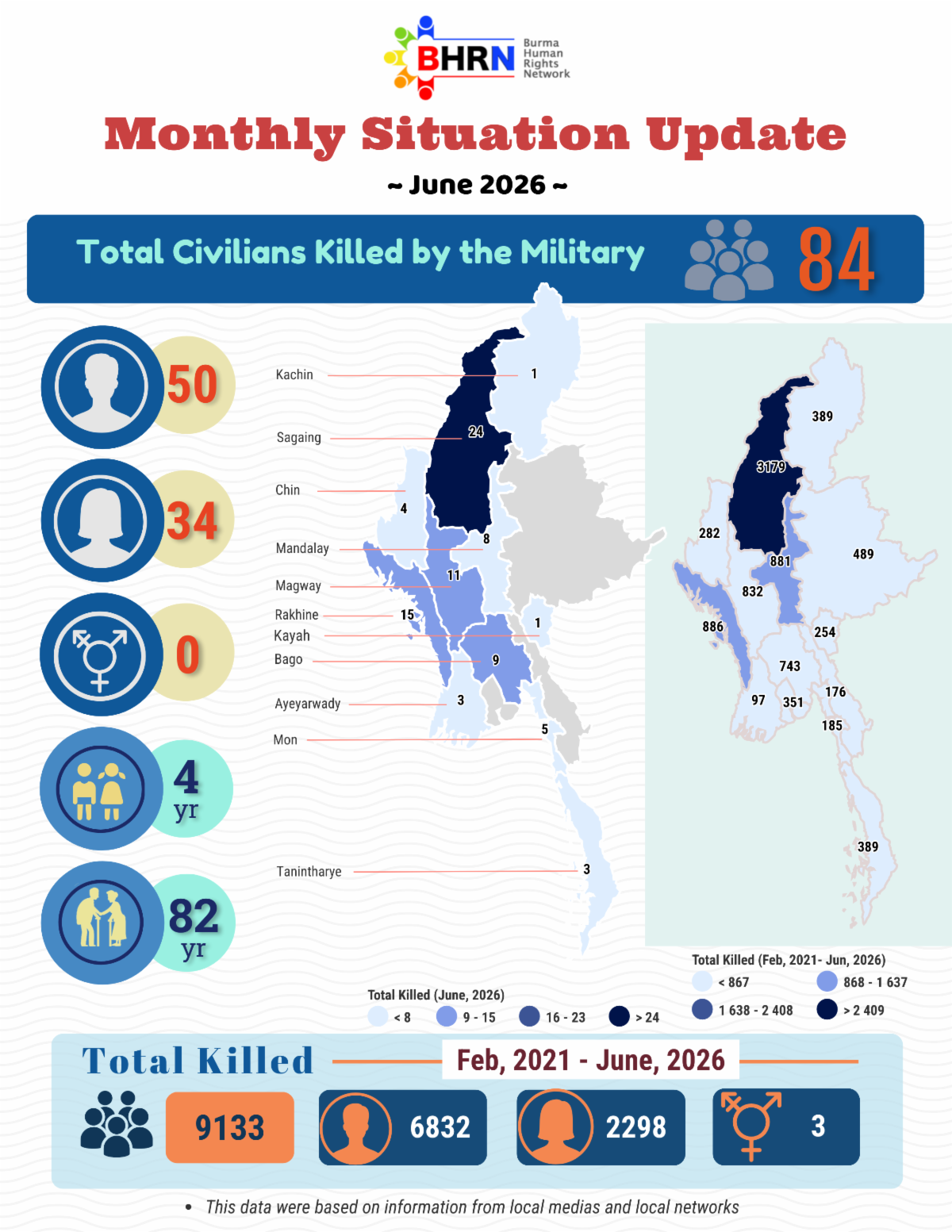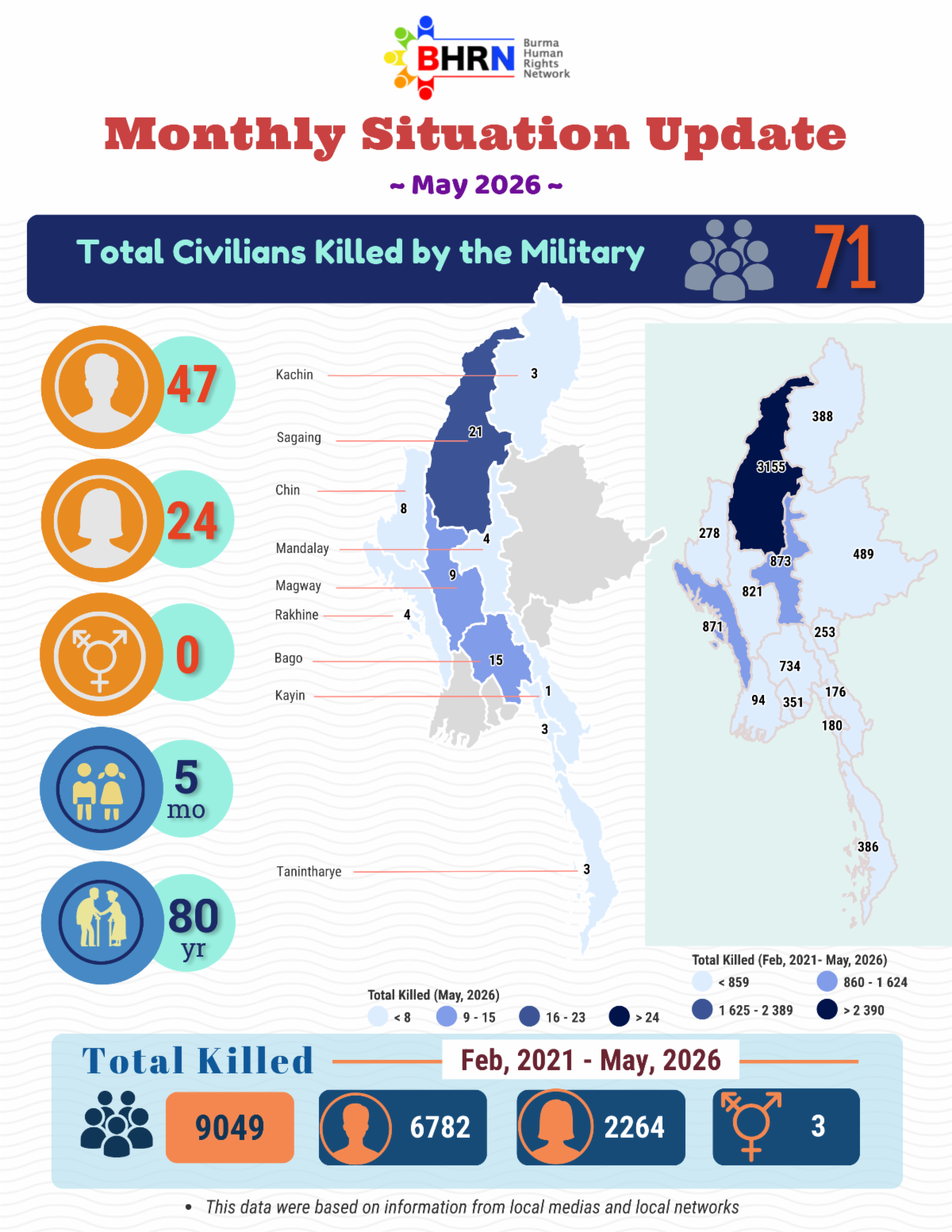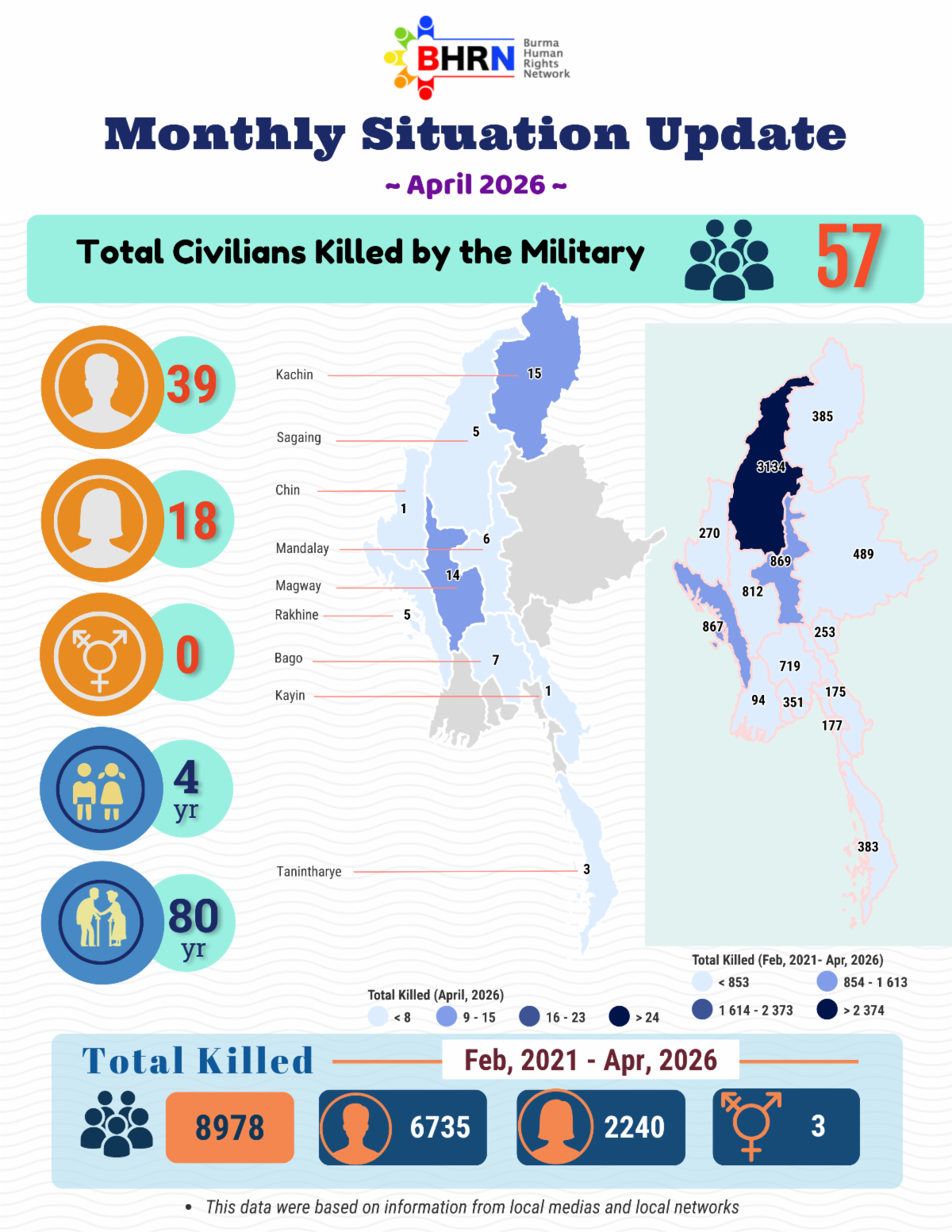

Methodology
Information in this document has been gathered by the BHRN team by primary and secondary research methods. We employed local researchers and local informers across Burma including in Rakhine State, Thai-Burma border and the Bangladesh border monitoring, investigating and documenting incidents of human rights violations. Any information we receive is carefully checked for credibility and authenticity by experienced senior research officers in the organisation. Once the information is approved the editorial team prepares the final document.
1Info-graphs of BHRN’s Report

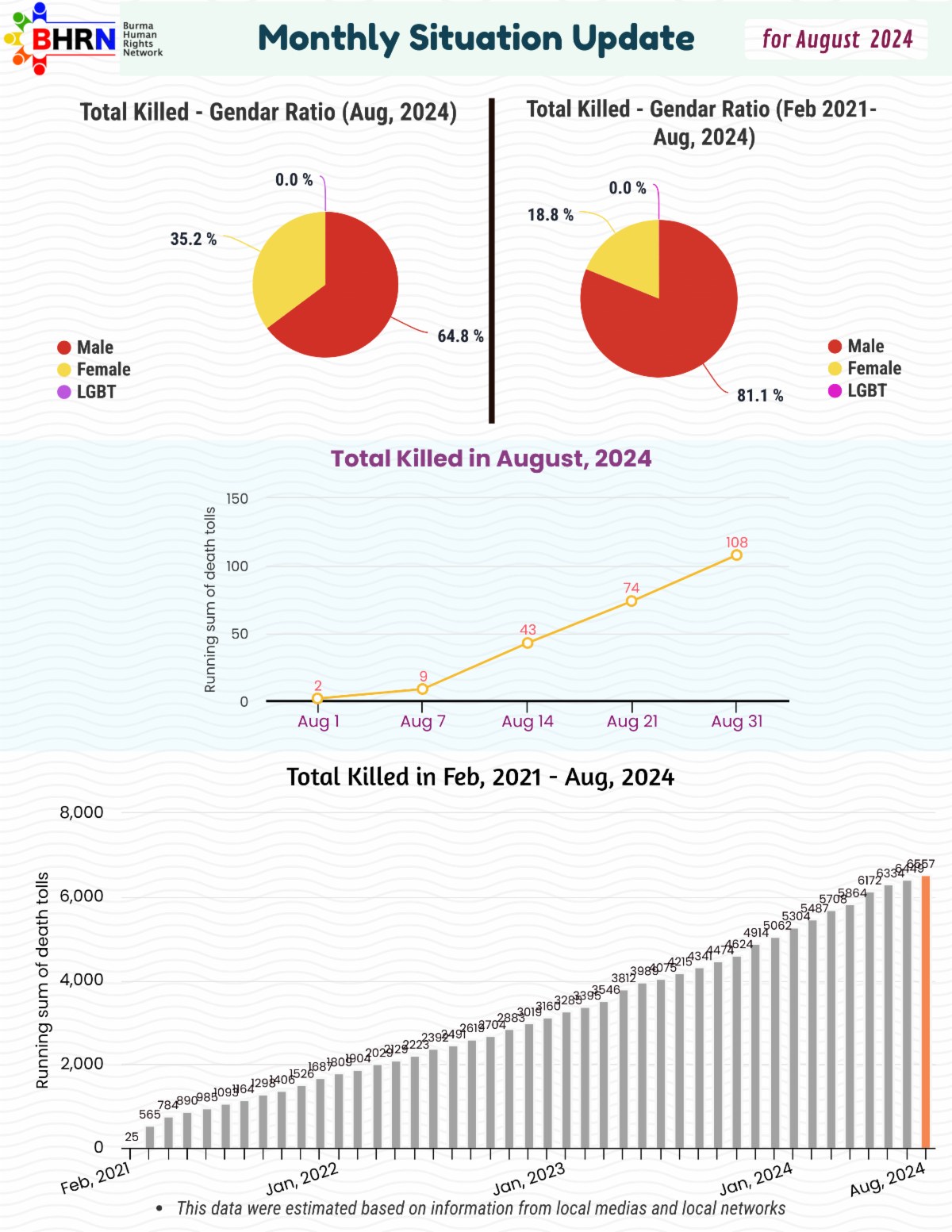
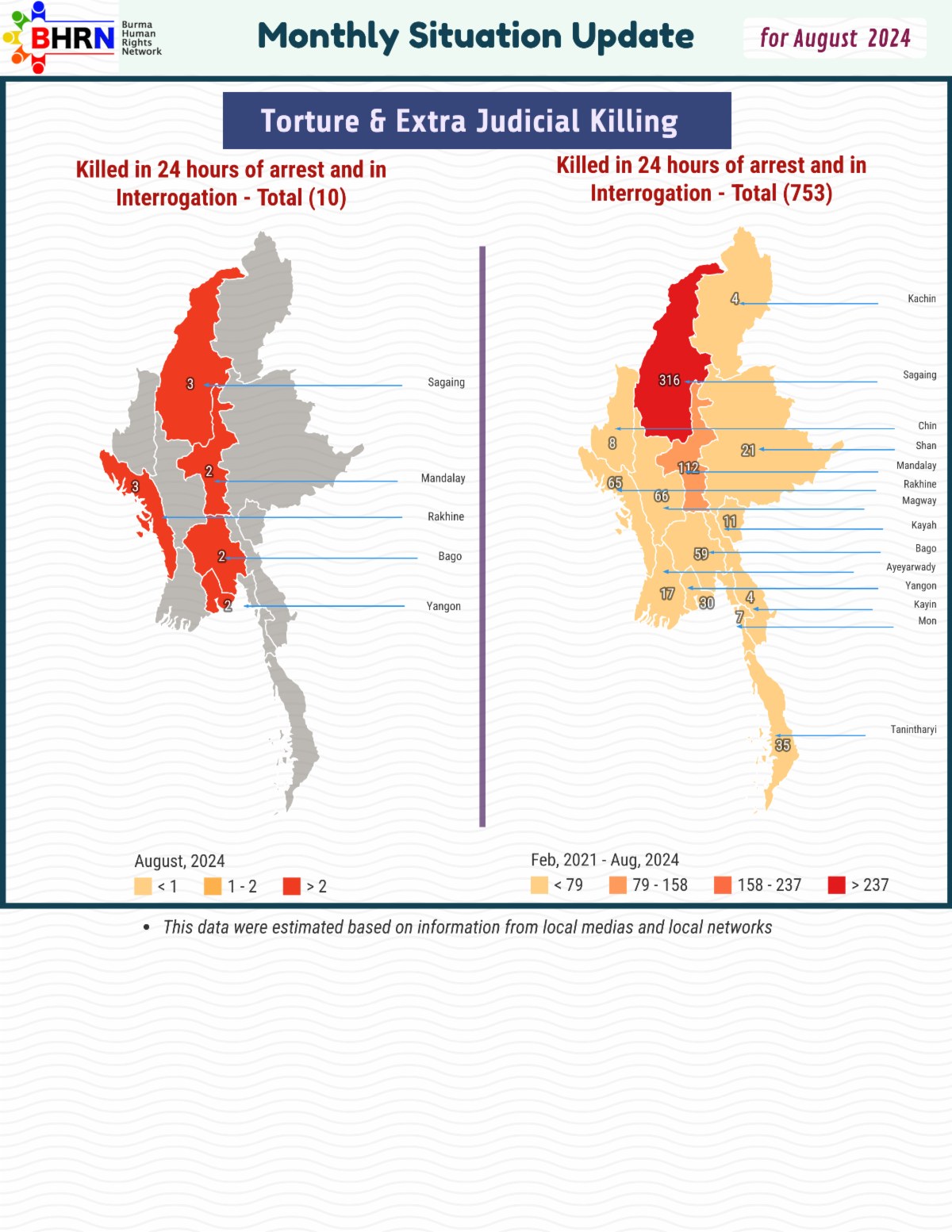

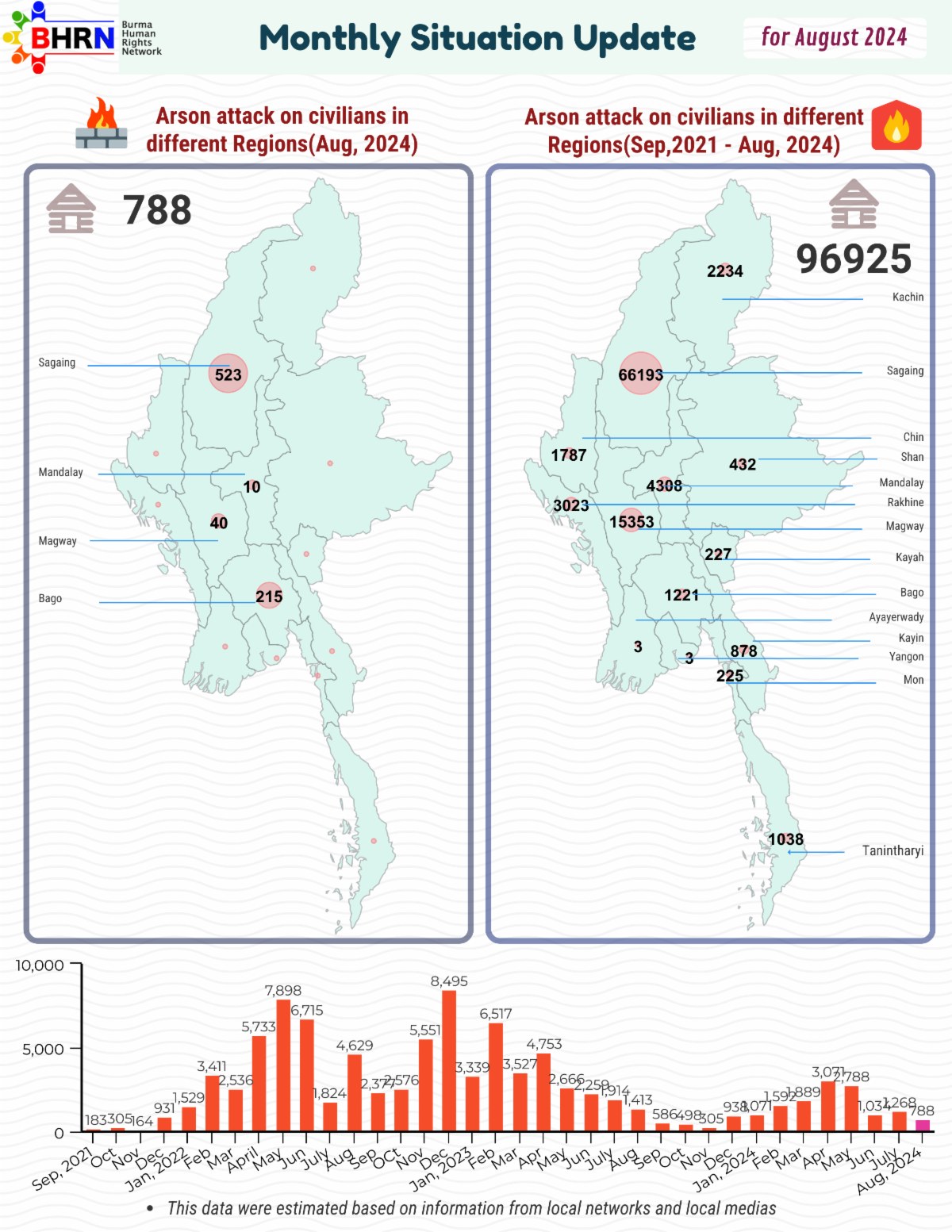
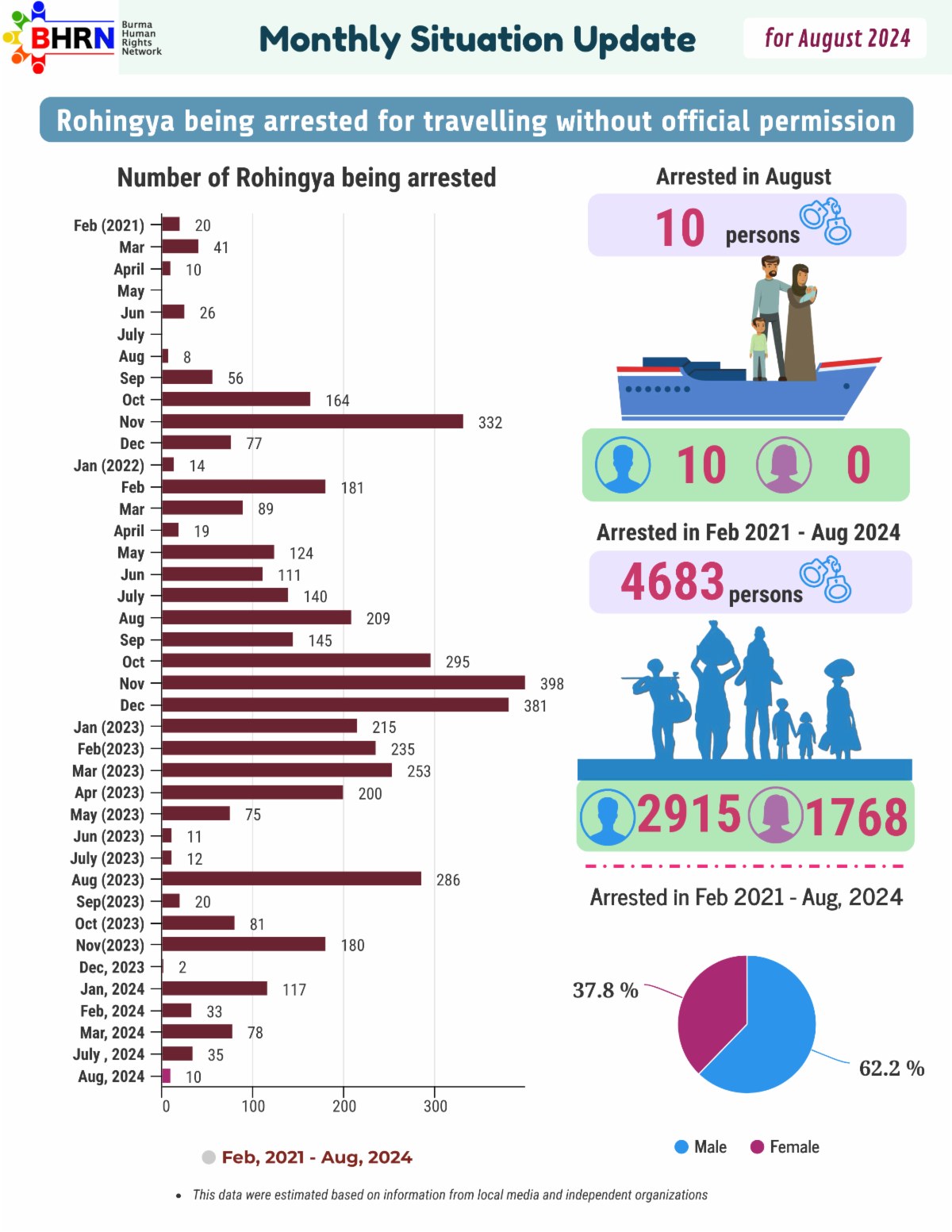

Tap any image to see it full size.
2Analysis
Background
- The continuing loss of territory by the junta troops during this month (in August) left the junta only in full control of the Yangon Region and its main base, the Special Administrative Area Nay Pyi Taw. The junta lost full control of all other States/regions in the country. In the ethnic areas, the junta today controls the Southern Shan State, as well as some parts of the Kayin and Kachin states, these positions are likely to be untenable for the junta to maintain control as they are circled by the joint forces of the ethnic armies and the people defence forces (PDF).
- Myanmar is today controlled by 21 different groups; the junta is one of them which itself controls only about 25 per cent of the country’s territory. The second largest city in the Country Mandalay is likely to come under attacks by anti-junta groups in the coming weeks. If it loses the seat of the former Burmese king, the junta is to face a strong repudiation of the junta from the nationalist monks who are the regime's key supporters.
- The 21 groups that currently control Myanmar have diverse issues and interests which they are fighting for, the only palatable common ground they have is to transform Myanmar into a federal democratic union without any role for the junta in it. However, judging from the position each of these groups stands for it is expected that it take years if not decades for these groups to reach a common solution.
- Among all the conflicts that are currently happening in the country, the situation in Rakhine and Northern Shan seems to be the most severe and complex.
- In Rakhine, the rebel group fighting the regime there, the Arakan Army (AA) has made significant gains in territories in recent weeks. The junta currently control only two key cities in the state, they are the provincial capital Sittwe and the coastal town of Kyaukphyu after AA took control of the Muslim-majority Northern Rakhine State and the resort town of Thandwe, during a series of attacks against the junta troops in August.
- Even though the territorial gains are widely welcomed by the people of Myanmar, however, the AA is going to be under scrutiny on how it will administer the region without the support of the entire people of the state and by neighbouring countries like Bangladesh and India.
- Also, questions are likely to be raised on how it will treat Muslims in the region and to which extent it could provide protection to the Chinese investments in the state. These will be the key factors that will determine if the AA can maintain its control over the state.
- In Northern Shan State, the two groups which mainly control the region are the Myanmar National Democratic Alliance Army (MNDAA) led by the Kokang ethnic group and the Tang Palaung Liberation Army (TNLA) they are part of the Three Brotherhood Alliance, which mostly operate with the instruction from China. The third group in the alliance is AA.
- China wants these groups to control some parts of the country to put pressure on the regime in Nay Pyi Taw to put the country back on the path of democracy. However, at the same time, Beijing did not want the regime to totally collapse to avoid creating a power vacuum in Myanmar. The approach taken by China during a visit of its Foreign Minister Wang Yi to Nay Pyi Taw in August to promote Beijing's cautious approach in choosing side in the conflict in Myanmar was rejected by all the stakeholders in the country.
- Against the backdrop of these developments, one scenario which is worth noting is the possibility of pro-Bama groups once again controlling in reshaping the country's future. Such a development would be disastrous for the entire country. It was evident that such an approach did not work when the country's political future was decided before the country gained independence from Britain in the late 1940s. The approach of a Bama-dominated rule that was created at the time of the country’s independence is a prelude to the civil war that has been endured in Burma for nearly eight decades.
- This should be a lesson learned for all stakeholders that in the current crisis the stakeholders should not allow a group like the National Unity Government (NUG), which is dominated by pro-Burma ideologies, even though some of its leaders are the members of the ethnic groups, to dominate the process.
Update of the key developments
In early August the junta’s key base which has existed for more than 50 years to control the Northern Shan hill area had fallen to the hands of the MNDAA troops. Tens of thousands of the junta troops in Northeastern Command based in Lashio had surrendered to the MNDAA. Never in the history of the Myanmar military history its regional headquarters fallen into the hands of the rebel group. Such a case did not happen even during the height of the Communist insurgency in the Northern Shan State during the 1960s and 1970s.
Since the taking control of the Northeastern Command and Lashio town[1], the comments made by the local residents to independent media tend to indicate that, even though MNDAA is not ideal in terms of civilian protection and providing an effective administration, however, they said current conditions under MNDAA are far better than at the time when the town was under the junta’s control.
Some major battles were fought in Rakhine State as well during the month of August and the rebel group there AA has made significant gains of territory including taking over a key tourist town of Thandwe. After AA took control of the town one of the first moves was to release the political prisoners the junta held in the prison in the town in very inhumane conditions[2].
The month of August also saw AA making an advance to the Northern Rakhine State close to the border with Bangladesh, where AA faced criticisms over possible atrocities committed by the Rohingya communities in the area. The situation seems to be still very complicated to verify the actual situation. However, the International Crisis Group said in its report Breaking Away: The Battle for Myanmar’s Rakhine State published on 27 August, advised AA that “to foster stability, the Arakan Army should mend relations with the Rohingya, support an independent investigation of alleged abuses, and reach out to Dhaka and donors, which should find ways to work with the group on shared humanitarian and security objectives”.
Practically, it will be very challenging to foster unity and harmony among the members of the Rohingya and Rakhine Buddhist communities.
The developments in the Northern Shan and Rakhine States tend to indicate that the human rights situation of civilians has somewhat improved after the junta lost control of these areas. It would, however, be naïve to think that any administration that comes after the collapse of the current military regime will work in the interest of the civilians.
The elected government led by Daw Aung San Suu Kyi, failed to protect the civilians during its five-year terms in the government. Although the government that was in power from 2016-2021 has a limited mandate to address the rights situation for civilians, however, it failed even to condemn the acts of atrocities committed by the military regime, most notably committing genocide against the Rohingya Muslims by the Burmese Army in 2016 and 2017.
The policy of that government is mostly inherited by the government in exile of Myanmar, the NUG. The NUG issued a statement on 25 August, which marks the 5th anniversary of the massacre of Rohingya Muslims, which it failed to do so when it was in the government. The statement, however, did not say how it would be different from the previous regime in terms of the treatment of minority groups in the country, including Rohingya Muslims if it is back in power.
The NUG is also leading a successful military campaign against the regime forces through the People Defense Forces (PDF), which are fighting under its command. The PDF troops are a group of selfless youths fighting against the rights violations by the junta troops.
The PDFs are currently in control of most of the areas in Sagaing, Magwe and Mandalay regions. It also controls some pockets of territories in Western parts of Bago and a small area in the Ayeyarwady Region. Now, the PDF troops are engaging with the Three Brotherhood Alliance in attacking Mandalay City.
The human cost of the conflict in Myanmar
As the civil war raged in the different parts of the country the civilians were reeling with displacements, and shortage of food, fuel and medicine. The United Nations said in mid-August that an estimated 18.6 million people, including 6 million children, are displaced and they are in urgent need of humanitarian assistance.
As international financial sanctions take their toll on the junta’s foreign currency reserve there have been reports of the widespread scarcity of fuel and medicines across the country. To make matters worse, those who are seeking overseas employment face a severe restriction from the junta to leave the country. Especially, youths who are aged between 25 to 35 are barred from leaving the country. They face the looming threat of forced conscription.
In showing desperation over the foreign currency shortage the junta is to impose a mandatory 25 per cent income tax on the citizens working overseas.
Is Myanmar a failed state and moving toward a total collapse?
A US-based NGO Funds for Peace (FFP) in its latest Global Fragile State Index released in August put Myanmar at the rank of 11, among Asian countries Myanmar rank 3rd after Syrian and Afghanistan.
FFP said the Fragile States Index is based on a conflict assessment framework that it developed nearly a quarter-century ago for assessing the vulnerability of states to collapse.
This index gives a very good indication that Myanmar is indeed fast moving toward total collapse. However, the regime in Nay Pyi Taw is still trying to pretend that the situation is normal and that it is in full control to retake the lost territory.
It even announces a plan to conduct a nationwide census toward the end of September this year. The regime head said the census is the first step to organising an election next year.
The junta plans these moves against the backdrop of the predictions in Myanmar that the regime may not survive until next year.
[1] https://www.frontiermyanmar.net/en/new-sheriffs-in-town-brotherhood-takes-charge/
[2] https://www.bnionline.net/en/news/aa-rescues-thandwe-prison-inmates-arakan-state
Observation and analysis
- The key highlight of this month is the failed diplomacy conducted by China, to seek the junta’s cooperation in organising an election and to open a political dialogue with the opposition forces. Such a notion attracted widespread criticism across all concerned parties to Myanmar politics.
- The most explicit rejection of China’s call comes from the NUG, which asked Beijing to stop supporting the regime and to avoid interference in the internal matters of the country. While the head of AA Tun Myat Naing said the call by China will not impact its plan to take over the entire Rakhine State.
- It will be interesting to note how NUG would like to position itself in the future political status. The worst thing that could happen to the process would be to allow the NUG to lead the process as it is a mainstream, pro-Bama political group.
- Although the possibility for such a scenario is less likely but cannot be completely ruled out. As the armed crisis continues and the rebel groups continue to take control of towns, there will be additional pressure on them to establish a stable administration. In that case, they could seek support from groups like NUG to provide support in civilian administration, which will lend NUG to take lead in the future political negotiations.
- It is evident that all parties are watching closely internal dynamics within the junta after the historic loss of a regional command under the watch of Min Aung Hlaing. At one stage during the month, there were rumours circulating in the country that the junta boss was removed from the position. However, subsequently, it was reported that the junta head had promoted some of his close colleagues to the rank of full General to appease them and prevent them from moving against him.
- One move Beijing may be considering is to seek if an interim government could be appointed to oversee the election. That could be one of the reasons why Wang Yi during his visit to Nay Pyi Taw met, the former junta head Than Shwe, who still seems to influence some of the current military leaders. However, Than Shwe knows his limitations and he is well aware that he and his family will likely end up the same as former dictator Ne Win if he tries to raise his profile. [1].
- The people of Myanmar believe that they will continue to suffer at the hands of the current regime until it is forcibly removed. Although the regime must go as soon as possible, the damage it has inflicted during the past three years is going to have a long-lasting impact on the country.
- To attain peace, stability, and economic prosperity in the post-junta era would very much depend on how the anti-junta group forged a political settlement. Some of the groups controlling large territories may not now agree to the federal structure that was discussed from 2012 to 2021. Some of them may be looking for a confederation model.
[1] Than Shwe arrested and jailed at least five family members of the former dictator Ne Win in 2021, and a few months later he died in disgrace. Ne Win ruled Burma for 26 years after he came to power in a military coup in 1962.
3Rohingya Issue
3.1Rohingya in Rakhine Updates
- 1 August
The military allows only ten fishing boats to fish at once, but the boats must pay half their earnings to the military in exchange for permission. People who bring fish to sell at the markets by crossing checkpoints have to give 5,000 kyats to 10,000 kyats to a checkpoint. Or the military sometimes takes fish instead of money.
Source: BHRN - 1 August
Since the Arakan Army launched the offensive in Rakhine state, the junta has not only blockaded all the roads to Sittwe from other townships but also canceled travel authorization for INGOs and restricted INGOs/NGOs from visiting and implementing projects in IDP camps except for food distribution and education. Since then, only one UN medical team car can visit the IDP camps. Furthermore, due to the restriction on INGOs going to Rohingya camps, healthcare providers cannot go to Rohingya IDPs. This has led to a lack of healthcare for Rohingya IDPs. The Rohingya IDPs have to go to private clinics, which are very expensive. Because of this, many IDPs do not see doctors if they feel sick or ill.
Source: BHRN - 2 August
There are a series of media reports emerging in recent weeks, which highlight the alleged atrocities being committed against Rohingya Muslim minorities by the members of a rebel group the Arakan Army (AA) in Northern Rakhine State. A local online news site Arakan Express News (AEN) reported that there is new evidence emerging to support the claim that AA was involved in committing atrocities against Rohingya Muslims during a recent fighting in Buthitaung town. Reuters news agency reported on the incident of abuse of Rohingya Muslims in Buthitaung, which purportedly happened on 17 and 18 May of this year, and it was found to be different from the account of an AA spokesperson Khaing Thu Kha, who earlier said those killed were members of extremist Rohingya groups operating in the region. The junta killed them as they tried to flee without permission. The AEN, which is seen as a pro-Rohingya news agency reported that the AA has attacked those who fled their homes to avoid the conflict. AEN said AA troops were involved in looting the properties of fleeing Rohingya Muslims and committed sexual violence on women. AEN said its report was based on the testimonies of the victims. AEN also reported that AA prohibits Rohingya Muslims living in the areas under their control from using mobile phones and imposed travel restrictions. It said AA banned the use of mobile phones to conceal the atrocities it committed against the members of the Rohingya Muslim communities.
Source: Arakan Express - 4 August
At least 4 Rohingya Muslims were swept away in a flash flood after heavy torrential rain in Mrauk U Township in Rakhine State, a local source told Burma Human Rights Network on 5 August. The source said those who died were from Pi Yin village in Mrauk U Township. The source said the number of people killed in the flood could be higher as the scale of the disaster was so severe. The flood followed a heavy downpour of rain across Rakhine State on the 2nd and 3rd of August, with similar incidents of flood reported in other parts of the state.
Source: BHRN - 4 August
A Rohingya Muslim student was shot dead in Maungtaw town on the Myanmar-Bangladesh border on 4 August, a news report said. The Arakan Express News reported that 22-year-old Alsalam Islam was shot dead near the clock tower situated in the centre of the town. AEN reported that the Border Guard Force of the junta army was responsible for the killing of Alsalam, who was a student at Sittwe University. AEN said the victim was in Maungtaw town to flee conflict in his village.
Source: Arakan Express - 5 August
Fighting between the Arakan Army and the Burmese military spilled over into attacks on Rohingya civilians by the Arakan Army in Maungdaw Township. Several eyewitnesses described how drones and artillery were used on their villages, civilians were shot point blank and killed, and fleeing Rohingya gathered together on the river bank were targeted with explosives. Locals estimate that hundreds of Rohingya have been killed in the fighting, and photos and video reviewed by BHRN show dozens of dead Rohingya along the Naf River bank. Many of those dead have visible wounds on their body consistent with the kinds of attacks survivors described, while others appeared to have drowned while fleeing the fighting. Thousands of Rohingya have fled to Bangladesh, but many are being detained by Bangladesh authorities and set back to Burma. The fighting and attacks on Rohingya have continued on through the duration of the month.
Source: BHRN - 9 August
The Military arrested 24 Rohingya from Aung Mingla village, including IDPs from Buthidaung, accusing them of violating Section 144, the article allowing authorities to issue curfews and restrict movement. They were detained near Sittwe prison. They were released on 24th August after being charged 650,000 MMK per person.
Source: BHRN - 9 August
Hundreds of Rohingya Muslims were killed in an ongoing fight between the junta troops and a rebel group the Arakan Army (AA) in Maungtaw Township near the Myanmar-Bangladesh border, a local source told Burma Human Rights Network (BHRN). The source said at least 200 Rohingya Muslims were killed in the Naf River after a heavy weapon shell fell on the boat they were traveling to flee to Bangladesh, the source said. The source said the number of people killed in the incident could be around 200, however, he could not confirm the exact number of people killed. The two conflicting parties in the region the Myanmar junta army and the Arkan Army (AA) put blame on each other for the deaths of Rohingya Muslims. AA denied its responsibility over the incident over the incident on 8 August.
Source: BHRN - 12 August
A rebel group the Arakan Army (AA) has arrested several Rohingya Muslims, including a prominent Maulvi in Maungtaw Township situated on the Myanmar-Bangladesh border on 12 August, a local source said. He said the victims were taken away by AA troops with an explanation that they were to be evacuated to a safer place to avoid ongoing fighting between AA and Myanmar junta troops. The source said he could not confirm the number of Rohingya arrested by AA. Still, it confirmed that among the victims was Maulvi Anwar Shah, a prominent Muslim scholar in the region. The source said the victims have not committed any crime. A local news agency Arakan Express News reported that they were arrested after arguing with AA troops over the ban on the use of mobile phones. The source said AA confirmed that it has only 6 Rohingya Muslims under its detention, however, it is believed that the rebel group is currently holding tens of thousands of Rohingya Muslims under its detention.
Source: Arakan Express - 13 August
The junta troops arrested 20 Rohingya Muslims in the Rakhine State capital Sittwe on 9 August, a local source told Burma Human Rights Network (BHRN). He said among those arrested included two from the Kone Tan ward, 8 from the Aung Minglar ward and another group of 10 Rohingya Muslims who are in the city to avoid the conflict in their homes. The source said it was not known where the arrested people were held.
Source: BHRN - 16 August
More than one hundred Rohingya Muslim prisoners, who are held in Myaungmya Prison in Ayeyarwady Region are still being detained even though their release date was due in January this year, a former prisoner of Myaungmya prison said. He said among them four Rohingya Muslim prisoners had died in February and June of this year. The source said on 16 August that among those who died were youth aged between 20 and 30 and they were arrested for trying to flee Rakhine State, to look for employment opportunities in overseas countries. The source said the rest of the Rohingya Muslim prisoners are still held in the prison.
Source: Arakan Express - 17 August
The junta troops arrested 8 Rohingya Muslims in Pauktaw Township in Rakhine State on 15 August, a local source told Burma Human Rights Network (BHRN). He said the victims are from Ah Nauk Ye, a Rohingya village and they were arrested while fishing. The junta is accused of targeting Rohingya Muslims and arresting them arbitrarily across Rakhine State. In one incident 20 Rohingya Muslims were arrested in Sittwe. The reason for these arrests is unknown, the source said.
Source: BHRN - 19 August
The authorities of Sittwe University conducted an orientation conference explaining the 2008 constitution. The university authorities ordered all students to attend, and it will cover 75% of total attendance.
Source: BHRN - 30 and 31 August
the Rakhine state SAC authorities met with Rohingya in Thet Key Pyin, Bawdupha, and Bumay Rohingya villages. They put pressure on the Rohingya to protect Sittwe together with the SAC against the “terrorists” by joining the People Force (Pyay Thu Sit). They also told the people that the conscripted Rohingya would be full-time on duty at the battalions and check posts. Before then, the SAC divided the conscripted Rohingya into groups, and if one group was on duty, another group would be at their home.
Source: BHRN - 31 August
In the camps, prices for Rohingya internally displaced persons (IDPs) in Sittwe continue to experience upward trends. Compared to the previous month, the cost of food products has increased by two to four times. The military's actions prevent ships from arriving on schedule, resulting in inconsistent food prices among various regions. Moreover, the military's restrictions on importing medicines from Yangon and other townships via ship or airplane have caused a significant increase in pharmaceutical prices, ranging from seven to fifteen times higher than the average.
Source: BHRN
| Items | Unit | Before November 13th | In July | In August |
|---|---|---|---|---|
| Rice | 1 bag/ 48 to 50 kg | 65,000 MMK to 110,000 MMK | 125,000 MMK to 170,000 MMK | 125,000 MMK to 170,000 MMK |
| Onion | 1 viss | 32,00 MMK | 6,500 MMK | 20,000 MMK |
| Cooking Oil | 1 litter | 4,500 MMK | 6,500 MMK | 15,000 MMK |
| Petrol | 1 litter | 2,700 MMK | 20,000 MMK | 18,000 MMK |
| Green Chilli | 1 viss | 4,000 MMK | 40,000 MMK | 40,000 MMK |
3.2Rohingya in Bangladesh Camp
- 5 August
Rohingya refugees have fled in large numbers from Burma after fighting between the Arakan Army and the Burmese military spilled over into targeted attacks against Rohingya civilians. The Bangladesh authorities have tried to push back against the flow of refugees, sending many back to an ongoing warzone where civilians are being attacked arbitrarily. Refugees who manage to evade police have had to go into hiding. Most of them have no food, money, or medicine. Many of those entering Bangladesh are significantly injured and require medical attention but are afraid to seek it.
Source: BHRN - 7 August
The bodies of nine Rohingya Muslims were found in Teknaf Town of Bangladesh's Cox's Bazaar district, a local newspaper the Financial Express reported on 7 August. The incident took place after a boat carrying more than 30 Rohingya Muslims fleeing the fighting in Rakhine State capsized in the Naf River, another Bangladeshi media bdnews24.com reported. The report said about 30 people could have died in the incident. The nine bodies found were the first among those killed in the incident. The bdnews.24 reported that among the nine bodies found 3 were children four women and 2 men.
Source: Narinjara - 14 August
A confrontation occurred in Camp 8E between the Rohingya Solidarity Organization (RSO), the Armed Police Battalion (APBn), and the Arakan Rohingya Salvation Army (ARSA). An alleged ARSA commander, accused of multiple killings in the camps since 2021, was arrested during the clash. The arrest follows violent confrontations between the RSO and ARSA in camps 18, 17, 20, 4, 8W, and 8E.
Source: BHRN - 17 August
The Bangladeshi authorities are blocking the Rohingya Muslims who are trying to enter Bangladesh, a local source said. The news comes as tens of thousands of Rohingya Muslims are trying to flee their home to avoid fighting between the junta troops and a rebel group the Arakan Army (AA) in the Northern Rakhine State since earlier this year. A member of the family of a refugee said the authorities are planning to repatriate them back to Rakhine State. He said that currently more than 300 Rohingya refugees are being held by the Bangladesh Border Guard Police and all of them are expected to be sent back.
Source: Arakan Express - 28 August
Numerous ARSA members reportedly returned to Burma to engage in combat against the Arakan Army (AA). Their current whereabouts and activities are unknown, but the AA is reportedly aware of their border crossing and has begun detaining Rohingya youths in Arakan as a result. The RSO later established an ambush, killing four members of the Arakan Army from the Bangladesh border on 4 September.
Source: BHRN - 31 August
Authorities in Bangladesh arrested Nabi Hussain, the alleged leader of the Arakan Rohingya Army (ARA), and his brother, Syed Hussain, in Camp 8. The arrests were made in connection with charges of murder, drug smuggling, and robbery. Media reports indicate that the men were armed at the time of their arrest. The ARA is an armed group accused of collaborating with the Burmese Junta and fighting the Arakan Army in Burma. They have also been implicated in drug trafficking and other criminal activities.
Source: BHRN, Ukhiya News - 31 August
Rohingya refugee volunteers delivered aid to Bangladeshis impacted by Monsoons and flooding. The Rohingya volunteers brought aid packages to 3,000 families in Feni, Cumilla, and Noakhali. Flash flooding caused by heavy monsoon rains impacted northeastern and southeastern Bangladesh. The Rohingya camps have been less affected than other areas but remain vulnerable.
Source: BHRN, ReliefWeb, Arab News
4Violations of Freedom of Religion and Belief
- 17 August
Several pagodas including a historic stupa were destroyed in a series of shellings by the junta troops in Natogyi Township in Mandalay Region on 15 August, a local source told Burma Human Rights Network (BHRN). He said the soldiers of No 15 Light Infantry Division under the 99 Infantry Division, which is based in the region, were responsible for the shellings in which Hlaingshay historic pagoda in Ta Soe village and other pagodas were hit. Hlaingshay Pagoda was built by the Queen of Inwa during the 16th Century. The incident was reported a day after a small pagoda was destroyed in a shelling by the junta troops in nearby Lat Wai Myin Ni village, in Natogyi Township the source said adding that several homes near the pagoda were also destroyed in the attack.
Source: BHRN - 17 August
A monastic school was destroyed in an airstrike by the junta troops in Taunggyup Township in Rakhine State on 16 August, a local source said. He said Moe Pyinnya Dana school was destroyed in the attack. The source added that the junta bombarded Taunggyup township despite no active conflict in the area.
Source: DVB - 21 August
Members of 10 Christian families were banished from their homes in a village in Chin State's Matupi Township, a local source said. He said the administrator of Launghtalan village, where the victims live, had asked them to leave the village after they changed their allegiance to a new Church. The source said the administrators are under the authority of a faction of a local resistance group the Chin Defence Force- Laungto. The source said the victim families previously belonged to Mara Evangelical Church and recently they decided to change their allegiance to the Assemblies of God Church, whose headquarters is in the US. The village administrator said the explosion was due to a breach of the agreement between the families and the administrators over the allegiance of the church.
Source: Irrawaddy
5Human Rights Violations
5.1Rape as War Crime (Committed by Junta Troops)
- 20 August
The junta troops committed sexual violence on two minor girls and a woman in Bying Phyu village near the Rakhine State's capital Sittwe, a local source said. He said the two victims are minor teenagers adding that the incident happened during a raid by the junta troops on the village on 29 May this year. The source said that the victims include a mentally retarded person.
Source: Khit Thit News
5.2Extra Judicial Punishment
5.2.1Arbitrary arrests and imprisonment
- 8 August
The junta troops arrested 40 internally displaced people in a village in Yinmarpin Township in Sagaing Region on 7 August, a local source said. He said the incident took place after a convoy of the junta's troops came under attack in Banbwe village. After the incident, the soldiers sent as reinforcement from the junta's Northeastern Command started to arrest the IDPs. The source said that among those IDPs arrested included 11 IDPs from Kwe Chaung and 30 others from Nabutaw villages.
Source: Mizzima - 8 August
The junta troops arrested nine people in a village in Gwa Township in Rakhine State during the first week of August, a local source said. He said among those arrested include a child who is only three months old along with his parents and six other men. Among the other six men arrested are from Kankaw Ah Laei and Kankaw Kwat Thit villages of Gwa Township. The source said they work as a laborer at a bus gate and are arrested after being accused of supporting a rebel group the Arakan Army (AA). The other four are from Kaing Khone village and they are held in Gwa Prsion, the source said.
Source: Narinjara - 13 August
The junta troops arrested two youths in Monywa Township in Sagaing Region on 9 August, a local source told Burma Human Rights Network (BHRN), adding that the reason for the arrest was not known. He said he expects the victims are likely to be conscripted. The source told BHRN that the two men both in their early 20s were arrested as they planned to leave the village to go to Malaysia as migrant labourers. The pair are currently held in No 2 Police Station in Monywa, He said they are expected to be sent to the headquarters of the junta’s Northern Command, based in Monywa.
Source: BHRN - 20 August
The junta is involved in abducting youth in six townships in the western parts of Bago Region as a part of its drive for conscription, a local source told Burma Human Rights Network (BHRN). He said the junta troops raided the homes in Latpatan, Oakpho, Minhla, Myo Nyo, Oh The Kone and Zigone townships in the region and forced youths to join the army. The source said the junta troops asked for money during the raid for those who would not like to be conscripted. He said those who could not pay were taken away.
Source: BHRN - 26 August
The junta abducted more than 60 civilians in Kawthaung Township in Tanintharyi Region, a local source told Burma Human Rights Network (BHRN). The source said the junta troops stopped pedestrian during their patrols and abducted youths mainly to be used as conscripts. The majority of those who were abducted are from Bayint Naung, Shwe Pyi Thar, Shwe Zin Yaw and Aye Nyein wards of Kawthaung town, which is situated on the Myanmar -Thai border.
Source: BHRN
5.2.2Issues of Political Prisoners
- 6 August
A rebel group, the Arakan Army (AA) freed 372 prisoners, including political prisoners from Thandwe Prison in Rakhine State on 6 July. The move came as they took control of the major part of the resort town, according to a statement issued by AA on 9 August. It said five prisoners were killed and two seriously injured due to an artillery attack by the junta troops on the prison during the evacuation. The statement said the two wounded prisoners later died in hospital, which brings the total number of prisoners who died during the evacuation to 7. The AA statement said among those evacuated included 43 political prisoners among them two were killed during the evacuation.
Source: BHRN - 19 August
The political prisoners who were recently moved from Yangon's Insein prison to Tharyarwaddy Prison in Bago Region are facing torture by the prison authorities in the new jail, a civil society group the Political Prisoners Network Myanmar (PPNM) said in a statement issued on 19 August. The statement said 300 prisoners majority of whom are political prisoners were sent to Tharyarwaddy Prison on 21 July and since then they have been treated as enemies and are facing beating and other forms of torture daily. PPNM said more than 40 prisoners sustained injuries on their heads and other parts of their bodies. It said they were chained for more than a month without committing any crime. The statement said the political prisoners faced inhuman treatment by the prison authorities to degrade them instead of taking measures to provide security to the prisoners.
Source: Mizzima - 22 August
The prison authorities in Daik-U prison in Bago Prsion beat up a group of seven female political prisoners after they refused to allow a body search on them by male staff of the prison. A source familiar with the incident told Mizzima News Agency that the male prison staff forced female prisoners to allow body search including touching their private parts areas. They were forced after the prisoners met their families. The source said the female prisoners sustained injuries in their eyes, abdomen, head and elbow areas due to inhumane beating by prison staff. In addition, the prison staff attacked the female ward in the prison with a catapult to threaten them, the source said. He said the prison authorities banned family visits after the incident. Some of the families of the prisoners who were already in Daik U were asked to return without meeting their loved ones.
Source: Mizzima - 23 August
more than 100 political prisoners have been killed in prisons across Myanmar since the military coup in February 2021, due to a lack of sufficient medical care in the prisons, six civil society groups which are working to support political prisoners said in a statement issued on 23 August. The report also highlighted the plight of political prisoners inside the prisons including beating and other forms of inhuman treatment against the inmate being committed by the prison authorities.
Source: RFA
5.2.3Arrest and killings of journalists
- 23 August
Two journalists and two members of a local resistance group KRF were killed in a raid on a home in Kyeikhto Township in Mon State on 21 August, a source who is familiar with the incident told Burma Human Rights Network (BHRN). Ko Win Htut Oo (a.k.a) Faizal, who works as a citizen journalist for the Democratic Voice of Burma and the Nation Voice news agency along with Ko Htet Myat Thu who works as a freelance journalist for the Voice of Than Phyu Zayat news agency were killed in the raid. The source said the bodies of the four people killed were cremated without returning them to their respective families, the source said. The junta has increased its crackdown on the independent media in Myanmar in the aftermath of the military coup in February 2021. They include killing, imprisonment and torture against them. According to an Independent Press Media Council, more than 50 journalists are still being jailed across the country.
Source: BHRN - 28 August
The junta imposed lengthy prison sentences on two journalists in Myeik Township in Tanintharyi Region. Two journalists of a local newspaper Dawei Watch, Ko Aung San Oo and Ko Myo Myint Oo were sentenced to 20 years and life imprisonment respectively, the source said. He said they were sent to prison on unknown charges, adding that the jail sentence on Ko Aung San Oo was passed on 16 February and Ko Myo Myint Oo on 15 May this year. However, he said he could not recall the exact date of passing the verdicts against them. The source said the family members of the two journalists were not allowed to ask the authorities why the pair were arrested and what were the charges against them. The pair were arrested last December. After that they were sent for four days of interrogation in Myik Prison, the source said.
Source: Irrawaddy
5.3Extra Judicial Killings and Enforced Disappearances
- 16 August
The junta troops killed two civilians in Paukkhaung Township in Bago Region on 13 August, a local source said. He said the pair who were from Dala Mei and Shwe Gu villages of Paukkhaung were arrested after they could not produce the license of the motorbike they were riding at the time of their arrest. The source said they were later killed and accused of being members of the local people's defense forces after their deaths.
Source: Khit Thit News - 21 August
Nearly 700 civilians were killed or injured across Myanmar due to landmines during the first half of 2024, the UN Children's Funds UNICEF reported. The UNICEF's report on Landmine and Explosive Remnants of War Information Fact Sheet released on 6 August said 692 casualties were reported in Myanmar due to the impact of these explosives in 420 incidents. The report said the figure already represents 66 percent of the total casualties reported in 2023, which were 1052. The largest number of casualties were reported in Shan State where 117 civilians were impacted. The figure represents about 24 per cent of the total number of victims, the report said. Sagaing Region and Rakhine State followed with 17 and 12 percent respectively. The report said 47 percent of casualties were reported in other parts of Myanmar including Ayeyarwaddy, Bago, Magwe, Mandalay, Tanintharyi and Yangon regions as well as in Kachin, Chin, Kayah, Kayin and Mon states as well as in Nay Pyi Taw Special Administrative Region. The UNICEF report said at least 32 percent of the casualties were children. It said the figure is only the casualties among the civilians.
Source: DVB - 22 August
The junta troops killed two civilians, including a pregnant woman, in Chaung U Township in Sagaing Region on 22 August, a local source said. He said one of the victims was Ma Zar Chi Oo who worked as a teacher in a government school and later joined the Civil Disobedience Movement (CDM) against the junta. The 24-year-old, who was pregnant, was arrested and killed by her captors after committing torture. A 25-year-old man, who was believed to be together with Ma Zar Chi Oo, and arrested along with her was also killed and his body was thrown on a highway, the source said.
Source: RFA
5.4Violence attacks by pro-junta thugs
- 18 August
The junta troops along with its affiliate group Pyu Saw Htee are forcing youths in Latpantan Township in Bago Region to join the military under the mandatory service law the junta announced in February this year, a local source told Burma Human Rights Network (BHRN). He said the junta ordered the local administration in Latpantan Township to mobilize youths to serve in the military. The local administration has asked the families who can not join as conscripts to pay Kyat 50,000 for each household, the source said. He said the junta and Pyu Saw Htee troops are arresting those who failed to pay bribes to the local administrators.
Source: BHRN
About BHRN
Burma Human Rights Network (BHRN) is based in London, operates across Burma/Myanmar and works for human rights, minority rights and religious freedom in Burma. BHRN has played a crucial role in advocating for human rights and religious freedom with politicians and world leaders.