
1Executive summary
- Burma’s weaponisation of its legal system against an entire ethno-religious group is a key part of the apparatus of systemic discrimination used to persecute the Rohingya.
- After subjecting the Rohingya to discriminatory deprivation of their nationality/ citizenship over decades, effectively rendering them stateless in their own country, the government then declares them to be “illegal Bengalis”.
- Rohingya are pressured to apply for a National Verification Card, which denotes residency, not citizenship. They are denied their identity as Rohingya during the application process and are forced to accept the foreigner designation ‘Bengali’ in order to obtain the card. As a result, many refuse to accept the NVC.
- Burma is confining Rohingya in apartheid conditions in Rakhine State and denying their right to freedom of movement. Rohingya who want to travel either within Rakhine State or outside of it are required to obtain special permission and subjected to numerous discriminatory administrative barriers.
- Stripped of citizenship and denied the right to their identity under domestic laws, Rohingya who attempt to exercise their right to freedom of movement and seek a better life for themselves are subsequently criminalised for travelling without identity documents or travel authorisation.
- Rohingya Muslims arrested for traveling out of Rakhine State without official permission are prosecuted, convicted and handed down the harshest possible penalty under the law; either the maximum two years with hard labour under the 1949 Residents of Burma Registration Act, or the maximum five years under the 1947 Burma Immigration (Emergency Provisions) Act.
- BHRN has documented 160 separate cases amounting to the arrests of at least 1,675 Rohingya Muslims during the period October 2016 and March 2020. This figure includes Rohingya children, who receive similar sentences but are separated from their parents or relatives and detained in either juvenile detention centres or youth training centres run by the Ministry of Social Welfare, Relief and Resettlement.
- The Rohingya are routinely and consistently demonised as “illegal Bengalis” by the government, military, ultra-nationalists, and some local media. By using this term rather than their name Rohingya, these actors stoke fears of the Rohingya as a nefarious outsider group seeking to do harm to the country, when in fact they were born in Burma and have lived there for generations. This narrative is then further used to justify the grossly inhumane treatment of the Rohingya and the systematic violence which potentially amounts to crimes against humanity and genocide.
- Two confidential high-level immigration orders dated 3 April 2020 instruct the release of “Bengali” prisoners, to drop charges against them, and to avoid bringing further charges. However, the release of Rohingya detainees is conditional as they are reportedly required to sign a pledge stating that they would not attempt to travel outside of Rakhine State again.
- Their conditional release merely returns Rohingya from jail to the open prison of Rakhine State, where they face the prospect of further gross human rights violations and atrocity crimes.
- BHRN has documented evidence that in spite of these high-level immigration orders dated 3 April, the authorities have continued to apply the same laws in July 2020. Faced with the impossible choice between the risk of contracting COVID-19 in overcrowded refugee camps in Bangladesh, or an insecure and uncertain future in their places of origin, small numbers of Rohingya refugees have chosen to return to northern Rakhine State, but have been arrested, detained and in some cases, sentenced to six months in prison.
- The denial of the right to identity for Rohingya, ongoing arbitrary deprivation of citizenship and restrictions on freedom of movement are in defiance of provisional measures ordered by the International Court of Justice in January 2020, as part of the legal proceedings in the case brought by the Gambia against Burma for alleged breaches of the Genocide Convention.
2Methodology
BHRN adopts a mixed methods approach to research. The majority of the information contained in this report is based on publicly available Burmese-language media reports from inside Burma about the arbitrary arrest and detention of Rohingya as they attempt to exercise their right to freedom of movement. Such media reports between October of 2016 and March of 2020 have been monitored, documented, reviewed, and analysed by BHRN staff members working in the country. This timeframe coincided with gross human rights violations perpetrated against the Rohingya in Rakhine State during military 'clearance operations', amounting to possible crimes against humanity, war crimes and genocide. The information and language from these media articles have been professionally translated by BHRN staff members who are native Burmese and Rohingya language speakers living inside the country. BHRN also conducted interviews with victims and witnesses of freedom of movement abuses in person and by phone from January to March of 2020. All interviews were conducted by native Burmese speakers. The information contained in this report provides a snapshot of the severity of the situation faced by Rohingya attempting to exercise their right to freedom of movement in Burma. Such cases tend to be underreported and are difficult to document. According to BHRN’s analysis, the full scale of arbitrary arrests and detention of Rohingya is likely to be even more alarming.
3Introduction
The Rohingya are an ethno-religious minority living in Rakhine State in Western Burma, most of whom are Muslim. Over the years the Rohingya have seen their citizenship status degraded through discriminatory legislation designed to exclude them from state recognition, effectively rendering them stateless in their own country. Officially designated as ‘foreigners’, this has in turn been used as justification to strip them of other fundamental human rights. This report focuses in particular on how Rohingya continue to be denied the right to freedom of movement. They are routinely subjected to arbitrary arrest and detention via discriminatory laws, policies, and practices, underpinned by systemic racism and anti-Muslim sentiment within the government and domestic media.
The Rohingya population has faced decades of systemic discrimination amounting to persecution. They are denied their identity as Rohingya, and face restrictions on movement, access to education, healthcare, and livelihoods. The Rohingya have been subjected to repeated large-scale military operations and gross human rights violations at the hands of the military and other actors, resulting in mass exoduses from the country beginning in the 1970s and most recently in 2016 and 2017, when almost 800,000 Rohingya were forced to flee Rakhine State and seek refuge in overcrowded camps in neighbouring Bangladesh.
The outgoing UN Special Rapporteur on the human rights situation in Burma Yanghee Lee has said that the crimes committed against the Rohingya ‘bear the hallmarks of genocide’ and has made repeated calls for justice and accountability.1

Following its own investigations, the UN-mandated Independent International Fact-Finding Mission on Burma concluded that ‘the factors allowing the inference of genocidal intent are present’. The investigative body set out seven indicators from which it inferred such genocidal intent, including, ‘the existence of discriminatory plans and policies’ that ‘formed the basis of the government's persecution of the Rohingya’. It called on the UN Security Council to either refer the situation to the International Criminal Court, or establish an international criminal tribunal to ensure accountability for possible war crimes, crimes against humanity, and genocide committed under international law.2
At the time of writing, three international legal processes are underway in the pursuit of justice and accountability. In November 2019 the Gambia lodged a case against Burma at the International Court of Justice (ICJ), the ‘World Court’ of the UN, for alleged breaches of its obligations under the 1948 Convention on the Prevention and Punishment of the Crime of Genocide. On 23 January 2020 the ICJ issued a legally-binding provisional measures order instructing Burma to ‘take all measures within its power’ to prevent the commission of genocidal acts, including ‘deliberately inflicting on the group conditions of life calculated to bring about its physical destruction in whole or in part’.

In November 2019, Rohingya and Argentinian human rights activists petitioned courts in Argentina to open a case against Burma's military and civilian leaders for alleged crimes against humanity and genocide under the legal principle of universal jurisdiction. At the same time, the International Criminal Court began a formal investigation into the crimes against humanity of persecution, other inhumane acts, and deportation or forcible transfer of population, with reference to the mass exodus of Rohingya from Rakhine State.
4Background
The restrictions on freedom of movement for the Rohingya have been in place since at least 1992 and have prevented them from leaving territory outside of their townships. The restrictions on freedom of movement faced by Rohingya in Rakhine State are universally applicable, regardless of whether or not individual Rohingya Muslims have citizenship or other types of identity documentation. In Burma, freedom of movement is linked to possession of such documentation. However, for members of minority Muslim communities – especially the Rohingya – having such documentation does not guarantee freedom of movement.
The Rohingya people have been systematically stripped of citizenship over recent decades. During the 1990s the government replaced the de facto citizenship National Registration Card (NRC) with the Citizenship Scrutiny Card (CSC). However, members of some minority communities were only granted a Temporary Registration Card (TRC) denoting identification instead of the CSC, signifying citizenship. The notable groups of people who were granted temporary identification in this way are the Rohingya, and people of Indian and Chinese origins.
A pilot project of issuing the CSC was conducted in 1989 in Maungdaw Township in Rakhine State and Thanlyin in Yangon Division. The process of issuing the CSC from 1989 to 1993 was led by then-Secretary of the State Peace and Development Council and the Director-General of the Military Intelligence, Lieutenant General Khin Nyunt. He acted as the chief of the National Immigration Department. During that process, Rohingya people were degraded by their new classification as temporary residents, and only issued with the TRCs. In 2015, during the era of President U Thein Sein, a commission was established to confiscate the TRCs from Rohingya people, resulting in them being disenfranchised prior to the 2015 general elections.
Over the past several years Muslims in Rakhine State – those who identify as Kaman, Rakhine Muslims, or Rohingya - have faced immense difficulties in getting citizenship documentation due to unreasonable requirements, expensive fees (as well as bribes), and frequent rejections. On top of this, when Rohingya have asked the local authorities to identify their ethnicity as Rohingya during the application process, they are instead identified as Bengali, a violation of the group's right to their identity. This practice is intended to erase their indigenous history in Rakhine State and instead present the Rohingya as foreign interlopers. In 2015, the Department of Immigration and Population started a process of issuing the National Verification Card (NVC) to the Rohingya. The NVC is an identity document which denotes temporary residency while the holder supposedly undergoes the citizenship scrutiny process. It is a separate document which does not guarantee any form of citizenship. Rohingya NVC holders (who are small in number, as most Rohingya have rejected the NVC) within Burma are still subject to rights restrictions including controls over their movement. For them, the NVC has not provided a viable pathway to the recognition of their citizenship rights.3 Over time, several generations of Rohingya people have been degraded, by having their status diminished from full citizens of Burma to stateless in their own country.

5Burma’s obligations under international human rights law

All human beings are born free and equal in dignity and rights. This is a basic premise of the 1948 Universal Declaration of Human Rights (UDHR). Human rights are universal, and closely interlinked with each other. The enjoyment of one right usually depends on the enjoyment of other rights at the same time.
For example, the UDHR enshrines the right to nationality, as well as protection from being arbitrarily deprived of nationality. This depends on the rights to non- discrimination and equal treatment before the law, which are also intrinsic to the UDHR. Under international law, any form of discriminatory denial or deprivation of citizenship/ nationality is automatically considered arbitrary. The rights to nationality, non- discrimination, and equality before the law underpin the right to freedom of movement within the borders of a person's own country. Under the UDHR, persons also have the right to seek and enjoy asylum from persecution in another country. Although the UDHR is not legally binding per se, many of its provisions reflect customary international law, including the rights to nationality and non-discrimination. Like all States, Burma is obliged to uphold customary international law.4
Burma is a State party to a number of legally-binding international human rights conventions, namely the Conventions on the Rights of the Child (CRC), the Elimination of All Forms of Discrimination Against Women (CEDAW), the Rights of Persons with Disabilities (CRPD), and the International Covenant on Economic, Social and Cultural Rights (ICESCR). Burma is legally bound to respect, protect, and promote the right to nationality under Articles 7 and 8 CRC, Article 9 CEDAW, and Article 18 CRPD.
Article 15(4) CEDAW and Article 18 CRPD enshrine the right to freedom of movement. The right to freedom of movement may only be restricted by the State under exceptional circumstances: to protect national security, public order, public health, and the rights and freedoms of others. Such restrictions must be provided for in law and must be consistent with other rights in the Conventions, such as the right to non-discrimination and equality before the law. Any restrictions should be proportionate, and the least intrusive measure possible to protect national security, public health etc. The right to freedom of movement is to be enjoyed by everyone ‘lawfully’ within the territory of the State, a matter which is governed by domestic law. However, domestic law must be in line with a State's international human rights obligations, including the right to a nationality and the right to protection from being arbitrarily deprived of a nationality.5
The right to identity is closely interlinked with the right to nationality.6 The right to identity is of particular importance to ethnic, religious, and linguistic minorities. Their rights are protected under Article 27 of the International Covenant on Civil and Political Rights (ICCPR), Article 30 of CRC, and the 1992 UN Declaration on Minorities. Burma is obliged to uphold these rights under CRC. Article 7 CRC sets out the right to registration and nationality after birth, while Article 8 specifies that the State party must ‘respect the right of the child to preserve his or her identity, including nationality, name and family relations as recognised by law without unlawful interference.’
Changes in domestic legislation resulting in deprivation of previously held nationality/ citizenship is the most common cause of statelessness for millions of minorities. More than three quarters of the world’s stateless populations are persons belonging to minorities. In the case of the Rohingya, they have been deliberately targeted for systemic discrimination, resulting in them being stripped of their previously held citizenship under the 1982 Citizenship Law. When a person is made stateless because he/she has been subjected to discriminatory deprivation of their nationality or citizenship, the State cannot then use this to justify the denial of other fundamental rights, such as the right to freedom of movement.7
Moreover, under international law those displaced within their own country by violent conflict and gross human rights violations are entitled to the same rights as other persons in the country, in full equality and without discrimination on the basis of their status as Internally Displaced Persons (IDPs). Every human being has the right to liberty and security of person. As such, IDPs should not be ‘interned in or confined to a camp’. They have the right to freedom of movement, including ‘the right to move freely in and out of camps or other settlements.’ IDPs also have the right to look for work.8
The documentation presented by BHRN in this and other reports demonstrates that the Rohingya are systematically denied the rights to their identity and to nationality/ citizenship. Over decades, the authorities have confiscated their citizenship documents, replacing them with inferior identity documents which progressively stripped them of their rights. Under the current NVC process - which is supposed to offer a path to citizenship - the Rohingya are denied the right to their identity during the application process and are instead forced to accept the designation of 'Bengali' (i.e. foreigner). Rohingya face pressure and coercion from the authorities to accept the NVC in order to have a chance at exercising very limited rights (including applying for a sub-tier of citizenship, although this is by no means guaranteed).9
After subjecting the Rohingya to discriminatory deprivation of their nationality/ citizenship over decades, effectively rendering them stateless in their own country, the government then declares them to be ‘illegal Bengalis’. This rhetoric is employed as justification for further violations of their fundamental rights, including confining Rohingya in apartheid conditions and denying their right to freedom of movement.

6Confinement of Rohingya and other Muslims in Rakhine State
All of the estimated 600,000 Rohingya remaining in Rakhine State are confined in conditions of apartheid. Most Rohingya families are confined to the villages they live in, surrounded by armed security forces and check-points. Following the anti-Muslim violence that was instigated in Rakhine State in 2012 by both State and non-State actors, Muslims were evicted from towns across Rakhine State, apart from Buthidaung, Rathedaung and Maungdaw, the Muslim-majority townships in the north of the state. Those evicted were confined to IDP camps - better understood as internment camps - which are fenced off with barbed wire and have security forces stationed throughout and at the exits. The evictions and subsequent confinement in internment camps has severely restricted access to healthcare, education, and livelihoods primarily for the Rohingya, but also for other Muslim minority communities such as the Kaman.
Restrictions on movement are decades old and confinement within internment camps has been in place for eight years, without any sign of meaningful camp closure or return and resettlement in most areas. These areas have also been affected by shortages of food and medicine at various times, particularly in light of the recent escalation of armed conflict between the Arakan Army and the Burmese military known as the Tatmadaw in the state.
Due to these appalling conditions and an ongoing threat of renewed violence, many Rohingya decide they have to leave to save their own lives, or to be able to support themselves and their families. While there is an administrative process by which Rohingya can seek permission to travel, they often find themselves denied permission, or face extortion demands far beyond their financial means. Consequently, many Rohingya seek help from “brokers” who arrange for them to leave with smugglers or human traffickers. The risks of leaving are dire, as Rohingya fleeing in this way are often trafficked into modern slavery in Malaysia, or arrested en route in Burma for travelling without the necessary citizenship or identity documentation, or travel authorisations.
When Rohingya are arrested in Burma for traveling “illegally” - without the citizenship documentation and travel authorisation that the State itself has refused to give them - they are treated as foreigner interlopers trespassing through the country they were in fact born in. In this way, discriminatory laws have been weaponised against the Rohingya to further dispossess them of status and inflict even greater hardship on them as they struggle to survive.
7Restrictions on freedom of movement for Rohingya and other Muslims in Rakhine State
Rohingya Muslims in Rakhine State who want to travel either within the state or outside of the state are subjected to numerous discriminatory administrative barriers. In order to travel between village tracts within a particular township, they have to apply and pay for a Village Departure Certificate, an official form issued by the Village Administrator. This is a long-standing requirement for Rohingya Muslims, although other populations (Kaman, Hindu, and some Rakhine in active conflict zones) have more recently also had to follow this procedure. Rohingya who wish to travel outside of Rakhine State have to obtain permission via what is known as Form Number 4, issued by the respective Immigration Department, but only after approval from the Minister of Security and Border Affairs in Rakhine State.

Form Number 4 is an administrative requirement for Foreigner Registration Card (FRC) holders. Under domestic law, a foreigner is defined as ‘a person who is not a citizen of the Union’. This includes people who apply for citizenship under the 1982 Citizenship Law, but are unable to provide the necessary documentation tracing their family lineage in Burma pre-1824, and are instead issued with FRCs. A 1997 directive issued by the Rakhine State Immigration and National Registration Department extends the requirement for Form Number 4 to “Bengali races” in Rakhine State. Failure to comply is punishable by a prison term of up to two years under Section 188 of the Penal Code and sections 6(2) and 6(3) of the 1949 Residents of Myanmar Registration Act (discussed below).10
The approval for travel is granted by the Minister of Security and Border Affairs in the Rakhine State government, who is a military appointee. The Head of the Immigration Department of the State has to submit all the travel permission requests to the Minister. Previously during the time of military rule, a travel permit could be issued by the local immigration department.
For the application two guarantors are required and they have to state that they will pay a financial penalty if the person they are vouching for fails to return. Permission from the house owner where the person will be staying on arrival at their destination must also be submitted. In addition, the traveller needs to inform the Military Affairs Security Department (Military Intelligence) as well as immigration and the police upon arrival at Yangon Airport. They register the arrival in their records. The person must stay in exactly the same address that was provided to the immigration department in their place of origin.
Although it is not usually difficult for FRC holders to obtain official permission for travel, for Rohingya Muslims from Rakhine State (and Kaman without full citizenship) it sometimes takes months - if they are permitted at all. In some cases, sick people have died as they are prohibited from traveling in time for their medical treatment. As it can take months to obtain travel permission, the local authorities take advantage of Muslims by soliciting bribes of up to Kyat 1.3 million (around US$925. US$1 = MMK 1,400) to grant permission.
A Rohingya man who is a resident of Sittwe shared his experience with BHRN: “I was planning to travel to Yangon to attend a training course. That’s why I applied via Form Number 4 in the immigration office. As some staff members of the immigration office were my friends I got my travel permission within a month. It cost me Kyat 1 million (approximately US$715). For other people, it cost up to 1.2 to 1.3 million Kyat (around US$855 to $930). And in their cases, it could take up to two months.”
A large number of Rohingya are denied permission to travel outside of their villages, despite applying for permission via the appropriate forms. This leaves Rohingya with no other option but to travel “illegally”, in breach of the various discriminatory domestic laws, directives and regulations. They are willing to risk financial hardship, arrest, or even death because they feel they have no alternative. Typically, those who leave Rakhine State are doing so to seek work to support their families elsewhere in Burma, or to seek asylum from persecution in another country.
A Muslim resident of Kyauktaw Township explained the impact of the discriminatory restrictions to BHRN: “It is impossible for us to travel outside of our village. Most of the villages nearby are Buddhist villages. Muslim villages are far off. We are not allowed to travel to the town. We find difficulties in getting a job for our living.”
8Methods of migration
As a result, many have tried to leave Rakhine State in search of jobs in Yangon or to travel to neighbouring countries to seek asylum from persecution, and/or to find work for their survival. However, Yangon is often dangerous as Rohingya are frequently arrested in large numbers and are treated as illegal immigrants from Bangladesh. For this reason, many expect help from their relatives living abroad, or turn to brokers for traffickers and smugglers to help them in their attempts to seek asylum from persecution and/or seeking work in other countries.
There are two routes for Rohingya people to exit Rakhine State, an open prison: by land and by sea. However, to take either of these routes, they need people who can help in their escape. A Rohingya resident of Kyauktaw Township explains, “If the broker (trafficker) has not made a prior arrangement, no one would agree to transport us out of Rakhine State. Even if we are allowed to go via car it is not possible to reach a place where we can live without danger. Even if we make an arrangement through the brokers. there is no guarantee that we would not face danger along the way. However, we have to take this risk in spite of such danger.” The cost for each person to travel out of the state with the arrangement of a broker could cost more than Kyat 1 million (approximately US$714). However, the latest evidence obtained by BHRN showed the price had gone up to Kyat 2.5 million (approximately US$1,785).
9Land route
It is more common for Rohingya to flee by sea than by land. However, those who are seeking work within the country, or those who want to reach Malaysia by land, continue to risk this method of migration as a way of escaping their impossible situation in Rakhine State. The recent crackdowns on trafficking boats have also likely increased the number of people traveling overland as those risking this option may have felt they were less likely to be caught. Most routes BHRN has documented lead to Yangon, Burma’s largest city and former capital. Those who arrive in Yangon either stay for work or attempt to migrate outside of the country to seek asylum and/or employment.
Those who travel by land have to pass through the Rakhine mountain range of Minbu or Gwa mountain valley. The travellers have to pass through at least three special checkpoints being manned by immigration and police officials. The traffickers transport Muslims – mostly Rohingya, but also Kaman and those who identify as Rakhine Muslims - in trucks. They attempt to avoid being stopped and searched by the officials by using trucks that frequently travel on those routes to avoid suspicion by the authorities. However, in many cases, Muslims are arrested after people local to the area they are travelling through (for example, Rakhine or Bamar Buddhists) informed officials of their presence or in some cases due to road mishaps.
10Sea route

Rohingya aim to travel to Ayeyarwaddy Region or to Thailand and Malaysia through Sittwe and Pauktaw townships by sea. Some of the routes begin in Northern Rakhine and Bangladesh then travel south. In several incidents Rohingya on board were arrested after the overcrowded boat they were traveling on capsized due to weather conditions or mechanical failure. In other incidents, Rohingya were arrested after local Rakhine and Burman Buddhists alerted the police of their movement, as the local authorities and ultra-nationalist groups have been reportedly been encouraging locals to do.
In the aftermath of the 2012 anti-Muslim riots in Rakhine State, internally displaced Rohingya who were trapped in the camps in Sittwe tried to travel to Malaysia through the arrangement of human traffickers. According to one IDP, the Chief of Rakhine State Police, Police Colonel Kyi Lin and other officials were mostly aware of the plan by IDPs to flee. He said the leaders of the camp and security forces guarding the camp allowed human traffickers to make the arrangements for the IDPs to flee.11
In recent years boats carrying Rohingya have been stopped by Burmese authorities more frequently. Ostensibly this may give the impression that Burma is taking the human trafficking problem seriously, but the harsh treatment meted out to Rohingya for attempting to flee demonstrates that the government does not view or treat them as victims. Instead, Rohingya who risked their lives to flee the ongoing persecution and continuing threat of atrocity crimes in Rakhine State are subjected to a similarly miserable existence, incarcerated in prison or juvenile detention facilities.
11Discrimination and demonisation of the Rohingya
The Rohingya are routinely and consistently demonised as “illegal Bengalis” by the government, military, ultra-nationalists, and the media. By using the term “illegal Bengalis” rather than their name Rohingya, these actors deny the Rohingya their right to their identity, demean their indigenous claims in the country, and stoke fears of the Rohingya as a nefarious outsider group seeking to do harm to the country.
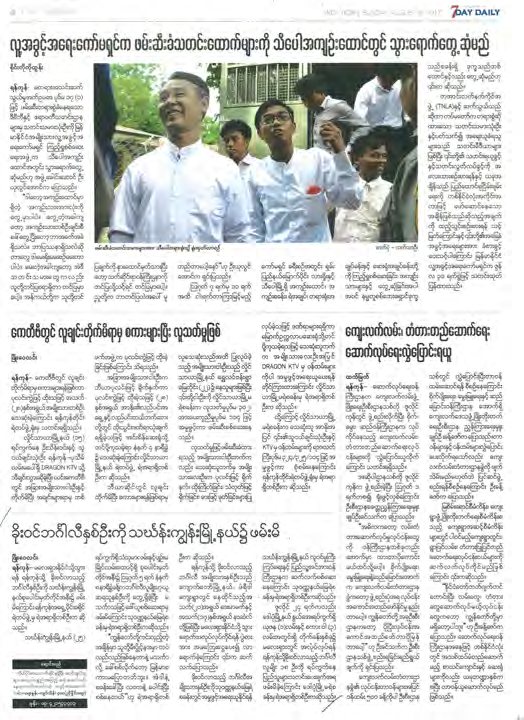
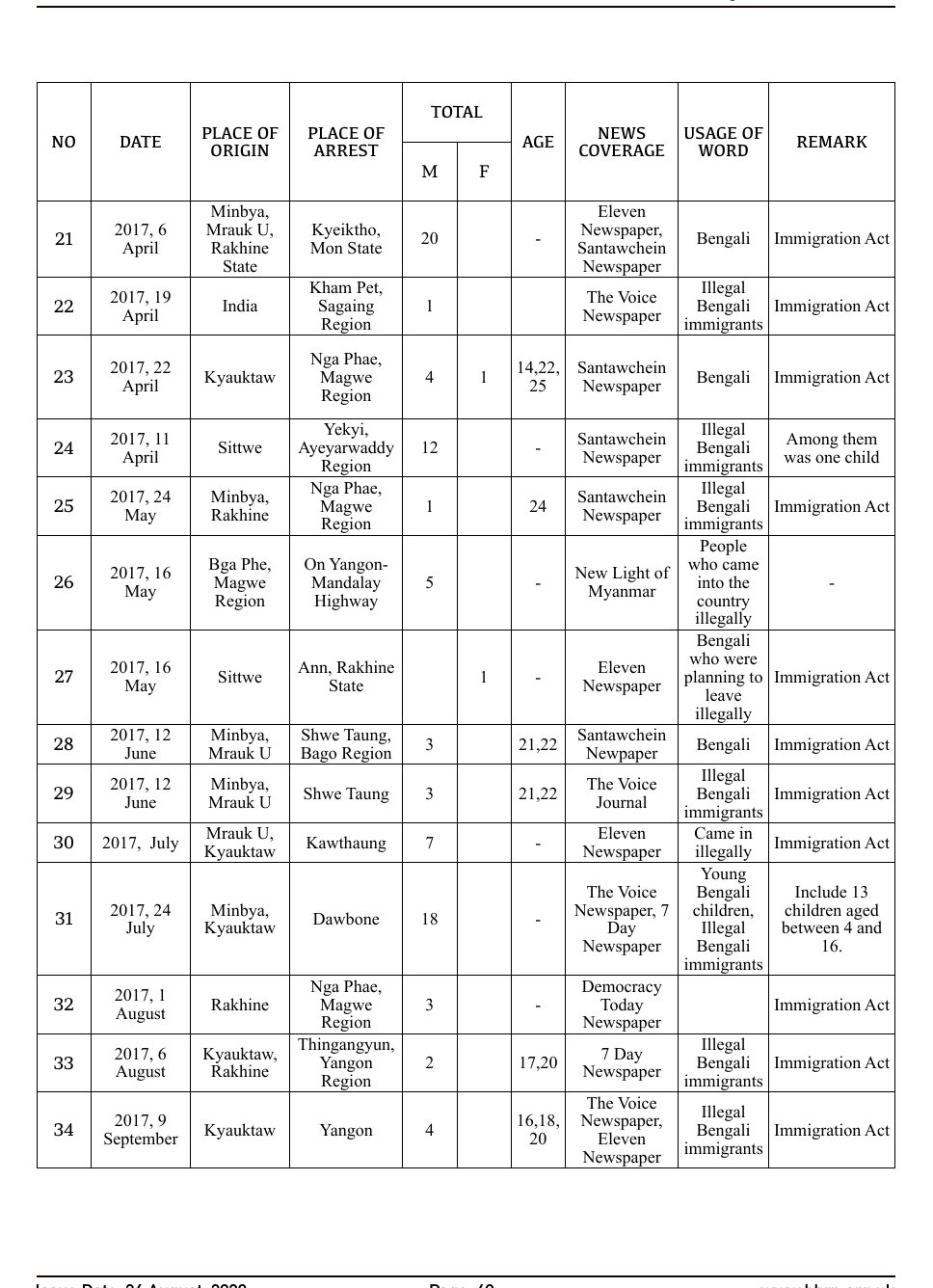
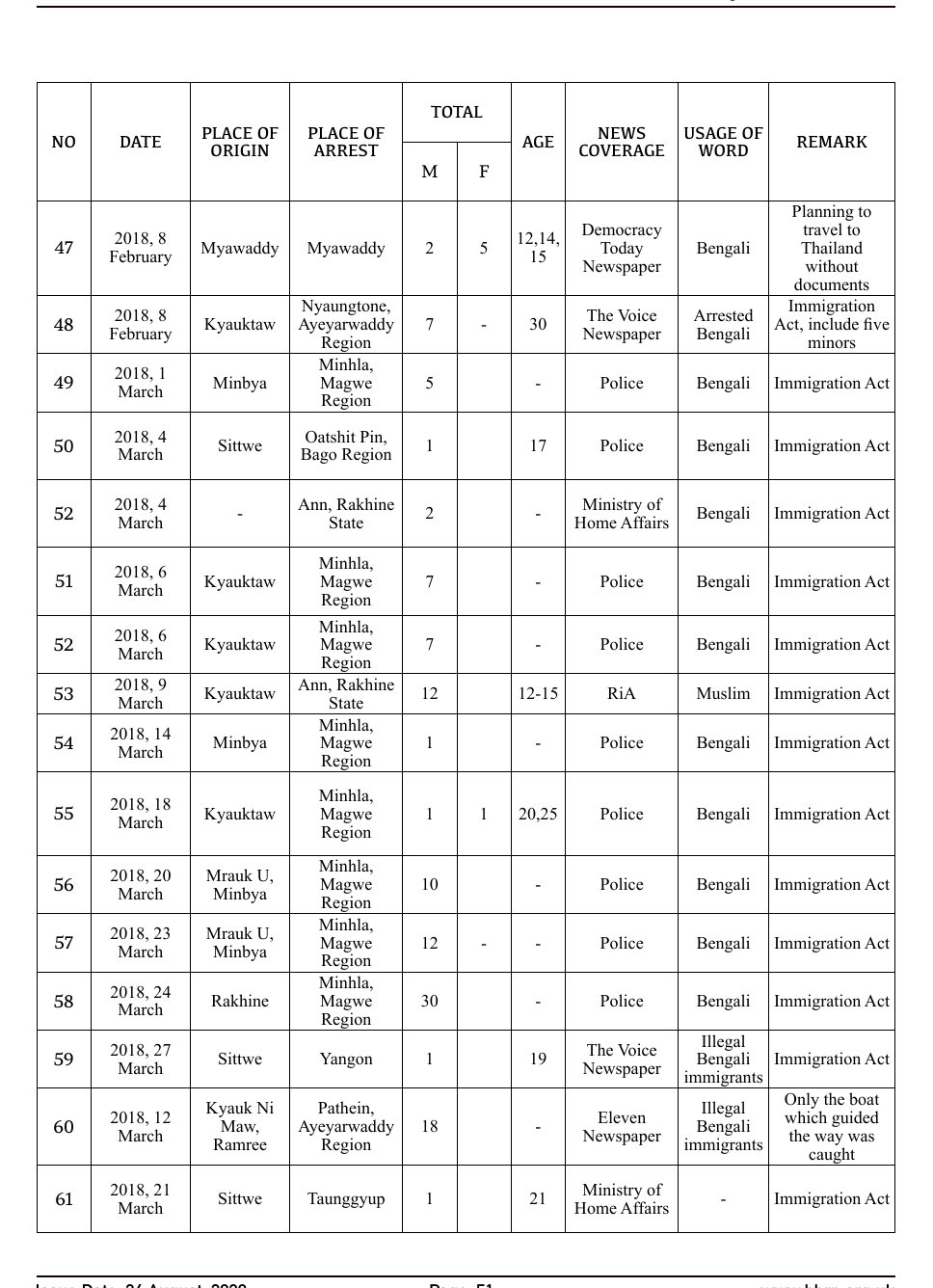
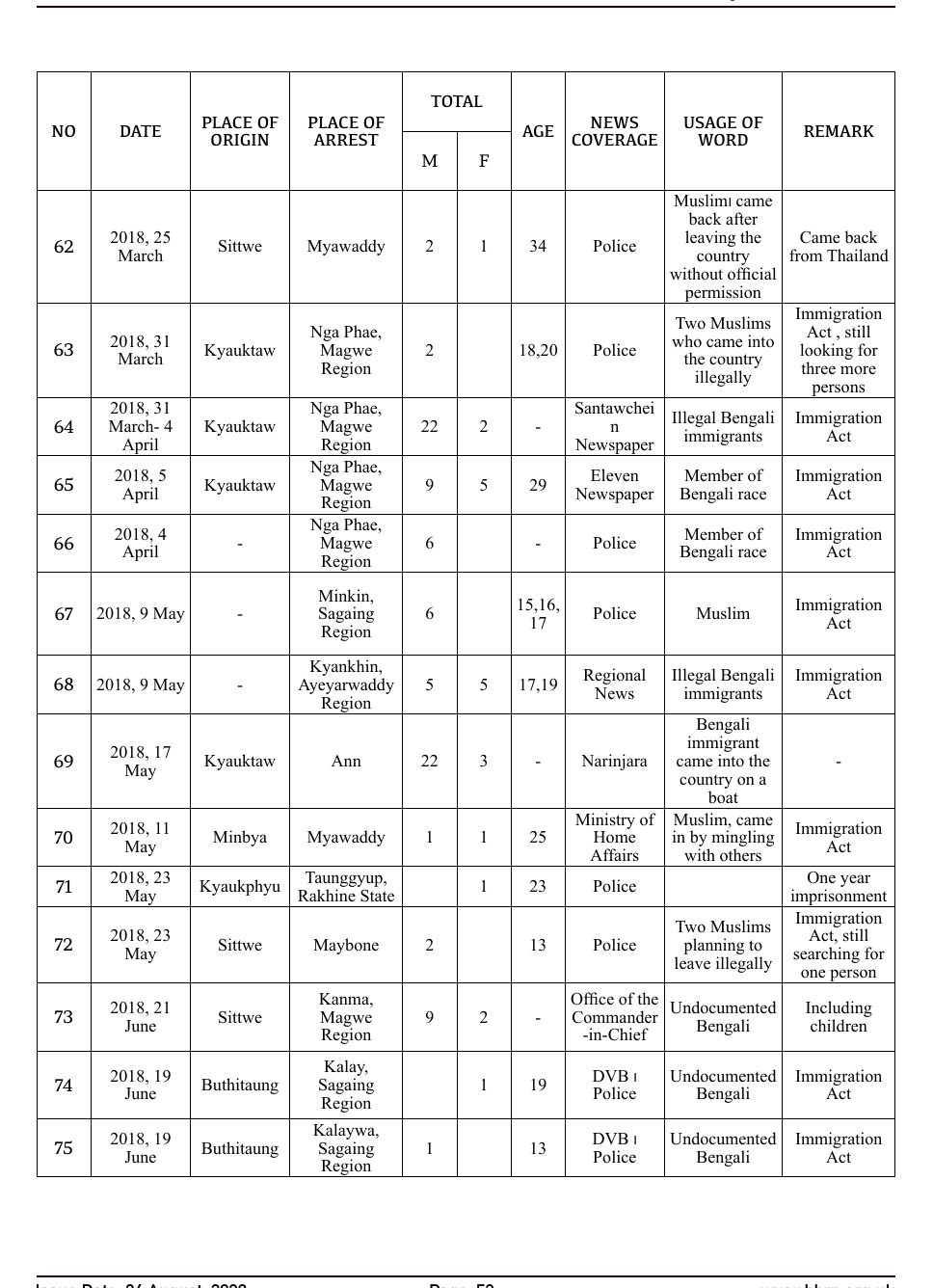
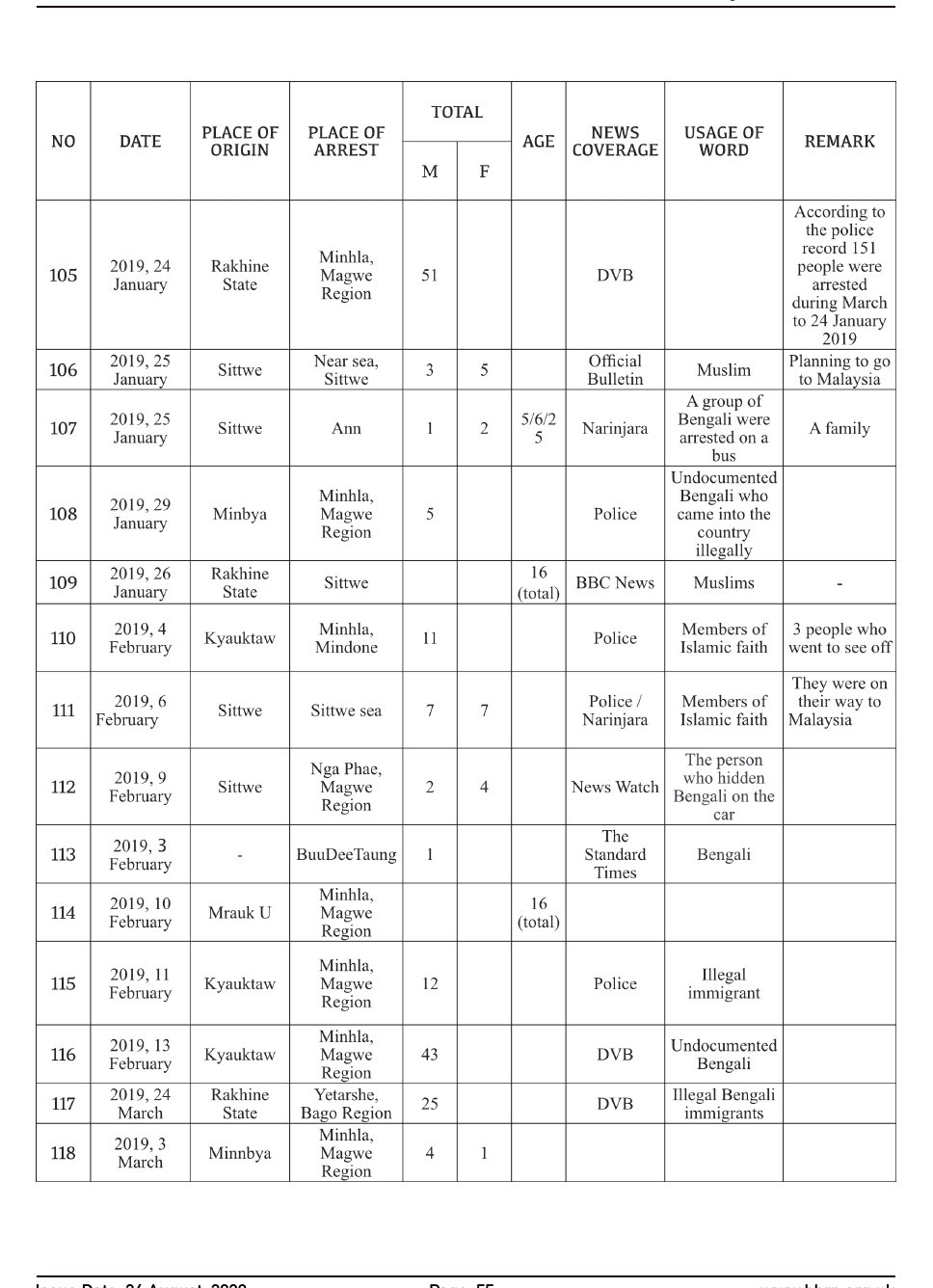
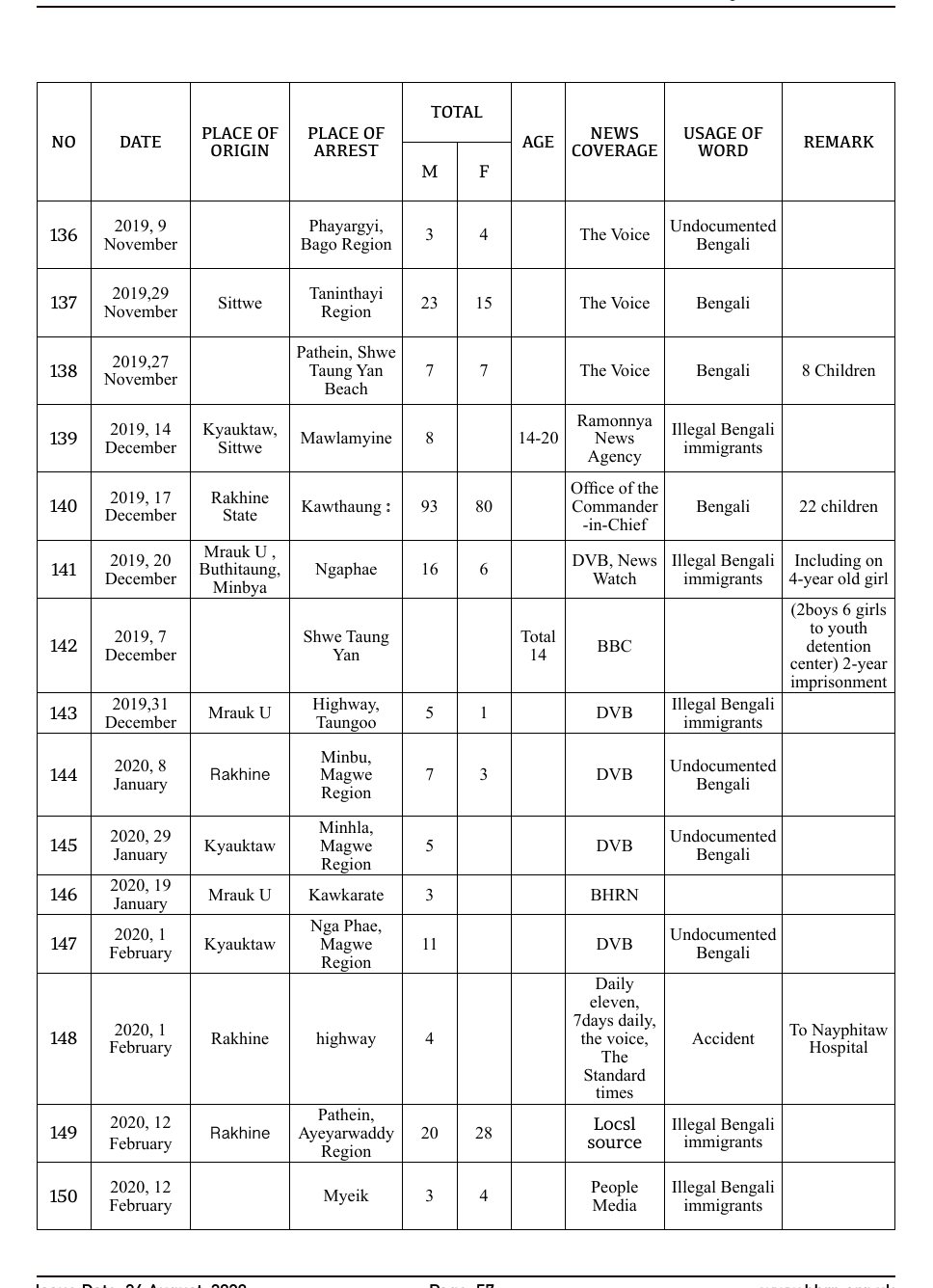
This is particularly evident with regard to arrests of Muslims from Rakhine who have attempted to travel outside of their villages. Domestic news in the country frequently uses language and imagery meant to portray the Rohingya as dangerous outsiders spreading throughout the country. BHRN documented 160 news articles between October 2016 and February 2020, where demeaning terms were used to describe Rohingya arrested for traveling outside of Rakhine State without the necessary – but very difficult to obtain - identity documentation and travel authorisations. These terms include “Bengali,” “Suspicious Bengalis,” “Illegal Bengali Immigrants,” “Members of the Islamic Faith without national registration,” and “People who came to the country illegally.” By using this language, the media echoes the sentiments of the government and military in trying to delegitimise and demonise innocent people in the country where they were born, who are simply seeking a better life for themselves. In doing so, the media foments public fear of the Rohingya and propagates support for policies that harm them.
News about the arrest of Rohingya Muslims is issued by the Office of the State Counsellor Aung San Suu Kyi as well as by the Ministry of Home Affairs and the police. Such news is also featured in local publications and disseminated by ultra-nationalists. In these news articles, derogatory words have been used in referring to the arrested Muslims. The politest of these refers to them as “Bengali,” a term the Rohingya categorically reject as it is meant to portray them as foreigner interlopers. In other cases, they are referred to as “suspicious-looking Bengali people” and “undocumented Muslim travellers.” An MP of the Yangon Region parliament posted a news article about the arrest of Muslims on his Facebook page, the title of the post reads as “Illegal Bengali Immigrants arrested.”
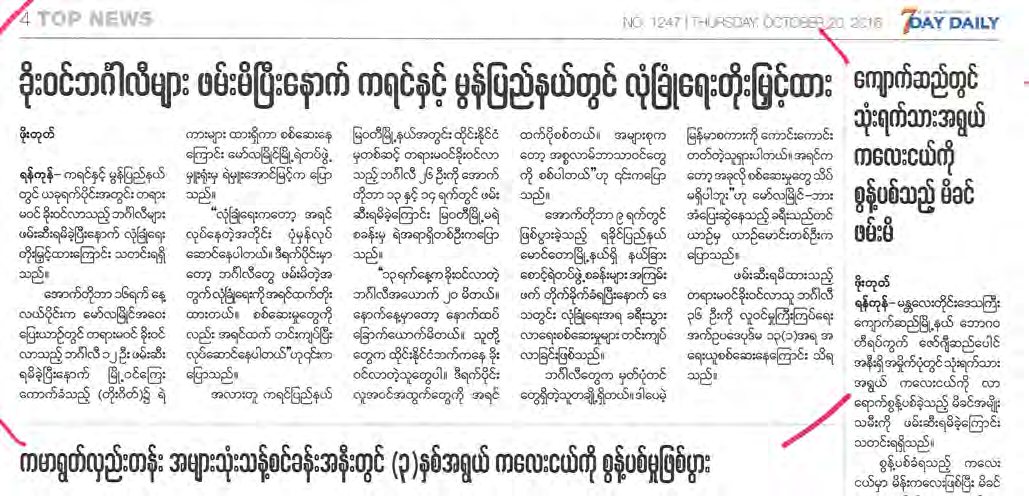

Such usage is designed to deny the Rohingya people their right to their identity. It also coaches the public to be familiar with this demonising language, thereby normalising it. In the news coverage the reason for arresting Rohingya is usually not given, as news outlets only attempt to portray them as illegal immigrants coming into Burma from a foreign country. This deliberate misinformation and withholding of key facts has the added effect of obscuring the reality that the Rohingya have been living in Rakhine State since well before the British colonial era.
The news coverage also fails to mention that the Rohingya have tried to flee to other countries due to the long-standing persecution, acts of genocide, and other atrocity crimes that they have been facing in Burma. Instead, their situation is portrayed as if they tried to “illegally” enter into the heartland of Burma. This is a clear attempt to support the narrative of the government and the ultra-nationalists, who try to convey that people from Bangladesh are coming into Burma illegally and that they are trying to exert their influence over the country. This narrative is then used to justify the grossly inhumane treatment of the Rohingya and the systematic violence which potentially amounts to crimes against humanity and genocide.

12Arbitrary application of the law and harsh sentencing
Rohingya Muslims arrested for traveling out of Rakhine State without official permission are subsequently prosecuted under two different laws. Those charged under Article 13(1) of the 1947 Burma Immigration (Emergency Provisions) Act (amended by a 1990 SLORC decree) are considered to have entered the country illegally, and face up to five years in prison. Those charged under the 1949 Residents of Burma Registration Act (read together with the 1951 Resident of Burma Registration Rules) are treated as foreign residents who lack official identity documents and/or the necessary travel authorisations (Form Number Four), and face up to two years in prison. It is unclear why some Rohingya Muslims are treated as illegal immigrants under the law, while others are regarded as foreign residents in breach of residency rules. The decision to proceed with a criminal prosecution and which law should be applied in these cases appears to rest at the Township Law Officer (prosecutor) level. However, it is unclear whether Township Law Officers are following instructions issued by the Union Attorney General’s Office, or if they have discretionary powers in such cases.12
Sections 6 (2) and 6 (3) of the 1949 Residents of Burma Registration Act (the 1949 Act) are frequently used as the legal basis for prosecution and conviction, in conjunction with the 1951 Resident of Burma Registration Rules (1951 Rules). Sections 16 and 29(1) of the 1951 Rules stipulate that residents are responsible for maintaining their identity card and having it with them when they travel. Section 6 (2) of the 1949 Act criminalises the breaking of any rules associated with the Act (including the 1951 rules) and Section 6 (3) sets out the punishment of a maximum of two years ‘with rigorous imprisonment’ (hard labour).
Section 5(2)(d) of the 1949 Act is the legal basis for the National Verification Card, the current iteration of identity - not citizenship - document issued to the Rohingya.13 It is important to understand that Rohingya are denied their identity as Rohingya during the application process for the NVC and are forced to accept the foreigner designation 'Bengali' in order to obtain the card. As a result, many refuse to accept the NVC.
Stripped of citizenship and denied the right to their identity, Rohingya who attempt to exercise their right to freedom of movement and seek a better life for themselves are subsequently criminalised for travelling without identity documents or travel authorisation.
In many cases, Rohingya Muslims arrested for traveling without identity documentation or official permission are charged soon after their arrest. Even though it usually takes many months for a court case to be heard in Burma, the cases involving Rohingya Muslims are often heard and the sentence announced within a single day. In many cases, Rohingya Muslims could not afford to hire a lawyer. Others were unable to hire one due to a lack of contact with their families during an extremely short period between their arrest, court appearance, and sentencing. BHRN has also received reports that Rohingya Muslims in such cases are often denied access to a lawyer.
In most cases, Rohingya Muslims are convicted and handed down the harshest possible penalty under the law; either the maximum two years with hard labour under the 1949 Residents of Burma Registration Act, or the maximum five years under the 1947 Burma Immigration (Emergency Provisions) Act. There are very few cases in which Rohingya receive a lesser sentence. When Rohingya children are arrested for traveling without identity documents or travel authorisation, they receive similar sentences but are separated from their parents or relatives and detained in either juvenile detention centres or youth training centres run by the Ministry of Social Welfare, Relief and Resettlement. Such practices are in violation of Article 37(b) of the Convention on the Rights of the Child, which protects children from arbitrary detention and specifies that lawful detention should be used ‘only as a measure of last resort and for the shortest appropriate period of time’.
The Burmese authorities have reportedly arrested more than 2,200 Rohingya at sea since 2015.14 Many of those arrested were being trafficked to Malaysia or Thailand but have not been treated as trafficking victims by the authorities. While BHRN is aware of some trafficking victims being released to newly-built repatriation camps in northern Rakhine State and forced to accept National Verification Cards, others remain in detention. BHRN has spoken to family members of Rohingya who attempted to flee the Bangladesh refugee camps by boat and were stopped and detained by the Burmese authorities in or near Burmese territorial waters. They were detained in custody, then sent back to their places of origin in Rakhine State.
At the same time, people who are involved in the trafficking of Rohingya Muslims face conviction under section 367 (“kidnapping or abducting in order to subject a person to grievous hurt, slavery, etc”) and section 370 of the Penal Code (“buying or disposing of any person as a slave”). These charges carry a maximum 10 years of prison term. However, human traffickers in Burma are far less frequently investigated, arrested, or charged for their actual crimes of coercing human beings into slavery.
In these cases, it is clear that those who assist the Rohingya to flee Rakhine State are often human traffickers and that the Rohingya should be treated as victims, as is the case with non-Muslims who take similar journeys regularly in search of work overseas. As such, they should not be imprisoned.
In some cases, both the Rohingya and the human traffickers are charged and convicted under sections of the law that carry maximum sentences, even though the Rohingya are simply the victims in these cases. Yet no members of parliament or domestic human rights organisations have protested against such grossly unfair convictions of Rohingya trafficking victims or the harsh sentences they face.
BHRN has documented 160 separate cases amounting to the arrests of at least 1,675 Rohingya Muslims during the period October 2016 and March 2020.
According to research conducted by BHRN, there are at least 1,675 Rohingya Muslims from Rakhine State that have been arrested during the period between October 2016 to March 2020. This information was collected from government sources, news agencies, and other local sources. As such, the figure is likely to be higher, as some cases were not reported in the public domain. Gender-disaggregated figures are usually either unavailable, or not reported.
There were 160 cases recorded during that period.

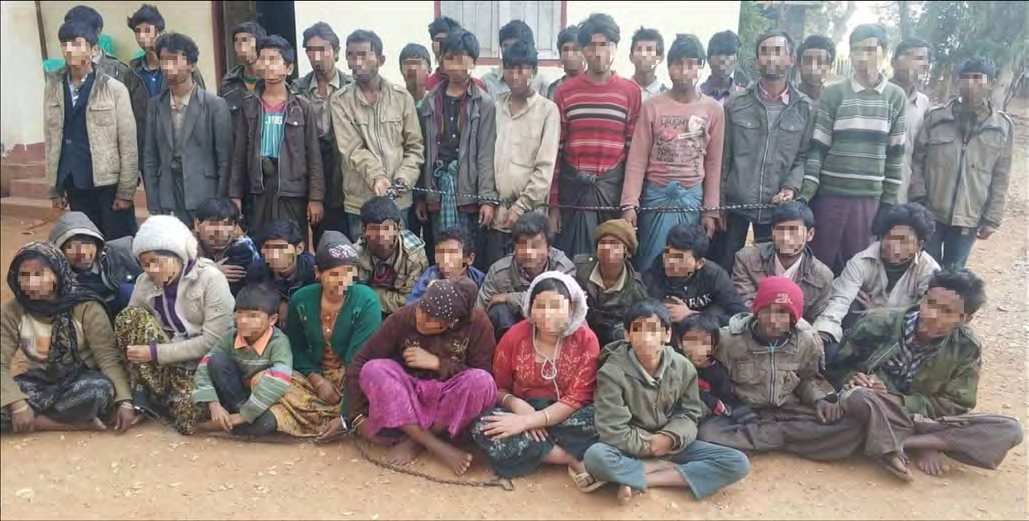
Among those arrested were toddlers and small children. The government sends minors to the youth training centres run by the Department of Social Welfare and the adults to prison. In addition, among those arrested were people who were no longer living in Rakhine State. Some of them were living in Thailand and Malaysia and were arrested upon their attempted return to Rakhine State. In recent years, migrant workers from Burma living in Thailand need to provide proof of their Burmese citizenship in order to obtain a Certificate of Identity as a precursor to a work permit for Thailand.15 Rohingya Muslims in particular face an impossible choice: risking arrest for being undocumented in Thailand and Malaysia, or risking arrest for travelling home without citizenship or other identity documents.
In some cases, BHRN found that Rohingya were arrested arbitrarily while still within the borders of Rakhine State. In extreme cases, BHRN found that Rohingya were arrested in their own homes on the accusations that they were planning to flee to other parts of Burma or to another country. They are similarly accused of traveling without official permission.
In a recent case, a group of eight Rohingya youths were sentenced to one-year imprisonment under 1947 Burma Immigration (Emergency Provisions) Act on 14 December 2019. They were arrested in Naung Khaye ward in Mawlamyine in Mon State. Among them, four minors were sent to a youth training school in Sangyi ward in Mawlamyine run by the Ministry of Social Welfare, Relief and Resettlement, and the rest, who are over 18 years of age, were sent to Mawlamyine jail. The four minors told BHRN in an interview that they fled Sein Ngwe Taung IDP camp in Rakhine State because of restrictions in the area and harassment by police. While in the training school in Mawlamyine the boys said they were unable to contact their family, had limited food, were unable to pray openly in accordance with their Islamic faith, and did not have adequate access to soap or other hygiene items. While the boys said life is mostly peaceful for them, they said they are beaten or abused if they do not listen to authorities in the school or if they are found smoking cigarettes. The boys were told they could be returned home if their parents came to collect them with their passports, a task which would be impossible for them to complete as Rohingya are systematically denied citizenship, and by extension, passports.
One of the boys told BHRN, “We do not know how our parents and siblings are spending their time. We are at least living in a room and have food to eat. When we think about their plight, especially when we’re eating, it makes us cry.”
Among the eight who were arrested was a man accused of trafficking the Rohingya, but according to the boys he was uninvolved. “The person who was arrested along with us is not the one who trafficked us, but the owner of the house we were lodging at, at the rate of Kyat 7,000 (around $US5) per day. We were arrested about 10 to 15 minutes before we were planning to leave the place.” One of the boys told BHRN.
The government is using these laws to effectively impose a travel ban on Rohingya and other Muslims from Rakhine State and as such, they have been arrested and convicted via the misrule of law, while the media simultaneously uses these cases to discredit and demonise the Rohingya to the wider public.

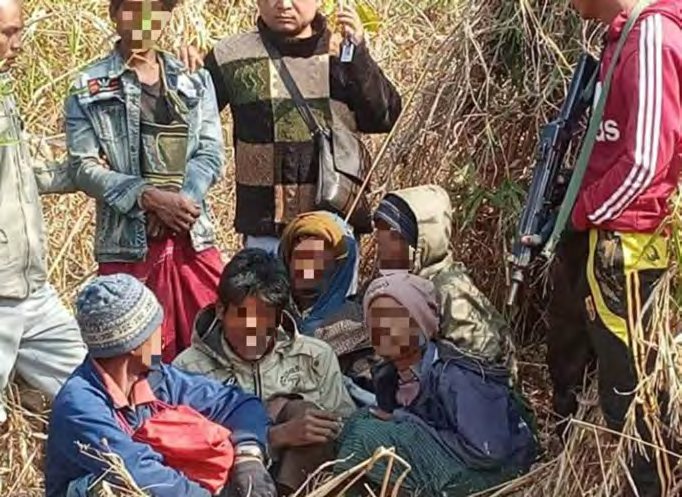
By comparison, a group of 12 Chinese nationals arrested in Mandalay on 10 February 2020 and charged under section 13 of the 1947 Burma Immigration (Emergency Provisions) Act were given six months imprisonment and fined 150,000 Kyat – the lightest punishment under the law – before being deported back to China. News agencies which covered the incident accurately described them as “Chinese nationals” who had violated visa regulations, rather than as illegal or undocumented immigrants. The photo released by the police does not show them restrained or appearing as prisoners, as has been the case of arrested Rohingya Muslims, where in some cases the police even point a gun at the arrested person. At a systemic level, foreign nationals have received better treatment under the law than the Rohingya who were born in Burma and should be entitled to citizenship, yet are demonised as “illegal Bengalis” and criminalised for seeking to exercise their right to freedom of movement.
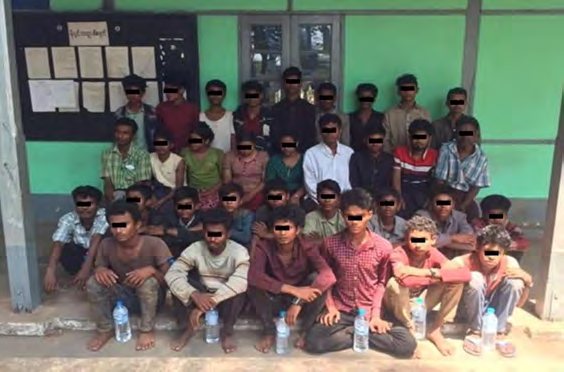
On 4 December 2019 a group of 14 Rohingya were sentenced to two years rigorous imprisonment (imprisonment with hard labour) for traveling from Sittwe to Milong Gyine village in Baw Mi village tract in Pathein Township, Ayeyarwaddy Region, without National Verification Cards. The Criminal Procedure Form 97 from the case stated that, “The 14 defendants have violated article 29 (1) of the Resident of Burma Registration Rules of 1951 and the Plaintiff appealed to the court to charge them under the section 6 (1) 6 (2) and 6 (3) of the 1949 Residents of Myanmar Registration Act.” The 14 pleaded guilty to section 6 (3) which recommends a sentence of no more than two years with hard labour. The defence lawyer in the case argued that the Rohingya were trafficking victims who are also residents of Burma. However, they were given the maximum sentence possible, including hard labour, despite this.
In April 2020, media reports indicated that the Rohingya were released, although at the time the reason was unclear.16 BHRN has since obtained two confidential orders dated 3 April from the office of the Permanent Secretary of the Minister for Labour, Immigration and Population, as well as the Director-General of the Immigration Department and the Director-General of National Registration, ordering that charges against “Bengali” be dropped and for “Bengali” prisoners to be released. However, in BHRN’s understanding, the release of Rohingya detained for exercising their right to freedom of movement was conditional on them signing a pledge stating that they would not attempt to travel outside of Rakhine State again. As such, their freedom of movement continues to be curtailed and those released have simply been transferred from jail back to the open-air prison of Rakhine State. The significance of these orders is discussed in more detail below.
Burma’s weaponisation of its legal system against an entire ethnic-religious group born and living in the country for generations is a key part of the apparatus of systemic discrimination used to persecute the Rohingya.
As long as this apparatus remains in place, Rohingya will be forced to flee Burma for Bangladesh where they will continue to live indefinitely in refugee camps while they wait for the world to hold Burma accountable.
Typical sequence of events – from arrest of Rohingya Muslims to sentencing
- Local people notice Rohingya Muslims travelling through their area, and report them to the Ward Administrator.
- The Ward Administrator informs the police, who in turn inform Immigration.
- The Rohingya Muslims are detained at the local police station.
- The local head of Immigration becomes the plaintiff in the case against Rohingya Muslims, who are accused of travelling without the official documentation which is so difficult for them to obtain.
- The police question the plaintiff and the Ward Administrator as a key witness in the case, as well as the defendants.
- The police then file the case with the local Township Law Officer (Prosecutor), who is appointed by the Office of the Union Attorney General.
- The decision to proceed with a criminal prosecution – and which section of the law applies – rests with the local Township Law Officer (Prosecutor).
- In most cases, this is either Sections 6 (2) and 6 (3) of the 1949 Residents of Burma Registration Act in conjunction with the 1951 Resident of Burma Registration Rules or Article 13(1) of the 1947 Burma Immigration (Emergency Provisions) Act (amended by a 1990 SLORC decree).
- Such cases usually reach court very quickly, sometimes within one day of arrests taking place.
- Due legal process is rarely followed. Rohingya Muslims are either denied access to a lawyer, or unable to appoint one due to the short timeframe between their arrest and court appearance.
In most cases, the harshest possible penalty under the law is handed down – either two years with hard labour, or five years.
13Violations of the rights of the Rohingya and the International Court of Justice ruling
On 23 January 2020, the International Court of Justice ordered a series of provisional measures to be implemented by Burma in order to protect the Rohingya from genocidal acts as part of the case brought by the Gambia regarding alleged breaches of Burma's obligations under the Genocide Convention. The measures were as follows:
- Burma must take all measures within its power to prevent the commission of all acts within the scope of article II of the Genocide Convention, including - killing members of the group, causing serious physical or mental harm, and deliberately inflicting on the group conditions of life calculated to bring about its physical destruction.
- Burma must ensure that its military and any irregular units/persons subject to its control, do not commit any of the genocidal acts outlined above, or conspiracy to commit genocide, public incitement to commit genocide, attempt to commit genocide, or complicity in genocide.
- Burma must take effective measures to prevent the destruction of and preserve evidence of genocidal acts.
- Burma must submit a report to the court on all measures implemented as a result of this order, within 4 months and then every 6 months until a final decision is made on the case.
The arrests of Rohingya and continued denial of other fundamental human rights, such as the right to a nationality and the right not to be arbitrarily deprived of nationality, as well as the right to freedom of movement, are in defiance of the ICJ’s provisional measures. In particular, such violations could be interpreted as being in breach of measure 1), which instructs Burma to ‘take all measures within its power’ to prevent the commission of all genocidal acts, including ‘deliberately inflicting on the group conditions of life calculated to bring about its physical destruction’. By continuing to intentionally harm the Rohingya through confining them in apartheid-like conditions where they are unable to access adequate food and aid supplies, and denying them access to healthcare and livelihoods, Burma is ensuring a continued exodus while others languish in IDP camps or their villages, or die before they can leave.

Simultaneously, the war between the Burmese Army and the ethnic Rakhine militia the Arakan Army has significantly escalated in the areas where the Rohingya live. The Rohingya have once again found themselves trapped by conflict and have suffered high casualties as a result. Since the ruling by the ICJ, several incidents have occurred where Rohingya have been killed by security forces’ artillery - despite no fighting reported to be going on in the area at the time, which suggests they may have been deliberately targeted. These instances are especially egregious violations of the ICJ’s orders to prevent all genocidal acts, and have further driven Rohingya to migrate away from their villages in search of the safety and refuge that the Burmese legal system denies them.

14Government attempts to save face
On 23 May 2020, the government submitted its first report to the ICJ pursuant to the fourth provisional measure ordered by the ICJ, outlined above. On 8 April 2020, the President’s Office issued a directive on ‘Compliance with the Convention on the Prevention and Punishment of the Crime of Genocide’, ‘Preservation of evidence and property in areas of northern Rakhine State’ and ‘Prevention of incitement to hatred and violence (or) Prevention of proliferation of hate speech’. These publicly-issued Presidential directives can be seen as an attempt to show that Burma is complying with the ICJ provisional measures order, both domestically and internationally.17
April 2020 immigration orders obtained by BHRN instruct the release of Bengali prisoners and to avoid bringing further charges against Bengalis.
BHRN obtained two confidential orders dated 3 April from the office of the Permanent Secretary of the Minister for Labour, Immigration and Population, as well as the Director-General of the Immigration Department and the Director-General of National Registration. The letters refer to a Presidential order (letter no. 559 issued by the President's office) instructing the release of “Bengali” prisoners, dropping charges against them, and to avoid bringing further charges against them. The instructions from the President's Office are that Rohingya are to be given help returning to their homes and that arrangements must be made to release them as part of a Presidential amnesty. The Immigration letters appear to relate to the charges brought under immigration and residency laws, relating to the arrest and detention of Rohingya who attempt to exercise their right to freedom of movement. It is noteworthy that this particular Presidential order was not released publicly - unlike those mentioned above, which were published a few days later - as this would undermine the government's narrative about the need to control “illegal Bengali” interlopers and would likely have been deeply unpopular with the many in the Burman Buddhist majority, consumers of this narrative who have already internalised it.

Ostensibly these orders are a welcome step. Approximately 870 Rohingya were in fact released during the annual Presidential amnesty for prisoners to coincide with Buddhist New Year in Burma and allowed to return to their homes in Rakhine State.18 However, in BHRN’s understanding their release was conditional on signing a pledge that they would not attempt to travel outside of Rakhine State again. The release of Rohingya who have committed absolutely no wrongdoing and should never have been arrested and detained in the first place is long overdue and welcome.
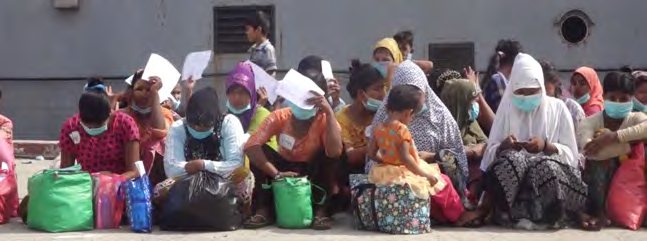
Although this may be a sign that pressure from the international community as a result of high- profile international legal cases is beginning to work, this is not yet clear. There are indications that in spite of this immigration order, the authorities continue to arrest Rohingya under these laws, and the 1947 Burma Immigration (Emergency Provisions) Act in particular. However, the circumstances are different. Since cases of the global COVID-19 pandemic have been confirmed in the overcrowded refugee camps in Bangladesh where Rohingyas have been sheltering, Rohingya refugees have faced yet another impossible choice: the risk of exposure and possible death from COVID-19, or the risk of returning home to an insecure and uncertain future. Some have independently chosen to return home to northern Rakhine State, but have subsequently been arrested and detained under Article 13(1) of the 1947 Burma Immigration (Emergency Provisions) Act according to information collected by BHRN. In the first week of July 2020, Maungdaw Township Court sentenced 11 returning Rohingya refugees to six months in prison. Dozens of others are reported to have been charged. The high-level immigration order thus appears to either be ignored in such cases, or adhered to in an ad hoc manner. It should be viewed as mere window-dressing for the sake of saving face, rather than any effort at substantive reform or compliance with the ICJ provisional measures.
It is imperative that while the release of Rohingya who have been arbitrarily detained is to be welcomed, the international community should remain cognisant of the wider context. These include violations in the context of the ongoing conflict between the Arakan Army and the Tatmadaw which has had a devastating impact on all civilians, including Rohingya. The Rohingyas’ right to their identity as well as their right to a nationality continue to be routinely and systematically violated. Rohingya who were conditionally released as part of the Presidential amnesty were reportedly offered the NVC, but most apparently refused on the grounds that to accept this would be to deny their identity as Rohingya. As such, the Presidential amnesty and their conditional release merely returns Rohingya from jail to the open prison of Rakhine State, where they face the prospect of further gross human rights violations and atrocity crimes.
The release of Rohingya detainees during the Presidential amnesty was conditional, as they were required to sign a pledge stating that they would not attempt to travel outside of Rakhine State again.
15Conclusion
The Rohingya have nowhere to run in Burma. They remain in a precarious state, trapped between suffering, abuses, and the risks posed by attempting to flee to relative safety. The Rohingya remaining in Burma see little hope of positive change in the coming years and have to decide how to live and survive while they wait for justice. Some will choose to remain in place hoping their situation does not further deteriorate, while others will decide they must leave in order to survive. Those who flee risk imprisonment, slavery, abuse, and death but they will continue to do so for the prospect of a freer and more equitable life. They will continue to flee in the belief that they will arrive somewhere they can simply exist freely without being persecuted on the basis of their ethnicity and religion. They will flee to ensure their families can be fed and cared for. They will flee so they can pursue the fundamental freedoms all humans have a right to enjoy.
Those who flee have been disproportionately targeted, unfairly tried, and cruelly and unjustly punished. The State has taken measures to ensure that the Rohingya cannot leave the villages they are born in without fear of arrest in times of peace, and death in times of military operations and ultra-nationalist campaigns. The Rohingya are trapped between jail and an open-air prison. Those attempting to flee the country are now returned to its shores, imprisoned, tortured, and humiliated with degrading headlines and news blurbs. For the Rohingya, existing in Burma has become a crime.
Burma can remedy this situation simply, by acknowledging the Rohingyas’ place in their society, recognising their identity as Rohingya, restoring their citizenship in full, and allowing them to live freely and in dignity. However, without significant pressure from the international community, Burma is unlikely to implement any positive measures or revoke any unjust law that disproportionately harms the Rohingya. These laws, policies and practices by the State are not meant to maintain order but are rather tools to inflict suffering on the Rohingya. While Burma has ostensibly taken some positive steps by releasing some Rohingya from prison in April 2020, this was conditional and there is no apparent change in the restrictions on freedom of movement. It is therefore vital that pressure on the military and government is increased rather than eased at this critical juncture. It is likely that the authorities will continue with unjust policies and practices so long as there are no ramifications for doing so. As such, international support for robust and transparent implementation of the ICJ’s provisional measures is essential.
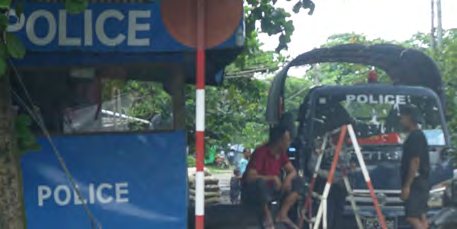
Maximum pressure must be exerted on the Burmese government to ensure that discriminatory laws are repealed and that the Rohingya have full citizenship restored to them in line with international human rights standards, as well as guarantees of all other fundamental human rights and freedoms.
16Recommendations
1To the Government of Burma
- Immediately and unconditionally release all Rohingya detained for exercising their right to freedom of movement and end the practice of arbitrary arrest and detention of Rohingya.
- Abolish the practice of detaining Rohingya children. Immediately and unconditionally release any Rohingya children detained in youth training schools or other facilities and reunite them with their families.
- Immediately end all travel restrictions against the Rohingya and guarantee their right to freedom of movement.
- Publicly and officially recognise the Rohingyas’ right to their identity as Rohingya in law, policy and practice.
- Abolish the 1982 Citizenship Law, related by-laws and civil service instructions. Any citizenship law and accompanying implementation guidance must be in line with Burma’s obligations under international human rights law, in order to guarantee the Rohingyas full citizenship and interrelated fundamental rights and freedoms such as the right to freedom of movement, right to an adequate standard of living, and right to health.
- Comply robustly and transparently with all of the provisional measures ordered by the International Court of Justice.
- Make concerted, transparent efforts to combat human trafficking by investigating and dismantling the clandestine networks and holding those responsible accountable. Treat Rohingya who are being trafficked as victims instead of criminals.
- Allow full, unfettered access to all humanitarian organisations seeking to provide aid to the Rohingya and other minorities in need.
2To the International Community
- Pressure the Government of Burma to immediately and unconditionally release all Rohingya detained for exercising their right to freedom of movement.
- Publicly condemn alternative processes such as the National Verification Card and insist that Burma recognise the Rohingya as full citizens, in line with Burma’s obligations under international human rights law.
- Join other State parties to the Genocide Convention in supporting and assisting the efforts of the Gambia in the legal case against Myanmar at the International Court of Justice. Publicly support the ongoing International Criminal Court investigation.
- Refer the situation in Burma to the International Criminal Court, or alternatively establish an international criminal tribunal to try alleged perpetrators of international crimes.
- Enforce targeted sanctions against key figures in the Burmese military as well as military-owned companies such as Union of Myanmar Economic Holding Limited and Myanmar Economic Corporation for atrocity crimes committed since at least 2016.
- Negotiate and facilitate the safe, equitable, and voluntary return to their places of origin for Rohingya who have been displaced both within the country and beyond its borders. Demand their right to housing, land, and property restitution, as set out under the Pinheiro Principles.
- Support OHCHR’s Rabat Plan of Action19 as a best practice approach to dealing with discrimination, hate speech, and violence inside of Burma. The conclusions drawn from the plan establish clear standards which countries and communities can be held to while maintaining equitable treatment of all nations.
- Work to implement the UN’s Strategy and Plan on Hate Speech20 in Burma and urge State actors to comply with the steps outlined therein. Specifically, this would help Burma to identify hate speech in the country and provide them with tools to remedy its negative effects.
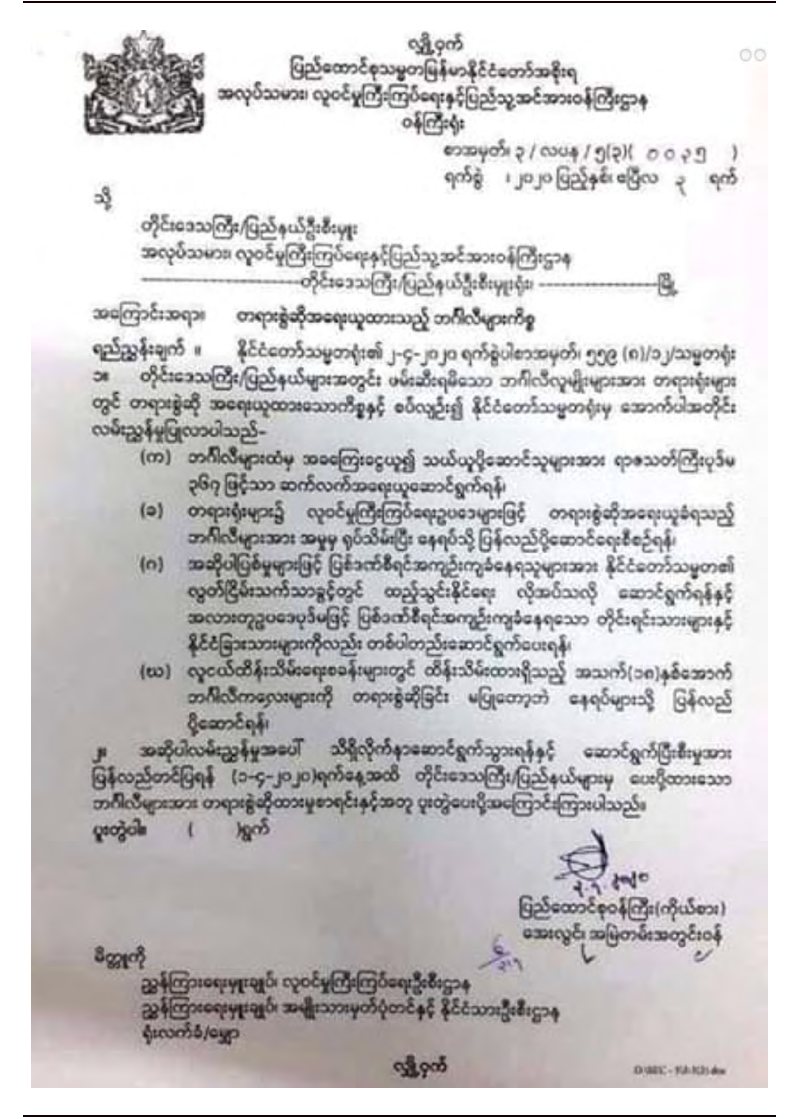
17Appendix 1 – The immigration orders of 3 April 2020
Two confidential orders from the Office of the Minister of Labour, Immigration and Population, obtained by BHRN (English translation).
Confidential The Government of the Republic of the Union of Myanmar The Ministry of Labour, Immigration and Population Office of the Minister
Letter No. 3/LaPaNa/5(3) (0035) Date- 2020 April (3)
To The Head of State/Region
The Ministry of Labour, Immigration and Population ---------------- --------------- Office of the State/Region head-------------------- Township
Subject: Matter related to indicted Bengalis
Reference: The letter no 559 (f)/12/President Office- issued by the Office of the President
1. In dealing with the Bengali people who are indicted to face lawsuits in the courts, the President Office has made the following instructions. • To charge those who attempted to traffick Bengali under section 367 of the Penal Code
• To withdraw all the cases against Bengali people and help them in repatriation to their own places.
• To make all necessary arrangement include those who are serving sentences under the above mentioned offences in the Presidential amnesty of prisoners. Also, to make the necessary arrangements for including in the Presidential Amnesty the citizens and foreigners imprisoned for committing a similar offence.
• Not to proceed with legal actions against the Bengali minors who are detained in Youth Detention Centres and to make arrangement to send them back to their homes.
2. Please be informed of the order from the Office of the President and take necessary actions Report back to this office on the actions you have taken. Together with the report attach a list of Bengalis who are facing legal actions, as reported by each State/Region governments.
Attached ( ) copies On behalf of the Minister Aye Lwin, Permanent Secretary
Copies to The Director General of the Immigration Department The Director General of the National Registration and Naturalization Department Office Copy
Confidential
Confidential The Government of the Republic of the Union of Myanmar The Ministry of Labour, Immigration and Population Office of the Minister
Letter No. 3/LaPaNa/5(3) (0036) Date- 2020 April (3)
To The Head of State/Region
The Ministry of Labour, Immigration and Population ---------------- --------------- Office of the State/Region head-------------------- Township
Subject: Matter related to indicted Bengalis
Reference: The letter no 3/LaPaNa/5(3) (0035) of this office issued on 3-4-2020
1. In reference to the above-mentioned letter, this office has informed to your office on the instruction issued by the Office of the President in relation to the lawsuits being faced by the Bengali people in the courts in various State/Regions.
2. In that regard, please be informed that all the cases against Bengali people be withdrawn by 9 April 2020 as latest. Also, do not press charges against the Bengali people in the future and seek instruction from the higher offices on how to deal with such a situation.
Sd. On behalf of the Minister Aye Lwin, Permanent Secretary
Copies to The Director General of the Immigration Department The Director General of the National Registration and Naturalisation Department Office Copy Internal Circulation
Confidential
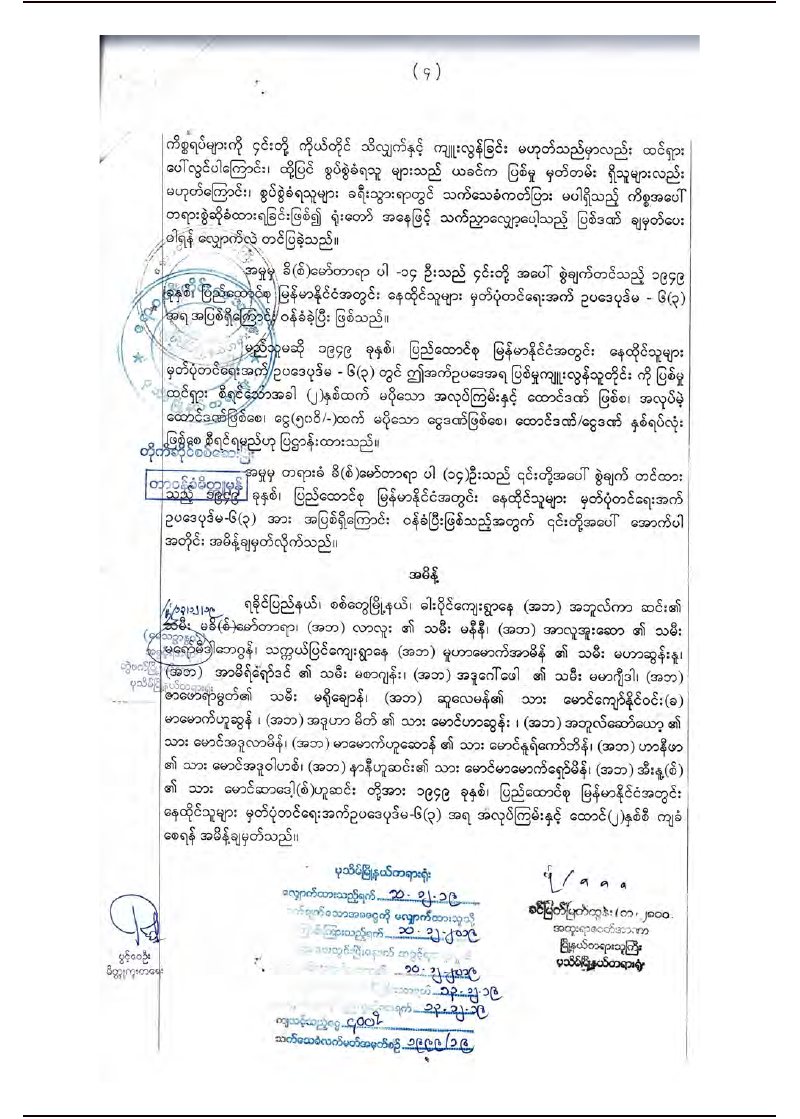
The original orders (Burmese)

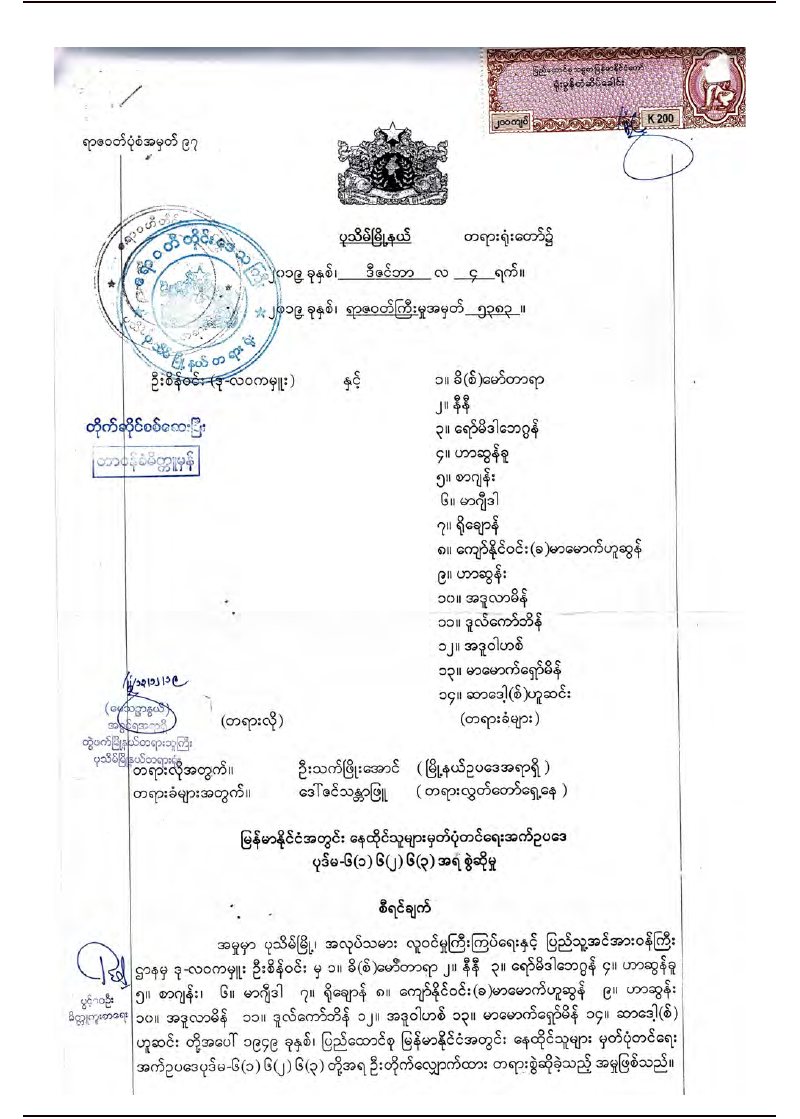
18Appendix 2 – A court case: Pathein Township Court, December 2019
The court record (translation)
Criminal Procedure Form No 97
Seal of the Republic of the Republic of the Union of Myanmar
Pathein Township Court Year-2019 Month-December Day- 4 2019 Criminal Case No 5383
Seal of the Pathein Township Court, Ayeyarwaddy Region
U Sein Win (Deputy Head of Immigration) vs. 1 Khit Motara
Plaintiff 2 Ni Ni
3 Romida Begum
4 Hassan Nur
5 Sajan
6 Majida
7 Roshan
8 Kyaw Naing Win (a.k.a) Mohamad Husein
9 Hassan
10 Abdullah Mein
11 Dul Kadar
12 Abdul Wahib
13 Mohamed Shamin
14 Sadak Husein
Defendants
Legal counsel for Prosecution-U Thet Phyo Aung (Township Judicial Officer) Legal Counsel for Defense – Daw Zin Thandar Phyu (Advocate) Lawsuit under the sections 6 (1), 6(2) and 6 (3) of the Residents of Myanmar Registration Act
Translation of the judgment
This case was filed by the Deputy Head of the Pathein Township Department of Labour, Immigration and Population, U Sein Win, against Khit Motara, Ni Ni, Romida Begum, Hassan Nur, Sajan, Majida, Roshan, Kyaw Naing Win (a.k.a) Mohamad Husein, Hassan, Abdullah Mein, Dul Kadar, Abdul Wahib, Mohamed Shamin and Sadak Husein under sections 6 (1) 6(2) and 6 (3) of the 1949 Residents of Myanmar Registration Act.
The plaintiff has testified in the court as follows. The plaintiff is serving as the Deputy Head of the Department of Labour, Immigration and Population. The 14 defendants, including Khit Motara, had travelled from their homes in Dapein Village in Dapein Village Tract of Sittwe Township, Rakhine State to Milong Gyine village in Baw Mi village Tract in Pathein Township in Ayeyarwaddy Region. They were found to have travelled out of their township without holding the Nationalities Verification Card (NVC) as required under the law. As such, the 14 defendants have violated the article 29 (1) of the Resident of Burma Registration Rules of 1951 and the plaintiff appealed to the court to charge them under the section 6 (1) 6 (2) and 6 (3) of the 1949 Residents of Myanmar Registration Act.
As the plaintiff is a public servant the count has exempted further testimonies from U Sein Win, under section 200 of the Criminal Procedure Code and the court has accepted the indictment of 14 defendants, including Khit Motera, under section 6(3) of the Residents of Myanmar Registration Act U Sein Win (prosecution witness No 1) has testified that he is serving as the Deputy Head of the Pathein Township Department of Labour, Immigration and Population. As he was informed by the Head of the General Administration Department of the Shwe Thaung Yan Township that a group of 22 Bengali people were brought for investigation, he along with the Township Head U Naing Oo Lwin, Deputy Head U Kyaw Win Khaing, Deputy Head U Han Thaw Zin and Assistant Head U Tun Min Thu, to serve as an interpreter went to the Myoma Police Station in Pathein.
The team has questioned all the 22 arrested Bengali and found out that 14 defendants including Khit Motara are adults and the rest are minors. The team was informed that they are residents of Da pein and That Kaepyin villages in Sittwe Township in Rakhine State.
They left their homes in search for livelihood opportunities in Yangon, as they as facing economic hardships in their villages.
They testified that they had embarked their journey to Yangon without holding the national registration card, or temporary registration or the Nationalities Verification Card (NVC). Under article 16 of the Resident of Burma Registration Rules of 1951, the defendants are required to apply for a travel permit at the immigration offices at their places of origin. They testified that they had failed to do so and also failed to hold any permission for travel from the immigration authorities.
Although it was mandatory for them to present their nationalities registration card under the section 29 (1) of the Resident of Burma Registration Rules of 1951, they have however failed to produce any registration cards. Moreover, it is incumbent upon the defendants to apply for a form of nationalities registration card under article 14 of the Resident of Burma Registration Rules of 1951. The article further stipulates that for minors their respective parents must apply on their behalf, and those who are over 18 years of age have to apply by themselves, but they are found to have not applied for such a card.
That is why he, on behalf of the head of the Township, acting as a plaintiff, appealed to the court to indict 14 people including Khit Motera under the section 6 (1), 6(2) and 6 (3) of the 1949 Residents of Myanmar Registration Act.
As the 22 people including Khit Motera could not identify their ages accurately, their age was verified by the Township Hospital of Pathein. According to the report received from the Township Hospital, it was verified that 14 defendants including Khit Motera were found to be over 18 years of age and the rest are found to be minors.
During the questioning they were not subjected to pressure or coercion, the questions were asked individually through the interpreter. And they were asked to sign or put thumb stamp on the written testimonies. The testimonies by 14 defendants have been presented to the court as the prosecution evidences no A to A-13.
U Kyaw Win Khaing (Prosecution Witness-2) also testified in the court in support of the plaintiff and he presented the prosecution pieces of evidence B up to B-1, which are the lists of the people who came into Pathein from Sittwe without holding any identification papers. Also, he presented to the court the age verification document dated 22 November 2019 as the prosecution evidence no C to C1.
U Han Thaw Zin (the Prosecution witness-3) has also testified in the court in support of the Plaintiff and the prosecution witnesses.
The court asked the 14 defendants, including Khit Motera, to enter into a plea whether guilty or not guilty against the charges they are facing under the 1949 Residents of Myanmar Registration Act. They have pleaded guilty.
The defence counsel in his testimony on behalf of the defendants testified in the court that the 14 defendants, including Khit Motera, are the residents of the Thatkae Pyin and Dar Paing villages in Sittwe Township of Rakhine State which is situated inside the Republic of the Union of Myanmar.
As such, they are the residents of the Republic of the Union of Myanmar. As the economic conditions in many villages in Rakhine State are not good and they have left their places of origin to Yangon in search of jobs. The defendants were lured to do so by human traffickers. They were unaware of the fact that they needed to carry immigration-related documents with them. If we study the testimonies by the Plaintiff and Prosecution witnesses it is evident that the defendants are the victims of human trafficking.
They have left their places of origin in search of jobs in Yangon at the persuasion of human traffickers. That is why those who tried to lure the defendants and took money from them should be prosecuted. It is evident that the defendants are unaware of the laws related to Immigration and they have not committed the crime knowingly.
Moreover, the defendants have no past criminal records. The court has indicted the defendants for not holding any kinds of nationalities registration cards, and he appealed to the court to consider leniency in this case.
The 14 defendants, including Khit Motera, have pleaded guilty to the charges they are facing under sections 6 (1) 6 (2) and 6 (3) of the 1949 Residents of Myanmar Registration Act.
Section 6 (3) of the 1949 Residents of Myanmar Registration Act states that anyone found guilty of these charges should be given a sentence not exceeding 2 years of rigorous imprisonment or imprisonment without hard labour or penalty not exceeding Kyat 500 or both imprisonment and penalty collectively.
As 14 defendants, including Khit Motera, have pleaded guilty to section 6 (3) of the 1949 Residents of Myanmar Registration Act, the court has pronounced the following order.
Order of the court
The court hereby sentenced Khit Motera, daughter of Abul Kasim a resident of Da Pine village in Sittwe Township in Rakhine State, Ma Ni Ni, daughter of Lalu, Ma Romida Begum, daughter of Alu Ausul, a resident of Thakaepyin village Ma Hassan Nur daughter of Muhamad Amin, Ma Sajan, daughter of Amulldin, Ma Majida, daughter of Abdul Gaffar, Ma Roshan, daughter of Zuhaur Muhammad, Maung Kyaw Naing Win (a.k.a) Muhamad Husein, son of Suleiman, Maung Hasun, son of Abdul Hamid, Maung Abdul Amen, son of Abdul Sayed,, Maung Nur Kawbein, son of Muhamad Husein, Maung Abdul Wahid, son of Hanifa, Maung Mohamed Shamin, son of Nasi Husein, Maung Sadak Husein son of Younous- each to two years rigorous imprisonment under section 6 (3) of the 1949 Residents of Myanmar Registration Act.
Order signed by Khin Myat Myat Tun (Ta) 2800 Special Criminal Judge Township Judge Pathein Township Court
The original judgment (Burmese)


19Appendix 3 – Arrests reported in Burmese publications
Below is a chart detailing reports from Burmese publications of Rohingya who were arrested on immigration offences, and the language used to describe them. Tap a page to see it full size.







Footnotes
- Voice of America. “UN Rights Official: Events in Rakhine State Bear Hallmarks of Genocide” 12 March 2018 ( https://www.voanews.com/east-asia/un-rights-official-events-rakhine-state-bear-hallmarks-genocide ). ↩
- UN Human Rights Council, 'Report of the detailed findings of the Independent International Fact- Finding Mission on Myanmar' (17 September 2018) UN Doc A/HRC/39/CRP.2 364 [1441] 426 [1700]and UN Human Rights Council, 'Detailed findings of the Independent International Fact-Finding Mission on Myanmar' (16 September 2019) UN Doc A/HRC/42/CRP.5 73 [224], 6 [2]. ↩
- See BHRN, ‘National Verification Cards - A Barrier to Rohingya Repatriation’ (July 2019). ↩
- International Commission of Jurists, ‘Citizenship and Human Rights in Myanmar: Why Law Reform is Urgent and Possible - A Legal Briefing’ (June 2019), UN General Assembly, ‘Report of the Special Rapporteur on Minority Issues - Statelessness: a minority issue’ (20 July 2018 ) UN Doc A/73/205. ↩
- UN Human Rights Committee, General Comment No. 27: Freedom of Movement (1 November 1999) UN Doc CCPR/C/ 21/Rev.1/Add.9, UN General Assembly, ‘Report of the Special Rapporteur on Minority Issues - Statelessness: a minority issue’ (20 July 2018) UN Doc A/73/205. ↩
- UN Human Rights Council, ‘Resolution on human rights and arbitrary deprivation of nationality’ (15 July 2016) UN Doc A/HRC/RES/32/5. ↩
- UN General Assembly, ‘Report of the Special Rapporteur on Minority Issues - Statelessness: a minority issue’ (20 July 2018) UN Doc A/73/205, UN Human Rights Council, ‘Resolution on human rights and arbitrary deprivation of nationality’ (15 July 2016) UN Doc A/HRC/RES/32/5. ↩
- UN Commission on Human Rights, ‘Guiding Principles on Internal Displacement’ (11 February 1998) UN Doc E/ CN.4/1998/53/Add.2. ↩
- BHRN, ‘National Verification Cards - A Barrier to Rohingya Repatriation’ (July 2019). ↩
- Amnesty International, ‘ “Caged Without A Roof”: Apartheid in Myanmar's Rakhine State’ (2017), Justice Base, ‘A Legal Guide to Citizenship and Identity Documents in Myanmar’ (December 2018), Independent Rakhine Initiative, ‘Freedom of Movement in Rakhine State’ (March 2020). ↩
- https://www.facebook.com/watch/?v=345742469563942 ↩
- Ye Mon, ‘Myanmar’s invisible prosecutors: their powers and the pressures they face’, Frontier Myanmar (16 October 2019) available at <https://www.frontiermyanmar.net/en/myanmars-invisible-prosecutors-their-powers-and-the-pressures-they-face/ ↩
- Justice Base, ‘A Legal Guide to Citizenship and Identity Documents in Myanmar’ (December 2018). ↩
- Radio Free Asia. “Myanmar Court Jails 15 Rohingya for Trying to Flee Country” 6 March 2020. https://www.rfa.org/ english/news/myanmar/rohingya-jailed-03062020155637.html ↩
- BHRN, ‘Existence Denied’ (2018). ↩
- Sorwar Alam, ‘Dropping charges against Rohingya 'just an eyewash' ’, Analodu Agency (17 April 2020) available at <https://www.aa.com.tr/en/asia-pacific/dropping-charges-against-rohingya-just-an-eyewash/1808494 , Zaw Zaw Htwe,’Myanmar Authorities Drop Illegal Travel Charges Against Hundreds of Rohingya’, the Irrawaddy (9 April 2020) available at <https://www.irrawaddy.com/news/burma/myanmar-authorities-drop-illegal-travel-charges-hundreds-rohingya.html . ↩
- Burmese Rohingya Organisation UK, 'A continuing genocide: Myanmar's failure to implement the International Court of Justice Provisional Measures Order' (May 2020). ↩
- The Straits Times, ‘Coronavirus: Myanmar ships 800 freed Rohingya prisoners back to Rakhine’ (20 April 2020) available at <https://www.straitstimes.com/asia/se-asia/coronavirus-myanmar-ships-800-freed-rohingya-prisoners-back-to-rakhine . ↩
- https://ohchr.org/Documents/Issues/Opinion/SeminarRabat/Rabat_draft_outcome.pdf ↩
- https://www.un.org/en/genocideprevention/documents/ UN%20Strategy%20and%20Plan%20of%20Action%20on%20Hate%20Speech%2018%20June%20SYNOPSIS.pdf ↩
About BHRN
BHRN is funded by the National Endowment for Democracy (NED), Unitarian Universalist Service Committee (UUSC), American Jewish World Service (AJWS), Tide Foundation, and private individuals. We employ local researchers across Burma and neighboring areas in Rakhine State, on the Thai-Burma border, and on the Bangladesh border investigating and documenting human rights violations. Any information we receive is carefully checked for credibility by experienced senior research officers in the organisation. BHRN publishes press releases and research reports after investigations are concluded on concerning issues. BHRN is one of the leading organisations from Burma conducting evidence-based international advocacy for human rights, including statelessness, minority rights, and freedom of religion and belief.
Freedom and Human Rights for All from Birth
www.bhrn.org.uk · facebook.com/bhrnuk · @bhrnuk