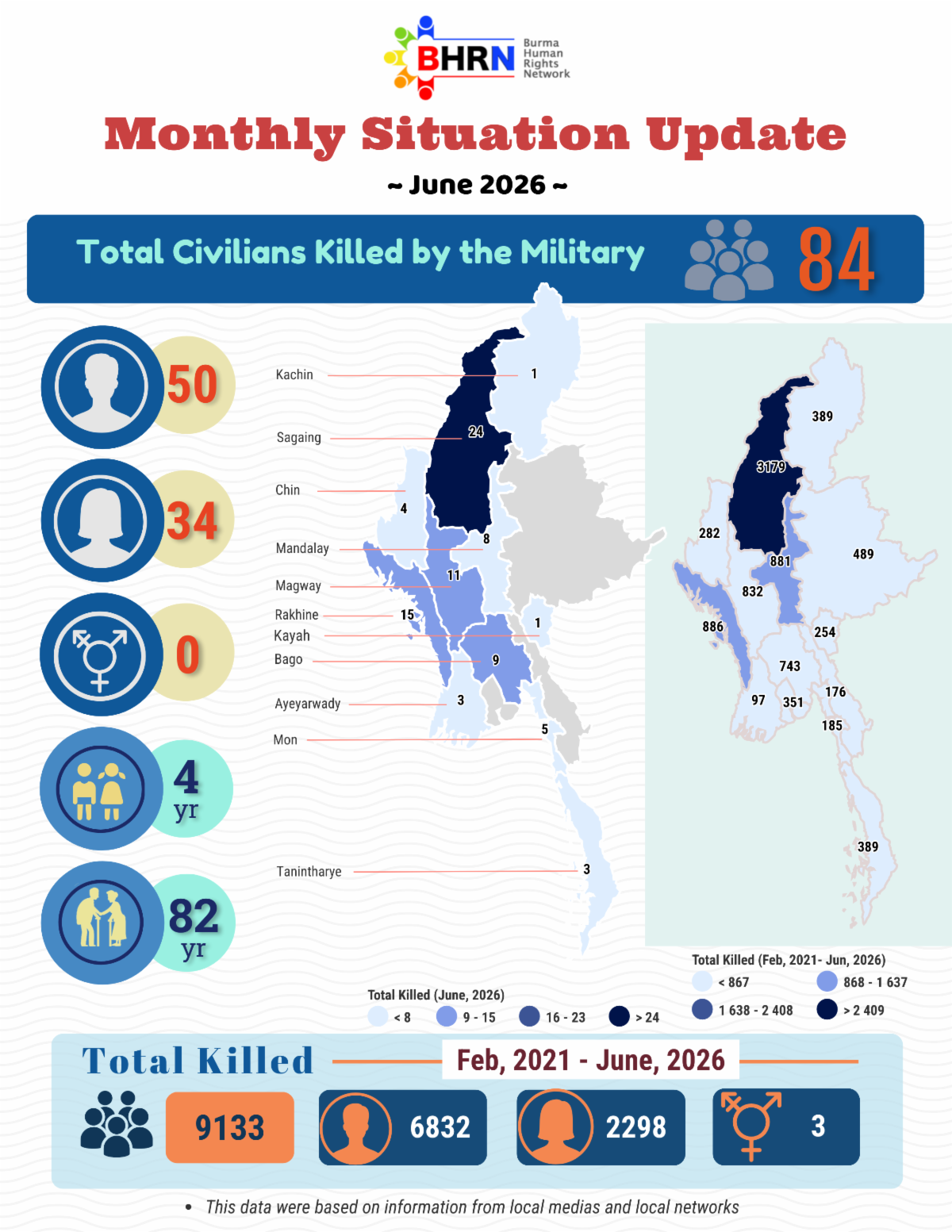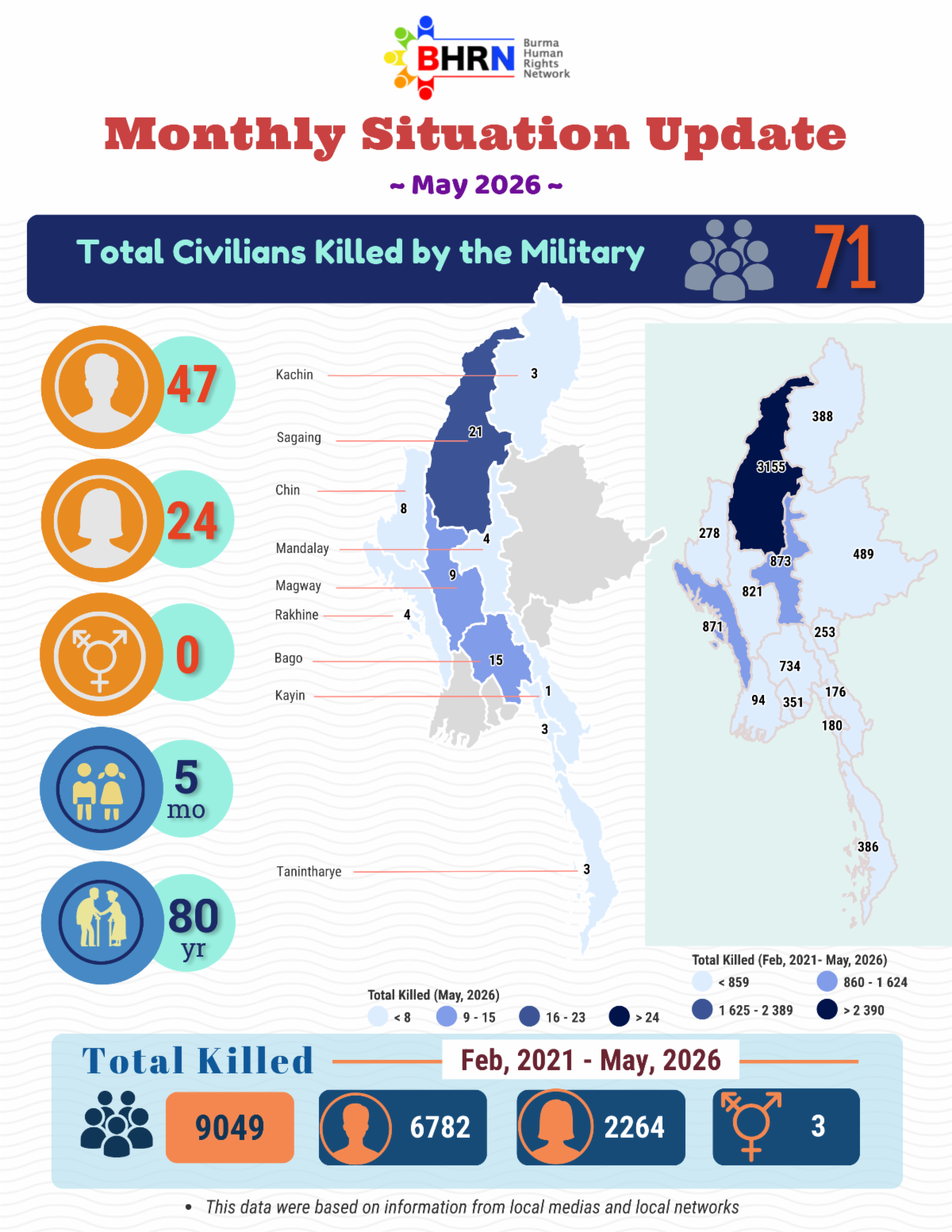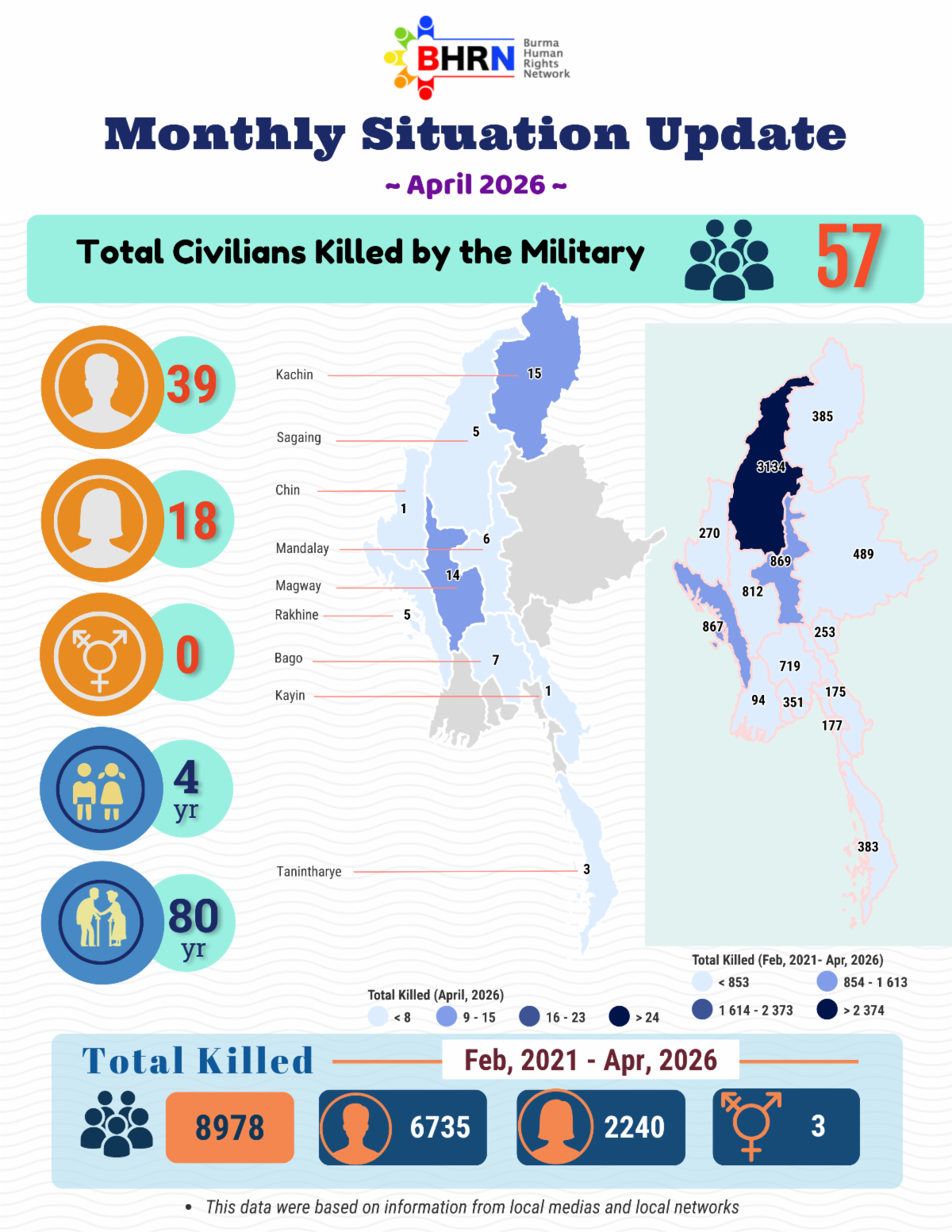

Methodology
Information in this document has been gathered by the BHRN team by primary and secondary research methods. We employed local researchers and local informers across Burma including in Rakhine State, Thai-Burma border and the Bangladesh border monitoring, investigating and documenting incidents of human rights violations. Any information we receive is carefully checked for credibility and authenticity by experienced senior research officers in the organisation. Once the information is approved the editorial team prepares the final document.
1Info-graphs of BHRN’s Report
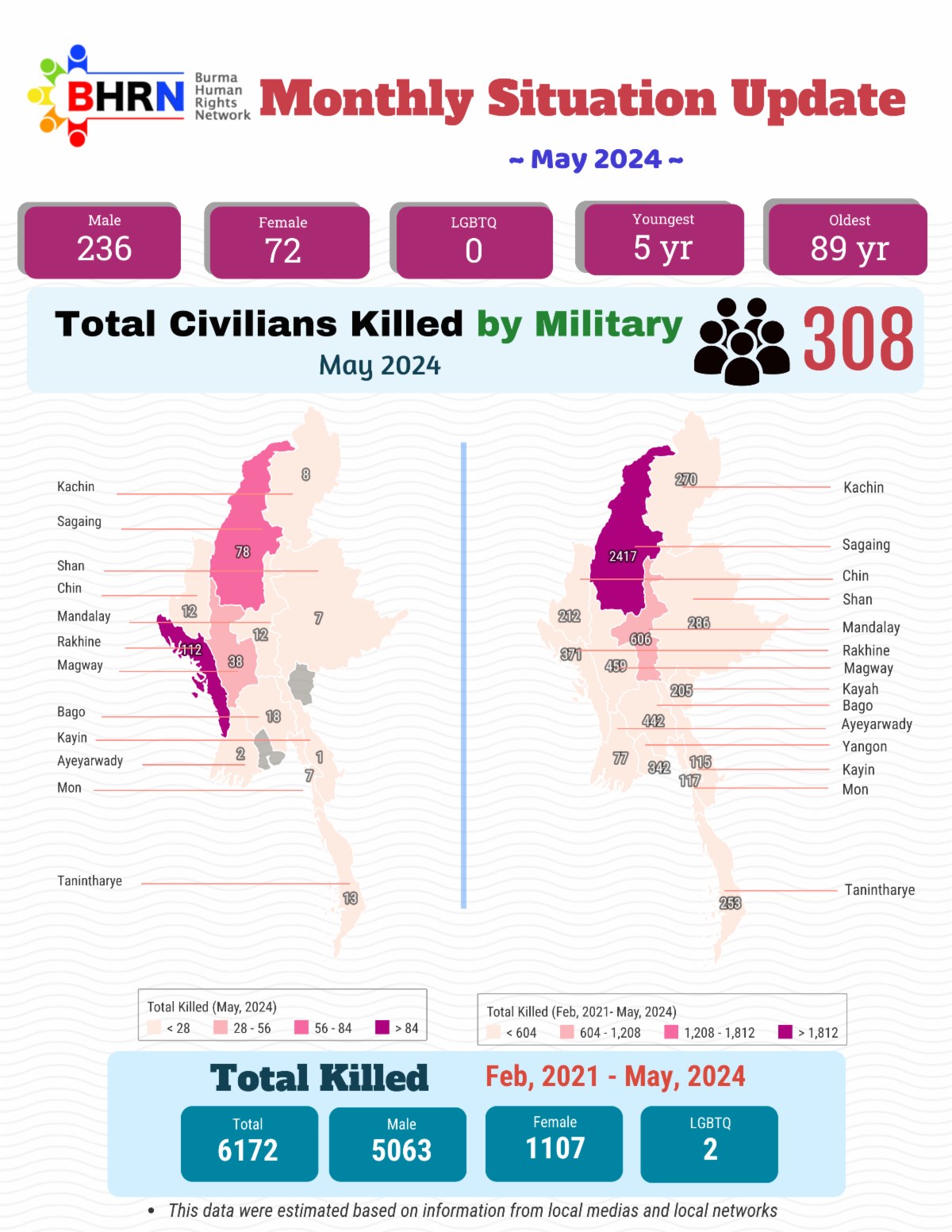
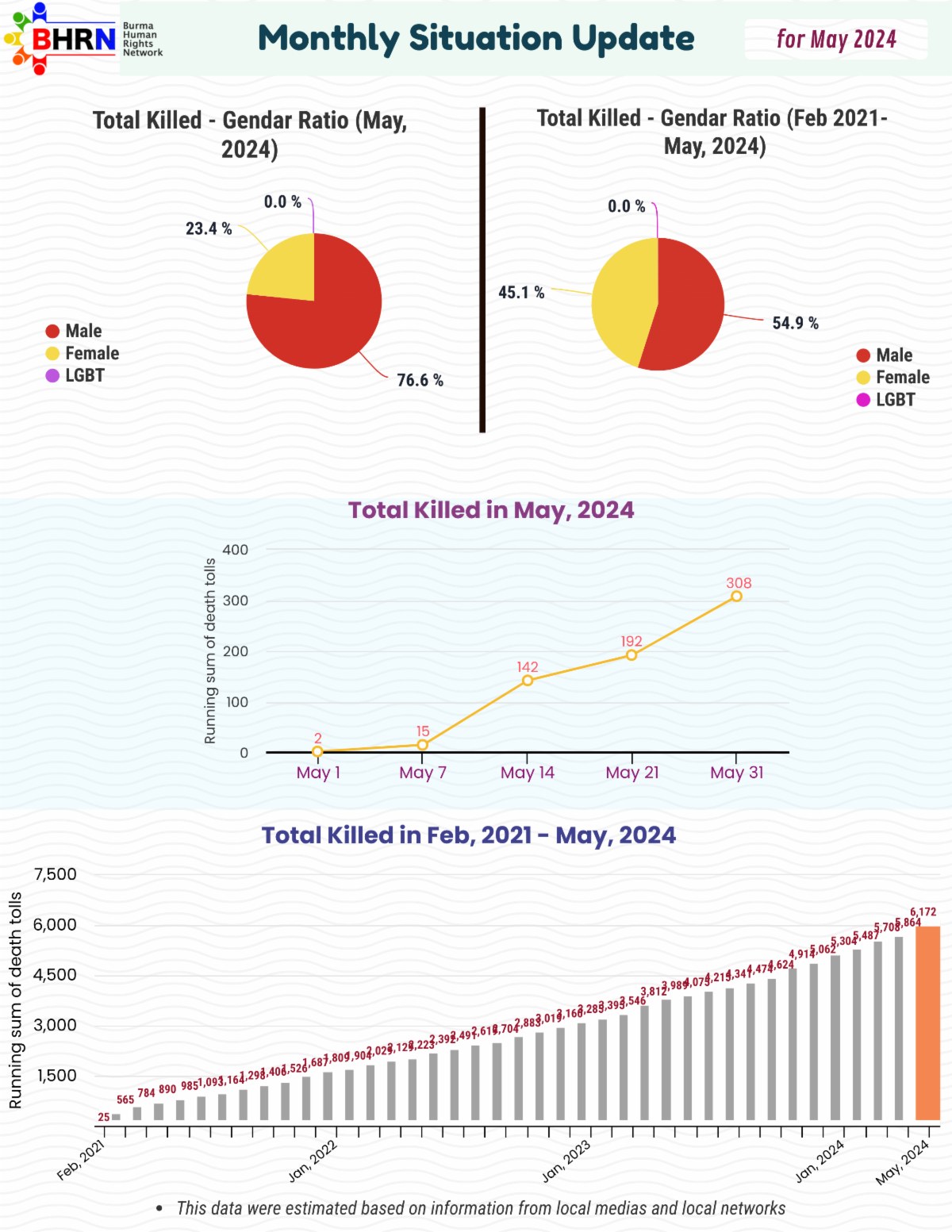

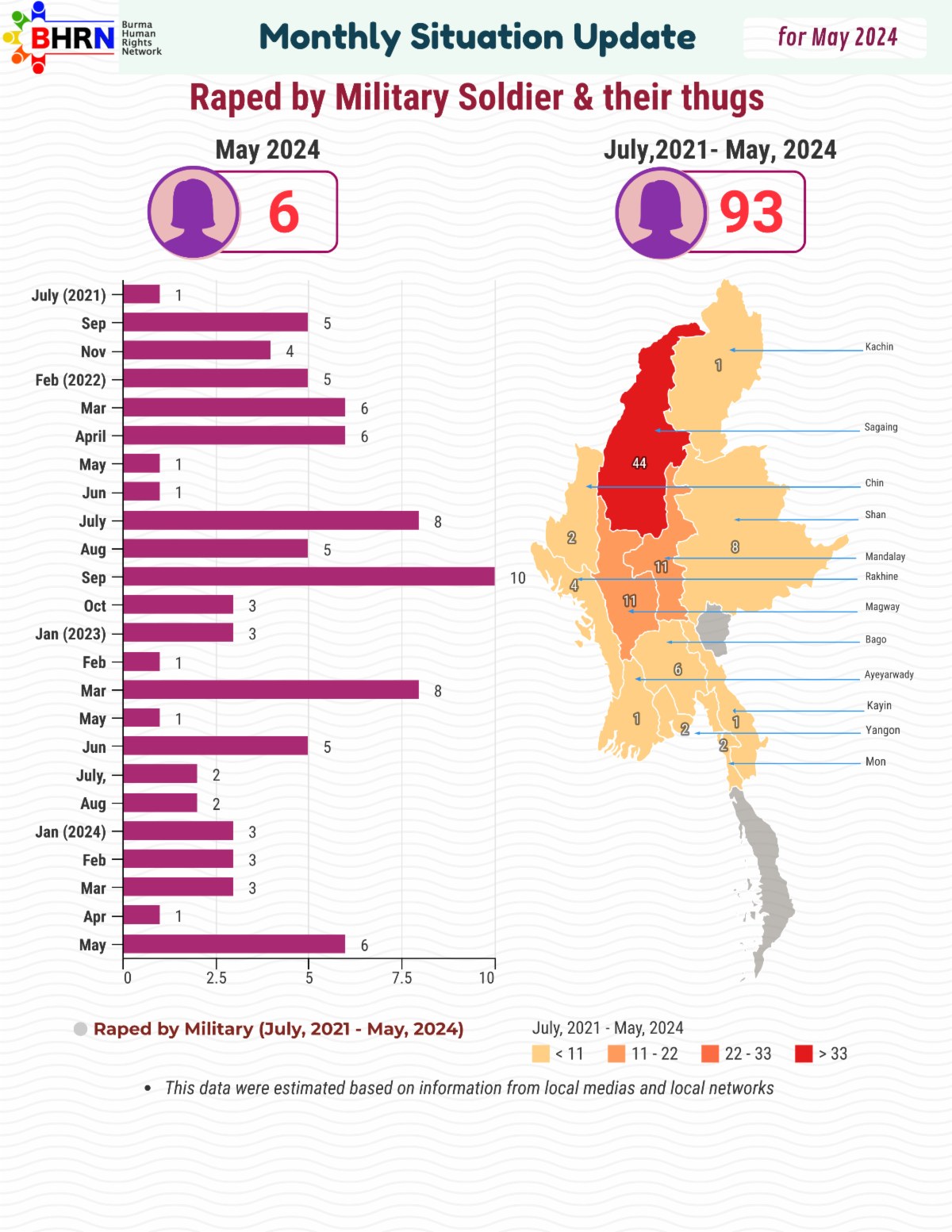
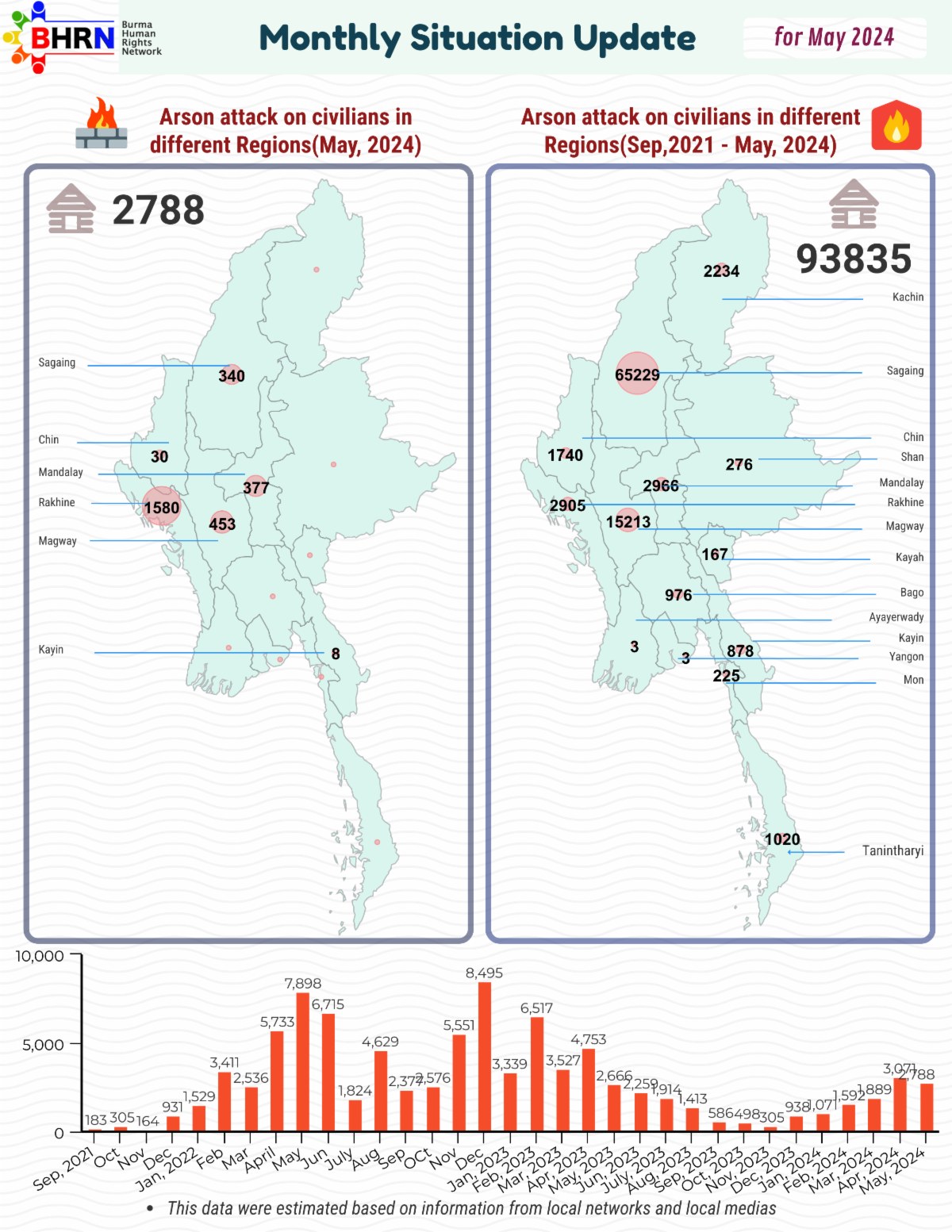

Tap any image to see it full size.
2Analysis
Background and context
- Two key developments that took place last October have contributed to the current economic troubles in Myanmar.
- They are - announcements by the United States on the imposition of sanctions on Myanmar State-owned Myanma Oil and Gas Enterprise (MoGE), a key source of foreign exchange for the junta and other is the beginning of “Operation 1027”, which not only put the junta on the back foot militarily, but it also gives a major blow to the junta’s source of income. The military operation by the Three Brotherhood Alliance that started on 27 October led the junta to lose the major border trading towns with China to the rebel groups.
- According to some experts, the income from the sales of oil and gas amounts to more than US$1.5 billion in the financial year 2020-2021. The border trade with China accounts for USD 3 billion in 2023, up to 40 percent of the country's overall border trade figure.
- Since last October the junta also lost control of most of the border trading points along the Thai, Indian and more recently with Bangladesh, to different rebel groups. The military losses to the ethnic armies also led to the loss of more than USD 7 billion per year in total border trade between Myanmar and its neighbours.
- Also, as the junta faced debacles militarily, with mounting casualties, it attempted to conscript civilians by enforcing the mandatory military service law in early February. That has led many youths, who are the key contributor to the country’s productivity, to flee the country.
- The widely held assumption that sanctions never work seems to be changing in Myanmar's context. The junta is starting to show signs of desperation due to economic woes which are largely contributed by the loss of foreign income due to sanctions on the country’s oil and gas industry.
- In a sign of frustration, the junta urged its proxy political parties to issue a statement calling for the end of international sanctions. 25 political parties led by the Union Solidarity and Development Party (USDP) in a statement issued on 29 May urged the Western powers to end their sanctions against the regime, saying it was against the spirit of the United Nations Declaration. Past experiences indicate that such kind of calls from the pro-junta groups will not get any attention in the Western capitals.
- Meanwhile, during the month of May, the junta continues to face loss of territory to the ethnic armed organisation, most notably in Rakhine State, where the Arakan Army (AA) has controlled nearly half of the state, and it is now aiming to strike the state capital Sittwe at any time. In late May AA inflicted another major blow to the junta by taking over Buthitaung, a key town near Myanmar Bangladesh border.
- These developments are having an impact on each other in a sequence, and they all tend to contribute to the weakening of the control of the military junta in the country.
- The question many international observers ask at this stage is will the junta make a political move to appease the international community in a bid to find a reprieve from the current challenges it is facing.
- The previous military junta survived the international sanctions for several years, mainly because it was receiving income from the sales of gas and oil to neighbouring countries and from the income from border trade. Diplomatically it received the support of China and other Asian nations as well as Russia, a permanent member of the UN Security Council.
- However, this time round the junta seems to be losing all the sources of income and international support, especially from its staunch supporter China which has become somewhat ambivalent after the latest military takeover.
Myanmar's economy in free fall
Many Myanmar observers largely agreed that the junta could maintain its iron grip on power despite of major economic downturn, as well as unprecedented local and international pressure since its first intervention in the country’s politics in 1958. However, the current regime is facing all these pressures at one time, especially during the past few months.
It is no doubt that Myanmar's economy has been in crisis since the military coup in February 2021, and the COVID-19 pandemic has made it worse. The World Bank said in one of its recent estimates that in 2023, Myanmar's economy was 30% smaller than it would have been without the pandemic and coup.
Myanmar currently faces hyperinflation, especially in the prices of consumer goods and commodities, due to a massive depression of Kyat (which has lost more than 50 per cent of its value since the military coup), as well as a shortage of fuel.
On the other hand, the conflict continued to create misery for the people in many parts of the country, a regular humanitarian update for May issued by the UN this month put the number of displaced people across Myanmar to 3 million.
The worsening humanitarian crisis in Rakhine?
The Arakan Army (AA) made important territorial gains in Rakhine State, where it is believed to have taken over at least 34 bases of the junta troops and several towns. Currently, AA is pushing in two directions in Rakhine State including an attempt to cut off the Myanmar army from the Bangladesh border. It has taken over Buthitaung, a major town in the region where a sizable Rohingya Muslim population lives, in mid-May. AA reportedly pushed further towards Maungtaw, a Rohingya Muslim majority town on the Myanmar-Bangladesh border. It is also pushing towards taking control of the state capital Sittwe.
The main question arises of how AA will treat the Rohingya people, several accounts support AA persecuting Rohingya, and other reports suggest AA is showing of as if it has been helping Muslims since the rebel group took over Buthitaung in mid-May. Several Rohingya families were kicked out from their properties and AA has burned all of these properties in downtown Buthidaung. AA mouthpiece media and supporters are heavily countering with their own narrative against the above findings. Some reports suggest that AA has freed political prisoners locked up by the junta in Buthitaung prison after it took over the town.
AA may be under pressure from right-wing Rakhine groups to continue the same policies of persecution of Rohingya Muslims as the military regime did. Therefore, AA's policies on Rohingya Muslims could be as oppressive as they used to be or AA could be more humane toward the Rohingya Muslims than the military regime, it depends how international community will respond on current AA's action.
The first point is the AA understands how important it is to get support from the international community to support its military campaign against the military regime. The second point is AA will only garner continued support from China- although from behind the scenes- when it can bring back stability to Rakhine State, where Beijing has a massive economic and strategic interest.
At this stage, the AA and international humanitarian organisations should work together on a strategy for how to support the conflict-affected population under international humanitarian principles. However, humanitarian organisation should be be independent and remain neutral to be able to criticise AA's action in Rakhine state.
How is the junta addressing these crises?
To tackle the economic crisis the junta is using a heavy-handed approach of clamping down on the business operators. They include forcing them to stop speculation of the price of foreign currencies and commodities. Such an approach had never worked in the past, arrest of businessmen would instead contribute to a further shoot up of the prices.
The statement by 25 political parties to end the sanction was also another tested tactic that has never worked in the past.
The junta head still seems to be expecting his troops to retake the lost territories. In recent weeks the junta head exercised the same sort of internal control measures his predecessors did, including reshuffling of the top military officials by bringing the loyalists to take up the key positions.
He replaced the commanders of military regions, where the junta troops were suffering losses. However, that approach has failed as the junta continued to lose ground and according to many analysts morale among the troops is the lowest at this stage and changing the leadership would help a lot.
Like in the past, the regime is particularly sensitive about who leads the Nay Pyi Taw Command, a key role that is assigned to protect the junta leaders. The junta replaced the head of Nay Pyi Taw Command four times since the military coup. The latest commander appointed in the administrative capital is Lieutenant General Soe Min, a close confidante of the junta head.
The Irrawaddy news agency reported that Soe Min was sent to lead the Nay Pyi Taw command despite overseeing a series of military defeats in his previous role as the Commander of the Coastal Command based in the Tanintharyi Region.
With the tightening international sanctions including a ban on the sale of jet fuel to the junta imposed by the UN earlier this year, the junta’s war machine could not be as lethal as it used to be. However, the junta is continuing war crimes by continuing to target civilians.
How to find a much-needed political solution to the country’s problems?
The junta is still not interested in finding a political solution at this stage. It is in no mood to conduct a dialogue with the jailed civilian political leaders. A recent request by the Association of Southeast Nations (ASEAN) to do so has been dismissed. In the latest move, the junta rebuked its close ally Cambodia dictator Hun Sen by turning down his request to do a video call with the pro-democracy leader Daw Aung San Suu Kyi, the Phanom Penh newspaper reported. The request was made by Hun Sen during his virtual meeting with Min Aung Hlaing in early May.
Without the involvement of civilian leaders of the National League for Democracy (NLD), which won the last general elections held in 2020, it is impossible to find a political solution in Myanmar. This is a well-accepted fact which is also shared by some supporters of the Myanmar military.
The previous military junta got a message that it needed to work together with the opposition in 2007- when the country was economically bankrupt, although not as bad as the current situation. Also, they understood that the international community would not readmit Myanmar unless it worked together with the opposition politicians.
The current military junta must use this precedent of the past and should ask itself a question, if not now then when?
Observation and Analysis
- So far, the junta and the members of their families as well as the cronies close to it are not severely affected by the current economic crisis. Also, their security is not affected even though the country’s civil strife has significantly intensified since late last year.
- However, it is beyond anyone’s doubt that the situation is deteriorating very fast and could reach a stage quickly where the junta and its associates could suffer not only economically but could threaten their lives.
- Such an understanding would help the junta to find a solution by engaging with the civilian politicians sooner rather than later. The key approach should be to recognize the results of the last elections and establish an accountability mechanism for the atrocities committed by the junta during its illegitimate rule.
- International mediation is of utmost importance to find a viable solution to Myanmar’s crisis, the most important role perhaps would be that of China, India and to a certain extent Thailand and Bangladesh.
- From the side of the opposition, especially the National Unity Government (NUG) and many other groups are understandably unwilling to enter into a dialogue with the murderous military regime. But apart from the military solution they also are not offering a viable alternative for how to address the country's economic and political woes.
- From the current approach, it seems that all opposition forces are aiming to topple the military regime after taking over its headquarters in Nay Pyi Taw. Such an approach would have been unthinkable before Operation 1027 and the successes of AA and other groups militarily across the country. It sounds realistic now, more so in recent weeks with other major groups making advances, for example, the Kachin Independence Army (KIA) in the north is aiming to take over the state capital Myitkyina. However, at this stage, no group is sure when this goal will be achieved and at what cost.
- With the situation further deteriorating in Myanmar ASEAN took the initiative at least to call for “the immediate cessation of all forms of violence and the use of force to create a conducive environment for the safe and timely delivery of humanitarian assistance and inclusive national dialogues,” it sounds like a right move by ASEAN; however, it is unlikely that ASEAN's call would not be accepted by the conflicting parties in Myanmar.
- However, such a call could trigger a regional approach to find a solution to Myanmar’s crisis, it could be more effective if Myanmar’s neighbours, especially China and India play a proactive role beyond their strategic interest to find a viable political solution to end Myanmar’s deepening economic and political crisis.
3Rohingya Issue
3.1Rohingya in Rakhine Updates
- 6 May
4 Rohingya Muslims were killed, and 15 others injured in a shelling on Buthitaung Township in Rakhine State on 4 May, a local source. He said it was not clear who was responsible for the shelling. The junta troops and the Arakan Army (AA) rebels have been fighting recently near Buthitaung to the town. The junta said it was not responsible and blamed AA for targeting civilians.
Source: RFA - 9 May
A US-based think-tank said the junta and its ally the Arakan Rohingya Salvation Army (ARSA) are forcibly recruiting Rohingya Muslims. The United States Institutes of Peace (USIP) said those Rohingya Muslims recruited are being used as human shields. USIP said in a report recently issued that after the junta introduced mandatory conscription law in early February this year Rohingya Muslim youths were rounded up and forced to join the military. It said Rohingya Muslims were given a few days of training, and they were asked to fight on the battlefields. It said they are used as human shields for junta troops. The report also said that the junta and ARSA troops have close collaboration and the commanders of ARSA have recently issued orders to its troops to support the junta troops. The report also accused ARSA of involvement in helping the junta in the conscription of Rohingya Muslims.
Source: Khit Thit Media - 13 May
The Arakan Army (AA) said on 8 May that more than 7000 Rohingya Muslims have taken refuge in the territory under their control after a series of airstrikes carried out by the junta troops in Buthitaung Township in Rakhine State in recent days. A spokesperson of AA said that the displaced Rohingya are from the villages in Buthitaung which are still under the control of the junta. They include Kakyabat, Kakyabat Kan Pyin, Maung Na, Ah Lei Chaung, Bagone Narr and Latthar villages. The AA spokesperson said some Rohingya fled to the junta’s border security force battalion no 8.
Source: BHRN - 15 May
10 civilians from the same family were killed and five others injured in a shelling by the junta troops on a civilian target in Thandwe Township in Rakhine State, a local source told the Burma Human Rights Network (BHRN). The source said the junta troops fired heavy weapons on Linthee village in Thandwe, where the majority of the population are Kaman Muslims. The source said the junta established its bases in Linthee village in the past few weeks.
Source: BHRN - 17 May
Arakan Army forces have been accused of setting fire and looting Rohingya homes in Rakhine. More than 200,000 people fled the arson attacks. Eyewitnesses told BHRN that they saw the Arakan Army shooting at villagers, including a point-blank execution of an administrator after he ignored questions from an AA soldier. Rohingya sources say 8,000 homes in the central area of the village were set on fire by AA fighters who had told the Rohingya residents to evacuate their homes despite there being no junta forces in the area.
Source: BHRN - 17 May
A school sheltering Rohingya fleeing violence was shelled, leaving 18 civilians dead. Locals blamed the Arakan Army for the attack, though the group denies this.
Source: BHRN - 22 May
A joint statement issued by a group of 195 Civil Society Organisations (CSOs) called for the end of the exploitation of the persecuted Rohingya Muslims for the benefit of certain organisations and individuals politically and militarily. The statement said at least 100 Rohingya Muslims were massacred by the Myanmar military in Ah Ngu Maw town in Rakhine State in March this year. The Rohingya Muslims were killed after the Myanmar military accused them of supporting a rebel group the Arakan Arkan (AA) operating in the area. The Myanmar military which has been declared a terrorist group by pro-democracy groups is committing serious violations of the human rights of Rohingya Muslims. The Myanmar military was indicted by the International Court of Justice in 2019 on an allegation of committing genocide against Rohingya Muslims. The military junta also uses Rohingya Muslims as forced laborers and conscripts and sends them to battlefields as human shields.
Source: BHRN - 26 May
The military junta continuing to force displaced Rohingya Muslims to join the Myanmar military as conscripts, a local source said. They said a group of junta officials visited several camps of Rohingya Muslims in Sittwe to force IDPs to join the Myanmar military. The source said the officials visited Basara, Ohn Taw Gyi, Ohntaw Gyi Che, Bawduda, Thakaypyin and other IDP camps. He said the Rohingya families were forced to commit one conscript per family or give up to Kyat 200 000 per household as compensation.
Source: Arakan Express - 30 May
Forcible recruitment of Rohingya in Rakhine State persists as the junta continues to lose ground in the fight against the Arakan Army. The junta has continued to threaten to withhold food and aid from villages that do not give young men for conscription to the army.
Source: BHRN
3.2Rohingya in Bangladesh Camp
The Director General of the International Organization of Migration, Amy Pope, visited the camp. IOM's partner NGOs and donors joined her. The DG's team visited many IOM projects, such as Side Development Projects, Site Management Projects, Women's Empowerment Projects, and Mental Health and Psychosocial Support projects, especially the Rohingya Cultural Memory Centre (RCMC) in Camp 18.
Source: BHRN- 9 May
A US-based news agency Associated Press reported the incident of sexual exploitation involving the Rohingya girls who fled their homes in Rakhine State due to the oppression of the junta troops. The AP report published on 8 May said Rohingya women who tried to flee using the sea routes mostly faced exploitation. In the report, a 12-year-old girl said she was sexually exploited by the captain and staff on the ship and told her not to mention the incident to anyone. The report using the girl’s name as “N” (not a real name) said the perpetrators had threatened to kill her if she disclosed the incident to others. The information in the AP report is based on the interviews conducted with the Rohingya Muslim boat people at a camp in Aceh province in Northwestern Sumatra, Indonesia. The girl said she travelled alone from Rakhine State to go to Malaysia.
Source: VOA - 13 May
A head Majhi of Camp 04, Kutuapalong Cox's Bazar, was shot dead allegedly over establishing dominance in the area.
Source: BHRN - 17 May
National Security Intelligence (NSI) and Police raided a meeting of Rohingya-led organizations organized by the Arakan Rohingya Society for Peace and Human Rights (ARSPH) in Ukhiya. NSI and Police took all the participants to Ukhiya Police Station and released them after a few hours. Police seized the smartphones and laptops of some participants, accusing them of sharing sensitive and security-related information with international journalists and media.
Source: BHRN - 20 May
At 7:00 pm, RSO members, along with ABPN police, were attempting to abduct a young man from Camp 1E forcibly. His parents and brother shouted for help. His mother and brother tried to pull him back. Later, some community members intervened to try to get her son released. During this confrontation, RSO members shot his mother. She reportedly died later after being taken home. The RSO stabbed another man. A large crowd gathered and attacked and beat the RSO members and ABPN police by the community people. People in the camp-1E are now worried. Many men are leaving, fearing that the RSO and police will return tonight to retaliate against those involved.
Source: BHRN - 21 May
Violence escalated in Camp 1 when Rohingya refugees clashed with the Armed Police Battalion (APBn) over RSO members. Refugees in Camp 1 reportedly searched for members of the Rohingya Solidarity Organisation, leading to the destruction of some "RSO shelters." Tensions escalated when RSO members sought refuge in an APBn outpost, prompting refugees to besiege the facility and demand that the APBn hand over the RSO individuals. The situation intensified when APBn attempted to transport the RSO members away from the scene in a bus. A large crowd of refugees surrounded the vehicle, insisting the RSO members be handed over to them. In response, APBn police discharged some kind of pellet firearm to disperse the crowd, resulting in several injuries.
Source: BHRN - 22 May
Violence escalated in Rohingya Camp 4 when the Rohingya Solidarity Organisation (RSO) fired their guns and injured six, including one girl, four children, and an older woman. Refugees reported critical conditions as APBN police stood by amid the chaos. On the same night, a mob attack in Camp 15 killed a member of RSO.
Source: BHRN - 23 May
Mohammed Foyas, a Head Majhi of Camp 8e, was seriously beaten by the community in Camp 8e.
Source: BHRN - 24 May
A fire ripped through Camp 13, destroying over 400 dwellings and buildings and leaving an estimated 4,000 refugees homeless. A cyclone that hit a few days later further battered the camps and severely affected the vulnerable refugees, especially those already impacted by the fire. These victims were already in a dire situation and suffered heavy mental pressure and trauma. Community volunteers trained by the Bangladesh Fire Service Unit and BDRS, NGO workers, and the Bangladesh Fire Service Unit responded rapidly to and extinguished the fire.
Source: BHRN - 28 May
The community attacked a group of RSO armed members while they were walking through the street in Camp 8e. One of the armed group members was killed.
Source: BHRN - 28 May
The community attacked a group of APBn who had been raiding camp 8e at night to arrest the perpetrators who were suspected to be involved in the incident that killed a member of the armed gang. According to some photos and video footage, community people seized back the two handcuffed men who APBn arrested in the raid.
Source: BHRN - 29 May
Gunshots were fired around Kutupalong and Balukhali camps, including Camps 2w, 1w, 3, 5, 17, 8w, and 8e at night. The shootings resulted in at least four community people being injured and killed, including a young boy and a teacher at an NGO learning center in Camp 17.
Source: BHRN - 30 May
APBn personnel and senior officials from Cox’s Bazar, along with APBn camp personnel from Camp 09, organized two meetings with the elders and religious leaders of the community at two different mosques in Camp 8e. During these meetings, APBn raised concerns about the escalating security issues and community chaos in the camp, which they said are detrimental to the law and order of Bangladesh. APBn requested the community to identify and expel gang members from the camp, arrest them if possible, and hand them over to APBn without resorting to vigilante actions. APBn senior officials stated that they have never negotiated with any armed gangs and reaffirmed their commitment to ensuring the safety and security of refugees in the camp.
Source: BHRN
4Violations of Freedom of Religion and Belief
- 6 May
Four civilians including a monk were killed in a shelling by the junta troops on a village in Kyauktaw Township in Rakhine State, a local source told Burma Human Rights Network (BHRN). He said five other people were injured in the shelling of Ahlay Kyun village. The source said local civilians are afraid of the junta troops targeting the civilians from the air.
Source: BHRN - 12 May
Three monks were injured in a shelling by the junta troops in a village in Moneywa Township in Sagaing Region, a local source told Burma Human Rights Network (BHRN). The source said the monks were injured after a shell drooped on their monastery in Kanma village. He said the injured monks were admitted to Moneywa Hospital for treatment.
Source: BHRN - 13 May
Two churches were destroyed in an airstrike by the junta troops on Twanzan Township in Chin State on 11 May, a local source said. The source who declined to be named in the report said the junta carried out the airstrike without any ongoing conflict in the area. A local group the Chin Human Rights Organisation (CHRO), said at least 35 religious buildings in Chin State have been destroyed due to airstrikes by the junta troops since the military coup in February 2021.
Source: RFA - 22 May
The junta ordered the closure of 12 Islamic schools in a village in Myeik Township in Tanintharyi Region, a local religious leader told Burma Human Rights Network (BHRN). The source said the order for the closure of schools in Tanyeik village was issued verbally by the head of the village U Zaw Min Latt. The source said the closure of the school came as the village head took bribes from the schools. The source said U Zaw Min Latt invited all the religious leaders of the 12 schools to a meeting on 14 May where he collected Kyat 50,000 from each, saying that the junta ordered him to take the funds. When the incident was reported on social media U Zaw Min Latt issued a verbal order to close the school, the source said. He threatened the schools that he would ask the junta to demolish the schools if they tried to reopen the schools. There are a total of 13 Islamic religious schools in Tanyeik village, one school whose administration is close to U Zaw Min Latt is allowed to continue its classes.
Source: BHRN - 24 May
The junta demolished a statue of Buddha in a village Hlaing Tharyar Township in Yangon on 24 May, a local source told Burma Human Rights Network (BHRN). The source said the statue which was under construction was destroyed after the junta said the land on which it was being built was inside the military control area. The source said the municipal office of Anawratha Industrial Zone 2 asked the engineers building the statue to demolish it. As they failed to do so the junta sent its troops with armed guards to demolish the statue.
Source: BHRN - 26 May
At least 116 religious buildings in Chin State were destroyed during the past three years due to attacks by the junta troops, a civil society group the Chin Human Rights Organisation (CHRO) said in a statement issued on 26 May. The statement said the religious sites were destroyed in airstrikes, shelling and arson attacks carried out by the junta troops after the latest military coup in Myanmar in 2021. It said the largest numbers of religious sites were reported in Ha Kha, Pha Lam, Kanpaklat, Mindat, Tedim and Twanzan townships in Chin State, where the majority of people live are Christians, the statement said.
Source: Irrawaddy - 29 May
A monastery was destroyed in a shelling by the junta troops in Hsi Hseng Township in Southern Shan State on 27 May, a spokesperson of an ethnic armed organisation PaO National Liberation Army (PNLA) said. He said the monastery was deemed sacred by the local people. PNLA spokesperson said one civilian home was also destroyed in the same attack.
Source: BHRN
5Human Rights Violations
5.1Rape as War Crime (Committed by Junta Troops)
- 24 May
At least two women prisoners said they faced sexual exploitation by the prison authorities in a jail in Mon State, a source close to the victims told the Irrawaddy news website. The source said the two victims aged 24 and 50 years old were being inappropriately touched by the female prison guards of Kyeikmaraw jail, the source said. He said the incidents took place in front of the male prison staff.
Source: Irrawaddy - 27 May
Two members of a pro-junta militant group Pyu Saw Htee are accused of committing sexual violence on one woman in Sagaing Township in Sagaing Region on 22 May, a local source told Burma Human Rights Network (BHRN). He said the victim belonged to a family close to the military junta. He said the incident took place at Sagaing Mountain, where the victim came to meet her boyfriend. The source said two members of Pyu Saw Htee Kyaw Soe and Zaw Gyi raped the woman after they arrested her boyfriend. The victim reported the incident to a police station in Sagaing first, however, after the police failed to take action, she reported to higher authorities in the Administrative Capital Nay Pyi Taw, the source said. Kyaw Soe and Zaw Gyi were later arrested, he said adding that the officials from Nay Pyi Taw are also investigating if any other Pyu Saw Htee members were involved in the crime.
Source: BHRN
5.2Extra Judicial Punishment
5.2.1Arbitrary arrests and imprisonment
- 2 May
The junta troops abducted More than 20 youths in Ye U Township in Sagaing Region on 29 April to force them to serve in the Myanmar military under a recently introduced conscription law, a local group the People Defense Comrade said. The source said the junta troops who were based in the town raided the civilian homes in Aung Minglar and Shwe Pyithar wards and other places in the town on 29 April, and they forcibly took away youths who refused to serve in the military, the source said.
Source: BHRN - 16 May
A group of 7 women were abducted in Ohthekone Township in Bago Region to force them to serve in the military, a local source told Burma Human Rights Network (BHRN). The source said six of them were sent to join military training in Taungoo Township. He said one is still being held in a local police station.
Source: BHRN - 17 May
The junta arrested more than 80 youths in the Rakhine State capital Sittwe, a local source said. He said those who were not from Sittwe were arrested during a series of raids by the junta troops in different monasteries in Sittwe. He said it was not known where the arrested youths were held.
Source: RFA - 30 May
The military junta arrested at least 15 innocent civilians in a village in Monewa Township in Sagaing Region on 30 May, a local source told Burma Human Rights Network (BHRN). He said the civilians from Kan Ma village were arrested after a convoy of soldiers from the Myanmar Army was ambushed near the village. He said among the civilians arrested include 5 women including those who are them are over 50 years of age.
Source: BHRN
5.2.2Issues of Political Prisoners
- 4 May
A political prisoner was sexually assaulted in Tharyarwaddy Prison in Bago Region; a civil society group the Political Prisoners Network Myanmar (PPNM) told the Yangon Khit Thit newspaper. Ko Theik Tun Oo (a.k.a) Ye Ye who is a member of the LGBTQ+ community was raped by a fellow prisoner sharing the same cell with the victim. PPNM source was quoted as saying that the prison authorities failed to take action against the perpetrator named Pyu Gyi who was jailed for involvement in a criminal offence. PPNM said Ye Ye faced physical assault as he tried to defend himself from the sexual act. It said Pyu Gyi attacked by hitting a stone on his victim’s head. Ye Ye was admitted to the prison hospital after the incident. The incident took place after Ye Ye was moved from Yangon’s Insein Prison to Tharyarwaddy prison in February this year, PPNM said. Ye Ye is serving a 96-year prison sentence for his anti-junta activities. He was arrested in September 2021 on various offences including an offence under the Arms Act. PPNM said like Ye Ye many other LGBTQ+ prisoners are facing sexual assaults and attacks in several other prisons across Myanmar.
Source: Khit Thit Media - 11 May
A political prisoner has died in Daik U prison in Bago Region due to insufficient medical care in the prison, the spokesperson of the All-Myanmar Political Prisoner Network Myanmar (PPNM) told Yangon Khit Thit newspaper. Ko Lin Htun who is jailed for 10 years for alleged violation of the country’s security act died on 7 May, after the prison authorities refused to allow him to take medical treatment at a hospital outside of the jail for his unspecified emergency medical conditions. Ko Lin Htun was a resident of Lewai Township in the Mandalay Region.
Source: Khit Thit Media
5.3Extra Judicial Killings and Enforced Disappearances
- 3 May
A civil society group the Association for Assistance of Political Prisoners (AAPP) said the junta troops killed at least 121 civilians including women and children during April this year. A statistic issued by AAPP said that the deaths included 16 children and 33 women. It said most of the deaths were caused by the junta’s airstrike on civilian targets, adding that 42 were killed in the airstrike in April. AAPP said Geographically Sagaing Region faced the highest number of deaths with 38 fatalities due to atrocities committed by the junta.
Source: BHRN - 11 May
The junta troops shot dead 30 displaced civilians in a village in Myinmu Township in Sagaing Region on 11 May, a local source told Burma Human Rights Network (BHRN). The source said they were killed in the compound of a monastery in Lathtu Taw village. He said the dead civilians were buried on the same day.
Source: BHRN - 17 May
A pro-junta militant group Pyu Saw Htee killed two civilians in Gangaw Township in Sagaing Region on 16 May, a local source told Burma Human Rights Network (BHRN). He said the group carried out killings during their raids on two villages in the town. The source said the junta troops ransacked the villages. He said among the deaths due to the attack by the junta included a 10-year-old boy.
Source: BHRN - 19 May
The junta troops slaughtered 10 civilians in a village in Phaung Pyin Township in Sagaing Region on 17 May, a local source told Radio Free Asia. The source who is involved in providing humanitarian assistance to victims said the signs of assault were found on the bodies of the victims.
Source: RFA - 21 May
At least 4 civilians including a pregnant woman were shot dead in Kawkareik Township in Kayin State on 19 May, a local source told Radio Free Asia (RFA). He said those killed were displaced civilians who trying to flee to Thailand, to escape fighting between the junta troops and ethnic armed organisations in the region, RFA reported.
Source: RFA - 23 May
The junta troops burned to death 7 civilians in Yesagyo Township in Magwe Region on 17 May, a local resistance group Yesagyo Revolution Group (YRG) told Mizzima news agency. A spokesperson of YRG said the victims, which include a schoolteacher were killed after they were abducted by the junta troops to guide them to the camps of YRG in the area. He said the victims were abducted from their village by a group of 300 junta soldiers who raided Kyaukhtet village. The spokesperson said one man in the group was shot dead and six women were burned to death.
Source: Mizzima - 29 May
A rebel group the Arakan Army (AA) said the junta troops have killed 268 civilians and wounded 640 others since the fighting resumed between AA and the junta army last November. The figure was released by AA’s social affairs wing the Humanitarian and Development Organisation (HDCO) in a statement issued on 29 May. The statement said it collected the numbers of casualties during the past six months since the fighting between AA and the junta troops on the 13th of November 2023. It said that the deaths included 182 Rakhine Buddhists, 78 Rohingya Muslims, as well as 3 members of the Mro ethnic group, 2 Burmese, 2 members of the Khumi ethnic group and 1 from the Marama Gyi community. And it said among those injured 43 per cent are women, the statement said.
Source: BHRN - 29 May
The junta troops shot dead 4 civilians in the Rakhine State capital Sittwe on 29 May, a local source told Burma Human Rights Network (BHRN). It said the killings took place when the junta troops raided the Setyoe Kya ward in Sittwe on midnight of 29 May, the source said, adding that the victims were killed on suspicion of having linked with a rebel group the Arakan.
Source: BHRN
5.4Violence attacks by pro-junta thugs
- 9 May
Three civilian youths were brutally murdered by a pro-junta death squad known as the “Black Death”. Their bodies were found with the tag of the death squad hanging on their neck, a local source said. He said the civilians were killed after they were accused of being the members of a pro-junta defence group, the People Defense Force Battalion 3601 based in Pyay in Bago Region. A post on a social media site Telegram channel belonging to a pro-junta group said Aung Myo Linn, Kyaw Phyo Linn and Kaung Htet Kyaw (a.k.a) Kaung Kaung were killed for their association with people defence forces. However, a spokesperson of the Battalion 3601 said the three youths were not its members.
Source: Mizzima - 11 May
A pro-junta militia group, PaO National Organisation (PNO), murdered two civilians in a village in Shan State, an announcement issued by an ethnic armed organisation PaO National Liberation Army (PNLA), which is fighting the junta said. It said the head of Naung Yin village Wai Zar Khun and his younger brother Wai Palun were killed after torture by PNO, the source said. He said the two brothers were told to return to the village for questioning on 10 May and they were later killed, the PNLA announcement said.
Source: BHRN - 26 May
A militia group loyal to the military junta has abducted two men in a village in Hsi Hseng Township in Southern Shan State, an ethnic armed organisation the PaO National Liberation Army (PNLA) said in a statement issued on 25 May. It said the militia group asked for ransom money for the release of Khun Win Naing, 50 and U Hteik Naing,50, who were abducted in two separate incidents in Nan Sae Mei village on 22 May. The PNLA statement said Khun Win Naing was released after his family paid for a car to his abductors. The family of U Htet Naing had to pay for gold jewelries, coins as well as a car and motorbike to secure his release. PNLA said the two civilians were held in a local cemetery. The PNLA statement said at least 20 civilians were abducted in several villages in His Hseng, which was briefly controlled by briefly by PNLA earlier this year.
Source: BHRN - 29 May
A junta-affiliated militant group Pyu Saw Htee abducted a group of 23 civilians in Pale Township in Sagaing Region on 24 May, a local source told Burma Human Rights Network (BHRN). He said among the abducted civilians 4 were killed and the rest were released after their families paid ransom money to secure their release. The source said Pyu Saw Htee took Kyat 2.5 million and food rations in return for the release of each of the abductees, the source said.
Source: BHRN - 29 May
The junta troops and the members of its affiliate group Pyu Saw Htee shot dead a civilian in Min Kin Township in Sagaing Region on 29 May, a local source told Burma Human Rights Network (BHRN). The source said the victim was a 44-year-old man who was killed during a raid by about 50 combined members of the military and Pyu Saw Htee raided the village where the man lived.
Source: BHRN
About BHRN
Burma Human Rights Network (BHRN) is based in London, operates across Burma/Myanmar and works for human rights, minority rights and religious freedom in Burma. BHRN has played a crucial role in advocating for human rights and religious freedom with politicians and world leaders.