Methodology
Information in this document has been gathered by the BHRN team by primary and secondary research methods. We employed local researchers and local informers across Burma including in Rakhine State, Thai-Burma border and the Bangladesh border monitoring, investigating and documenting incidents of human rights violations. Any information we receive is carefully checked for credibility and authenticity by experienced senior research officers in the organisation. Once the information is approved the editorial team prepares the final document.
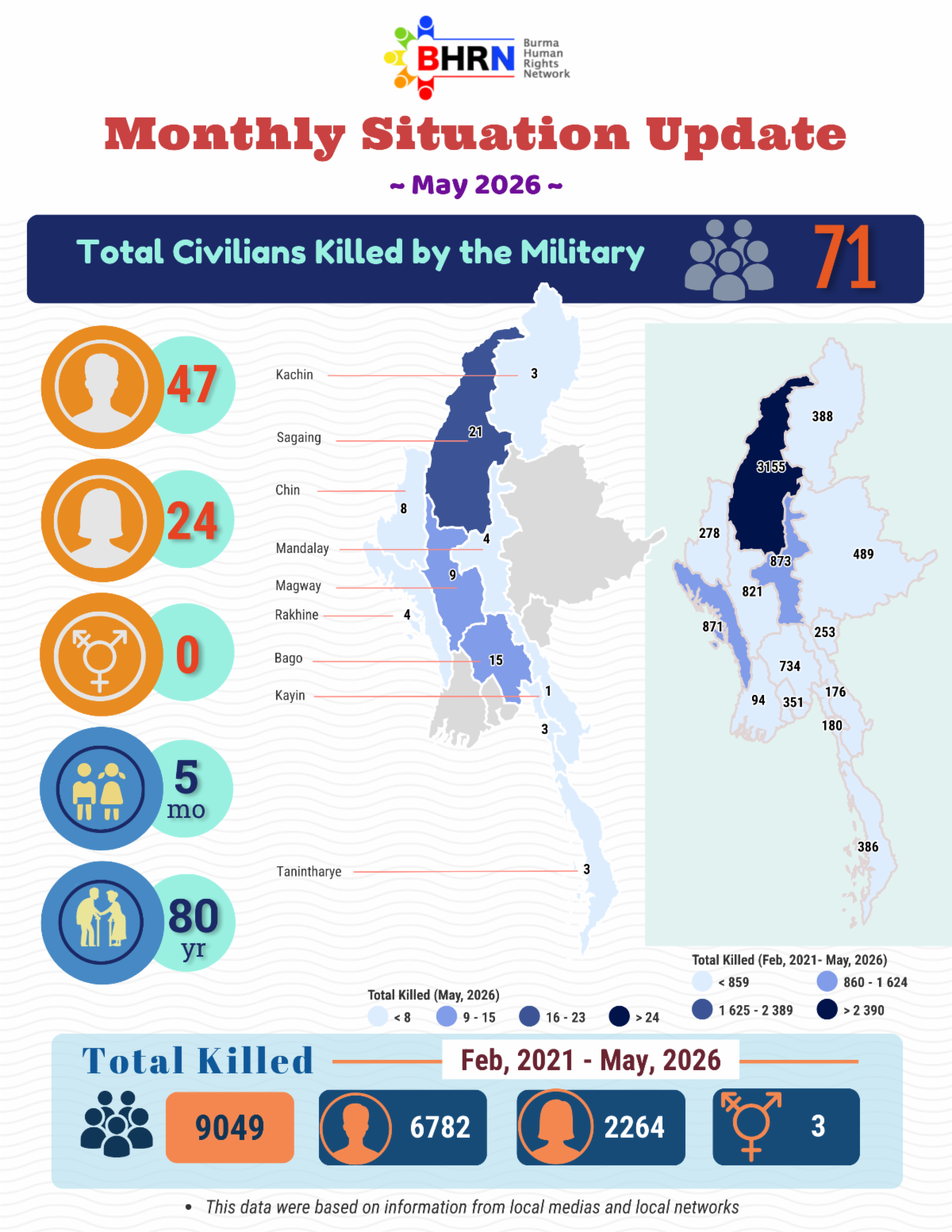
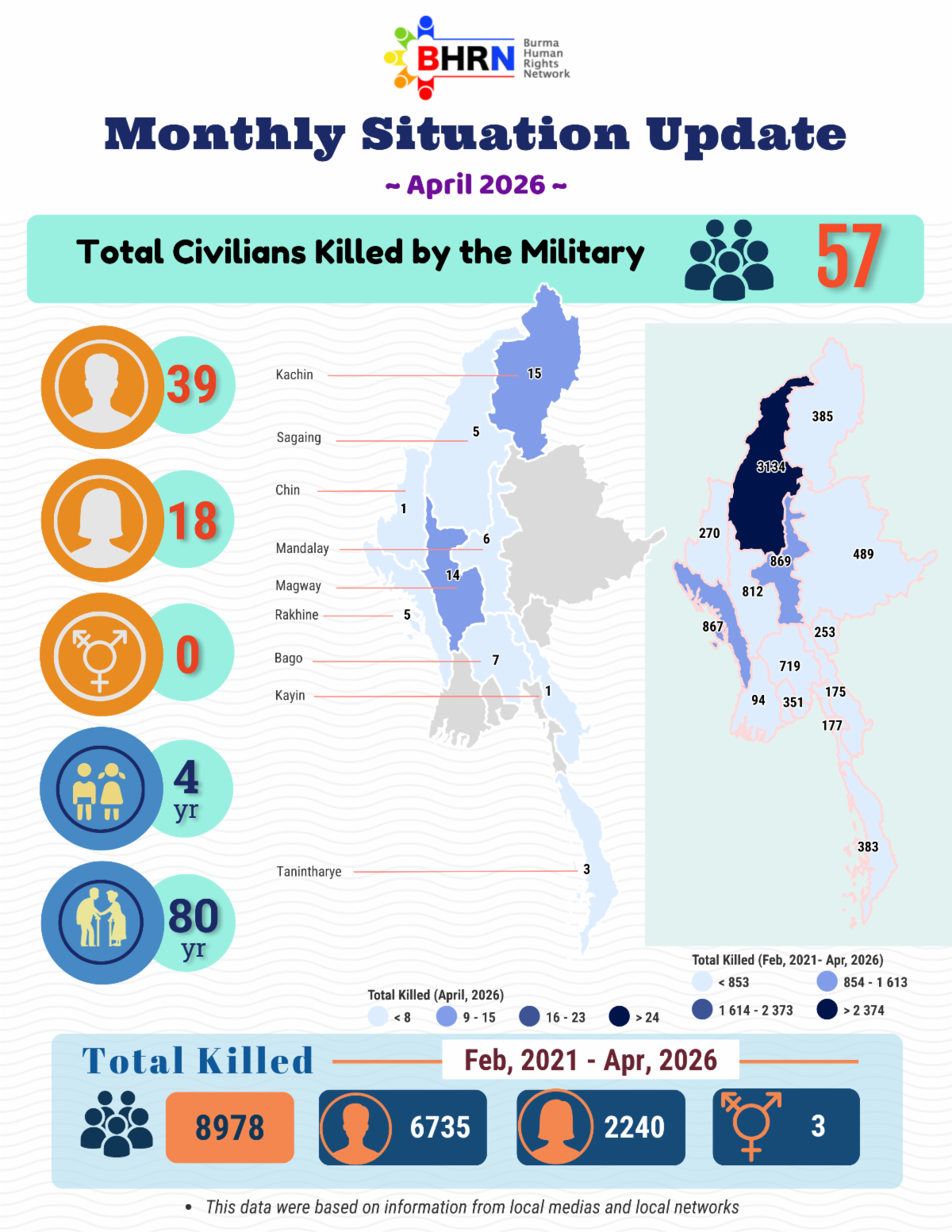
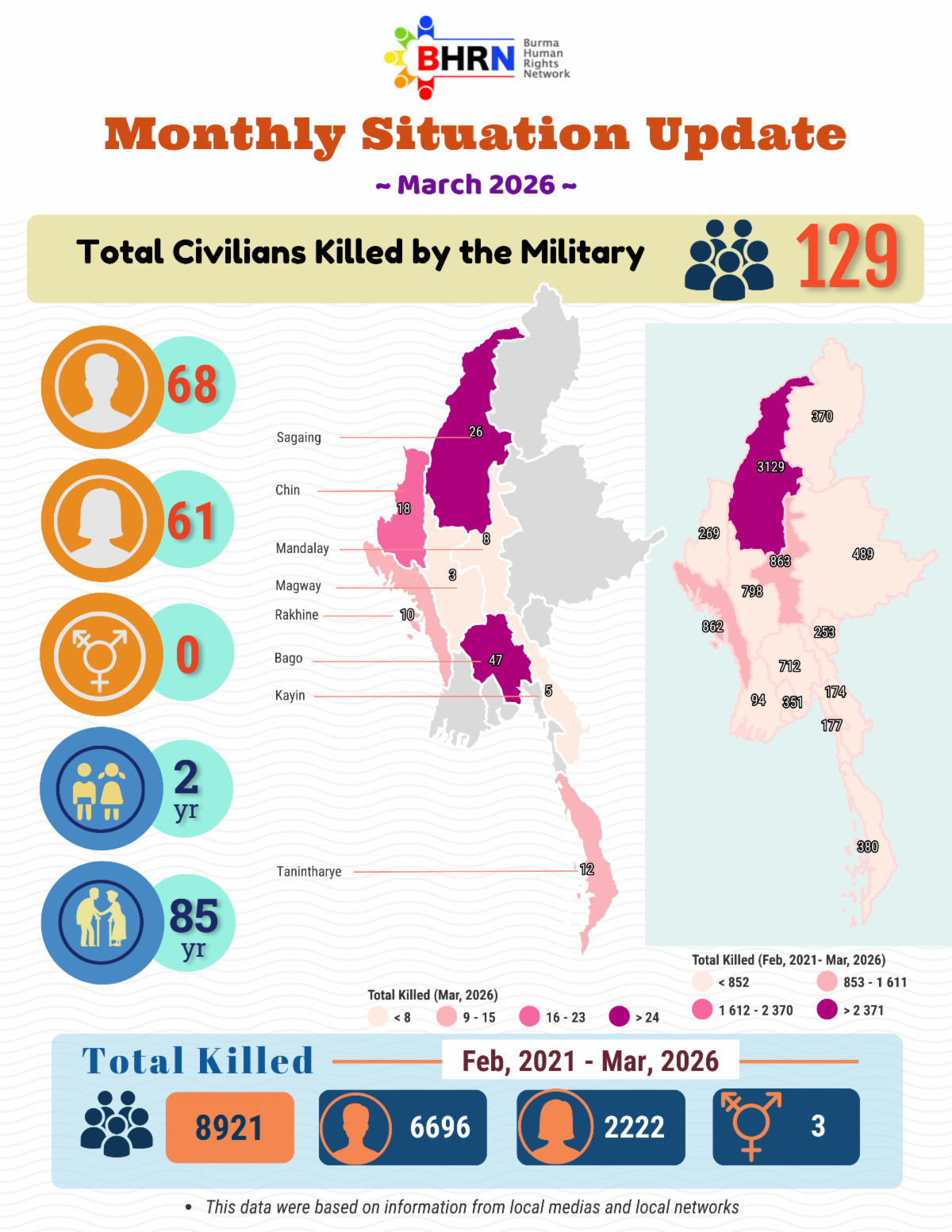
1Info-graphs of BHRN’s Report
Tap any image to see it full size.
2Editor's Note
INTRODUCTION
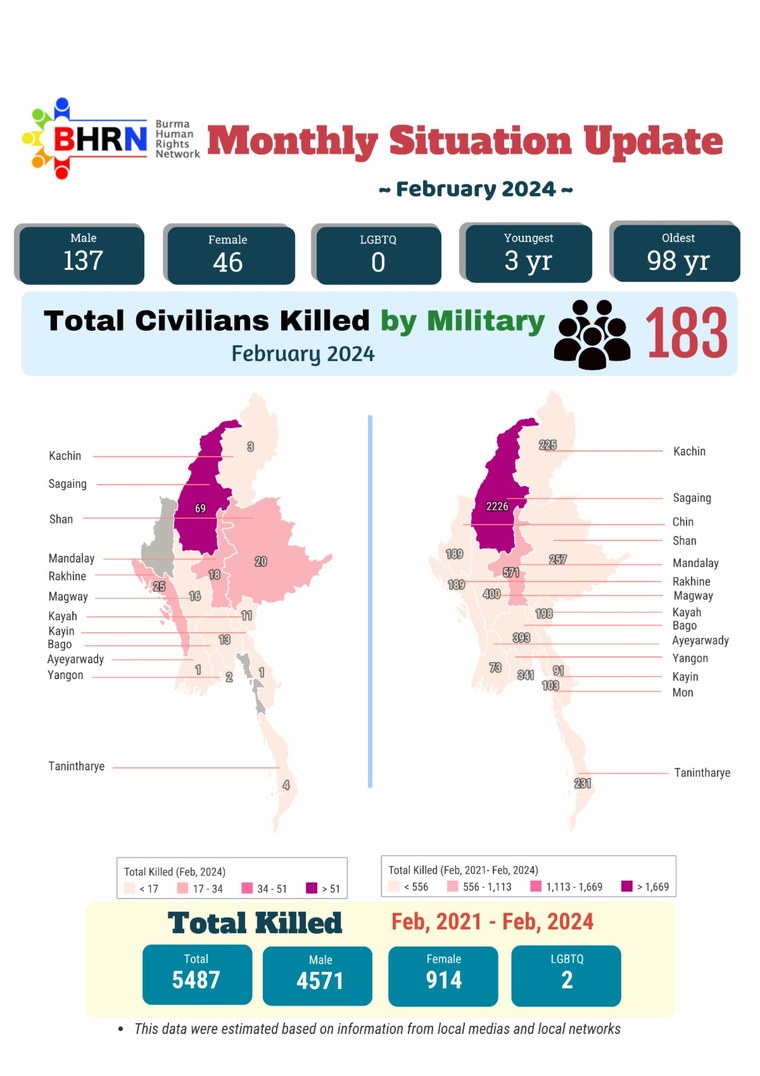
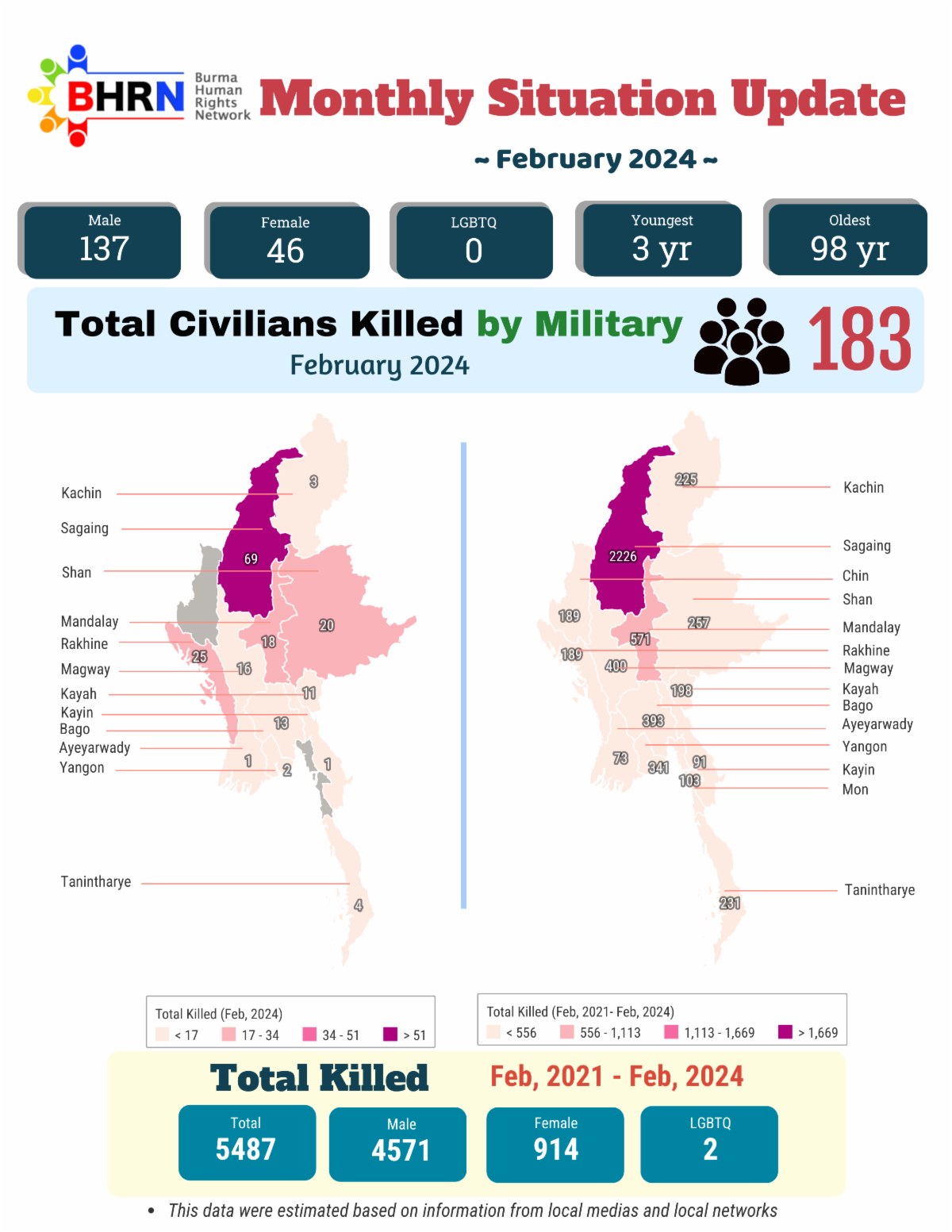
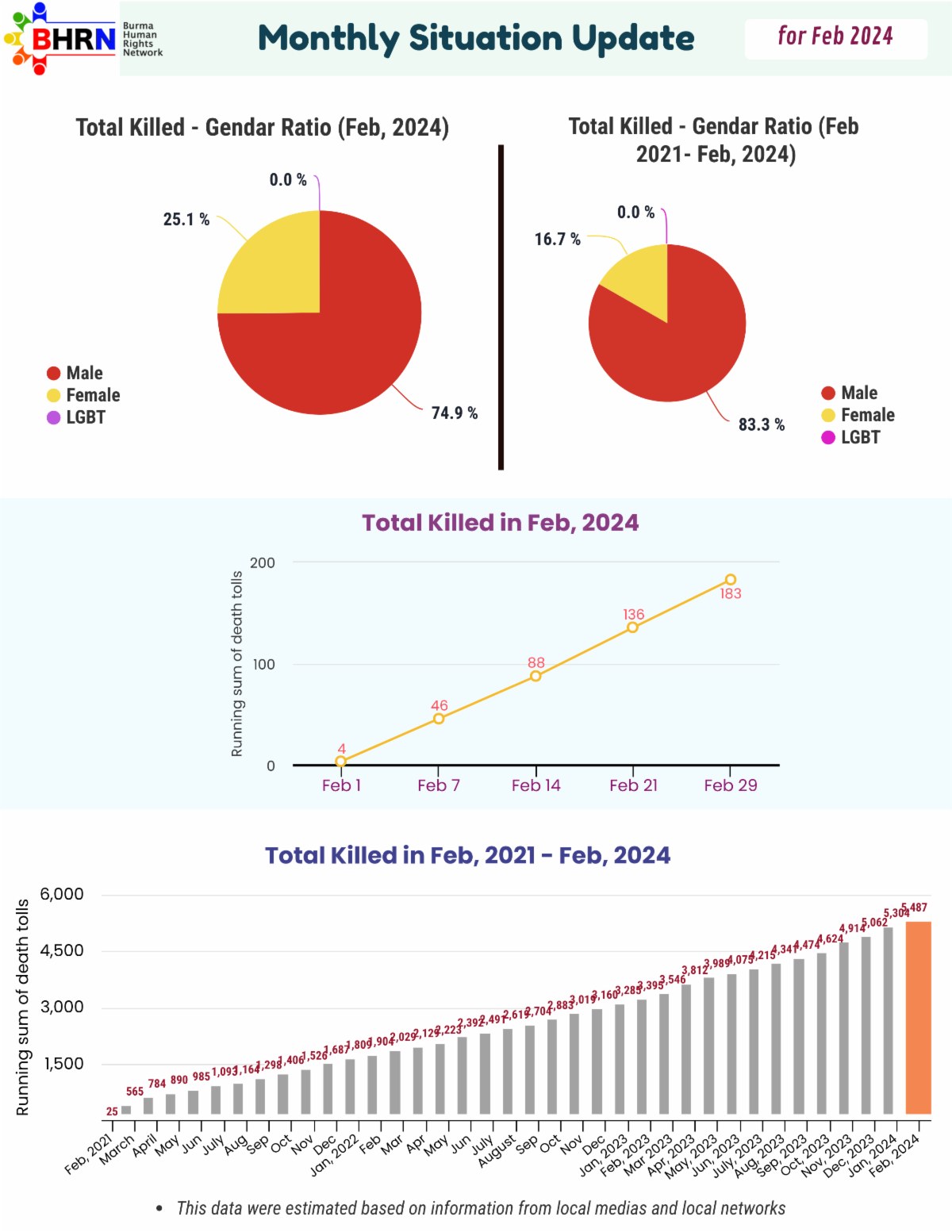
The panic situation among the public in Myanmar due to the enactment of the conscription law on 10 February as well as more losses to the ethnic groups and dwindling support from the regional allies, has left the Min Aung Hlaing regime in the worst crisis since its forcibly took overpower more than three years ago. The regime embarked on the worst human rights violations since it took overpower and unleashed unprecedented levels of brutality against the people of Myanmar. According to some estimates, the regime killed nearly 5000 opponents during the past three years.
In addition, the regime has created the worst economic crisis for Myanmar in modern times, with soaring inflation, and power and fuel shortages. The situation of the minority groups continues to worsen with the Rohingya and Kaman Muslims forcibly conscripted in Rakhine State.
Despite these facts, the regime survives for now.
CONTEXT
In response to the defeat of several ethnic armies, the junta enacted the conscription law, to increase its strength in fighting against the ethnic armed organizations. Also, to bolster its strength, the junta reenacted a law that allowed its civil servants to take up arms. However, these policies backfired, as they led the country to plunge into further chaos.
After the conscription law was introduced increasing numbers of Myanmar youths tried to flee the country to the neighbouring countries, especially Thailand, which allowed visa-free access to Myanmar citizens for two weeks. This incident coincides with the quasi-civilian government of Thailand starting to show more interest in the internal affairs of its neighbour.
For a shorter-term interest, more influx of Myanmar refugees is welcome for many Thai industries that require cheap labour, but in the longer term, it is going to have an impact on the job opportunities for Thais. In a longer-term strategic interest for Thailand, the latest situation in Myanmar offers an opportunity for Thailand to exercise more influence in the internal affairs of its long-term adversary Myanmar.
The Thai government is indicating its interest in establishing a humanitarian coordinator along the Myanmar-Thai border for the refugees fleeing Myanmar, and it called on the Association of Southeast Asian Nations (ASEAN), of which both Thailand and Myanmar, to help enforce a safe humanitarian zone for Myanmar refugees.
A seminar on Myanmar was organised recently by the Thai Parliament brainstorming on the possible role of Bangkok in resolving the crisis in Myanmar. Some of the participants of the seminar even started to think about how the situation in Myanmar would look like in the post-Min Aung Hlaing era. Also, the participants reportedly discussed where Min Aung Hlaing could flee to apply for political asylum.
They reportedly said Thailand could be one option in the mind of the brutal Myanmar regime leader to flee if indeed he is thinking of doing so.
Thailand’s role in Myanmar’s internal affairs has always been underrated when compared to China and the Western powers. But historically, the Thai influence on Myanmar, both politically and economically, has been very significant. Moreover, Thailand sees Myanmar as its rival and Thailand is ethnically linked to at least two major ethnic groups of Myanmar, Shan and Mon. These facts also make Thailand an influential regional actor when it comes to settling of political crisis in Myanmar. Thailand allows these ethnic groups and their sympathizers to operate within Thailand.
Thailand’s position towards the regime in Myanmar has gradually moved toward a more hardline in recent months, which could be due to the previous pro-military government in Thailand being replaced with an elected civilian government last September. It could not be a mere coincidence that the policy shift by Bangkok towards Myanmar comes after a visit by the US National Security Advisor Jake Sullivan, to Thailand in late January. During the visit, he reportedly had a discussion on the Myanmar crisis with the Thai Prime Minister, Srettha Thevenin
This is not the only episode related to Myanmar’s chaotic internal politics in recent weeks. China, which used to be a key supporter of the regime in Myanmar in the past, is trying to exercise its influence over the northeastern parts of Myanmar, and in recent weeks the Chinese-backed Myanmar ethnic rebels have controlled several townships in the region.
Operation 1027 launched by the pro-Chinese rebels, the Three Brotherhood Alliance, last October, has created a turning point in the battle for control of the areas along the Sino-Myanmar border region. These groups are now at the striking of the capital of Northern Shan State Lashio, and the Myanmar military’s garrison town of Pyin Oo Lwin. It seems that these rebel groups are waiting for a green light from Beijing to take over Lashio and Pyin Oo Lwin. With the fall of these two strategic towns for the Myanmar military, the entire northeast will be cut off from the rest of the country.
China’s dislike for Min Aung Hlaing is well known, it dates back to the time when Min Aung Hlaing led a brutal attack against a Chinese rebel group in the Kokang Region on the border with China in 2009. Also, since Min Aung Hlaing became the head of the Myanmar military in 2011, he cultivated a close tie with Russia, which also mostly replaced China as a major supplier of arms to the Myanmar regime.
Due to these facts, Min Aung Hlaing may not be considering China as a destination for him to seek asylum. Moreover, there have been rumours that China is considering issuing an arrest warrant against Min Aung Hlaing and his family for their alleged involvement with online scammers operating along the Myanmar-China border. Beijing has been asking the regime in Nay Pyi Taw to reign in on these groups, however, Min Aung Hlaing failed to do so, and he is accused of protecting these groups. Such a slow response from Min Aung Hlaing has led the pro-Chinese groups.
How about India? will the Modi regime, which is known for its pro-regime and heavy-hand approach toward the pro-democracy activists in Myanmar grant political asylum to Min Aung Hlaing? Most of the analyst who understands India’s foreign policy would say no to the possibility of such a scenario.
The support to the Min Aung Hlaing regime by the Modi government could further erode India’s credential as the world's largest democracy.
Will Min Aung Hlaing be purged?
Many political analysts at this stage rule out a possible regime change in Myanmar, and they predict that Min Aung Hlaing to remain as the head of the regime for some time.
Ye Myo Hein, executive director of the Tagaung Institute of Political Studies (TIPS), and a global fellow with the Asia Program at the Woodrow Wilson International Center for Scholars, told UK’s Guardian newspaper recently that Min Aung Hlaing cannot fall at this stage regardless, the military faces unprecedented battlefield challenges.
“For the first time in history, the military now faces simultaneous attacks from armed resistance of various types, ranging from conventional warfare to guerrilla tactics and from overt to covert operations, in 12 out of Myanmar’s 14 states and regions,” he said adding that there are reports that at senior levels there is growing frustration at the military leadership, the Guardian reported.
Despite this, Ye Myo Hein says it is highly unlikely that Min Aung Hlaing could be ousted as junta chief. “The military’s institutional culture, nurtured over seven decades, has established a feudal system with its top leader in the most powerful position,” he added.
Even if there were to be a change of leadership, some fear the alternative could be even more violent, he predicted.
However, it could be argued by looking at the precedents of the past like the overthrow of then-military leader Saw Maung, by his deputy Than Shwe, with the blessing of former dictator Nay Win in 1992. Also, corruption and abuse of power led to the downfall of powerful military intelligence chief Khin Nyunt in 2004. Khin Nyunt's downfall comes even though the power he was holding at the time of his purge was far stronger than what Min Aung Hlaing possesses today. Also, Khin Nyunt a half-Chinese was close to China when he was in power.
It is important to understand that there is no cardinal policy within the Myanmar military when it comes to power dynamic, Burmese supremacy is the only possible doctrine applicable in the Myanmar military, and in extreme cases, it can be best described that the Burmese military leaders adopt a dog-eat-dog kind of culture when its come to power struggle among the top brass.
Conflict in Rakhine
What has happened in the past few weeks was the worst for the Min Aung Hlaing regime in its three years in office and the past few weeks were perhaps the most humiliating period for the Myanmar army since the 1950s, when it was challenged by the Karen rebel in the outskirt of Yangon, that led the government at that time to be mocked as the “Yangon government”.
However, the defeat the Arakan Army (AA) inflicted on the Myanmar military in recent battles in Rakhine State was perhaps the most significant blow ever to be inflicted on the Myanmar army in its 83 years of existence.
AA continued its offensive throughout the state in February by claiming victory in Ponnagyun city, which sits just 24 kilometres (15 miles) east of the capital city, Sittwe. The rebel army has captured six townships across Rakhine state and another in neighbouring Chin state to the north since breaking a year-long ceasefire last November.
It is a significant achievement for AA if they could control Sittwe, the rebel group will become the only ethnic armed group fighting the Myanmar regime in more than 80 years to control a provisional capital. AA which was established in in late 2000s is a relatively younger organisation compared to the fellow ethnic armed organizations in Myanmar, most of whom were established in the late 1940s or 1950s.
The significant victory for AA is very much due to the support it has received from the Rakhine people in the state, who have traditionally held extreme hatred towards the Burmese.
The Rakhine State (or Arakan, as it was called then) was an independent State until it was invaded by Burman King Bowdawpaya in 1784 and annexed to the Burman Kingdom. The Rakhine king together with the tens of thousands of Rakhine people were slaughtered by the Burmese king during the invasion.
AA's key aim is to fight for the sovereignty of Rakhine, although it ruled out at this stage leaving the union, however, Rakhine would be among the ethnic groups in Myanmar, that would most actively seek stronger ethnic and territorial rights even if they decided to remain in the union or a future federal political structure.
While the regime facing defeat in fighting with AA, they are asking the displaced Rohingya community to join the Myanmar military. Such a move could be described as a brazen act of disrespect towards Rohingya people. Only as late as 2017, it was the same Myanmar military that committed acts of genocide against Rohingya people and now the same group is asking Rohingya to join the join force with the Myanmar military.
Meanwhile, the UN rights chief Volker Türk called the current crisis in Myanmar a “never-ending nightmare”. He commented in an address to the UN Human Rights Commission meeting on 1 March. He said the current crisis in Myanmar is contributed by the ethnic and religious tension ignited by the Myanmar military.
Mr Türk accused the Myanmar military of using the ultra-nationalist militias to stoke inter-ethnic tensions. Linked to this, violence had reached unprecedented levels in Rakhine state, with reports that civilians had been shelled and displaced en masse.
While many observers in Myanmar would agree with Türk’s assessment of the situation, however, they may call such a statement at this stage "too little too late". The UN was warned at the height of anti-Muslim riots across Myanmar in 2012, that the Myanmar military was responsible for igniting sectarian violence in which many Muslims were killed and tens of thousands of others displaced. The UN failed to understand the complexity of the situation then and supported inter-ethnic harmony in the country.
Observation and Analysis
- By introducing the conscription law and asking civil servants to take up arms against their enemies, the junta showed its intent to fight back against all the odds. However, to regain absolute control of the situation the junta will need the support of the people of Myanmar and its traditional allies like China, it is lacking both at this stage.
- As the chaotic situation grows the neighbouring countries are naturally to become wearier of the possible spillover effects into their countries. The recent move by China to ask its ally, Myanmar ethnic armies (the Brotherhood Alliance) to control the border areas and the latest move by Thailand to establish a humanitarian corridor under the auspices of ASEAN are indications that these countries would like to protect their countries from possible negative impacts of the crisis in Myanmar.
- Throughout Myanmar’s political crisis since the late 1980s, the international community always has had a role to play. But in the current situation, it has become mere spectators, only the local actors are to decide on the fate of the country’s political future.
- It would be interesting to note when the international community thinks that Myanmar needs an international protection force and political support regime, that will try to bring all the warring factions to the table and constitute free and fair elections.
3Rohingya Issue
3.1Rohingya in Rakhine Updates
- 13 February
At least 7 Rohingya Muslims were killed, and dozens injured in an airstrike by the junta troops in Kyauktaw Township in Rakhine State on 11 February. An eyewitness said a bomb fell on Peikthe ward in Kyauktaw, where many internally displaced Rohingya Muslims are taking refuge. He said many houses in the ward were burned down and several Muslims were forced to flee.
Source: Arakan Express - 17 February
The junta is persuading Muslims in Maungtaw Township in Rakhine State to join the Myanmar military and fight along with them, a media report said. A local news agency Narinjara reported that the junta organized a meeting with Muslim elders and Malawis in Maungtaw to persuade them to join the military. The authorities said they would provide arms to the recruits. The meeting on 9 February was held in a military barrack in Myothugyi village in Maungtaw Township which was attended by a local commander Thura Tun and the head of the District General Administration Department, Nay Oo. Narinjara reported that some Muslim elders who joined the meeting agreed to fight along with the junta if they were recognized as citizens of Myanmar, while some rejected the idea of holding arms for the junta.
Source: Narinjara - 18 February
The Burmese military coerced 300 Rohingya into conscription through offers of improved human rights for those who enlisted and threats of ration cuts for those who refused. Those recruited were from Baw Du Pha IDP camp and were taken on a 3-day training course at Military Battalion 354 in Sittwe Township.
Source: BHRN - 21 February
The junta arrested more than 100 Muslim youths in Buthitaung Township in Rakhine State to force them to join the Myanmar military, a local source told the Burma Human Rights Network (BHRN). He said, among those arrested were 13 people from Pusun Chaung village, 55 from Tatma Chaung village, 33 from Nga Kyeik Taung village and at least 10 from Kyaukphyu Taung village. The source said the civilians were abducted on 19 and 20 February. The source who declined to be named said abducted Muslim youths were taken into the barracks of no 535 and 353 battalions.
Source: BHRN - 27 February
The junta abducted 11 Muslim youths from Ngapali town in Rakhine State on 26 February to use as conscripts, a local source told Narinjara News agency. The report said the local organizers of the pro-junta the Union Solidarity and Development Party (USDP) abducted the youths from a civilian ward in Ngapali, which is a popular tourism site. The report said the abducted Muslim youths are being held in the headquarters of the Light Infantry Division nos 566 and 55 based in Ngapali, the report said.
Source: Narinjara - 28 February
The Burmese military from Division 542 forcibly recruited 125 Kaman Muslims in Kyauk Ta Lone Village, Kyauk Phyu, by threatening to harm them or their families if they did not join. On 27 February, the soldiers put up barricades around the village, preventing anyone from leaving, then took the men they recruited the following day.
Source: BHRN
3.2Rohingya in Bangladesh Camp
- 7 February
Bangladesh’s Minister for Road Transport and Bridges, Obaidul Quader, said that the country would not allow any more Rohingya refugees to enter the country, saying the persecuted minority is “already a burden for us.” Recent fighting between the Arakan Army and the Burmese military has displaced many villages of Rohingya caught in between the fighting parties who are now seeking somewhere safe to flee.
Source: BHRN, Reuters - 23 February
The Bangladesh Armed Police Batallion arrested four men they accuse of being members of the Arakan Rohingya Salvation Army in Camp-15. During the raid, many others fled the scene. Police also said that they found five guns and ammunition where the men were detained. Local refugees have reported that ARSA’s presence in the camps has diminished in recent months due to crackdowns and clashes with the Rohingya Solidarity Organization, who have taken a more dominant role in the camps.
Source: BHRN - 29 February
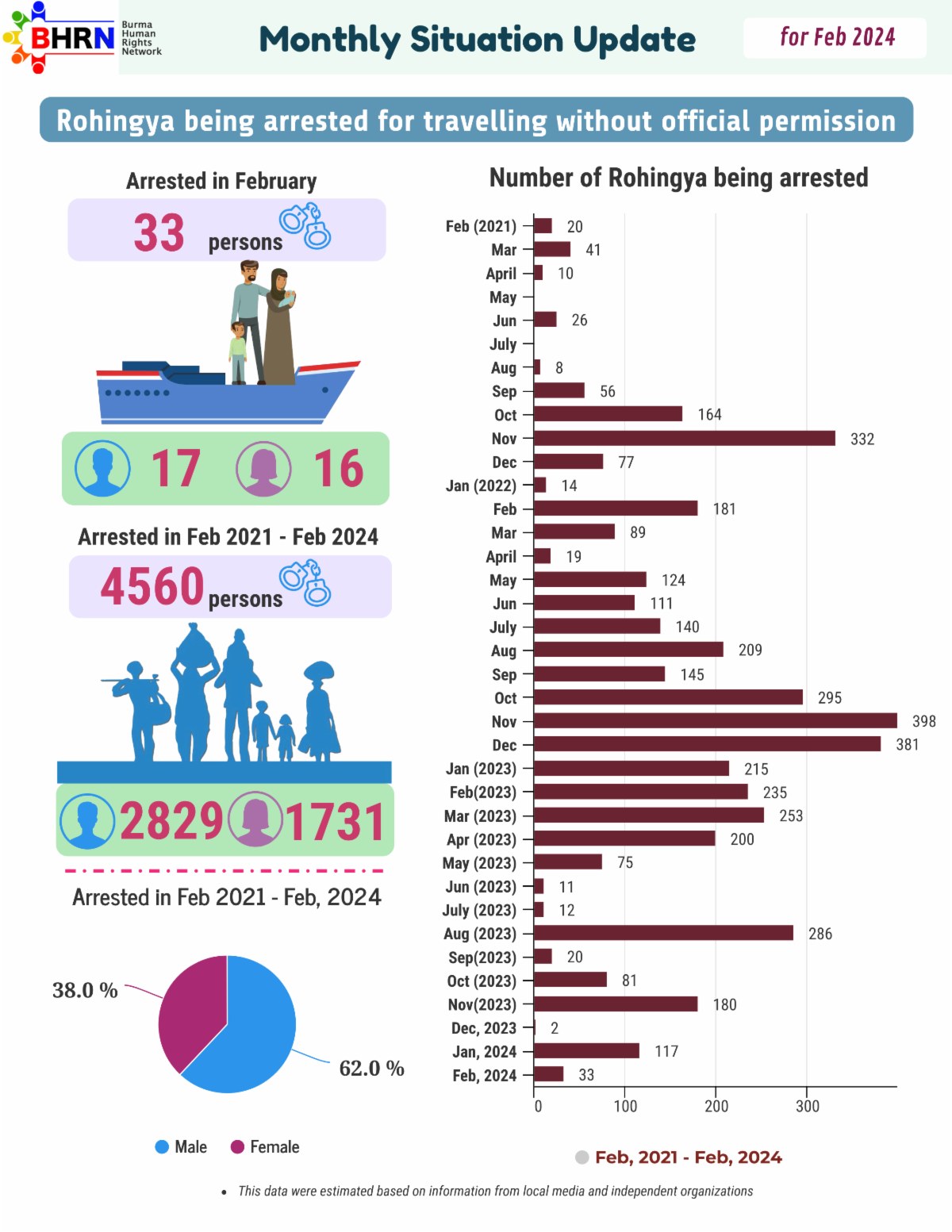
Over the month, police detained around 200 Rohingya refugees at checkpoints while seeking work outside of the camps. Residents in the camps noticed an increase in police presence at checkpoints during the month.
Source: BHRN
4Violations of Freedom of Religion and Belief
- 4 February
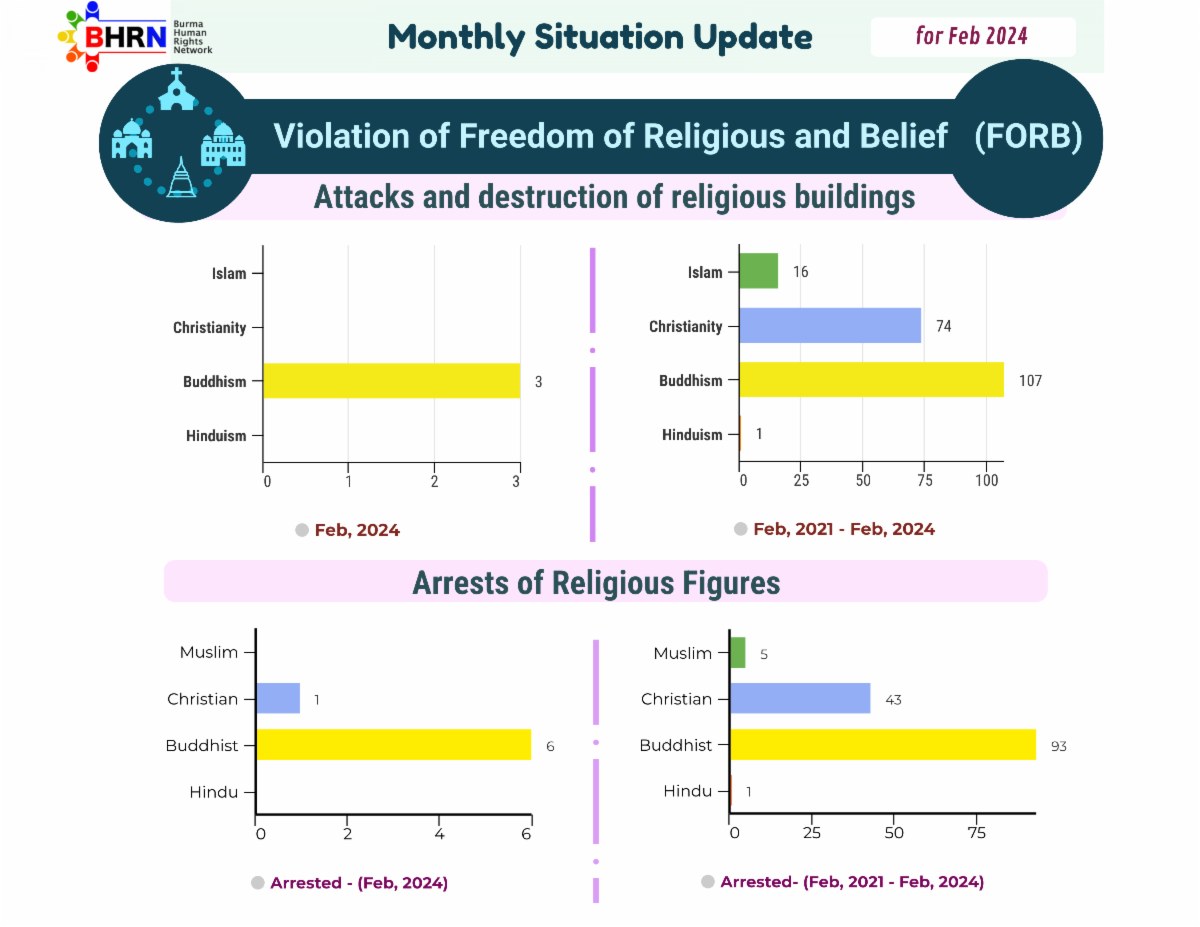
A monk and 8 other people were injured in an airstrike by the junta on a village in Kanbalu Township in Sagaing Region on 1 February, a local activist group told Burma Human Rights Network (BHRN). He said the airstrike destroyed a monastery, a pagoda, and a congregation hall in Thintaw village in Kinabalu. He said it could have been more death and destruction had the other bombs dropped on the monastery exploded.
Source: BHRN - 6 February
The junta abducted six monks from a village in Pulaw Township in Tanintharyi Region on 1 February, a local source told Burma Human Rights Network (BHRN). He said the monks from a monastery in Nan Payut village would be used as human shields to protect junta troops. The monks were arrested during a raid by the junta troops on the village, where they stayed in the monastery belonging to the six abducted monks.
Source: BHRN - 8 February
The junta troops abducted a priest and several other civilians during a raid on a village in Phakant Township in Kachin State on 7 February, a local source told Burma Human Rights Network (BHRN). He said the house of Reverand. Rahi Tu Lwan was burned down after his arrest. The reason for the arrest was still unknown, the source said.
Source: BHRN - 8 February
The junta is targeting monasteries in Hsi Hseng Township in Shan State where monks from the PaO ethnic group are based, a statement issued by an ethnic armed organisation, PaO National Liberation Army (PNLA) said. The statement said the junta shelled Htita Maung monastery which is situated only 7 miles from Hsi Hseng Town on 7 February in which a building in the monastery was destroyed. It said the junta attacked another monastery in Hsi Hseng Township a day earlier. The junta has been systemically destroying the places of religious significance of the PaO people in recent weeks after PNLA withdrew from the ceasefire agreement with the junta.
Source: BHRN - 13 February
The junta arrested a monk in Leiwei Township in Mandalay Region for criticizing the rights abuse committed by the junta, a local source said. He said monk Ashin Nyan Neithara, who is based in a monastery in Leiwei Township, the site of the Mandalay International Airport which is also known as Aelar Airport. The junta currently jailed more than 20,000 political prisoners, among them 105 are monks.
Source: Myanmar Now - 15 February
A pro-junta militant group Pyu Saw Htee killed a monk in Gangaw Township in Magwe Region on 12 February, a local source told Burma Human Rights Network (BHRN). He said U Pyinnya Wara (a.k.a) U Kyaw Zin Hlwar, 45, who is based in a monastery in Hanthawaddy village in Gangaw was invited by Pyu Saw Htee members to deliver a sermon on 12 February, the monk’s body was a return to his monastery a day later, the source said. The killing of the monk came after he encouraged Pyu Saw Htee forces based in Gangaw and nearby Kalay Region to surrender to the pro-democracy militant People Defence Forces (PDF).
Source: BHRN - 16 February
A 25-year-old student of Christian Theology school in Kalay Township in Sagaing Region died on 10 February while he was under arrest by the junta troops, a media report said. The family of Salai Steven Kyin Lai Khan told Radio Free Asia on 15 February that he was arrested on 10 February and the junta informed the family that Salai Steven was dead and his body was cremated. The family source said Salai Steven was studying to become a Christian religious scholar.
Source: RFA - 27 February
Two civilians including a monk were killed due to indiscriminate firing by police in Butalin Township in Sagaing Region on 26 February, a local pro-democracy militia group People Defence Force (PDF) said. A statement issued by Moneywa based no 20 Battalion of PDF said the civilians were killed near the main market of Butalin town. The group said the police burned down the market in which three electronic shops and 1 food stall were burned down.
Source: BHRN
5Human Rights Violations
5.1Rape as War Crime (Committed by Junta Troops)
- 28 February
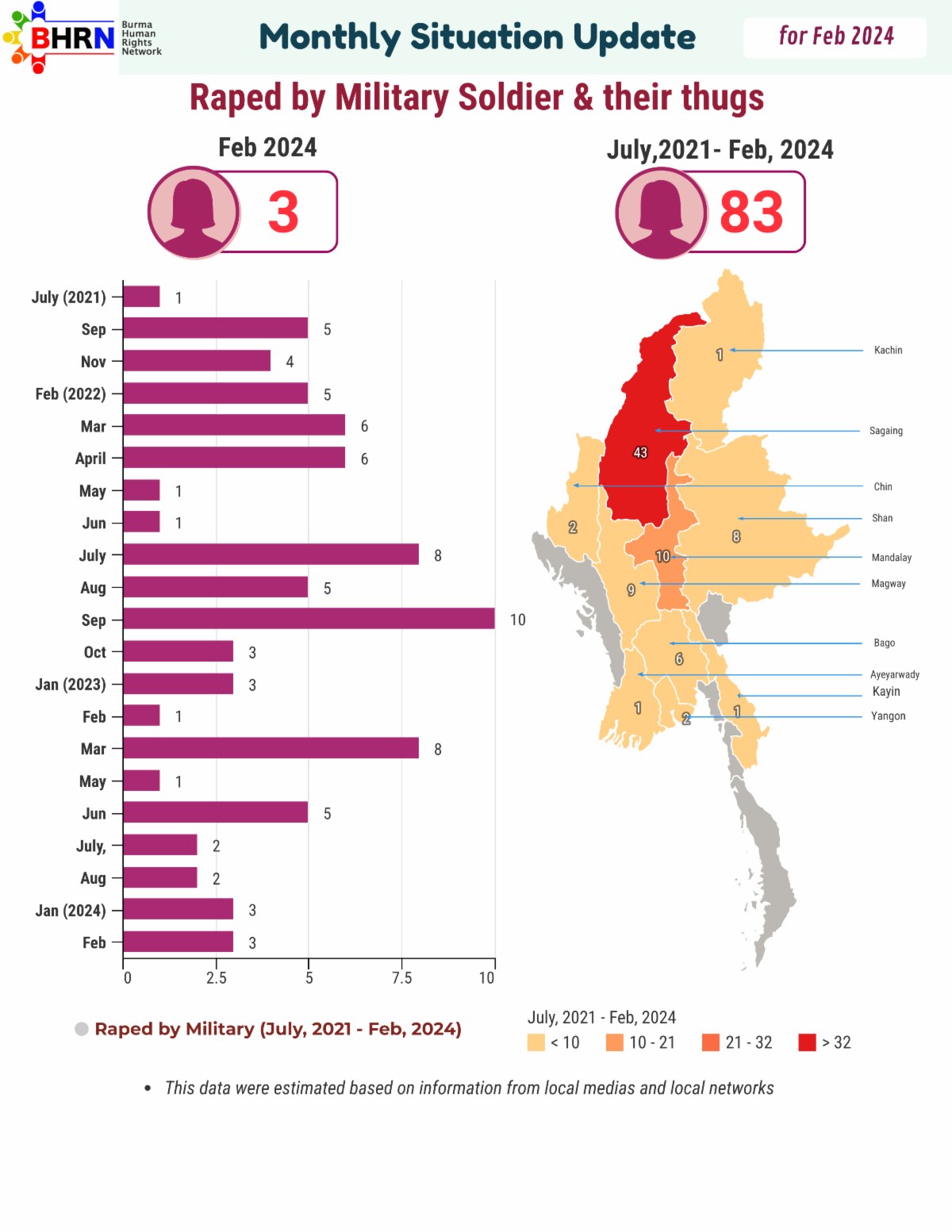
the junta troops are accused of committing gang rape of three women in Moemeik Township in Northern Shan State, a civil society group the Shan Human Rights Focus said in a statement issued on 27 February. It reported three different incidents of rape that took place in recent weeks all involving the soldiers of the 99 Light Infantry Division. The first incident was on 19 January in which a 24-year-old woman from the Ywa Taw Lay ward was gang-raped by three soldiers. A day later a married woman in Ohn Kyaw Ywa Thit was sexually assaulted and her husband was shot dead. The Shan Human Rights Focus said the soldiers from the 99 Light Infantry Division have also committed the rape of four displaced women from Thayat Taw village in Moemeik Township.
Source: Mizzima
5.2Extra Judicial Punishment
5.2.1Arbitrary arrests and imprisonment
- 9 February
A schoolteacher was arrested in Chaung Sone Township in Mon State on 8 February, a local source told Burma Human Rights Network (BHRN). U Chit Ko Ko, 44, a teacher at Ahdipadi private school was arrested after he wrote a post on his social media page encouraging school teachers to join the Civil Disobedience Movement (CDM). U Chit Ko Ko is involved in charitable works including establishing a blood donation group in Chaung Sone township.
Source: BHRN - 13 February
The junta arrested many youths for conscription in Dawei Township in Tanintharyi Region on 13 February, a local source told Burma Human Rights Network (BHRN). They were arrested after the junta announced the conscription law, which is effective from 10 February, the source said. He said several incidents of arrest of youth were reported in other parts of Tanintharyi Region after the conscription law came into force.
Source: BHRN - 13 February
The junta troops, police and local authorities arrested a group of 17 youth workers in South Dagon Industrial Zone no 1 on the outskirts of Yangon on 12 February, a local source said. He said the authorities arrested the youths above the age of 18 after checking their citizenship card, adding that the authorities said that they would be recruited into the military under the conscript law, which came into force on 10 February.
Source: Khit Thit News - 18 February
Five young Rakhine women were arrested in Shwe Pyi Thar Township in Yangon Region on 17 February, a local source told Narinjara News agency. He said among the five one woman was released shortly after her arrest, as her height was not high enough for her to be eligible to serve in the military. The woman was released only after she paid Kyat 200 000 to her captors. The source said the whereabouts of the other four women were still unknown. The junta troops are targeting the Rakhine ethnic people as it is facing defeats at the hands of the Rakhine ethnic armed group the Arakan Army (AA) in Rakhine State. The source said the junta troops raided the monasteries in Yangon which is headed by Rakhine monks.
Source: Narinjara - 27 February
The junta arrested at least 20 civilians in Kyeikhto Township in Mon State on 23 February, a local source told Burma Human Rights Network (BHRN). The source said they were arrested on the suspicion of having links with the anti-junta groups operating in the region. The source said the victims are merchants who were arrested while on a business trip to Mae Yong Gyi and Mae Yone Lay villages in Kyeik Hto Township.
Source: BHRN
5.2.2Arrest and killings of journalists
- 10 February
The bodies of five civilians were found in the battalion headquarters of the junta’s army after they were taken over by a rebel group the Arakan Army (AA) in early February. It said the body of a former journalist of the Democratic Voice of Burma (DVB) Ko Phoe Thiha. Ko Phoe Thiha was arrested on charges of sedition and the hearing against him is still ongoing in the court. Ko Phoe Thiha worked as a freelance journalist for DVB and many other local and international media organizations. He was running a toy shop after he was forced to quit a journalist job, since the military coup in February 2021.
Source: Narinjara
5.2.3Issues of Political Prisoners
- 5 February
Four political prisoners in Tharyarwaddy prison in Bago Region were sent to solitary confinement, a source close to the family of a political prisoner said. He said the punishment of the political prisoner follows their refusal to join a worship event in the jail. The source said the prison staff including the superintendent of the prison beaten up the prisoners before they were sent to solidarity confinement. The source said the prison authorities forced the prisoners to follow one particular religion.
Source: Mizzima - 7 February
A political prisoner died in Mandalay’s Ohbo prison after she was denied permission to take treatment for her kidney conditions, The Political Prisoners Network Myanmar said in a statement issued on 7 February. It said 35-year-old Ma Yin Moe has died in Mandalay Hospital on 4 February. Ma Yin Moe was serving a 6-year prison term starting in 2022. First, she was serving Myinchan prison in Mandalay Region after she was found guilty of a criminal defamation charge.
Source: BHRN - 16 February
The junta killed prominent political prisoners Ma Noble Aye and Ko Lay Khwin in the Bago Region during the second week of February, the Political Prisoners’ Network Myanmar said. He said they were killed on the way back to the prison after producing in the court. Ma Noble Aye, who previously served a lengthy prison sentence for her activism during the Saffron Revolution in 2007, was arrested in late January this year.
Source: BHRN
5.3Extra Judicial Killings and Enforced Disappearances
- 4 February
The junta killed and burned the body of a mentally challenged person in Kanbalu Township in Sagaing Region on 3 February, a local source told Burma Human Rights Network (BHRN). He said 46-year-old Ko Myint Kyi, 49, a resident of Shan Tat village in Kanbalu was pushed into a house, which was later burned down. The reason for the brutal killing of Ko Myint Kyi was not known. The source said another civilian a 62-year-old man from the same village was abducted by the junta troops and his whereabouts are still unknown.
Source: BHRN - 6 February
A pro-junta militia group Pyu Saw Htee has killed two members of the People Defence Force (PDF) in Gangaw in Magwe Region, a local source said. He said the two PDF soldiers were tied with iron chains and later burned alive. The source said the Pyu Saw Htee group led by Htet Wai Oo operating in the region was responsible for the brutal murder. He added that Htet Wai Oo is close to a member of the pro-junta Union Solidarity and Development Party (USDO) Bullet Hla Swe. The source said the two soldiers were arrested last November by Pyu Saw Htee in a fight between Pyu Saw Htee and the combined forces of PDF operating in the region.
Source: Khit Thit Media - 7 February
The bodies of eight civilians were found in a village in Shwe Bo Township in Sagaing Region, a local source said. He said the bodies some of them with the wounds of burns were found in Zee Phyu Kone village, which was under the control of the combined forces of the junta and Pyu Saw Htee militia group since 7 January. The source said the junta arrested about 50 civilians during its raid on the village and 8 were later murdered.
Source: RFA - 8 February
The junta killed three women including one who was pregnant as well as three children in Shar Taw Township in Kayah State, a local source told Burma Human Rights Network (BHRN). He said the junta troops raided Shar Taw Township on 4 February during which it arrested civilians who were displaced due to the conflict in the region. They were later shot dead. The source said the children killed were under 5 years of age.
Source: BHRN - 12 February
The junta arrested about 40 civilians on Mandalay Monewa highway on 11 February, a local source told Burma Human Rights Network (BHRN). He said the arrests were made in Sagaing Township. Most of the arrested civilians were youths.
Source: BHRN - 28 February
The junta troops brutally murdered 17 civilians in Moemeik Township in Northern Shan State, during its two weeks of siege of the town, a civil society group the Shan Human Rights Focus in a statement issued on 27 February. The statement said among those killed included two teenagers who were beheaded and some bodies with wounds or burns. It said the soldiers of the 99 Light Infantry Division were responsible for the brutal murder of the civilians. Among those killed 5 were from Shwe Zar Li village, and 6 were from Kyi Taw Su village, which included one woman. The statement said the junta troops killed those who were in their homes or the jungle.
Source: Mizzima
5.4Violence attacks by pro-junta thugs
- 7 February
More than 300 cadets of the military training were armed at a ceremony held in Pyay Township in the western parts of Bago Region on 5 February. The event was attended by the Chief Minister of the Region Myo Swe Win and a senior official from the Ministry of Defence Lieutenant General Tay Kyaw Zaw, a war veteran said. He said the recruits were given M-11 rifles and the recruits were selected through a lucky draw, and they were promised to provide salary. However, the source said so far, the junta failed to pay salaries to the recruits. More than 80 local people joined the ceremony, the source said.
Source: DVB - 14 February
A pro-junta group Pyu Saw Htee massacred 10 civilians in a village in Gangaw Township in Magwe Region on 14 February, a local source told Burma Human Rights Network (BHRN). The massacre was carried out during a series of raids on civilian targets by more than 2000 Pyu Saw Htee members in Gangaw Township.
Source: BHRN - 23 February
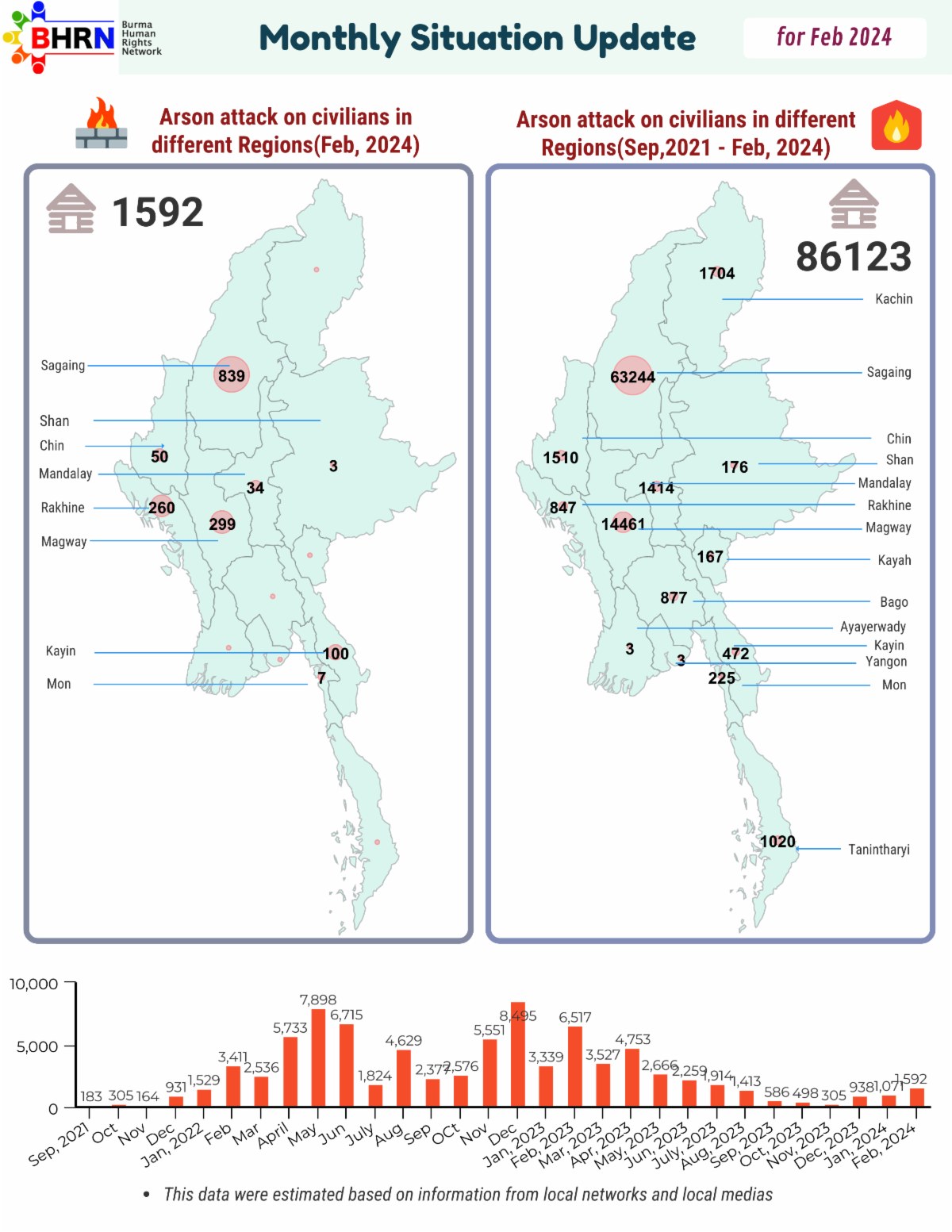
The junta and its affiliate militant group Pyu Saw Htee ransacked Myo Hla village in Shwe Bo Township in Sagaing Region on 2 and 7 February, a local source told Burma Human Rights Network. The majority of the residents of the village are Muslims, the reason for the attack on the village was unknown, the source said. He said 266 houses in the village were destroyed in the attack. Hundreds of people were displaced in the attack and they are currently in need of relief supplies, the source said.
Source: BHRN - 23 February
A junta-affiliated militant group Pyu Saw Htee has massacred a family of six people in a village in Shwe Bo Township in Sagaing Region, a statement issued by the Ministry of Human Rights of the National Unity Government (NUG) said. It said the killings of the civilians including a pregnant woman and a three-year-old child were carried out by a faction of the Pyu Saw Htee group led by Htay Aung. It said the family was targeted as the head of the family U Lin served as the head of the local election commission during the 2020 general elections, in which pro-military candidates were heavily defeated by the pro-democracy parties across the country. The NUG statement provided graphic details of the brutal killing, in which it said Ma Chit Su Aung, who was five months pregnant, was shot in the face from a close range and the three-year-old victim was killed by knife until he succumbed to death.
Source: BHRN
About BHRN
Burma Human Rights Network (BHRN) is based in London, operates across Burma/Myanmar and works for human rights, minority rights and religious freedom in Burma. BHRN has played a crucial role in advocating for human rights and religious freedom with politicians and world leaders.